by Michael Fox | Jul 16, 2026 | big tech, free speech, Podcast, Politics and Movements: International, The Battle for Free Speech
Disinformation is impacting our lives. Much of it is being pushed by unregulated Silicon Valley tech companies and their billionaire owners. But people in Europe are pushing back.
In this episode, Michael Fox goes to Spain, to look at how members of the Spanish far right have been inspired by Charlie Kirk. Then we look at grassroots organizing against Big Tech in Ireland, media education initiatives in Finland, and European measures regulating Big Tech.
“This has now been a topic of discussion very much in Europe,” says Finnish educator Saara Salomaa. “Should we actually trust any US tech companies, or should we try to get rid of US tech companies as soon as possible?”
Michael is joined in the episode by Laura Flanders. She is the host of Laura Flanders and Friends on public television — formerly known as the Laura Flanders show.
The Battle for Free Speech Podcast is a production of The Real News Network.
Hosted by Michael Fox and Marc Steiner. Theme music by Michael Fox, Jordan Klein and Daniel Nuñez. Other music from Blue Dot Sessions and Epidemic Sound. Production and Sound Design by Michael Fox and Stephen Frank. Editorial support by Kayla Rivara. Research by Ben Schweiger.
Guests
Sergio Villanueva
Jude Farrell
Saara Salomaa
Iva Nenadic
Many thanks, also, to Ilona Taimela for taking the time to speak with me about media education in Finland.
Resources
Here is a link to TikTok about the Puchaina Avocado videos.
Follow The Battle For Free Speech on Spotify or Apple Podcasts.Support Michael Fox’s reporting at patreon.com/mfox. Never miss an episode — sign up for The Real News newsletter at therealnews.com.
Transcript
The following is a rushed transcript and may contain errors. It will be updated.
Michael Fox: Hi folks. Just a quick heads up before we get started. There are a few
by Maximillian Alvarez | Jul 15, 2026 | AI, Economy, Economy and Inequality, Podcast, Politics and Movements: US, Working People
In so-called “red states” and “blue states” around the US, from rural areas to urban centers, the explosion of new data center projects is impacting residents in poor, working-class, and middle-class communities alike. In this episode of Working People, we speak with a diverse panel of residents fighting new and proposed data center projects in Texas and Maryland about what it means for you and your community when one of these loud, polluting, energy- and water-guzzling behemoths comes to your town—and how to fight back.
Panelists include: Cheryl Shadden, a registered nurse anesthetist who lives right next to the site of a Marathon bitcoin mine in Granbury, Texas; Karen Pearson, a licensed professional counselor and a resident of Granbury who also lives right next to the Marathon bitcoin mine; Dr. Shannon Wolf, Precinct Chair in Hood County, who lives three miles from the Marathon bitcoin mine; Craig Jackson, a resident of Granbury who lives 300 feet from the site of a new proposed data center, and who is also a plaintiff in a current lawsuit residents have filed against the city of Granbury; Micaiah Lloyd, a grassroots organizer and resident of Charles County, Maryland, who lives near the site of a proposed data center; Hillary Gonzalez, an eco-poet, author, founder of Sacred Parks & Waterways, and a resident of Baltimore, Maryland, who lives right next to the site of Johns Hopkins University’s future Data Science and Artificial Intelligence complex.
Additional links/info:
Protect Hood County website and Facebook page
Sacred Parks & Waterways website and Instagram
Viral MS Now clip featuring Cheryl Shadden of Granbury, Texas
Maximillian Alvarez, Working People / TRNN, “A bitcoin mine in Texas
by Michael Fox | Jul 9, 2026 | brazil, free speech, Podcast, Politics and Movements: International, Politics and Movements: US, The Battle for Free Speech
This is really a tale of two countries: the United States and Brazil. In both countries, far-right presidents come to power — Donald Trump and Jair Bolsonaro. In both those countries, the presidents spent several years unraveling democratic institutions and public policy. Both presidents then ran for reelection. Both presidents lied about their country’s voting systems in order to undermine the elections and whip up their base.
Both those presidents lost their reelections — Trump in 2020. Bolsonaro in 2022. They both claimed fraud and tried to carry out a coup to stay in power.
But that is where these two paths diverged. In the United States, President Donald Trump continued to peddle his lies about the elections. He created his own social media platform and he used it to push his agenda. He was reelected in 2024 and returned to power. In Brazil, however, the country’s Supreme Electoral Court blocked former President Jair Bolsonaro from running for office for eight years, because of the lies he told about the country’s electoral system.
It wasn’t censorship. it was a different interpretation of free speech. One that said the right to free expression must be balanced with the other rights in the country and the country’s democratic system. The United States doesn’t agree. And the Trump administration has been pushing to bend Brazil toward its definition of “free speech.”
In this episode, Michael Fox journeys to Brazil to understand the lengths that the country has gone to fight disinformation.
Michael is joined in the episode by Maximillian Alvarez, editor-in-chief and co-executive director of The Real News Network and the host of the Working People Podcast.
The Battle for Free Speech
by Maximillian Alvarez | Jul 6, 2026 | east palestine, Economy, Economy and Inequality, Podcast, Politics and Movements: International, Politics and Movements: US, railroad, sacrifice zones, Working People
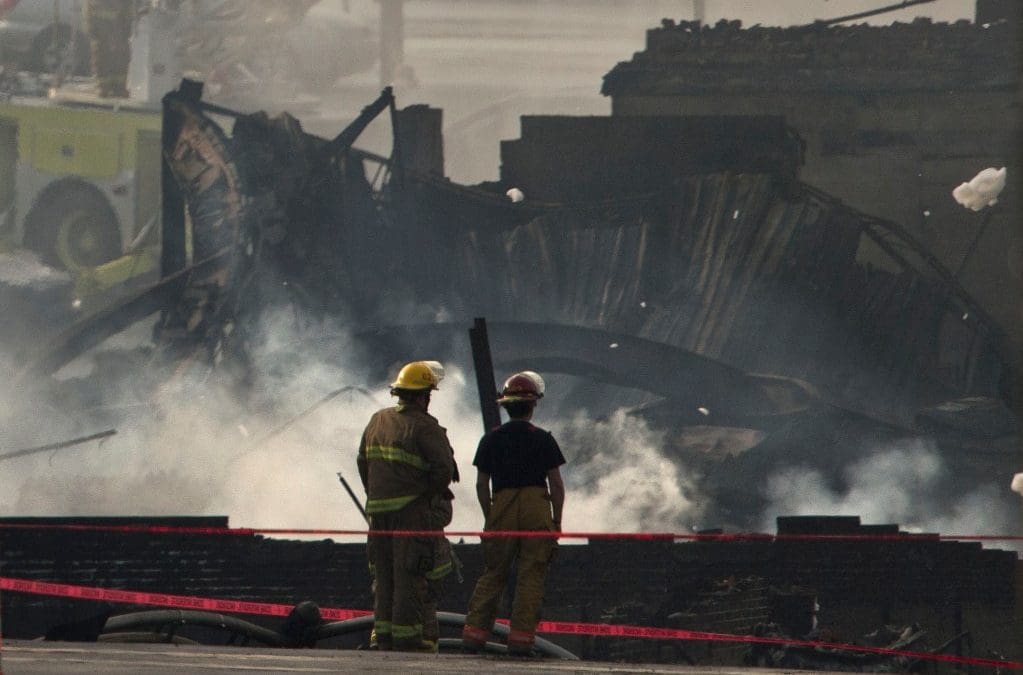
10 years before the catastrophic train derailment and chemical disaster in East Palestine, Ohio, one of the deadliest rail disasters in North American history took place in the Canadian town of Lac-Mégantic, Quebec.
On July 6, 2013, an unattended freight train that had been parked on the tracks overnight began to roll downhill and gather alarming speed as it careened towards the city center of Lac-Mégantic. The train, which was operated by Montreal, Maine, and Atlantic Railway and carrying over 2 million gallons of crude oil, derailed around 1:15 AM. The resulting explosions and fire killed 47 people and destroyed over 40 buildings, obliterating a large portion of the downtown area and prompting mass evacuations.
In this special episode of Working People, we speak with a panel of survivors of the Lac-Mégantic rail disaster in Canada and the East Palestine rail disaster in the USA.
Panelists include: Robert Bellefleur, a resident of Lac-Mégantic and spokesperson for the Lac-Mégantic Citizens’ Coalition for Railroad Safety; Gilbert Carette, a resident of Lac-Mégantic and a member of the Lac-Mégantic Citizens’ Coalition for Railroad Safety; Gilles Fluet, a resident of Lac-Mégantic who narrowly escaped the 2013 train crash and witnessed the derailment firsthand; Anne-Marie Saint-Cerny, award-winning writer, videographer, social and environmental justice activist, and author of Mégantic: A Deadly Mix of Oil, Rail, and Avarice; Jami Wallace, a displaced resident of East Palestine, Ohio, and founder of the Chemically Impacted Communities Coalition; Christina Siceloff, a Creek Ranger and resident of Beaver County, Pennsylvania, affected by the 2023 Norfolk Southern train derailment and chemical disaster.
If you or members of your community are interested in attending or participating in TRNN’s
by Michael Fox | Jul 2, 2026 | free speech, Podcast, Politics and Movements: US, The Battle for Free Speech
Transcript
The following is a rushed transcript and may contain errors. It will be updated as soon as possible.
Michael Fox: It’s good to see you, Mansa.
Mansa Musa: It’s good to be seen.
Michael Fox: I want to start us in Washington at the Lincoln Memorial.
Michael Fox: I’m standing inside the mausoleum of the Lincoln Memorial. President Abraham Lincoln sitting on his chair, staring out, looking down across Washington over the reflecting pool at the Washington Monument in the Capitol.
Michael Fox: So early last fall, I went down to the Lincoln Memorial on the Washington Mall and I wanted to go because this is, for me, it’s kind of one of the most iconic places I can think of for free speech in the United States.
Speaker 4: As the greatest demonstration for freedom in the history of our nation.
Michael Fox: Clearly, like the images of the 1963 March on Washington and Martin Luther King’s, I have a dream speech and hundreds of thousands of people covering the steps of the Lincoln Memorial, running all the way back along the reflecting pool. And I went there to ask people what free speech meant to them. Excuse me, sir.
Speaker 5: Yes.
Michael Fox: My name’s Mike Fox. Yes, sir. I’m a freelance reporter and I’m working on a podcast about free speech. And so I spoke with one guy named Ric. He’s retired. He’s from Arizona. He came there with his wife. They were in town for the day. He actually works as a pit line firefighter for NASCAR. And he told me –
Speaker 6: The freedom to say what you feel, to express what you
by Maximillian Alvarez | Jul 1, 2026 | AI, east palestine, Economy, Economy and Inequality, Podcast, Politics and Movements: US, sacrifice zones, Working People
From the explosion of AI data centers to the increasing number of toxic spills, explosions, and industrial disasters happening across the country, corporations and the government are turning the USA into one giant “sacrifice zone.” In “red” states and “blue” states, in rural areas and urban areas, poor and working people are suffering the toxic effects of a crisis that has resulted from decades of deregulation, corporate capture of government, and the protection of private profits over the lives and health of the public.
No one is coming to save us, and nothing is going to change unless residents of different sacrifice zones and poisoned communities, workers and unions on the front lines of the industries poisoning us, environmental justice groups, community and faith organizations, scientists, journalists, and all others who have a stake in this fight start coming together, working together, and fighting back together. In this special panel discussion, recorded at the 2026 Railroad Workers United convention in Chicago, Illinois, we speak with a panel of guests who are part of a new coalition that is doing just that.
Panelists include: Jeff Kurtz, a retired locomotive engineer, union officer, and Railroad Workers United member who also served as a state representative in the Iowa House of Representatives; Jami Wallace, a displaced resident of East Palestine, Ohio, and founder of the Chemically Impacted Communities Coalition (CICC); Dr. Nicole Fabricant, a professor of anthropology at Towson University and scholar-activist who has been working with chemically impacted communities in South Baltimore, Maryland, for 15 years; Scott Smith, independent testing expert and founder of the Blue Shirt Justice League; and Lesley Pacey, Senior Environmental