How can anyone still deny Israel is committing genocide in Gaza?

How can anyone still deny Israel is committing genocide in Gaza?

Intent to destroy all or part of a group is required to meet the criteria of genocide, and Israeli officials have made their intentions towards the people of Gaza explicitly clear, says Phyllis Bennis. In this discussion of her new book, Understanding Palestine & Israel, she explains how other recognized genocides have been defined, the influence of the Holocaust and its aftermath on Zionism and Jewish identity, and why the ceasefire movement indicates a change in the movement for Palestinian rights.

Guests:

Phyllis Bennis is a fellow at the Institute for Policy Studies in Washington, DC, where she also serves as co-director of the New Internationalism Project. She is a founding member of the US Campaign to End Israeli Occupation and served for six years on the national board of Jewish Voice for Peace. She is the author of numerous books, including Understanding Palestine & Israel.

Credits:

Studio Production: Cameron Granadino

Post-Production: Stephen Frank

Transcript
The following is a rushed transcript and may contain errors. A proofread version will be made available as soon as possible.

Marc Steiner:

Welcome to the Marc Steiner Show here in the World News. I’m Marc Steiner. It’s good to have you all with this as we open our program today. Somewhere between 66,000 and 80,000 people have been buried under the rubble and Gaza and killed the majority of women and children. Most of the infrastructure has been destroyed. Over 1.2 million people face starvation and seemingly nothing is being done to end this massacre. Many of the most profound voices and leaders of the fight against the war in Gaza are members of the Jewish community who say not in our name. And today we’re

Original

US veterans’ final message from the Global Sumud Flotilla before being intercepted by Israel

US veterans’ final message from the Global Sumud Flotilla before being intercepted by Israel

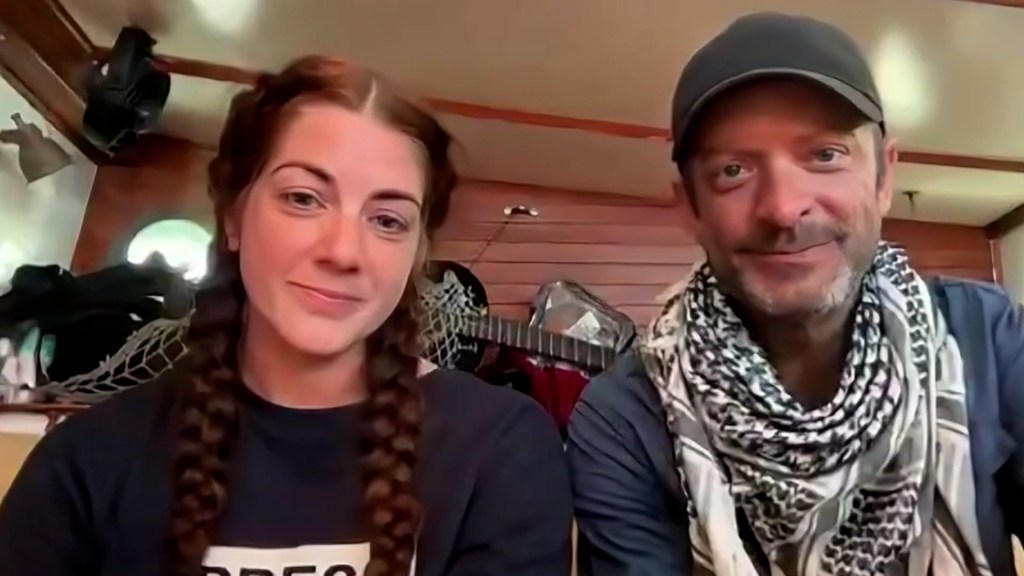
Peace activists sailing to Gaza with the Global Sumud Flotilla reported Wednesday evening that Israeli naval ships had begun intercepting vessels in their fleet and arresting flotilla members. On Tuesday, just hours before the flotilla entered the “high-risk zone” near the shores of Gaza, Marc Steiner spoke with Phillip Tottenham and Jessica Coltfelter, two US Marine Corps veterans sailing with the flotilla. In this episode of The Marc Steiner Show, Tottenham and Coltfelter discuss why they, as veterans, felt compelled to join this humanitarian mission, and what message they wanted to share with the world in the event of their capture—or worse—by Israel.

Guests:

Philip Tottenham is a US Marine Corps veteran, a member of Veterans For Peace, and a peace and human rights activist.

Jessica Coltfelter, is a US Marine Corps veteran (2008-2012) who served as security detail for Presidential Helicopter Squadron Marine One and, upon End of Active Service, worked as a defense contractor for Triple Canopy. Refusing to perpetuate imperialism, Coltfelter became an activist, educator, and an anti-fascist librarian serving rural and marginalized communities in pursuit of mindful liberation.

Additional resources:

Global Sumud Flotilla website, TikTok, and Instagram

Ephrat Livni and Liam Stack, The New York Times, “Israel intercepts boats headed to Gaza with humanitarian aid”

Maximillian Alvarez, The Real News Network,”‘If I’m killed on this mission…’: Global Sumud Flotilla sets sail for Gaza despite Israel’s threats”

Maximillian Alvarez, The Real News Network, “Why US veterans are sailing to Gaza with the Global Sumud Flotilla”

Credits:

Producer: Rosette Sewali

Studio Production: Cameron Granadino

Audio Post-Production: Stephen Frank

Transcript
The following is a rushed transcript and may contain errors. A proofread version will be made available as soon as possible.

Marc Steiner:

Welcome to the Marc Steiner Show here on

Original

We’re finalists for the prestigious Signal Awards. Help us win!

We’re finalists for the prestigious Signal Awards. Help us win!

We know things are extremely dark and heavy right now, but we wanted to share a little light with you—and to ask for your help. We were officially notified this morning that two of our premiere podcasts, The Marc Steiner Show and Stories of Resistance , are finalists for the prestigious Signal Awards! 

Our brilliant colleague and Baltimore radio legend Marc Steiner is a finalist for Best Host of an Individual Episode for this masterful, powerful, perspective-changing interview he conducted with three Canadian doctors returning from a medical mission in Gaza . 

Latin-America-based journalist and longtime TRNN contributor and collaborator Michael Fox is also a finalist in the History Podcast category for his truly unique, rich, and inspirational weekly series Stories of Resistance . 

The Signal Award Judging Academy is a large, esteemed body made up of media professionals, scholars, and practitioners across the industry. To get this recognition from our peers is humbling and motivating validation of the importance and quality of the work we do, and of the impact our unique brand of grassroots storytelling has on those who hear it. It is also a reminder that, with your help and support, our scrappy team of former prisoners, organizers, and low-wage workers turned journalists can go toe-to-toe with the best and biggest media organizations out there. (Move over, Jon Stewart. The Real News is here…)

But we don’t just want to be nominated—we want to win this thing! We need you to go to the Signal Award voting portals and vote for Marc and Mike to win in their respective categories!  With your help, we can make that happen—please take a minute to register and vote for Marc and Mike! 

How to vote for Marc: Click on this link to see the finalists for Best Host of an Individual Episode, then click on The Marc Steiner Show logo. You will be asked to register with an email and password (this is to ensure spam voting does not occur). Once you register, your vote will be logged!

How to vote for Stories of Resistance: Click on this link to see the finalists for Best Show – History, then click on the Stories of Resistance logo. You will be asked to register with an email and password (this is to ensure spam voting does not occur). Once you register, your vote will be logged! 

And lastly, if you’re not already a regular listener to our unique slate of podcasts, be sure to subscribe to The Marc Steiner Show , Stories of Resistance , and The Real News Network feeds wherever you listen to your podcasts. Take a moment to leave positive reviews of our shows on Apple Podcasts and Spotify, send us your feedback, and recommend our shows to your friends, family members, and coworkers. We will continue to put in the painstaking work of finding the stories and lifting up the essential voices from the front lines of struggle across the US and around the world, but we need your help to amplify these stories! 

Solidarity,

Maximillian Alavarez
Editor-in-Chief
The Real News Network

Original

How Democrats set the stage for Trump’s assault on free speech

How Democrats set the stage for Trump’s assault on free speech

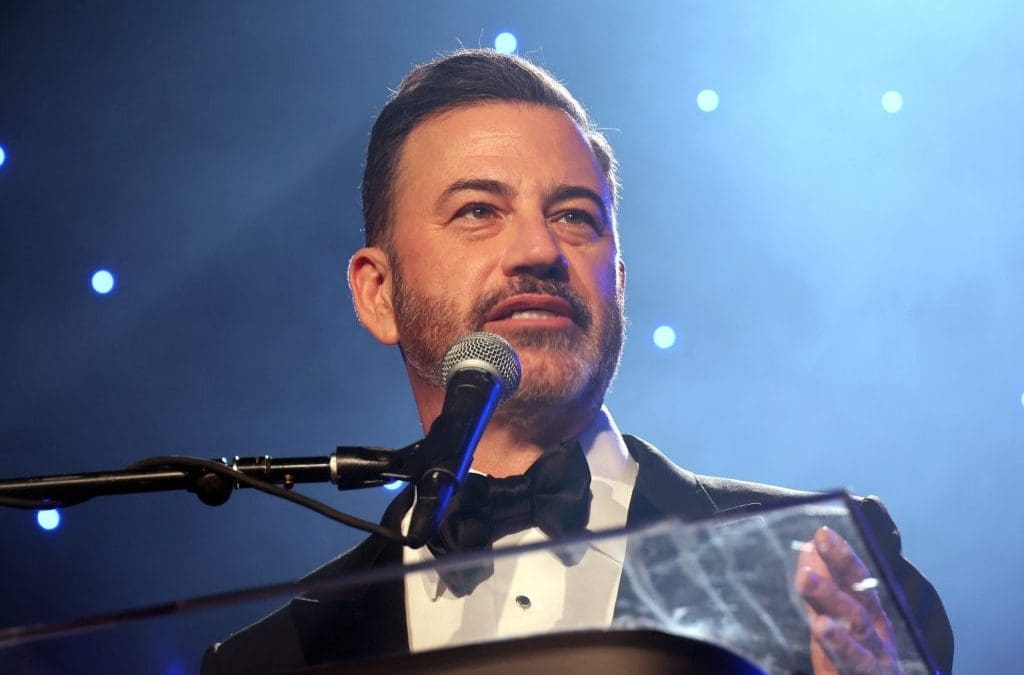
LOS ANGELES, CALIFORNIA - FEBRUARY 01: Jimmy Kimmel speaks onstage during the 67th GRAMMY Awards Pre-GRAMMY Gala & GRAMMY Salute to Industry Icons Honoring Jody Gerson on February 01, 2025 in Los Angeles, California. Photo by Johnny Nunez/Getty Images for The Recording Academy

By pressuring broadcast giant ABC to suspend Jimmy Kimmel’s late-night show—a decision that ABC reversed this week—the Trump administration has taken its assault on the First Amendment to new heights over the past week. Kimmel’s show is back on the air for now, but the whole debacle has revealed just how vulnerable free speech in America is to political and corporate authoritarianism. This is a crisis, and both Democrats and Republicans have set the stage for it. “As corporate media accelerate their censorship of comedians and journalists,” renowned media analyst Jeff Cohen writes, “we must realize that we got to this dire situation because of old-fashioned, bipartisan corruption in Washington, DC.” In this episode of The Marc Steiner Show, Marc speaks with Cohen about how the consolidation of corporate control over the media, mixed with a ravenously censorious Trump administration, has left free speech in America hanging by a thread.

Guest:

Additional resources:

Credits:

  • Producer: Rosette Sewali
  • Studio Production: David Hebden
  • Audio Post-Production: Stephen Frank
Transcript

The following is a rushed transcript and may contain errors. A proofread version will be made available as soon as possible.

Marc Steiner:

Welcome to the Marc Steiner Show here in The Real News. I’m Marc Steiner. It’s great to have you all with us. Our democracy is under attack and one of the underpinnings of a free society is a free and independent press. Right now, 90% of our media is controlled by just six corporations, and when those in media do their job and confront power, they’re attacked by their corporate owners and by the right wing. We’re in control of the White House. Trump said in response to the firing of Jimmy Kimmel, congratulations to a, b, C for finally having the courage to do what had to be done.

And while Jimmy Kimmel may be back on many stations controlled by right-wing conglomerates like Nexstar, which controls over 200 stations, reaching 220 million people will not carry Kimmel. This monopolistic control of our media is a canary in the coal mine. And to unravel we face, we’re joined today by Jeff Cohen, founder of the Media Watchdog Group, Fairness and Accuracy in Reporting, and co-founder of RootsAction.org. He’s a retired journalism professor at the college and author of Cable News Confidential: My Misadventures in Corporate Media. Jeff, it’s good to have you with us. I really appreciate you taking the time here.

Jeff Cohen:

Great to be with you

Marc Steiner:

And a propitious moment as well. I mean, we could talk about, as we will, the state of media in America today and where we are, but the Kimmel episode was really a frightening in the beginning, but enlightening and how this is unfolding talk. I really want to hear, start off with your kind of analysis of where that is, why this bloody thing happened in the first place and why it’s turned around the way it turned around.

Jeff Cohen:

Yeah, it’s been a long time coming. We’d almost have to talk about the decades of the federal government, both parties, Congress and the White House, allowing the media, placing the media in the hands of fewer and fewer ever larger conglomerates. That’s the beginning. And then these conglomerates, when they want to merge even bigger, they need to get federal approval. So if there’s too many employees that are interfering or making things difficult with them, for them, with whoever the government is, I experienced this as you know, Marc, I was at MSNBC in the run up to the Invasion of Iraq in 2003.

Marc Steiner:

I remember.

Jeff Cohen:

And we were muzzled by management and then terminated three weeks before the invasion and all the internal memos leaked out. Why? Because of what we were trying to question, ask journalistic questions about the invasion. So it’s been happening decade after decade, but it’s never been worse than now because the conglomerates are bigger than they ever were. And we have the Trump team. So you have all of these companies doing somersaults to please Trump, especially if they have merger business before the Federal Communications Commission. The reason that Colbert was terminated, many of us believe is because Paramount needed to merge with Skydance. When that happened, the boss of Paramount, Sherry Redstone became $2 billion richer than the day before the merger, and the merger could not go through until 60 Minutes had been squeezed. The executive producer 60 minutes left in protest, as did his boss, and they were still holding out.

That’s when I suspected they’re waiting for something to be done to either Colbert on CBS, which Paramount owns or comedy the Daily Show on Comedy Central. So now we come to Kimmel, and it’s the same thing. Disney had merger business before the Federal Communications Commission. Disney already owns Hulu, the streaming service, and they wanted to get fubu, and that needs federal approval. It’s currently at the Justice Department, Trump’s Justice Department. And then perhaps even more important than Disney’s collaboration with Trump in suspending, Kimmel was two big television groups. One is the right wing Sinclair Broadcast Group, which is as Trumpian as any media company in our country and the other, and they own or operate nearly 200 television stations. And nexstar owns even more TV stations. And both of them after the FCC threatened to go after a B, C affiliates carrying Kimmel. That’s also unprecedented. Those two companies said were preempting Kimmel and that put pressure on Disney and then Disney folded. But what it has to be understood about both Nexstar and Sinclair Broadcast Group, their government created conglomerates prior to the 1996 Telecommunications Act that was pushed through by Democratic President Bill Clinton, hand in hand with Republican Speaker of the House, Newt Gingrich.

You could only own 12 TV stations in the whole country. You couldn’t own 200 like Nexar and Sinclair owned. So that brings us up today. They’re going to bring Kimmel back this week according to Disney, but Nexstar and have said, no, he’s not coming back on our stations. I heard from someone in Washington DC they won’t be able to watch Kimmel’s return because of who owns the Washington DC ABC affiliates and nearly somewhere between 25 and 30% of ABC affiliates will not be carrying Kimmel on his return.

Marc Steiner:

It’s so convoluted, but also very dangerous. I’m going to take a step back for just a minute. People may not, who are watching and listening to us now may not be aware of what happened in 1996 and how that allowed all this to unfold and why the Democrats team built Republicans to allow it to happen, why Clinton allowed it to happen to kind of take this massive media world we have in our country owned by many different people across the country, local stations, doing it in local ways. Why that changed? Well, what was the dynamic in 1996 that allowed that to happen and exactly what did happen so people understand really what we’re facing?

Jeff Cohen:

Yeah, it’s really important. When we, for decades, one individual or company could only own in the whole country, seven television and 7:00 AM radio and seven FM radio, and you couldn’t own two in one market. When Reagan took over Fowler, his FCC chair got it changed. So it was 12, 12, 12. That’s how it stood until the point you want me to talk about, which is 1996 when there was this corrupt law written by the telecommunications and media company lobbyists that sort of divided up the media pie among fewer companies that were allowed to get bigger because the caps were relaxed. So instead of being able to own 12 TV stations, now you could own hundreds. And so Sinclair Broadcast Group only owned 12 in 1996, and they’re completely Trumpian, totally right wing. They’ve been right wing since they intervened. I remember in the 2004 presidential election

Marc Steiner:

Running

Jeff Cohen:

A smear documentary attacking Kerry two weeks before the election of Kerry and George W. Bush in 2004. So those companies, thanks to the Telecommunications Act of 1996, they now own or operate around 200 stations. That was illegal in 1995. You could only own 12 nationwide. So other things that happened, Murdoch, because of the 1996 bill, he was able to build his Fox Empire Clear Channel, a right wing radio company out of Texas, closely allied with George W. Bush. Prior to the Telecommunications Act, they owned 50 radio stations. Within two years, they owned about 1200 radio stations. Again, this was written by lobbyists Fair, the media watch group that I founded, we were protesting, we were trying to get journalists to even cover this 1996 telecommunications act, which was the biggest change in media since the 1930s, and you couldn’t get coverage. I remember the Consumer Federation of America was so concerned about how little attention this very dangerous corporate media bill was getting. They went to CNN and said, Hey, we’ve raised the money for a 32nd ad to warn the public, and CNN wouldn’t sell them the 32nd ad time

Marc Steiner:

Would not sell them the ad,

Jeff Cohen:

Right? So it was horrific at the time. I was able back then to write stuff in the Baltimore Sun actually

Marc Steiner:

About

Jeff Cohen:

How dangerous this bill was. And we’ve now seen the implications both parties back then. This is before Citizens United Corporations couldn’t give to politicians, but they could give to party organizations. That was what was called soft money. And the big media companies were giving big dollars to the Democratic party organizations and the Republican party organizations. And it passed the Senate, the Telecommunications Act of 1996, 81 to 18. And I remember talking shortly after it passed with Senator Paul Simon, not the singer, the senator from Illinois,

And Paul Simon was the only journalist in the Senate. He had been a newspaper publisher in Illinois, and he said, it’s one of the proudest votes I’ve ever cast was to vote no on this horrible bill giving all of our media information power to fewer and fewer big companies. So the 1996 Act, when I say to people, don’t just blame Trump. If you’re blaming presidents for the censorship that’s going on, whether it’s journalists, whether it’s Colbert, whether it’s Kimmel, also you have to blame President Bill Clinton, a Democrat because of the role he played in pushing this corrupt legislation. And again, Democrats were getting big money from the media companies as well as Republicans.

Marc Steiner:

That period I remember, well, I was on public radio with my show and we covered this. It was almost like was deafening the silence of the opposition to what we saw unfold. And I think so especially what you’ve been writing lately is we are reaping what was sowed then. And I think that this is, as I said earlier, we’re on a very dangerous precipice with corporate control of everything we see, read and hear, and a very right, right-wing government in power in our country. And I don’t think people really understand the clear danger

Jeff Cohen:

That

Marc Steiner:

This poses for us.

Jeff Cohen:

And remember, when these companies want to get even bigger, they need federal approval. And that means Trump and Trump’s basically told every federal agency, you work for me. So the Federal Communications Commission used to be somewhat independent. Now it’s headed by a Trump bite. He wrote part of Project 2025,

He wrote the part of it on the media, and that’s Brendan Carr. He’s maybe even more ferociously right wing than Trump. And so these companies, Nexar, which already owns or operates 200 television stations, and they won’t be running Kimmel, when Kimmel comes back, they want to merge with a company called TEGNA Media. And instead of just reaching 39% of US households, which is what the cap is now, they want it changed to 80%. And Brendan Carr at the FCC has basically said he would do that. So the FCC has to approve the Nexar merger. They need to approve that. The Justice Department will have to, is now investigating the merger Disney wants, where they will take over FUBU to go along with their Hulu. And it’s also the internet tycoons. I mean the billionaires control the media, and you had all of them sitting in the front row of the Trump inauguration. That was unprecedented. Marc, you and I go back a few decades, but for young viewers,

We have to let them know how abnormal all of this is. That instead of in the front row being US Senators who’ve been in office for 20, 30 years, it was the tech moguls. It was Zuckerberg, it was Bezos, it was Elon Musk. Bezos owns the Washington Post. He’s demanded that the opinion page only have free market propaganda. You can’t be critical of corporate capitalism on the Washington Post. People have had to resign their political cartoonists, their award winner. Ann, tell Nate, she had to resign recently over comments about Charlie Kirk that were accurate just quoting what Kirk stands for

Marc Steiner:

Said what actually said. Right?

Jeff Cohen:

Yes. She got fired. The Global Opinions editor and African-American woman, Karen Atia. So the censorship is worse than ever. It’s happening because the media are concentrating in the hands of a few. People always say, well, at least Colbert can go until May. I’ll be shocked if he survives till May Kimmel’s contract. He’s coming back, but he’s coming back limping because those huge station groups aren’t carrying it. At least not now. And I saw a great quote from the head of Nexstar or from their pr, they’re not going to bring Kimmel back to their, I think they have more than 30 ABC affiliates because approval is pending. They want to see if Kimmel will be fostering an environment of respectful dialogue. Now, I guess that means they can’t cover anything that comes out of the mouth of Trump. He’s usually so abusive and name calling, but Kimmel, they want to be more obedient.

So yeah, it’s utterly dangerous that the billionaires and these conglomerates have been having so much handed, so much media power. All they care about is profit maximization. They don’t care about journalism. They don’t care about the right to dissent. A, B, C News is a shrinking part of the Disney conglomerate. They don’t care about news or journalism. Paramount Skydance because they got rid of, or they’ve terminated Colbert as of May. That merger went through with Paramount that owns Comedy Central and CBS merging with Skydance, which is Larry Ellison’s money. He’s the 81-year-old billionaire who founded Oracle. His son David is the CEO of Skydance. They’ve already announced they’re going to move CBS news to the right. They’re going to make sure there’s no bias, nothing that will offend Trump. People have already left CBS news because of this. It’s going to get worse. And there was an amazing column by a former Wall Street banker who’s now a publisher in the New York Times a couple days ago.

And he said, Larry Ellison, the 81-year-old billionaire who’s now perhaps the billionaire most closely allied with Trump since Trump had his falling out with Musk, this guy is now the behind Paramount Skydance, which owns CBS Comedy Central and so much more. He’s going to get a majority stake. He’s part of this consortium taking over TikTok, and there’s evidence that Larry Ellison wants to take over Warner Brothers discovery, which owns HBO CNN. So we’re in, and again, if Trump gets what he wants out of these conglomerates, he’s going to approve these mergers that would not have been able to be approved years or decades ago.

Marc Steiner:

So one of the things I was thinking about reading all this and leading up to this conversation, but also just covering this because of the years I’ve been doing this work in media, is that this reminds me of the period of the trusts that ran America in the late 1890s, early 19 hundreds before Teddy Roosevelt broke them up. All you can say about Teddy Roosevelt, you can say about him, but he broke up the trusts, he went after

Jeff Cohen:

Them,

Marc Steiner:

He didn’t back down. So where do you think that political force today to take this on?

Jeff Cohen:

Well, what’s fascinating is when you do polls of the public, whether it’s right wing people, left wing people, everyone thinks there’s too much corporate power and too much corporate. It’s just not debatable that the masses want these things broken up. You can do polls on this. Are the insurance companies too big? Is big pharma too big? So you bring up the key point that the reason the media have been able to be put in the hands of such a few companies is antitrust law quit being enforced.

The Federal Communications Commission kept changing its rules to loosen ownership caps. And I mean, think about antitrust, one of the most important cases in the area of media and information when governments still enforced antitrust law that as you say, came about at the turn of the 20th century with a Republican president, Teddy Roosevelt in 1948, the Justice Department in a suit initiated under Franklin Roosevelt’s government that was continued under Harry Truman’s government. They said to the big movie studios, the case is called United States versus Paramount, the movie studios, you want to own movie studios. You shouldn’t be able to own the where you produce the content. You shouldn’t be able to own the movie theaters that are at the end delivery point of the product or the content. Classic vertical monopoly

Marc Steiner:

Was

Jeff Cohen:

Not allowed. And they had to sell off their theaters. And it allowed independent movies to sometimes be shown in theaters because there was no longer this vertical monopoly. That was 1948, beginning in the eighties with Reagan continuing with Clinton in the nineties. And Bush and Obama. They don’t enforce antitrust law. And what was interesting is one of Biden’s best appointments of all was the head of the Federal Trade Commission, Lena Kahn. And she was really a break on some of these mergers. And you had big democratic donors like Kamala Harris’s big donor, Reed Hoffman was demanding month after month. They’ve got to get rid of Lena Khan at the Federal Trade Commission

Because she was obstructing these ridiculous mergers that all would’ve been illegal 10, 20, 50 years ago. And if Kamala Harris had been elected and Kahn was probably going to go. So that’s the problem you bring up antitrust. We used to have rules that made the economy more competitive and allowed smaller outlets, smaller companies, including smaller media companies to compete. That’s a bygone era, and it’s not a natural process that the media were handed over to a few companies. It’s utterly corrupt. These companies were funding both parties, usually done behind closed doors. As you know, the 1996 Telecommunications Act, the biggest change in media law for 60 years was hardly discussed in mainstream media.

Marc Steiner:

Nobody covered it. I mean, in that period, I forced a conversation on Capitol Hill with our Maryland Congressman about that bill, because you saw the handwriting on the wall. You knew what it was going to mean. So I just wonder, in all the ways of looking where our media is at this moment, how do you see the political opposition organizing to stop it? Or does it exist?

Jeff Cohen:

Well, the fascinating thing is most of the people getting censored are not as famous or big as Jimmy Kimmel, but when he got suspended, it was an uprising. There were demonstrations in the streets. There were all these online petitions. There was let’s boycott Disney, boycott Hulu, 400 of the biggest names in Hollywood all signed an ACLU petition protesting the FCC, putting pressure to get Kimmel suspended. So that’s the good news is people know how to organize on behalf of freedom of speech, the right to dissent. But a broader answer to your question is independent media. That’s the key. I’ve supported The Real News Network since day one. If you know about The Real News Network, and most Americans do not.

Marc Steiner:

Right

Jeff Cohen:

Fund it, tell your neighbors and friends and relatives about it, independent news outlets are doing the serious journalistic work and having the serious debates that are not happening in mainstream media. And so if you’re an activist who cares about these big issues, whether it’s labor rights, environmental rights, environmental justice, anti-racism, you’ve got to also be, if you’re an activist on any of those issues, your second issue should be media activism. And if you’re a media activist, that means you resist censorship wherever you see it, and you use your own email, your own social media, your own word of mouth to promote The Real News Network, to support these places that are doing the real digging and having the voices. I can’t get on mainstream media anymore. I was banned in 2003. They

Marc Steiner:

Won’t have you.

Jeff Cohen:

I mean, with Phil Donahue, I saw what media censorship was up close. And so I’m a big believer in independent media. The independent media is strong, but it needs activist to promote it because The Real News Network doesn’t exactly have a big ad budget.

Marc Steiner:

It does not. I think one of the things in terms of what you’re laying out for people to hear is that most Americans, I think at this point don’t understand the danger we’re in with this kind of right wing authoritarian power in Washington dc. The destruction of our independent media, the monopolies taking place over our media and what we hear and learn. I mean, this is a moment where I think that people have to, the most we can do is to make people understand what we face. Our democracy is under threat. Our media independence is under threat. One of the things about America that made it blossom was freedom of the press. People speaking their minds and presses in the newspapers being owned locally by people in the community.

Jeff Cohen:

You’ve said it. I mean, we were the original democracy. It was always imperfect, always was racist.

Marc Steiner:

But

Jeff Cohen:

We went to Tocqueville, a French nobleman, traveling all around the us. He’s just amazed. Everyone’s reading newspapers. He came from Europe where it was all monarchs. And I’ve marveled as recently as a few weeks ago, that we’re a country where you can have Jimmy Kimmel and Colbert criticizing, ridiculing the president night after night with millions of people watching. But again, that seems to be a thing of the past. Even the comedians are going to have to go independent. Colbert. If he wants to do something, he’ll be doing it online. Probably Kim will, John Stewart, they’re all making plans for a post conglomerate. I mean, we have these great comics that have kept many of us sane through the Trump era, but they’re all employed by conglomerates. Paramount employs Colbert and John Stewart and the team at Comedy Central at the Daily Show, Warner Brothers Discovery, which may have a new right wing owner.

Soon they employ one of the great investigative journalists of our day, the comedian John Oliver Comcast. And Trump’s been threatening Comcast. Comcast is the employer of Seth Meyers and Jimmy Fallon on NBC. Now, most people, if we had media literacy in the schools, kids would be taught, oh, okay, here are the companies that own the media and information system, but we don’t have media literacy in our schools. So yeah, it’s very dangerous. The comedians have been a breath of fresh air. I’ve always said that you can learn more from a 10 minute monologue from Kimmel or John Oliver or Colbert than from watching like a month of news on those very same channels. The journalists have always been, this is why fair.org exists. And by the way, a good way to fight for media against censorship is with fair.org. But the reason we exist is because of this censorship that has gone on, and you can resist it together as a group, and it’s more effective. I am telling people the worst thing you can do in a period like this where Trump is collaborating with conglomerates to squeeze dissenting voices, the worst thing you can do is sit at home alone. You’ve got to join organizations. You need to become a sustainer of the Real News Network. You have to join fair fair.org. I’m also with Roots Action and Activism Group that fights this censorship roots action.org. When you’d start joining with other people.

That personal despair I think can be eroded because we’re taking action and we’re doing it with other like-minded people.

Marc Steiner:

What you’re saying is really critical. Everything you’ve been writing about it, I think is very critical. But what you’re saying at this moment in our conversation is critical because it’s, we’re not done yet. And I can remember in 19, I am dating myself here. I can remember in 1968 when we convened a national media in Washington DC of alternative media, but not just alternative media of media people, of small newspapers across America who came in to start talking about what we have to do to organize, to not allow then the corporate media from owning everything. And I think we’re at that moment.

Jeff Cohen:

Yeah, and we’re at that. I think it’s the most dangerous moment since the height of the Joe McCarthy era

Of Blacklist, where so many journalists were purged. Edward Murrow didn’t even defend some of the journalists that got purged from CBS News. Journalists across the country were purged. Academics were purged. Union leaders were purged. A number of unions were almost smashed during that era. And today, one of the most outrageous things that’s happened in the last week or two is the University of California President has taken the names of 160 professors, students and staff, and turn them over for investigation to Trump on the basis that maybe they engaged in antisemitism. We know a lot of these people on the list are Jewish. It’s a hoax, as we know from the encampments, protesting the Gaza genocide. And my daughter is one of them.

So many of the protesters are Jewish, but they use this charade, this hoax that they’re antisemitic when they protest the University of California being invested with Israel in killing Palestinian civilians. So they’ve turned over a list. It’s like if you’re talking about echoes of the McCarthy era, when a university is turning over a list and the people on the list don’t know what they did, they’ve been notified. They’re on the list, they have no clue why they’re on the list. Many of them are Jewish. They are not antisemitic. So yes, it’s a dangerous time, but we still have independent media. And if you put together the audience of the Real News Network and Democracy Now, and Common Dreams and Truth Dig and Truth Out and Counter Punch, and the Young Turks salon.com, I mean, you’ve got millions of people every day are getting independent news from non-corporate, non conglomerated sources. That’s new. Now, there’s obviously tens of millions that don’t know about these independent sources, but the fact that so many millions of people are getting the news every hour. This didn’t happen in the sixties. In the sixties and early seventies, which was a boom in independent media, which had underground newspapers and liberation news service. But it basically reached a youth demographic,

And it was once a week, aside from Pacifica Radio, it was once a week with the internet. We have these independent outlets that are giving you the real scoop, as you guys say, the Real News on an hourly and daily basis. And we didn’t have that in the late sixties, early seventies when the underground press, the alternative media boomed.

Marc Steiner:

Well, I really do appreciate this conversation, and I do want to have more of these conversations with you and others, and we have to keep this fire burning, and you keep your fire burning and keep putting yourself out there.

Jeff Cohen:

Thanks. And we have to be optimistic. I know The Real News Network emphasizes taking action, not just learning the news.

Marc Steiner:

That’s right. That’s

Jeff Cohen:

Right. That’s the key.

Marc Steiner:

That’s the key.

Jeff Cohen:

Thanks, Marc.

Marc Steiner:

Once again, thank you so much.

Jeff Cohen:

Thank you.

Marc Steiner:

We’ll stay in touch once again. Let me thank Jeff Cohen for joining us today. And thanks to David Hebden for not only running the program, but editing today’s program and producer Rosette Sewali for making it all work behind the scenes and everyone here through the news for making this show possible. So please let me know what you thought about what you heard today and what you’d like us to cover. Just write to me at mss@therealnews.com, and I’ll get right back to you. Once again, thank you to Jeff Cohen for joining us today and for the valuable work he does for all of us. So for the crew here at The Real News, I’m Marc Steiner. Stay involved. Keep listening, and take care.

Original

Sanitizing MLK’s legacy begins by forgetting his life outside the South

Sanitizing MLK’s legacy begins by forgetting his life outside the South

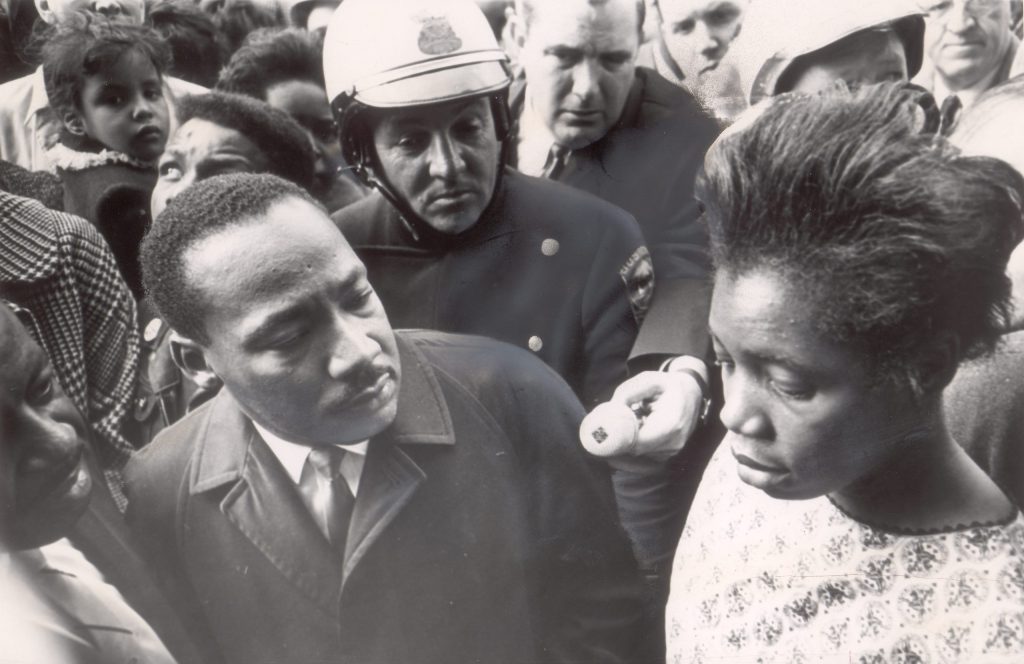
BOSTON - APRIL 22: Martin Luther King, Jr. hears complaints from Roxbury residents. Here, Mrs. Jennings, a resident of Howard Avenue, complained of cockroaches. Dr. King led a march through the city to protest segregated housing conditions and racially imbalanced schools, and spoke at Boston Common and the State House during his visit. Photo by Paul Connell/The Boston Globe via Getty Images

In our mythological retelling of the Civil Rights movement, Martin Luther King, Jr. vanquished the racist apartheid system of Jim Crow in the American South. However, in her groundbreaking new book, historian Jeanne Theoharis argues that King’s time in Boston, New York, Los Angeles, and Chicago—outside Dixie—was at the heart of his campaign for racial justice. As the book description lays out, “King of the North follows King as he crisscrosses the country from the Northeast to the West Coast, challenging school segregation, police brutality, housing segregation, and job discrimination. For these efforts, he was relentlessly attacked by white liberals, the media, and the federal government.” In this episode of The Marc Steiner Show, Marc speaks with Professor Theoharis about the MLK Americans have deliberately forgotten, and what this recovered history tells us about how to fight against injustice today.

Guest:

  • Jeanne Theoharis  is Distinguished Professor of Political Science at Brooklyn College of City University of New York. She is the author of the New York Times bestselling The Rebellious Life of Mrs. Rosa Parks and winner of the 2014 NAACP Image Award for Outstanding Literary Work Biography/Autobiography and the Letitia Woods Brown Award from the Association of Black Women Historians. Her book has been adapted into a documentary of the same name, executive produced by Soledad O’Brien for Peacock where Theoharis served as a consulting producer. Her book A More Beautiful and Terrible History: The Uses and Misuses of Civil Rights History won the 2018 Brooklyn Public Library Literary Prize in Nonfiction and was named one of the best Black history books of 2018 by Black Perspectives. Theoharis’s writing has appeared in the New York Times, the Washington Post, MSNBC, The Nation, Slate, The Atlantic, and many more. She is also the author of King of the North (The New Press) and lives in Brooklyn.

Additional resources:

Credits:

  • Producer: Rosette Sewali
  • Studio Production: David Hebden
  • Audio Post-Production: Stephen Frank
Transcript

The following is a rushed transcript and may contain errors. A proofread version will be made available as soon as possible.

Marc Steiner:

Welcome to the Marc Steiner Show here in The Real News. I’m Marc Steiner. It’s great to have you all with us. My guest today is Jean Theo Harris. She’s one of the most important and leading chronicler of the Civil Rights Movement and black power movements in our country. Our most recent book is King of the North, Martin Luther King’s Life of Struggle Outside the South. Dr. Theo Harris is a distinguished professor of political science and history at Brooklyn College and Cooney graduate school in New York, an author or co-author of 13 books and numerous articles on civil rights and black power movements and the Contemporary Politics of Race in America. And I also have to mention her amazing New York Times bestselling biography, the rebellious life of Mrs. Rosa Parks. There’s so much more to say, but if we kept up, we’d never talk to her. We’re about to have a conversation with author filmmaker Acts professor Jean Theo Harris. And so Jean, welcome. Good to have you with us. It’s been a long time. I’m glad you’re back here.

Jeanne Theoharis :

I’m glad to be back.

Marc Steiner:

So as always, we’re pumping on all cylinders. It must be something genetic in the family, but it’s great. So let me talk about the most recent book that we just mentioned about your idea of the sanitized Martin Luther King, what that means and well, let’s just start there.

Jeanne Theoharis :

I think part of the ways that we’ve sanitized King is that we’ve ized him. We’ve trapped him in the South. We’ve trapped non-violence in terms of lunch counter sit-ins and bus boycotts.

We have made him into some sort of respectability politics, kind of scolding minister, and all of these are deeply narrow and deeply inaccurate to who he was. So I think the first thing we want to remember is that Martin Luther King grows up in Atlanta, but he spends his formative coming of age years in grad school, but first in Pennsylvania at Crosier Seminary and then at Boston University getting his PhD, as does Coretta Scott. She goes to Antioch College for college, and then she goes to the New England Conservatory of Music. So fundamentally, both kings have experienced both that segregation is not a southern problem, but a national cancer. And they’ve also experienced the limits of northern liberalism at home, and they will never not know that. And so we often start the story of King in Montgomery, which is where he has his first pastorship and the Montgomery Bus boycott. But he comes into that experience with those lessons learned in Pennsylvania and Boston. Just to give you an example, when he moves to Boston, he tries to rent a place and no one will rent to him because he’s black. To give you another example, Coretta Scott goes to Antioch College in Ohio, probably the most liberal college in the nation.

Marc Steiner:

Absolutely.

Jeanne Theoharis :

Her and her sister are the first black students to go there in decades. She majors in music and elementary ed, and then all education majors, she asked Student Teach, but Antioch is located in Yellow Springs, Ohio, and Yellow Springs School Board says, no, we’re not having any black people. Student teach here. And Antioch goes along with them and she’s dumbfounded and her and her classmates are protesting the Korean War and they’re protesting all sorts of issues, and she tries to get those classmates to protest with her this policy and no one will. So she goes to the president of Antioch alone and basically protests and what they want her to do is to go student teach in a black town called Xenia, and she says, no, I am not paying for that. This is not American democracy. And I could go on with other stories. The point is that both of them have had these experiences that are going to forever shape how they see what the racial landscape of the United States is, not just the deep South and where they see the struggle is, which is again, coast to coast.

Marc Steiner:

Yeah, it’s interesting what you said is really important. People don’t realize that in that period, much of the north or the middle of the north, Ohio, Pennsylvania, where I grew up here in Baltimore, Maryland was segregated, separated

Jeanne Theoharis :

For sure.

Marc Steiner:

It wasn’t just Mississippi and Alabama.

Jeanne Theoharis :

Nope.

Marc Steiner:

And people do not realize that.

Jeanne Theoharis :

And the state or everyone from the mayor to the board of Ed to the governor is playing a role in that. It’s not just accidental or episodic segregation in New York, it’s the Board of Ed zoning schools so that some schools are almost all black and some schools are almost all white. And when those schools get overcrowded, whether it’s in New York or Chicago or la, do you know what those board of Eds do? They don’t rezone to move those black students into white schools. They go to double session days, they add trailer classrooms, they get deeply overcrowded. So I think another myth of the time is that somehow it was state sponsored in the South and more episodic or accidental or the result of personal prejudice, not sort of state action. And that’s also not

Marc Steiner:

True. Right, right. The personal prejudice. No, it’s not racism, just personal prejudice. Right. Well, I could digress into this and stay here for a long time, but let me answer this question. As someone who’s been in the media for a while and also been through the Civil Rights Movement, one of the things I think people do not get or even understand is the hostility in the way the media portrayed King and went after him, including great liberal institutions like the New York Times and more to talk a bit about that part of the world.

Jeanne Theoharis :

Yeah, I mean, I think that point is really important, and I think there’s been a tendency because the national media came to cover the Southern movement, and again, I’m talking about the Birmingham with sort of rigor and clarity that we then not scrutinized how they’re covering King, how they’re covering injustice closer to home in many ways. Part of the story I’m telling in King of the North required getting underneath a set of media narratives. The first was that segregation was sort of state sponsored in the South and not in the north. The second was that therefore the real problem of racism was in the South. The third then was southern black people were good and went for nonviolence and northern black people. And this set of media narratives, flattered, we could say northern sensibilities, and it produced wildly different coverage. If we look at how, for instance, the New York Times is covering Birmingham in 1963 versus how they cover as we were just talking about the New York City School boycott sort of the next year

And how they cover King and the kinds of criticisms that King is making of New York segregation or la. And so they tend to do a couple of things. One, for as long as they can, they minimize it. They call it alleged segregation. And they constantly use words like that in headlines. Activists alleged king alleges in ways that they don’t in the South, they tend to, as we talked about just using the New York City School boycott example, paint activists as reckless and unreasonable as hurting their own cause. In ways when we’re talking about activism, whether it’s in New York or Chicago or la and I should say when I’m using the word north, I’m using it the way King is using it and the way activists at the time are using it, and it basically means any place that thinks it’s not the South. So we’re talking the Northeast,

The Midwest, the West, and they obviously are very different in a lot of ways, but they also all take pride in, oh, we’re not the South. We don’t have that kind of racism. We’re open and tolerant. And so one of the things that I for the book is I looked at hundreds of articles from the LA Times, from the Chicago Tribune, from the Washington Post and from the New York Times to look at how they covered movements closer to home versus movements like the movement in Birmingham or what happens in Selma around voting rights versus what happens in Chicago versus what happens in la. And there was incredible discrepancy. Also, I should say the related to the myth about sort of southern black people go for non-violence and northern black people. So then the extension of that becomes after that you don’t have very much coverage of northern movements before the uprisings that happened in Harlem in 1964 and Watts, then the media discovers the problem in the north,

But in doing so, also paints northern black people as not going for nonviolence. Even though in LA in New York, there are years of movements basically calling out these issues. And that one of the things King will say over and over, I mean he will say about Watts, if you had listened, there would not have been a Watts. We have King stands with all these movements in LA in 62 and 63 and 64 against police brutality against school and housing segregation there. And then lo and behold, the LA Times is so surprised, how could we have this uprising? And King is basically calling the city to account. And it’s interesting. Then we have the mayor of LA who months earlier had given key to the city being like, you should never have come. You’re terrible when he’s talking about what needs to be happening in la. If the mayor could just stand next to King and be like, you’re great. You got a Nobel Prize, don’t talk about here. Then it’s like, we’re going to give you the key to the city. You’re always welcome. Except no, now you’re not welcome at all. And I’m being a little sassy, but that’s,

Marc Steiner:

That’s fine.

Jeanne Theoharis :

That’s the way that, so in many ways, we often talk about, and scholars like me talk about the ways that the king holiday is misused and king is stripped, but in fact, people are misusing king when he’s alive. They want to take pictures with him, but the minute he opens his mouth about their own problems, then they’re like, oh, be quiet. And the media helps to cement that narrative.

Marc Steiner:

I was thinking about what you just said a little bit ago and what you wrote about as well, about Coretta King.

Jeanne Theoharis :

Yeah,

Marc Steiner:

Because I think before we dive into other parts, I really think it’s important for people to understand who she really was

Jeanne Theoharis :

Absolutely.

Marc Steiner:

And how she was the radical not king, and how she dragged King into the radical world. I mean, let’s celebrate her for just a second.

Jeanne Theoharis :

As we were just talking about, she goes to Antioch College, gets politically involved at Antioch College, including with the Progressive Party. And people may remember the Progressive Party is a third party that gets started and they’re running a third party candidate, Henry Wallace for president in 1948, domestically on a kind of anti segregation platform, but also a kind of anti cold war. The progressive Party is bringing kind of a double challenge.

Marc Steiner:

This is 1948, as you said, it’s really important.

Jeanne Theoharis :

1948.

Marc Steiner:

48, right, right.

Jeanne Theoharis :

And she is supporting Henry Wallace for President 1948, and she is one of about 150 black people who go to the Progressive Party convention in Philadelphia. It is through her progressive party activism and work that she meets Bayard Rustin and Paul Robeson.

So I would like to say this very clearly, Coretta Scott King meets Paul Robeson meets Bayard Rustin long before Martin Luther King does, and long before she meets Martin Luther King. So she goes to Antioch and then she goes to New England Conservatory of Music for vocal education. And through a friend she meets Martin Luther King. And at first she’s very, she’s not sure she even is interested in a date. Most of the ministers she knows, and this is her words, are kind of about suits and sanctimony. They don’t have the kind of vision of Christian social responsibility. I mean, make no mistake, Coretta Scott King is a deep Christian, but for her, Christianity is how you live your life and the ways you practice that in the world. But she agrees to a date. And Martin Luther King, who is again getting his PhD at BU is smitten after that first date.

Right? He’s never met someone like her. They talk about racism and capitalism on their first date. Right? Good first date is at the end of the day, he says, you have everything I want in wife. Right? You’re beautiful, you’re smart, you’re thoughtful. And she’s like, you don’t even know me. So one of the things is that she is going to expand and kind of take many of the things that he is thinking and feeling and help those to grow. Many people talk about King going to be you, and that the influence that Howard Thurman absolutely has on king’s kind of growing, we might call liberation,

Marc Steiner:

Who’s a great radical black philosopher, if you will. Right, exactly.

Jeanne Theoharis :

He studies, and this is one of King’s mentors at BU and helps King find a kind of liberation theology, a black liberation theology, black social gospel, because we want to remember that King growing up didn’t think he wanted to be a minister because he found his father’s ministry both too emotional and too otherworldly, too materialistic, not in this world. And it is through his mentors at Morehouse and also his mentors at Crosier and bu. And again, Howard Thurman plays a big role in this that he begins to see this possibility for a ministry grounded in social justice. But another person who makes that vision a reality is Coretta Scott because she is living this kind of grounded Christianity that he also is wanting they date for a while. It takes her a while to decide on him. She’s worried that he’s marrying a minister, will make her small.

Her friends are worried. What if he doesn’t amount to anything? But she’s very impressed by his vision, by the ways that he has this drive to have this kind of socially committed ministry. And so ultimately she agrees to marry him. And just to give you a sense, they get married in June of 1953. She refuses to wear white. She does not wear a long dress. She wears a T length light blue dress in 1953 where this is not 1963, this is not 1973. This is not 1993. And she makes her very imposing father-in-law take obey out of the vows because she says it makes her feel like an indentured servant. This is Martin Luther King’s beloved, and I think seeing kind of the fullness of her politics and her spirit, and this is who Dr. King sort of Marys, I think also speaks to maybe different or bigger sense of who Martin Luther King is too.

Marc Steiner:

Yeah. I think that as you’re write about, I mean that Martin Luther King credits Coretta Scott King with making him the radical that he is, that changing his worldview

Jeanne Theoharis :

Because of the progressive party, the triple evils that we associate with kings last year, right. Racism, poverty, militarism,

Those she comes in with and she has that global vision and very much, one of the issues she really focuses on in the late fifties and early sixties is kind of global peace and anti-colonialism. She will be active in the anti-nuclear movement in the United States in 1962. She will go to Geneva with Women’s Strike for Peace to a 17 member Decir men conference trying to get the United States and the Soviet Union to sign a nuclear test ban treaty. And then when he gets the Nobel Prize in 1964, she really sees this as a broadened responsibility for him and for her to the world. And she begins to push him to come out against US involvement in Vietnam. And from 1965 on, she is publicly out against the war in Vietnam. She’s the only woman who speaks at a big rally at one of the big first rallies at Madison Square Garden in 1965. A reporter asks Dr. King afterwards sort of remarking on this, did you educate her? And he says, no, she educated me. So I mean, Reta Scott King is really, as both of them would say, the family leader around issues of kind of global peace. So in many ways, he leads on some issues, she leads on some issues, but I think we want to see that as a political partnership.

Marc Steiner:

So I want to talk a bit about as we bring this into the century we’re in today, that there’s been an effort of powerful effort to sanitize Martin Luther King to fit into this. I have a dream speech and that’s it. And to Deradicalize King to not make him a confrontational leader that he was.

Jeanne Theoharis :

Yeah.

Marc Steiner:

Talk a bit about that in terms of your analysis of how that happened, why that happened, and how we have pushed against that.

Jeanne Theoharis :

So I think all sorts of people misuse King Republicans as well as Democrats. And I think for our purposes today, I think we want to focus on the ways that liberals and moderates misuse him.

Because I think it’s sometimes easier to see, oh, when the FBI tweets out on Martin Luther King Day, were remembering Martin Luther King. There’s sort of something so absurd about it that we can just recognize that. But I think one of the things we’ve seen over and over from the beginning of Black Lives Matter more than a decade ago around the pro-Palestine demonstrations around anti-ice demonstrations that Dr. King tends to get rolled out to tell young activists, you’re not doing it the right way. You need to be less angry. You need to be less confrontational. You need to wear a suit. And I think that really misses both who Dr. King was and what a kind of politics of disruption he and many in the movement with him pursued and the kinds of criticisms they got for it. I think now we look back and whether we’re looking at the Montgomery Bus Boycott or whether we’re looking at the New York City School boycott in 1964, which was the biggest civil rights protest of the era happens in New York City,

And we assume, oh, we would’ve been with that. And in fact, many, many people, the national NAACP for instance, does not support the Montgomery Bus boycott, does not support that economic tactic at the time. They do support the legal case, but not the boycott. If we take the New York City School boycott the New York Times, who had been praising and reporting very seriously on King’s work in Birmingham, and we will see this with the Washington Post, we will see this with the LA Times. We will see this with the Chicago Tribune when the work gets closer to home, as King would say, as long as I was safe from them in the South, many of these national news outlets sort of covered the emerging Southern movement with rigor, with substance. They didn’t take public officials words verbatim. And then you get to New York, you get to Chicago, and that’s very different. So these are troublemakers, this is reckless. The New York Times, we’ll call the New York City School boycott, unreasonable, reckless, violent, in part because it’s disruptive in part because it’s meant to cost the city and state money. And so I think part of Southern King is also constraining what we see his non-violence to be about.

So we pacify it. Non-violence was about school boycotts. It was about rent strikes, it was about tenant unions and welfare unions. It was about disrupting the comforts of injustice because one of the key things that we can see him saying from Montgomery till the end of his life is that injustice is comfortable to too many people. The status quo works. And so in order to change that, you have to disrupt that and make people uncomfortable. Similar to what, again, black Lives Matter, the pro Palestine demonstrations, the anti-ice demonstrations, the notion that you have to disrupt. But I think we’ve taken that sense of disrupting injustice out of how we understand Dr. King. I think we’ve pitted him against young people. Some of my favorite stuff in the book is in Chicago. So in the mid sixties, king in the SELC join a huge movement in Chicago and help to expand that movement.

But that movement has been organizing for years to take on housing segregation, to take on the conditions in Chicago slums to take on economic inequality and job discrimination, to take on city negligence and public services, all these, and one of the things that King does in 1966 is he spends hundreds of hours working with gang members and sees in them real leadership potential, real organizing potential. And this is not just like pull your pants up, kind of talk. This is serious long conversations about how to take on the political economy of Chicago. And these gang members, these gang leaders who worked with King talked about, they didn’t agree on everything, but as the head of the Vice, Lord said, you couldn’t help but fall in love with him. But that’s not an image we have of King spending hours and hours with gang members and developing their leadership in the movements in Chicago, again, around unequal housing and unequal jobs.

Marc Steiner:

It was a period that people actually need to know more about. We come back and do a longer piece on that alone just as a lesson. I mean, it’s when that was happening, I was allied with the Young Patriots, which was the white gang of Appalachian whites, and they were in this Rainbow coalition. People don’t even realize how powerful that was at that moment. And so I say that now to think about what all of this teaches us about and how it talks to us about where we are today with Palestine, the struggle that’s going on in Palestine with this kind of neo right takeover of the United States and what King did to confront and others to end segregation and to fight against racism and to open America up. How do those things talk to us about this moment that we face right now?

Jeanne Theoharis :

I mean, I think some of the lessons that I draw both from Dr. King and Credit Scott King and also from Rosa Parks, is the ways that we’ve somehow made the Civil Rights movement seem obvious when in fact, part of the genius of people like Rosa Parks, like the Kings is their ability to move without having a clear sign that it’s going to do anything. I think we often get trapped today in trying to figure out what will be effective. And obviously those conversations are important, but I think we miss that part of what the Civil Rights Movement teaches us. Part of what looking at Dr. King’s life teaches us is that you try a bunch of things, you’re going at it a bunch of ways and you lose a lot, and that you can’t kind of measure what you’re going to do on some sort of sureness or some sort of calculation that it will work. Because in some sense, part of what, and I’m going to use Rosa Parks here, the summer before Rosa Parks makes her bus stand, she goes to Highlander Folk School. Highlander is an adult organizer training school in Tennessee at the time,

Marc Steiner:

Multiracial radical school

Jeanne Theoharis :

Multiracial radical. It really lifts her spirits. She goes to a two week workshop around implementing school desegregation in 1955, and yet on the last day, they do the go wrong. What are you going to do when you get home? And she says, there’s never going to be a mass movement in Montgomery. And so I’m going to keep working with the young people. And people like Rosa Parks, people like Dr. King we’re very worried about, could you ever get people to unite? Could you ever get a mass movement given the level of fear, given the level of reprisals, given the kind of class divisions. And yet when the Women’s Political Council decides to call for a boycott that day, the kings, they get up at 5:00 AM they’re hoping it’s going to work, and then they see the buses and it has, and that changes what’s Im imaginable. And so that one day boycott, and no one wants to speak at that mass meeting that night, none of the ministers, and Edie Nixon, who’s a longtime organizer, basically is trying to shame the ministers and being like, you guys are all cowards. And Dr. King’s like, I’m not a coward. And so basically, he volunteers to speak at the mass meeting that nobody wants to speak at because nobody, and it’s that night, that first night that the community feeling the power of that first day decides to change that one day boycott into an indefinite boycott.

So in many ways, I think that the second lesson here, besides what you don’t know, what’s going to work, is that being in motion expands what’s possible. So that night it’s like, okay, we’re going to do this indefinitely. Then six weeks in the King’s House gets bombed. Coretta and their baby two month old baby Yolanda are home. And Coretta thankfully gets them both out safely. But guess what? Both their dads show up that night and they’re like, oh no, you’re not being in this house with a baby having this happen. All of us can imagine this, right? Both dads. And she’s like, we’re not going anywhere. I’m not leaving. They want them all to leave, and if Martin’s going to be too stubborn, then Cor and the baby have to leave because we can’t have the baby under these conditions. And she’s like, no. And so that decision will then change the scope of the movement again, because in some ways what that bomb was intended to do was to try a different tactic to sort of unsettle or shorten the movement. And she was like, no, we’re not going anywhere. And I think the third thing is that they’re scared. And I think we forget this.

I think there’s a way, particularly with King, where it just seems like he’s built from different material. And in some ways, most of us don’t have those eloquent abilities to kind of draw the metaphors that he can. But he’s terrified that first night when he goes to speak, he’s shaking. He may have had a panic attack. I mean, he was terrified. They’re terrified. And I think the third thing to learn from them is part of what they are able to do is to be scared and to move. Anyways. So I think that’s the third thing is that sometimes the way that the civil rights movement appears in movies is like you’re scared, but then you have some sort of revelation and then you’re not scared. And that’s not true.

Marc Steiner:

No.

Jeanne Theoharis :

And so learning how to both acknowledge the fear and to move with the fear, I think is another lesson for us today, because it’s not going to not be scary, and they’re not going to not be costs.

Marc Steiner:

And what you’re saying is absolutely correct. I mean, in those days, I was terrified every second of every moment of every day we were in the Civil Rights movement that I could be killed, tortured. We were all terrified. But you didn’t stop,

Jeanne Theoharis :

Right.

Marc Steiner:

So what does that say about we are facing, I think in this country at this moment, we’re on a precipice and a very dangerous place. Everything that people think about America could be turned upside down. You’ve seen the repression across the country, immigrants being rounded up, people trying to defend immigrants being rounded up, and it is beyond that. So you’re seeing this massive push. So I’m wondering from your perspective as historian, as an activist as well, what those moments that you study write about, share with us, say to us now about what we face, what the Palestinians face, what black people face in America, what Americans face with this right wing growth, that’s a reaction to everything we fought for and changed. So what does it say to us now? What does it say to you?

Jeanne Theoharis :

I think one of the other things it says to me is that courage begets courage. So if we take the snapshot of Rosa Parks on the bus or we take a snapshot of King deciding, okay, I will speak at that mass meeting tonight, even though no one wants to, then it’s terrifying, then you’re alone. But I think what we then see the next day is, okay, nobody stands up on the bus with Rosa Parks, but that Monday she’s terrified that they’ve called this boycott for that Monday and nobody’s going to do it. And then they do. One of I think, the greatest gifts and getting to sort of spend many years studying Dr. King, that I think perhaps his greatest gift is that his courage made people feel their own courage.

It wasn’t just that he was incredibly eloquent. It was that in his actions, people found their own actions. So I think one of the other lessons that I take is the ways that stepping forward both opens up possibilities, but also that other people, and maybe it’s not as many as we would want at first, but that I think it also provides a path for other people to step forward too. And so even if it feels, oh, our numbers are so small, I think the perspective of history is that our heroes keep stepping forward and then the numbers get bigger. And so I think that’s one lesson I take. I think another lesson I take is the ways that they’re learning and listening. And I think that’s not often a word we think about with Dr. King. We’re so used to seeing him on the podium. But so many people talk about Dr. King being a good listener.

And I think that’s another skill for this moment is sitting there is hearing what people need so that then we can craft a way forward together and to kind of keep expanding how in some ways, if we look at the ways, if we’re thinking about Chicago and the Poor People’s Campaign, this kind of bringing in more people and bringing in more people. And one of the things that the Kings do very well is from the bus boycott on, they’re meeting people around the country who are doing the work, and then they keep bringing them in. And so some of those gang members I was talking about, when King goes down to Mississippi to take part in the Meredith march, he brings some of those gang members with him. He brings some of the Puerto Rican organizers in New York that he’d been working with down there too. So then we get to the Poor People’s campaign and there’s people from all around the country. So I think that sense of listening and of expanding,

Marc Steiner:

I know we have to close out here. I wonder for you and your thinking and yourself and what your books say if there is hope in that, in terms of confronting what we face today, whether it’s Palestine Israel, or whether it’s the repression taking place in the cities throughout America right now, rounding up immigrants, I mean the right wing push.

Jeanne Theoharis :

So I think it’s both gives me kind of soberness and hope. When you look at the history of the civil rights movement, you look at kind of how these movements in the North are treated and Dr. King is treated in the north. I think it’s a reminder that our activism is not necessarily going to be praised in the moment. And I think that’s another myth. This notion that you shine a light on injustice. This is George Bush’s take on Rosa Parks. She shined a light on injustice and then injustice was changed. That would be nice. That’s not how it really works. And so I think remembering that the kinds of criticisms that we get, that we’re being unreasonable, that we’re being troublemakers, the ways that it feels lonely, we stand on many shoulders who have felt that same way and who have had those very same criticisms. Even though now today, all those people are like, “Oh yeah, I would’ve been with King…”

Marc Steiner:

Right.

Jeanne Theoharis :

So I think that’s sobering. I think what’s hopeful is the ways one of King’s other, in my opinion, greatest gifts is his ability. I was talking about this kind of expanding, but that one of the things that he does is when faced with pressure, he doubles down. And I think that’s a lesson for us too, because I think sometimes it’s so dispiriting. It’s like, this isn’t working. We don’t have the numbers. And then I think taking that lesson that instead of shrinking or getting smaller, we go deeper and we go harder, and that we stand on shoulders like Dr. King’s when we do so. Because I think going back to where we started this conversation, I think one of the worst things about the ways that King is sanitized and lobbed at activists today is that those shoulders are taken from us.

When I was doing the research on Rosa Parks, I came upon some of her notes, speech notes during the boycott, and she’s talking about how she’s reading about Mary McLeod Bethune and she’s reading about Sojourner Truth that our heroes also needed to stand on shoulders, right? There was tremendous kind of sustenance to learning that people had gone before them. And so to me, one of the real dangers in the way that King is kind of turned into this respectability politics, just be nice and wear a suit kind of guy, is that it takes him from us and from this generation of activists when again, as you’re saying, we need him more than ever. We need this. Which is not to say we’re going to do it exactly the same way, but again, many of the lessons, tenant unions, rent strikes, blocking traffic, all these things are techniques that King and friends are using.

Marc Steiner:

It’s always a pleasure to talk to you, and I really will link to all the work you’ve been doing to people get this new book about King of the North and really kind of dive into it. Maybe we’ll have another conversation about that specifically someday soon. And I want to thank you so much for taking the time for all of our listeners here at The Real News and being part of the program today.

Jeanne Theoharis :

Thank you so much for having me.

Marc Steiner:

Once again, I want to thank Dr. Jean Theo Harris for joining us today, and we’ll be looking to her work here on this site. And thanks to David Hebdon for running the program today, audio editor Stephen Frank for working his magic rosette, so for producing the Mark Steiner show and putting up with me and the tireless Keller of our Making it All Work behind the scenes. And everyone here at Real News will making this show possible. So please let me know what you thought about, what you heard today, what you’d like us to cover. Just write to me at ss@therealnews.com and I’ll get right back to you. Once again, thank you Jean o’ Harris for joining us today. So for the crew here through Real News, I’m Marc Steiner. Stay involved. Keep listening, and take care.


Original