by Jon Queally | Sep 15, 2026 | Article, midterms, Politics and Movements: US, Reprint, Supreme Court, Trump, Voting Rights
This story originally appeared in Common Dreams on Sep. 14, 2026. It is shared here under a Creative Commons (CC BY-NC-ND 3.0) license.
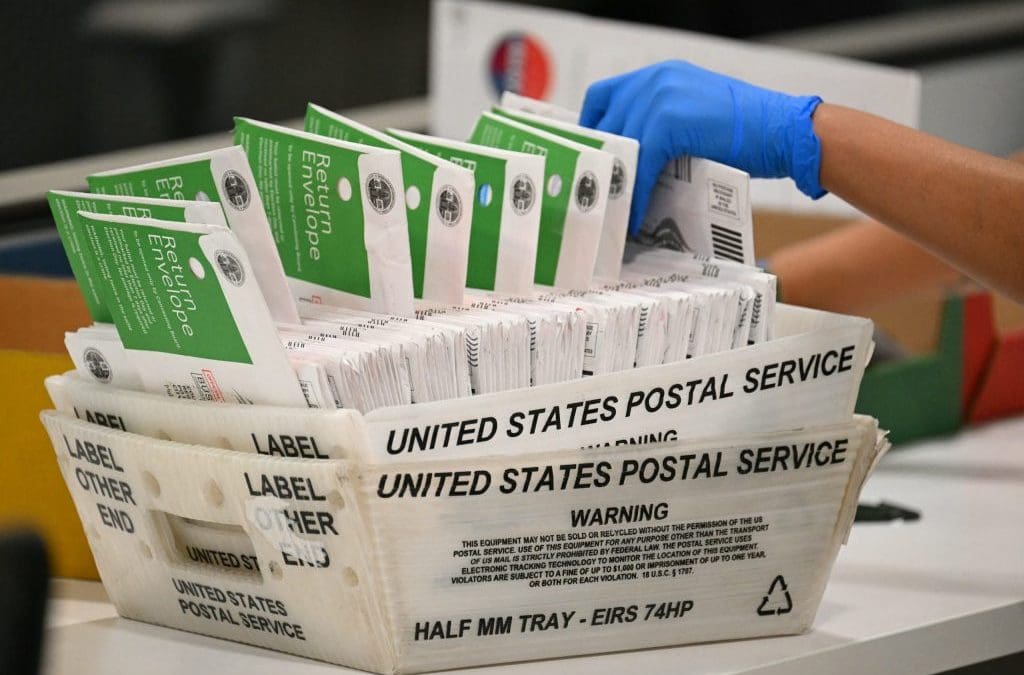
The US Supreme Court on Monday night rejected a bid by the Trump administration to keep onerous US Postal Service rules for mail-in ballots in place, which voting-rights defenders said risked depriving millions of people of the franchise in this year’s midterm elections.
After a back-and-forth legal battle over the USPS rules that dragged on for months, the nation’s highest court issued the 7-2 ruling without elaborating on its legal reasoning, though right-wing Justices Samuel Alito and Clarence Thomas issued dissents in favor of President Donald Trump’s side.
The ruling in USPS v. California was in response to a legal challenge brought by the League of Women’s Voters, the attorneys general of numerous states, and others who argued that newly-announced rules by the Postal Service regarding mail-in ballots, changes prompted by an executive order issued by Trump, would prevent people from having their ballots counted and cause chaos for those trying to administer this year’s elections.
A victory for democracy, a defeat for election deniers. https://t.co/MKjfKmgyTv— David Crowley (@DavidCCrowley) September 15, 2026
In response to the ruling, the plaintiffs’ legal team said the decision was “a critical step to ensuring free and fair elections this November by maintaining access to mail voting for millions of eligible voters across the United States and lifting the dire threat that the Postal Service would disenfranchise them.”
“Mail voting is safe, secure, and reliable—and the Trump administration has presented no evidence to the contrary, as the courts have repeatedly recognized,” the statement continued. “We will remain vigilant in countering threats to free and fair elections and ensuring that every eligible voter is able to cast a ballot and
by Jordan Rubin | Sep 15, 2026 | Deadline: Legal Blog, elections, Supreme Court, White House
The Supreme Court on Monday denied the Trump administration’s bid to halt a Boston judge’s order that blocked the federal government from implementing mail-in ballot restrictions for the midterms.
Over dissent from Justices Samuel Alito and Clarence Thomas, the court issued a brief order that said the government “is unlikely to succeed on the merits of its challenge to the District Court’s preliminary injunction. And the equitable factors applicable for obtaining emergency relief from this Court do not favor a stay.”
It is the latest action from the high court ahead of the November elections, as the justices have weighed in on an array of election-related issues, including congressional redistricting, campaign advertising and ballot measures.
The administration argued that the restrictions, contained in a new rule from the U.S. Postal Service, impose “only modest envelope-design and addressee-information requirements for federal-election ballots sent via U.S. Mail.” It insisted that the rule regulates the mail, not elections.
A coalition of Democratic-led states maintained that the rule is unlawful and that complying with it “would be impossible” for some states and would lead to millions of voters being unable to vote by mail and others being unable to vote at all. In other states, the coalition said, it would produce “chaos” and “a significant risk that millions more voters would be denied the ability to vote.”
The League of Women Voters and other groups who also challenged the rule said that it “would disrupt the administration of mail voting mid-election and disenfranchise eligible voters nationwide, including voters in all-mail states like Colorado and Utah and elderly, rural, and disabled voters who must vote by mail.”
In a brief concurring
by Jordan Rubin | Aug 18, 2026 | Deadline: Legal Blog, Supreme Court
The Supreme Court has issued a series of rulings in recent years expanding the role of religion in public life, including in public schools. Now, a religiously diverse group of Texas families is asking the justices to draw a line when it comes to a state law mandating the display of a state-selected Protestant version of the Ten Commandments in every public classroom.
Or, rather, the families are asking the justices to reaffirm a line the high court already drew in 1980, when it rejected a similar Kentucky law to the Texas law the families are challenging.
“Nearly fifty years ago, Stone v. Graham … held that permanently posting the Ten Commandments in public-school classrooms violates the Establishment Clause,” the families said in their petition to the justices, referring to that 1980 precedent and the First Amendment clause that says, “Congress shall make no law respecting an establishment of religion.”
They also pointed to a more recent ruling, last year’s Mahmoud v. Taylor, in which the high court sided with Maryland parents who wanted to opt their children out of instruction that the parents said violated their religious beliefs on gender and sexuality. The Texas families said the Maryland ruling reaffirmed the court’s recognition of the importance of free-exercise rights under the First Amendment.
The petition in the Ten Commandments case therefore presents the justices with legal questions under both religion clauses: whether the establishment clause “forbids a state from mandating the permanent, conspicuous display of a government-selected version of the Ten Commandments in every public-school classroom” and whether “permanently displaying the Ten Commandments in every public-school classroom interferes with parents’ Free Exercise Clause
by Erum Salam | Aug 16, 2026 | Civil Rights, elections, News, Supreme Court
The Trump administration “absolutely” is considering taking its voter roll litigation to the Supreme Court, Attorney General Todd Blanche said Sunday.
“We’re not going to stop doing what I think every American should expect us to do, which is make sure that we have elections that are fair. And as that relates to the Department of Justice, that means making sure that there are no constitutional, legal violations, even at the state level,” Blanche said in an interview on NBC’s “Meet the Press.”
President Donald Trump and his administration have repeatedly claimed, without providing proof, that voter fraud is widespread. Blanche’s remarks come after the Trump administration has lost more than 20 court cases across the country trying to force states to hand over voter roll information ahead of the Nov. 3 midterm elections, which will decide which party controls Congress.
A federal appeals court on Friday rejected the administration’s petition to reconsider a ruling by a three-judge panel that had denied the Trump administration access to Michigan’s complete voter rolls. Michigan’s attorney general called the Justice Department’s demands “invasive” and “a transparent attempt to intimidate and spread fear among voters.”
A federal judge in Nevada also ruled against the DOJ on Friday in its attempts to obtain Nevada’s unredacted voter registration records. Nevada Secretary of State Cisco Aguilar called the ruling “a victory for Nevada voters and their right to have their sensitive personal information protected.”
State officials have repeatedly cited the Constitution, which gives states power over their elections — not the federal government — in their pushback. Blanche said Sunday that “doesn’t mean the federal government should play no role.”
“And so the
by Chris Walker | Aug 13, 2026 | conflicts of interest, Fossil Fuels, Gas, News, Oil, recusal, Samuel Alito, Supreme Court
A new analysis suggests that Supreme Court Justice Samuel Alito gained as much as $2.9 million in assets from growth in stocks relating to the oil and gas industry over the course of the past two decades. The analysis from the nonprofit watchdog group Court Accountability found that Alito’s assets (not including his personal housing properties) expanded by between $3.4 million and as much as…
Source
by Chris Walker | Aug 7, 2026 | 14th Amendment, birth tourism, Birthright Citizenship, Donald Trump, immigration, News, Stephen Miller, Supreme Court
On Thursday evening, President Donald Trump signed two executive orders on birthright citizenship, just over a month after the U.S. Supreme Court ruled that a previous order he made on the issue was unconstitutional. The new orders are narrower than that previous one, which was signed in the first week of his second term in office. Several legal experts have already opined that the new orders…
Source