Fighting for the democracy we’ve never had

Fighting for the democracy we’ve never had

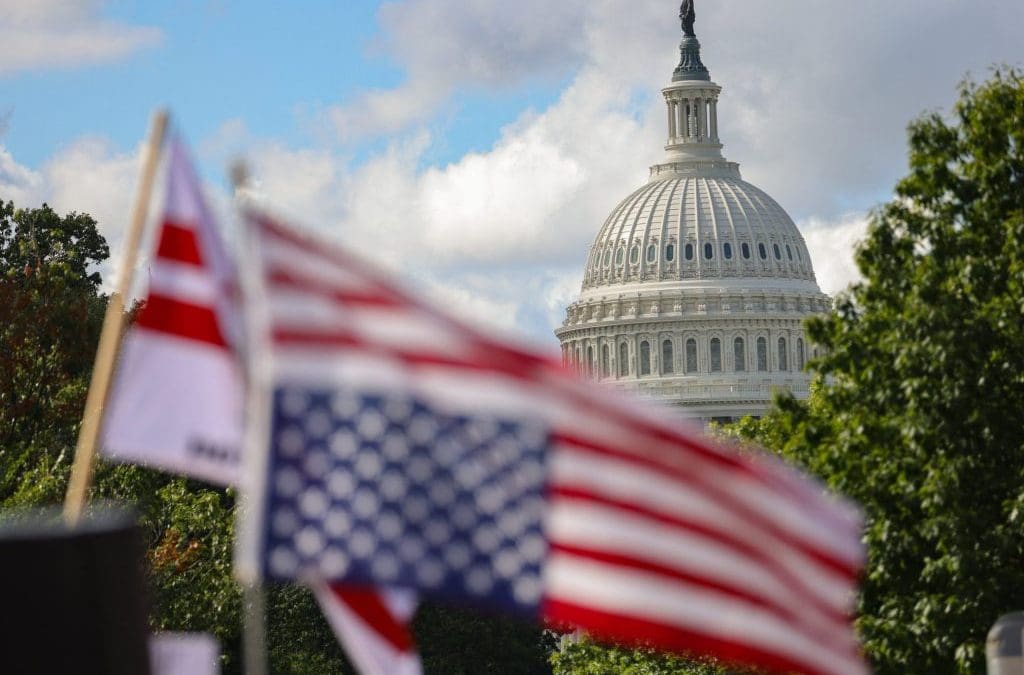
The dome of the U.S. Capitol building is seen beyond an upside-down U.S. flag during an anti-Trump protest at Union Station in Washington, D.C. on September 2, 2025. Photo by BRYAN DOZIER/Middle East Images/AFP via Getty Images

Not just in the United States, but around the world, authoritarianism is rising and people’s faith in the concept of “democracy” is collapsing. “In the absence of clarity from its defenders and amid the failures of our putatively democratic institutions,” Osita Nwanevu writes in his new book, The Right of the People, “democracy has become a specious and suspicious platitude, equally useful to marketers and would-be dictators—a hollow idea for a hollow, unserious time.” How did we get here? And what will it take to revive working people’s faith in democracy, not just as a philosophical ideal, but as a real, practiced force that will improve their lives? In this podcast, recorded at Red Emma’s Cooperative Bookstore and Cafe  in Baltimore on August 12, 2025, TRNN Editor-in-Chief Maximillian Alvarez and Chris Lehmann, DC Bureau Chief for The Nation, speak with Nwanevu about his new book and the fight to reclaim democracy in an age of rising authoritarianism.

Guest:

  • Osita Nwanevu  is a contributing editor at The New Republic, a columnist at The Guardian, and the Democratic Institutions fellow at the Roosevelt Institute. He is a former staff writer at The New Republic, The New Yorker, and Slate, and his work has also appeared in The New York Times, The New York Review of Books, The Nation, Harper’s Magazine, Columbia Journalism Review, In These Times, and Gawker. He lives in Baltimore, Maryland.

Additional resources:

Credits:

  • Studio Production: Maximillian Alvarez
  • Audio Post-Production: David Hebden
Transcript

The following is a rushed transcript and may contain errors. A proofread version will be made available as soon as possible.

John Duda:

My name is John Duda. I’m one of the worker owners here at Red Emma’s. We are a 20 plus year old radical worker owned bookstore, restaurant, social center, and we’re excited to see you all in the dog days of August and the waning days of the American Republic. We are tonight joined by a wonderful panel chief. Among them is AED Nueva, who is here to launch this amazing book, which I’ve been looking forward to for a long time. I think really grateful to be launching this book. It’s kind of a nerve wracking book because part of it is a catalog of everything that’s wrong with the system that sometimes we call democracy, but as he shows, really isn’t, I got to admit, it woke me up in a fit at one in the morning. So if I seem a little incoherent, it’s because this book caused me to lose sleep.

But as I finished it this morning in my sleep deprived days, it actually, there was something relaxing about it because once you accept that we’ve actually never really had a democracy in America and that it’s going to take generations to build it, it actually, given what we’re seeing today, given all of the shit, all of the backsliding, we know that we’re not losing something that we were actually had, we’re being set back in a struggle that’s a lot longer and has always been a lot longer than just the machinations of the current fascist regime. But to help us work through this today, we also have some amazing panelists with us. We have another good friend of the cooperative here, max Alvarez, editor-in-chief of the Real News Network. And then for the first time we have Chris Lehmann, who is a, I want to say legendary editor, a fantastic run at the head of the Bathler, an incredible generational run at the head of the New Republic, and now the bureau chief for DC for the nation. So excited to have these folks here tonight to talk to us about democracy or lack thereof. Please join me in giving them all a warm welcome.

Chris Lehmann:

Well, thank you all for coming out again in a hot August night or late afternoon. As John said, I’m Chris Lehmann and both Max and I will be enjoying the great opportunity to engage with Oida on these really urgent questions raised in his book, which are not, as John alluded to by any means, sort of academic or theoretical for us at this moment. I drove up from the newly anointed garrison state of Washington to be here today. And that experience just covering Trump’s surreal and fascist racist press conference yesterday was a good sort of distillation of a lot of what O CDA argues in this book, which is to say there is this kind of capital R resistance narrative about the Trump moment being a moment of profound backsliding where we have betrayed our faith and trust with the democratic ideal. In reality, it’s been an accelerationist moment.

It’s harnessing all of the very potent and not even dormant, but latent, I guess you could say, anti-democratic energies in the American political system. And so the challenge going forward in wrestling with this moment is that we are the sort of inheritors of an oligarchic system that uses a very loose rhetoric of democracy, largely to defend status quo arrangements. And to sort of get to the bottom of this morass, you actually need to return to certain basic first principles of what happens to one person, one vote when again, in places like Washington, there is no congressional representation. There is no ability to pass laws or a budget without congressional interference. What does it mean to say that Trump is an existential threat to democracy when the US is exporting a genocidal war in Israel? None of this actually works out at a basic level of logic. And the great virtue of O’S book is he began sort of unpacking the mythology we’ve used to avoid talking about substantive democracy in this moment. So with that all in view, I will toss over to Max.

Maximillian Alvarez:

Well, I just want to say before we get real deep into Osita’s incredible book, what an honor it is for Oita and I to be sitting with Chris who, without whom, I don’t know, I won’t speak for Osita. I mean, I’m sure he would’ve found a way, but I would not be where I am without Chris. And that is true of many of us that you read and see in left and independent media like both as the leader of a news network. Again, it’s never lost on me that I wouldn’t be here had Chris not believed in me in my writing 10 years ago. And also when I look for role models, I have very few, and you may not know it, but as far as like guys who have stuck by their principles and been chewed up, turned out, spit out, and somehow kept coming back and leading different newsrooms to improve, this is the guy that has managed to make a career the right way. So let’s give it up for Chris.

Chris Lehmann:

I think we should all also have a moment of silence for Max because anyone in the position of adopting me as a role model isn’t desperate straight. But thank you.

Maximillian Alvarez:

It was very, and Chris in ota, I just could not be proud of you brother for getting this book out. And I know it was a real slog, but it feels like it’s coming at the right moment when we need it most. And I really appreciate you for that. And like Chris was saying, we were all watching what’s going on in dc. I mean Donald Trump is Federalizing DC police calling in the National Guard. I was just back home reporting in Southern California where he did the same. And I came into reading ADA’s book with one of my favorite book titles from Sister Astor Taylor, another shout out, another Baffler contributor. She has one of the best book titles of all time that’s always swimming around in my head. Democracy may not exist but will miss it when it’s gone. So I’m coming into reading o’s book with that in my head and my head’s on fire with everything in o’s book.

And then I’m watching what’s unfolding over the last 24 hours. And I know we don’t live in a functional democracy in the way that any of us were taught to believe it, but I know when I’m seeing these images that I’m watching the death of something. And so I wanted that to sort of be the springboard for us to talk about and introduce your book Oda, what can your book, what does it give us and people like us who are feeling that same way to help understand what we’re seeing and help know to do what to do next. And let’s use that as a springboard for a larger introduction to what the book is.

Osita Nwanevu:

Sure thing. Thank you for that introduction. You’ve been a real supporter of me throughout the entire process of writing this, and I could not be more grateful, Chris. I could be here for the next hour talking about how grateful I am to you for hiring me at the New Republic. But everything that Max said was absolutely correct. You’ve been truly a real model. If that means bad things for me in the future, I don’t care. It is a fact. It’s true. And I’ll always be grateful. And while we’re doing Thanks Red Emmas, I’ve been really proud to be a part of this community for some years now. It’s not just a great gathering place and a point of community for Baltimore, but it is a place that instantiates every single day, the democratic values that I talk about in this book and inspiration to cooperatives in the city and around the country. And I would not have imagined starting this tour anywhere else but right here. So thank you for that as well.

What I think we’re staring down with the Trump administration, I think is fascism. You can continue to debate that point academically if you’d like to, but when I see people being whisked off the street and put into unmarked vans for expressing opinion, that’s really calling of all I need to know personally. And when you talk about something dying, what is the thing that we’re all kind of feeling? What is the collapse we’re all trying to interpret? I think that what’s collapsed is our kind of faith in the system broadly understood. These institutions that I think all of us are taught, or most of us are taught in school, were designed to prevent the rise of somebody like Donald Trump have not only failed to do that, but as I argue in this book actually helped him come to power the Democratic Party, which I think people might’ve hoped would be an effective bulwark against the radical right against Trump’s fascist movement.

I think its messaging has failed. I think its political approach and strategy has failed. I think even us on the left as much as energy and as much sweat as we’ve put into organizing the last 10, 15 years especially, we’re still a lot of work cut out for us in terms of building a true left majority in this country. And I think the people are kind of taking in all of that and wondering what the next steps are, where do we go from here from this point of collapse? And my book is a humble effort at constructing something that I think might be useful vision moving forward, which is taking democracy seriously, not just as a by word, not just as a cliche, but as a really, really deep system of ideals that I think has animated a lot of people on the left for a long time.

But that conception democracy has not been that prevailing understanding of democracy within mainstream politics. And I’m trying to, I think, bring people who are concerned about Donald Trump concerned about this moment, concerned about authoritarianism into a more ambitious and frankly more radical understanding of what democracy can and should mean for us and to get to a truly democratic America. I think that we have to take a critical look at our existing structures, existing systems, not just in our politics, but within our economy. And that’s what the book in a nutshell is fundamentally about and trying to do.

Chris Lehmann:

Yeah, and actually to put in a plug for my current home publication, the nation is running an excerpt from O’S book about economic democracy that goes live Thursday. So if you want, I mean you should obviously buy it here tonight, but you can send the link to your friends and that I think might be a good place to start the project of engaging with what a democracy worth preserving looks like in this country. And you talk about the first order failure, and I felt this all during the Kamala campaign in 2024, where it was a central theme of the campaign that Donald Trump is an urgent threat to democracy. We have to protect our democracy. And at the same time, there were genuine economic ills and inflation wasn’t under control. And the Trump campaign was able to cynically exploit that and cynically do these absurd gimmicks like suspending taxes on tips, suspending interest payments on auto loans, and Trump even dressed up like a McDonald’s worker to sort of drive home this idea that we are the party of the working class, the forgotten Americans.

And of course, when fast forward, whatever it is, 10 months, and the CBO report just came out on the combined effect of both the quote, big beautiful bill and Trump’s tariffs, and literally every decile of the American income spectrum is going to be paying more. So we don’t have to at Red Ams of all places. We don’t have to belabor this point except to say how is it that the Democrats in particular have become so flatfooted on what had historically been they were the party of workers, and how is it that the Republicans have found it so easy in the broader conditions that we all work and pay our bills under to present themselves effectively as that?

Osita Nwanevu:

Yeah, I mean, as I say in the introduction of the book, which is written after the election, a publisher did not like that they wanted an introduction well before, but there in the introduction of the book, I think that people in this last election felt that they’re being asked to make this binary choice. On the one hand, you can vote to save and protect democracy, which is this kind of that your civics teacher told you was important in sixth grade or something, or you can vote on the basis of your own economic self-interest. You’re paying too much for your groceries, you’re paying too much in your rent, you dunno how you’re going to pay your mortgage, et cetera, et cetera, et cetera. I think people saw themselves as having to make this choice between this ideal that Donald Trump was violating and their own material interest, which they, I think mistakenly believed many voters mistakenly believed that Donald Trump would be able to improve their material law. And that is not a way, first of all, that’s, it’s not a very compelling way to sell a democracy.

If it’s justice, abstraction, justice kind of academic thing that has no connection with your own lived material situation, you’re going to lose that fight to people making other kinds of appeals unless you can sell democracy. And I think truthfully argue for democracy as something can actually materially empower us and improve our standing in the economy, Democrats did not do this. And I don’t think it can be a surprise that for many of the critical constituencies that they needed to win in this election, people chose differently. The Gallup did a poll earlier last year where they found, I think 70 something percent of the American people, 74% it might’ve been, who were dissatisfied with the way American democracy was functioning. That’s not an environment where you want to come in as the people representing the status quo, representing the defense of institutions. You have to speak to that institutional cynicism.

And most Americans are not taking political science classes and they don’t know what senate mal apportionment is and all that, but they do, I think correctly feel that Washington is not set up to work democratically in their interests. They do know even if they don’t have the numbers, that the wealthy corporations get their way more often than not in Washington dc. And so I think people saw that and they saw this kind of defensive our democracy instead of themselves, well, hell, this democracy of ours has never really worked for me. And as a matter of fact, to the extent that you’re telling me that Donald Trump is going to disrupt and destroy those institutions, I might want that to happen. I might vote for him for that reason. And so I think a way to talk about democracy that is more compelling and I think more robust and full is one where you say to people, there’s something about democracy in the system of ideals that actually empowers you materially.

It’s not just about the right to vote. As important as that is, it’s not just about denying or rejecting efforts to overturn the election in 2020. It’s important as that was, but it is a system, it’s a set of ideas, a set of values that will actually improve your own material situation, material standing and ability to live the life that you want. And that’s a conception I’m kind of arguing for in this book, but I think that that can only come if you take a step back, go back to the drawing board and think kind of ambitiously and from first principles, but what democracy even means to begin with. For me, the definition that I came to after reading many dusty and dry books that I don’t know that you should read yourself work for you in a lot of political science or whatever definition I’ve come to that feels most simple to me is democracy is a system in which the govern, the people who are themselves subject to government are the ones who are doing the governing.

It’s not a system that lets some higher authority, arbitrary king or sort of rulers rule over you. You yourself have the power to govern or in Lincoln’s construction government of buy. And for the people, I think there are a lot of technical reasons I get into why that system is better than other alternatives ruled by the few in some guys or another, whether that’s a monarchy and oligarchy. But the thing that I think is increasingly compelling to me is a justification for democracy is this almost spiritual intuition that we, each and every one of us are entitled to a measure of control over the conditions that shape our lives that in this brief time we’re around, it is wrong for us to live as victims of arbitrary circumstance. It is wrong for us to live under in enthrall to hierarchies of people who happen to be born while you’re in more powerful than that.

So there’s something about that and spending our time dominated in that way that is unjust. And so democracy offers us a means to exercise some agency in the time that we have to exercise agency. And if you think about democracy at that level, it becomes very, very clear and obvious, at least to me. And I think a lot of political scientists who aren’t even leftists actually, that’s not just a system of ideals that tells you that you deserve the right to vote and go to the ballot box every couple of years, but that’s a system that says something about what you’re entitled to in the economy and at work

We spend about a third of our lives at work. The decisions that are made at the top of corporations we work for often affect us more directly, intimately and immediately than decisions made in Washington DC or City Hall. And we have very little democratic agency in the economy and at work at all. How can it be the case that somebody who works at Amazon, and I think this is true, this should be true, can go to the polls every two to four years and vote on the basis of what they think are foreign policy should be with respect to Russia or Iran, but has no place in their life where they get to say, this is how I think Amazon should be run as a worker who’s actually at that business generating that business, making what they do possible except for voting within a political system that is also dominated by their bosses at Amazon. That is a democratic problem, a democratic question, and you only come to understand that as a democratic problem if you take a sufficiently ambitious and first principles grounded view of what democracy is about in the first place.

Maximillian Alvarez:

I want to hover real quick on the relationship between democracy and material abundance or having one’s materials needs met, right? Because when you were saying that, a light kind of went on for me and it struck me that the 2024 election was in a way, a sort of bizarro reflection of the post nine 11 moment. And I’ll explain what I mean. Chris and OTA know this, and if anyone’s listened to my show, they know this, but I grew up deeply conservative in that era. I was in high school when nine 11 happened, and I didn’t know shit about shit, but I was with the majority of Americans fully on board, my family and I with this notion that we were going to go spread democracy around the rest of the world that we were going, we were invading Iraq, we were invading Afghanistan somehow in the name of democracy.

Again, not really knowing what democracy meant like Osda is showing, but having the gall to support such an effort because at that time we were middle class and it felt like the economy was doing okay for a lot of us. And when we talked about living in a democracy, let alone having the right to go out and spread democracy and invade other countries to do so again, something felt right there, not because I knew that the system was working, but because as a subject of that system, it felt like the bargain was still being kept and then all of that was effectively broken with the crash, the recession, and it’s just kept breaking ever since. And I think more and more of us have found ourselves falling into that meat grinder over the years, and then fast forward to 2024 where we’re making kind of the same sort of appeals from the Democratic party that we got to defend democracy, the faith bottomed out, and I was like, well, I don’t live in one because I, everything sucks and everything’s worse for my family. And so I think that that is kind of one of the ways that the false connection to democracy maintains when a relative degree of material wealth is available to people, and when that craters, the absence of democracy, real democracy becomes all the more apparent. And so I wanted to ask, what are the kind of tangible examples that people can grasp onto and that you examine in this book where we actually are practicing more democratic control over the conditions of our lives?

Osita Nwanevu:

Well, I think we’re sitting in one place like that. As I said at the beginning, I mean, worker cooperatives are, I think the fullest instantiation of economic democracy, places where workers themselves are running the business, own the business, manage the business, and are making democratic decisions about how things should be run. It’s a small sector in the United States right now, but I think it is a model for the kinds economy that we might aspire to have someday. So you come to places like Redx and you can see that this is not just a kind of pipe dream. This is not just a kind of abstract theory. The businesses can work like this in span. They have this company called the Mongan Corporation System of cooperatives that is actually very, very serious. They manufacture industrial products. There was a profile that Nick Romeo of the New Yorker did a couple of years ago about the business where they said, look, when you look at the kind of patents that they’ve been able to do and the kind of things that they built, it’s very possible that items sitting within a couple of feet of you right now was manufactured by the Mon Dragon Corporation in Spain, the system of cooperatives.

I think that that matters. I think there’s ways you can talk about this economic stuff that makes it seem like it’s so far away and so distant and so impossible to reach for it. I don’t think that has to be true. I think that having visions for the economy are important, and there are all kinds of other economic policies that I talk about in this book too, that have some elements that we’re already kind of seeing at work in the United States today. So I’ve been doing some reporting on worker standards boards, for instance, these panels in different industries around the country, cities and states have set these up where worker representatives and representatives from a particular sector, particular industry and state representatives come together to make decisions on basic working agreements. People see this as a step towards sectoral bargaining, which is common in Europe, a system where instead of firm by firm by firm or workplace by workplace, you need organizing.

You have these agreements that govern an entire sector of workers, and it’s not so hard to get people covered when it comes to their basic wages and working conditions. You’re not doing this kind of whack-a-mole approach to labor organizing. I think that in Europe you have kind of intersecting model of labor power where you have those traditional unions, you have sectoral bargaining, you have co determination, which always also talk about in the book where workers are representative on corporate boards and can vote in corporate decisions at that level. You have ideas like Bernie Sanders offered in 2020 for inclusive ownership funds. This is what John was talking about. They did this polling at the Democracy Collaborative, I believe it was years ago, where Americans were asked, what if we had a policy where companies of a certain size were required to give over, let’s say 20% of their shares to a fund that would be owned and controlled by workers that would pay them out dividends and that would give them voting rights.

In my recollection, and John probably remembers this even better than I do, American supported this idea up to 50% ownership of the company. Why is that? I think that people didn’t understand that proposal as this kind of crazy radical leftist thing. They said, hell, I work for this company. I do what I make it. What does possible. I’m entitled to something more than just my pay. I have a voice that ought to be heard in the basic decisions that are being made here. So I think all of these things are part of an economic agenda that is democratic and it feels, I think, novel in the American context, and it might be exciting to people who want to hear new ideas about addressing our economic situation addressing economic inequality. I think these are also ideas that would build democratic power in a way that would help us in our politics. Let’s say you’re not a leftist like I am, but you’re somebody who’s really, really concerned about tribalism or polarization and isolation. All these things you hear about in the Atlantic Magazine.

One great way to build community amongst people to get them to talk across difference are structures for labor power, whether that’s a union or some other kind of formal organization at work that brings you together with your fellow workers to hash out disagreements, make compromises, make arguments, practice these political skills that ideally we’d be doing more to practice than just trialing ’em out every two to four years in an election. If that was something you were doing on a regular basis, I think that would down to the benefit of our political cohesion as a society. So yeah, I mean, I think that all of these things intersect and interact as a democratic agenda, and it’s a fully conception of democracy again than what we’re used to hearing from our politicians, and I think that makes it rather exciting.

Chris Lehmann:

Yeah, absolutely. Though, naturally the question arises, you’ve sort of sketched out what should be on paper, a very simple program, right? There is tremendous polled support for workplace democracy. There’s tremendous suspicion of corporate oligarchy. There’s this, as we’ve been talking about, a deep drive to challenge the system and the status quo. And so why isn’t this translating into a mass left politics and more specifically, inevitably, I have to ask, why is Democratic party so utterly fucking clueless about

Osita Nwanevu:

This? Yeah, I mean, we could be here all night trying to delve into that question. I don’t know that I have the skills. I’m not a psychiatrist. I don’t know what exactly is going on there. I think there’s a confluence of different things. I think money matters, the fact that they’re being paid by corporations to avoid some of this agenda and some of this talk. I think complacency matters, chair cracy matters. There’s all kinds of cascading influences.

Chris Lehmann:

Not to interrupt, but I think there’s also a credibility problem when you have repeated elections where you say, look, there’s an existential crisis facing our democracy. And as we’ve seen in the last six months of the second Trump administration, Democrats have ruled over on Trump’s appointees. They voted for the Lake and Riley Act, the atrocious demagogic immigration bill. They voted to support the genius Act, which is like, that is the opposite of a small democratic political economy agenda if you’re enabling crypto Barrs and de regulating

Osita Nwanevu:

Banks. That’s, but to go to the other parts of my book, I think that there are also structural things we can point to here. So it matters, I think, for the contours of our politics that a resident of Wyoming has about 67 times representation of residents of California in the United States Senate.

Chris Lehmann:

But Liz Cheney supported Kamala. I’m kidding.

Osita Nwanevu:

Well, this is important to

Chris Lehmann:

Point out

Osita Nwanevu:

Liz Cheney. I believe that she, in all sincerity is offended by Donald Trump attempt to overturn the 2020 election probably genuinely offended by the January 6th attacks. Does Liz Cheney believe that a resident of Los Angeles should have as much power in our political system as one of our constituents in Wyoming? No, she doesn’t believe that. No, there’s not a single person who probably

Chris Lehmann:

Couldn’t afford to

Osita Nwanevu:

Who believes that,

But you welcome her into your political coalition out of an insufficiently serious understanding of what democracy means. It should mean more than just opposing people stealing elections. It’s like a very minimal kind of baseline thing. That’s fine. I think that’s great. But I think another minimal hurdle you should meet is believing in political equality that no matter who you are, no matter what the color of your skin is, no matter where you happen to live, you come into our political system, into the political process in equal standing with other people in your polity. That’s a baseline, I think, ground level democratic principle. And once you take that seriously as simple and as common sensical as it sounds, our existing political system is totally untenable in very basic ways. You talk about Washington dc, Washington DC is a city of about 700,000 people. More people, in fact, in Wyoming is an entire state that does not have full voting representation in Congress. They have a single non-voting delegate, Eleanor Holmes Norton, who cannot vote in the final passage of legislation that matters. You don’t even have to read this book to understand that that’s a democratic problem in 1978, I think more Americans should know this, that Congress actually passed in a bipartisan basis a constitutional amendment that would’ve given DC to senators

And the requisite number of representatives bipartisan Strom Thurmond voted for this, right? If you’re opposed to DC having full representation in Congress, you are to the right of Strom Thurmond’s on this question. It went to the states failed in the States as a constitutional amendment. Why? Because I think people understood

Speaker 5:

Benefit, right?

Osita Nwanevu:

I think that there was a racial question, a racial issue, should we have a majority black city empowered federally in this way? Republicans increasingly outside of Washington, were being pulled to the right, and I think opposed statehood or opposed, this was not statehood, but opposed fully voting rights for DC on that basis. And that’s where the movement for statehood emerges in the 1980s. This is a basic problem there. 4 million Americans for whom this is true, Puerto Rico has most of them. I say in this book that we should offer the Puerto Ricans a choice. Do you want independence or do you want to join this wheezing, jalopy known as the United States. And so it worked towards who carry better system. I think that should be left up to them, but the status quo is not tenable. And I think in very basic democratic ways,

Maximillian Alvarez:

I mean this is a basic ass point, but I think it really should be said that it can’t be underestimated how much damage to the concept of democracy. It has done that one of our two parties calls themselves the Democrats

And they suck so much. And that association with the word, with the name, with the people, with the process, it accrues over time. And that was true when I was a conservative. That was true when I was a lefty nut job over and over again. My disappointment with the democratic party tends to correlate with my lack of faith. That democracy as such is working. And I hear that from a lot of the folks that I talk to, and I think o’s really pushing us to take seriously how we use that term. And I think we should even broaden that to other terms on the left. One that I think about a lot is the leftist knee jerk, good faith tendency to champion community when so few of us actually know what that word means or feel. Any real genuine sense of community. I’ll be honest, I don’t have a big community. My family lives in California. I work all the time. I know people through work. I don’t have a big community. And so

Chris Lehmann:

He has cats.

Maximillian Alvarez:

Yeah, I got cats, my wife and I, we got our cats. But that’s all to say that when I hear people say community to me without it resonating in any sort of meaningful deep way, it cheapens the term to the point where I stopped caring so much about it. And we should care about what community we shouldn’t cheapen it. And same thing with democracy. We don’t give up on it because the term has been so laden with all this crap. But if we’re going to defend it, we need to be really clear about what it means and how it can help improve our lives and save our world from going to total shit. So more democracy equals better outcomes for working people. Let’s take unions as an example. Walk us through Oce a how unions are one of the few institutions, but not the only, where that makes more sense for people.

Osita Nwanevu:

Yeah, I mean, the unions are a straightforward instantiation of economic democracy. They’re formed either by literal election or by majority consensus. And on that basis, they organized the behalf of workers and give them the voice they would not otherwise have in their workplace. And that gave workers in a time when unions were more powerful in this country. In the fifties, there were about a third of the workforce was unionized that were down into workers material benefit. I think it’s been estimated that about a quarter of the decline in inequality between the 1930s and the 1960s is attributable to union membership. Some of the rise, a good proportion of the rise in the equality since unions have declines since the 1970s is attributable to the decline of unions. So it really mattered to deliver people better wages, better working conditions, but also made them, again, agents in their own life.

You don’t have to just take whatever boss tells you. You have an institution, you have advocates that work on your behalf. You can come together with your fellow workers and organize and do something together. That’s a level of agency that really matters. In Washington DC, they were representatives of working class people. Right now we have a lobbying scene in DC that’s obviously dominated by major corporations and business interests. Unions. Were one of the few institutions that would go to Washington and really fight for legislation on the benefit of working class people, instrumental in putting together the new deal and the great society agendas in their absence. That power is eroded, and I think we see the consequences all over our politics and all over our economy. So these worlds are intertwined. And when I started writing this book, I started writing this book in 2021.

I was getting into these economic arguments and I was like, you know what? This makes sense to me, but I’m not sure it’s clear enough to people that these conversations had to be had in tandem. And I wish there was a way to sort of more easily and simply convey that fast forward to this year where literally the wealthiest human being on earth, because he donated $260 million to Donald Trump’s campaign is awarded with a position in government where he fires thousands of federal workers, ends programs, restructure the executive branch to his liking because he just has the money. I could not have constructed a caricature. I know

Chris Lehmann:

Right

Osita Nwanevu:

Of our political situation with respect to economic inequality than what Elon Musk did and we’ll continue to do in policy. I mean, he was going over, I think it was in Wisconsin, this election where he was literally offering people million dollar checks if they could prove that they voted in this state. You can’t make this. It was almost too convenient. For me, this matters. We’re heading into a world where we’re going to have the first in our society, the ancients, whether it was Greece or Rome, these people took seriously the risks that concentrations of wealth would pose to political institutions in a way that we don’t. I think we’re operating this fantasy land where you can make as much money as you want and create as much economic power as you want, and political system will just keep chugging along in a way that makes sense. It’s not how it’s worked. When I was up the New Yorker briefly, I covered the Amazon HQ two process where cities were offering tax incentives and to rename themselves and do this and that in the hopes of getting the city to choose them as their headquarters processes that were shielded, blocked away from the public. People didn’t know what was going through these incentive packages. I think we can expect more and more of our politics even below level of Washington DC to look like that.

Again, these are basic democratic questions that I don’t think we could ignore. I don’t think we can sort of shun to the side. I think very well-meaning people who are political reformers will talk a lot about Citizens United campaign finance reform, lobbying reform. But you’ll read these books and they’ll be all they say about the economy as though if we just pass the right laws,

Chris Lehmann:

Right

Osita Nwanevu:

We will fully insulate our system from the influence of the wealthy. Well, one of the reasons why we can’t pass those laws is because the wealthy influence the system to prevent us from passing ’em.

But the impact of economic inequality is so much more diffuse than people handing each other checks for their campaigns. People who serve as politicians to a large extent are millionaires in this country. They send their children to the same schools as the corporate leaders. They are interacting in the same social circles. Meanwhile, those of us who try to make independent decisions as voters are getting our information from a corporate media that is profit driven depends on advertising for major corporations that influences coverage in all kinds of ways. There’s this paper that was done a couple of years ago on economic coverage, economic reporting that found, well, the metrics that we use to convey to people how well the economy is doing. Things like the Dow Jones Industrial Average, GDP numbers, I’ll tell you a macro story about what the United States is doing economically, how it’s doing economically, but those metrics often don’t have a direct relationship to how ordinary people are feeling. There are figures like corporate earnings, those numbers, they make sense as indicators for wealthy people, and that skews our perception of how the economy is actually functioning. So in all of these kinds of ways, inequality and concentrations of wealth, consciousness of power affect our politics in ways that you can’t just legislate away or you can’t just do away with overturning students to united. You have to really deal with inequality on its own terms as an economic question. And that’s what I think part of the economic portions of this book are trying to get us to think through.

Chris Lehmann:

One question that occurred to me as I was reading the book and occurs to me more broadly as I deal with the insanity of our public life is, and you don’t address this directly, but I’m just curious what you might think. I often find myself in a very, I don’t know, furtive and guilty way feeling almost nostalgic for the Cold War, not in the way that Max was describing of yeah, America first, blah, blah, blah, but it exerted a lot of discipline on these same elites. The idea that there was a serious ideological rival for global hegemony meant that maybe we did have to do something about racism just if only for appearance’s sake, and maybe we do have to make sure that union or that workers have job security and pensions. And so part of me thinks that absent that sort of disciplinary function, the ID of the American right has run wild. And I don’t think it’s a coincidence that the America first part of the Trump movement is so prominent because it is a rejection of that Cold War order through and through. Anyway, I just wanted to get your

Osita Nwanevu:

Yeah, I mean I do think about this a good deal. It’s not really in the book, but when it comes to things like the Trump tariff policies and our entire orientation towards China, I think that people are trying to reconstruct a Cold War arrangement, substitute the Soviet Union for the Chinese now, and it’s leading to a lot of, I think economic delusion. Again, the thing that made, whether it was a union, whether it was a job at a steel mill or an auto plant good back in the day, they sort of romanticized times of old was not the fact that there was something magical about working the steel plant that makes that a good job…

Chris Lehmann:

A union

Osita Nwanevu:

Unions. You had labor unions that fought for better wages, working conditions that extracted those from employers. This idea that if you, in our battle for world dominance with China hike up tariffs enough, a Ford plant is going to start sprouting up in somebody’s backyard with ready to, it is insane. It’s insane. So I think you’re right in the sense that on issues like racial inequality for instance, there was a drive to show up the Soviets by dealing with racial segregation, and that might’ve been useful to a certain extent, but I also think people don’t need to be told. There are also a lot of negative aspects that competition, and I think that that’s kind of replicating itself now with the ways that we talk about China. It feels to me like we are engaging with that battle and that sort of fight for global supremacy in a way that is intended to sideline the issue of labor justice and labor equality.

Chris Lehmann:

Yeah, I think that’s key.

Osita Nwanevu:

It’s the chinese’s fault that we have bad jobs now and you need to bring the steel plants back. It can’t be the case. You can just organize service workers. That’s not a thing. You need people making cars because that is automatically a good job. Nevermind the fact in the places we have people making cars in this country now today in the South. Those are not good paying jobs. People are losing their arms and legs. They have very few labor rights.

Chris Lehmann:

They’re a right to work state.

Osita Nwanevu:

Exactly. So again, how do we talk about this in a way that resonates with a broad swath of the American electorate and this broad swath even within the Democratic party? I think one way to sort of reductively capture the project of this book is that I’m trying to look at the person who I think is rightfully outraged by the authoritarianism of Donald Trump and the authoritarianism of this moment and all that he’s done, that it’s bad and say to them, well, if you care about authoritarianism as you should, there is this other whole sphere of our lives where we are functionally living with authoritarian structures and living with less power than we ought to. And that is the economy.

And if you are passionate as you should be about protecting democratic values, instantiating making good on the promise of American democracy, that is an obligation. That means you should also take seriously how little power workers now have in our economy. And if you repair that, you’ll actually do a whole lot, not just to improve their material lives, but to prevent the continuing drive authoritarianism on the right. I think that these projects have to be united. It is an effort to get somebody who watches M-S-N-B-C to care about labor rights. I think that’s the most protective framing of this project possible. We’re working on it. We’re working on it. We’ll see if it happens. But I think that democracy is a very powerful idea in this way. Even if you’re not somebody who self-consciously considers themselves on the left, people have good feelings about the concept of democracy. They want to feel that they are working for democracy towards democracy, at least on the democratic party side. If we can sort of pull people in that way to our economic project and economic values, I dunno, I think it’s worth a shot.

Maximillian Alvarez:

I think you’re right, man. And I wanted to sort of maybe transition us by way of getting us to the q and a portion. We really want to hear what you guys think. I was wondering if we could sort of end on that note of how important it is to see democracy as something that we all do and not just a thing we all have, and that’s supposed to do things in our name. And trying to think of where people can practice that doing and in so doing, become more hungry for more democracy because they see the benefits of a system where their democratic input improves the functioning of their lives. And so of course, everywhere I go, I’m telling people, join a union. Start a union. If your union sucks democratically, retake that union and make it better. Right? I mean because not just because I believe that every worker deserves a union and should have a union and that bosses should not have the authoritarian dictatorial power over our lives that they do in this country.

But because when I see and hear stories from working people who have had that experience, the small democratic experience of making something happen as a group, not always getting your way, but being satisfied with majoritarian consensus because it’s the best for all. And it’s not the end all be all, but there’s a process for improving things like having a say, having one’s voice heard, feeling like one’s voice deserves to be heard in the first place. When I see working people who have never experienced that before in or outside of the workplace, and they get a taste of it, they become a different version of themselves and they become a more powerful version of themselves. We all need to become those more powerful versions of ourselves if we’re going to start going on the offensive and reclaiming the terrains of life that have been democratized, exploited, and taken over by the rich. I wanted to ask, where else can people practice that in the smallest of ways, even in their own damn apartment buildings, but where and how can people get that taste for real democracy and build on that momentum?

Osita Nwanevu:

Well, I mean, I think red Emma’s people know that these spaces as well, I think you’re right to mention apartments, people doing tenant organizing, interact with people in these ways, bring people together in similar ways. There are other kinds of organizing you can do, whether it’s mutual aid, whatever, but it’s that same basic feeling. How do we give people agency that they don’t presently feel that they have? And again, if democracy has experienced this way is not just this thing that somebody’s telling you about on tv. It’s not just this kind of abstraction about voting in a system you don’t really believe in, but it is the way that you got your last raise. It’s the way that you addressed a working condition that sucked something at worked that was bothering you. I think that you become more committed to it as a system of ideals.

And I think that actually makes you more prepared to say, this person in our politics who’s an authoritarian, that’s a system of values that I don’t like. I can see the impact of that on my life in my own personal life, the way having a structure function that way. And I’ve seen by contrast what democracy can do in a very real material way because it’s embodied my economic wellbeing. And so I’m prepared to reject even political authoritarianism on those grounds rounds. So anywhere people can work to bring folks who are disempowered together in realization of their own agency to change things that is practicing democracy and the more concrete way. One of the things I point out in the book is, look, this is a long-term project, especially at the federal level of very gradual generational reform. I think we should abolish the Senate. Is that going to happen tomorrow in the next 10 years?

No, it’s like 2100 maybe. I dunno. But at the state and local level, your access to reforms is actually much, much greater. State constitutions are much easier to amend. In fact, people have input all kinds of policy items, progressive policy items within state constitutions, on education, on environmental policy. I think that can be one place where you actually build up labor rights. You have to deal with the preemption of federal labor law and how the interacts with state law. I’m not going to bore you, but there are things we can do, I think even within government, the state and local level to try to build up worker of power and to democratize our existing state and local political institutions as well. So that’s something else to try. But yeah, anywhere where you are actively working to bring people together to change their conditions and telling them that they don’t have to accept the way things are, they don’t have to accept being under the thumb of some boss or some higher up person that doesn’t respect them. Anytime you’re telling them to challenge that system, you’re participating in a very meaningful way in democracy.

Chris Lehmann:

I think we should probably open the floor to other questions.

Maximillian Alvarez:

Well, let’s give it up Osita real quick. Everybody. Okay. Now we’ll open up for questions.

Audience Member 1:

Thank you. I was struck by what you said earlier about sectoral organizing, and I had a two-part question. One, do you think there are structural issues the way our system is set up with the federal and state level to doing that in this country slash the size of the country? I’m curious if there are other countries of this size in the world that do sectoral organizing and if that size of the country limits the possibilities or makes it more difficult to implement. But the other side of that question too is do you see AI as a threat to all of these things that you’re discussing today? And how do we combat that?

Osita Nwanevu:

Yeah, we could be here for another two hours on ai. I have a lot of very heated thoughts about all that’s happening. I don’t know. I don’t even know if I want to get into it. I do see it as a threat to labor rights and the agency of workers. We’re seeing workers already replaced by these being replaced by these systems as somebody who believes that writing and art are creative labor. The fact that we have these systems built upon the stolen work of writers, illustrators, photographers, artists of all kinds without any compensation that matters as a labor issue to me. And it’s striking that nobody in politics, nobody in Washington really seems to take that seriously. But even beyond that, we’re already dealing with AI’s impact on the workforce. And actually we’ve had a couple of interesting conversations with some people about whether AI specifically might be a way to kind of test out sectoral bargaining.

If we can create agreements within workers of a particular sector, clerical workers, for instance, in a given city or state where you’re bringing together companies, you’re bringing together workers, bringing together representatives from government to hash out basic guidelines on how AI should be used. That can be kind of proof of concept for how sectoral bargaining might work in future. So I think they’re actually intersecting conversations. But as far as sectoral bargaining broadly considered is concerned. It’s more common in Europe. We’re a very large country that makes everything kind of difficult and hard. But you could have regional sectoral agreements. All companies in a given industry within this part of the country have a sectoral master agreement so on makes it maybe a little bit more manageable to run and to govern. But I think that the existing NLRB framework for labor organizing just does not work.

We should pass the PRO Act. We should make it easier to reform. Traditional unions, obviously in all kinds of ways people talk about all the time, but the process of going HoCo from firm to firm workplace by workplace is going to be so difficult. It’s just difficult to imagine getting up to a reasonable amount of unionization through that process. You need something larger. One way to bring workers all together and by the thousands across lots of workplaces together under the same agreements. And that’s what the promise of sectoral bargaining is. We have these panels that I talked about that are examples of how this could work out. We have a fast food council in California. I did some reporting on Colorado’s standards board for direct care workers industries that are particularly hard to organize traditional unions within, or especially promising for sectoral bargaining. So I think we should look to that, but I also think we should be even more ambitious than the Europeans in certain respects in thinking about how they could be democratically structured. What if you could vote for your worker representatives on the board? There’s an electoral process where you choose people you think are going to be the best people to represent your fellow workers on the sectoral panel if there’s a kind of sectoral Congress or something like that. I think that’s actually an exciting democratic way of making them even more ambitious than they are in current proposals. And I think that’s worth exploring.

Maximillian Alvarez:

Yes. And I want to just throw two quick examples out there for the non-labor folks. So on the sectoral bargaining, why should we consider it, right? Because the system we got now, like Osita said, we ain’t winning. We keep losing. Union density keeps going down. And even the unions that we do have are so vastly outmatched by the sectoral collaboration of the ruling class that we’re fighting against. The railroads are a perfect example. I mean, the corporate consolidation and Wall Street ification of the railroads has been happening for decades to the point where over the past 40 years, we went from over 30 different rail companies to four that own it’s a cartel. They don’t compete with each other. And now Union Pacific and Norfolk Southern are about to merge again and they’re going to be three. And these companies that operate as a cartel are going up against in bargaining like 13 different rail craft unions, which is insane because you got rail workers at all different points of the industry, but they’re bargaining in their own little different sector and sides of the rail industry.

And of course you see the value of that because the needs of someone who’s working in the rail yard fixing broken trains are different from someone who’s going out to fix track or someone in the dispatch office or someone who’s driving those trains, of course. But again, the unions, the less unified that they are and the more scattered and the less just manpower like numbers that they have, the less power that they’re going to have to contend with these fucking companies. So that’s just one example among many in which even with the unions that we’ve got, we are so far outmatched to the monsters that we’re facing that we got to be thinking big. And one other way to think big that like OTA said, goes beyond the NLRB model of organizing is thinking of ways that you can harness the power of communities to act like unions.

And they don’t have to just be labor unions. I mean, step up, Louisiana is doing this with dollar stores like the one across the fucking street. They get dollar store workers, customers like church members in the neighborhood who all start showing up to protest the fact that there are only two workers in those horribly understaffed and stores. So you get stakeholders to show up for each other and build a collective voice focused at a singular problem. Another really great example of this is the Immokalee Coalition of farm workers in Florida who don’t have sectoral bargaining, but what they have done is use people, power workers and their supporters to put pressure on companies like Wendy’s and grocery stores to voluntarily sign labor community standards. And they say, if you don’t abide by these standards and treat your workers according to these standards, we’re going to boycott your ass. Right? I mean, so there are ways that we can harness sectoral leverage without needing the long-term process of formalization, but we’re not going to get there unless we practice democracy every step of the way.

John Duda:

I’m going to go over there.

Audience Member 2:

Hi. Thank you so much for this fantastic talk. I had a quick question. I am 100% on board with this idea of strengthening political democracy. I’m also 100% on board with the idea of building and strengthening economic democracy. I’m not yet convinced of the connective tissue between the two. And I guess my question is in the places where we have, where the people have the strongest political representation, don’t you talk about Wyoming having 60 to one political representation over people in California. They’re the most hostile there to these ideas of labor rights. These are right to work states, et cetera. And then on the flip side, if you look at the places where some of the places where we have the strongest economic democracy unions, especially a lot of our public sector unions, we saw recently some political backsliding toward Trump and authoritarianism. So why do we think that strengthening one or the other will benefit the opposite? Why wouldn’t they just continue to undermine the other? Why is there a relationship?

Osita Nwanevu:

Well, they’re going to undermine the other if people don’t perceive the connection themselves. I mean, I think that people in Wyoming are not well-served by living in the right to work environment, labor environment as well-represented as they are in our politics. If they use that representation to vote for politicians that abrogate labor rights, they’re going to suffer. They’re going to suffer economically. I dunno that they’re, from my perspective, just because they’re well represented, it doesn’t mean that they’re acting democratically in their own interests. And you have to make the argument to them that these things are connected. And I think that they are, again, we have a political system that is dominated in very, very obvious ways by major corporations. The wealthy, you don’t get the just outcomes and sensible outcomes when it comes to policymaking. We want, unless we deal with that problem. Political scientists have been very troubled by this for a long time.

Students as united, et cetera, et cetera, et cetera, they are connected. Again, when unions were stronger, they were one of the few institutions that you would had in Washington DC that were not trade associations, that were not lobbyists for major corporations that were there to represent people who would otherwise not be well represented institutionally within the system. I think that we have suffered with the decline of unions in that respect, as ordinary, as ordinary workers. There have been a study that I talk about in the book where even the words that are used on the floor of Congress to describe the economic situation and the concerns that people talk about in their floor speeches, there’s been a meaningful shift in that given the decline in labor power in the United States, people are talking less and less about worker rights, minimum wage and so on, and talking more and more about narrow issues of direct appeal to major corporations and corporate shareholders. So these worlds are linked and intertwined. Voters might not perceive that, and if they don’t perceive that they’re going to maybe vote for their own democratic representation as people in Wyoming or a small state at the expense of their own economic empowerment or vice versa. I mean, unions traditional. You can talk all day probably about the problems with traditional unions and teamsters and et cetera, et cetera, et cetera.

Maximillian Alvarez:

But I’ll give my answer off the air. I want to make sure people can ask Osita their questions.

Osita Nwanevu:

But yeah, by no means true that just because you’re in a union, you believe in a progressive economic or social gender, an agenda that ought to be as economic progressive as it could be. But I do think that they’re a good starting place. I think that you’re better off or we are better off with unions as a potential place where you can build that politics than we are without ’em. And I think that history shows that, but that’s not going to mean that every trade union is going to have the right positions or agree with me on everything, if that makes sense.

Chris Lehmann:

Yeah. I think,

Maximillian Alvarez:

Oh, please, Chris, go.

Chris Lehmann:

Oh, no, I was just going to, just feeding back. Sorry. I was going to note that for instance, patco, the Air Traffic Controllers Union that was famously broken in 1982 by Reagan endorsed Reagan.

So that’s a sort of capsule portrait of what I think Sean Duffy could be court in or his membership is already suffering. And I think the other sort of relevant data point goes back to the Democrats, and we are in many ways living through the consequences of the Democrats embrace of free trade. In the nineties, when the Clinton administration made a very deliberate calculation to embrace nafta, to embrace the WTO and the savvy Beltway wisdom at that time was, what are workers going to do? Vote Republican? And they do. And now 30 odd years later, we have the answer. So I think this is not just again, to beat up on the Democrats, which I’m always happy to do, but to point out that there are real consequences when you divorce yourself from a core constituency like that. And the political consequences in this case were protracted. It took a good long time and it took the 2008 calamity, I think, to really surface it. But this is why I’m basically seconding oida that unions imperfect as they are, they’re often corrupt, they’re often self-dealing. They exist, and they are a voice that potentially that carries more democratic potential than big pharma or big oil or big maga.

Maximillian Alvarez:

Yeah, God damnit, you could make a real argument that in fact, the continual collapse of our democracy or what remained of it has coincided with the collapse of organized workers having more of a say in their lives, Allah unions. And with that, as unions have declined for the past 40 years, inequality has skyrocketed, right? I mean, Reed Hamilton Nolan’s book for a deeper dive on that. But that doesn’t mean, like you said, unions are perfect. It just means without those where else do you have the ability to tell a boss that, no, you got to pay me more. No, you can’t force me to work in those shitty conditions. And in fact, when unions were at their strongest, they were at the tip of the spear of social issues. When the Cuyahoga River was catching fire every year, the UAW was leading the charge against the companies that were polluting that river.

But then when you started getting globalization, the eighties, the neoliberal turn, when auto companies had a much bigger threat to make to say, we’re going to close this plant and go to the south, or we’re going to go across to Mexico, suddenly unions stop talking about social issues, and they only focus on their healthcare and their pay and benefits. So it’s been a long process and unions have contributed to their own decline. And the one thing that I would say that really makes the argument for OCE a’s book is that the most energy that I’m finding from labor right now is coming from people who believe in the principle that more democracy equals better outcomes. The UAW, their old leadership has been sitting in prison because they were so goddamn corrupt, and the union members led a democratic uprising to elect a new progressive slate and get President Sean feign in there who led the standup strike at the big three before. At the same time, the UAW workers rebelled against their previous international union leadership when they were 10,000 workers were on strike at John Deere, and the union leadership was saying, Hey, you guys should accept this shitty contract. They voted it down twice and stayed on strike and got a much better contract

Chris Lehmann:

I’m from the hometown of John Deere. So represent,

Maximillian Alvarez:

Just like we’re saying with the Democrats in democracy, there are so many people who have their handprints on the enshittification of the institutions that we actually need to save ourselves right now. So we can’t rely on those shitty people to lead those institutions. We got to take ’em over. We got to have a democratic, rebellious overtaking of the organs, institutions, and mechanisms of power building that have just eroded in front of our eyes over the last few decades. That’s whether it’s unions or something else, we got to be the ones to really inject it with that rank and file democratic input and accountability to make them into something that can actually fight

Osita Nwanevu:

To make a technical nerd point. Again, the Europeans have kind of figured a lot of this stuff out. I hate, I feel like very few Americans are persuaded by the idea that we should be Sweden. And so I hesitate

To argue on that basis. But look, in Europe, you have a whole labor infrastructure. You have traditional unions, you have works councils, you have co determination, you have sectoral bargaining. They all kind of intersect with each other and give workers different kinds of powers at different levels of organization, whether the results of that, they have better social mobility than we do. Workers have paid leave as crazy as that, that it’s required. I mean, it’s a different environment, and I think we told ourselves so often in this country that the way that things are, as far as the labor economy is concerned, are the way things have to be. If we want economic growth, we want people to innovate and so on. I just don’t think that that is true. I think we’re falling behind some of our peers with very different labor arrangements, and I think that’s all the more reason why we should again, build a real understanding that there needs to be a democratic reform to our economy that builds up worker power in different kinds of ways, both traditional unions and other forms of organization. If you want to read about this more in depth, Sharon Block at Harvard University has had this project called the Clean Slate for Worker Power. That’s like a full kind of platform that I drew upon substantially for this book, and it talked about how these different aspects of labor economy can intersect in a better system.

Chris Lehmann:

I also just feel like we should note that in the Momani campaign in New York right now, we are sort of seeing a proof of concept underway for the argument of your book, broadening the idea of democracy to include core economic relations and reintroducing, however, I don’t know how it’s going to work, but worker power sort of at the foundation of the Democratic Party in New York, which that’s a big ask because that is the city most dominated by wealth in this country. So I think it bears watching. I’m cautiously optimistic. I mean, I actually think a socialist is going to win in New York, which is, it feels weird to say those words out loud.

John Duda:

Anyone? So I had a question, actually, we’ll go back over there. I wanted to ask a question about roughly American exceptionalism in your book, and I’ll ask it three ways. I’ll try and keep it really schematic. Sure.

So first, there’s a lot of dysfunction in American democracy, but we see that dysfunction mirrored in a lot of other liberal democracies. We see the same weakening center. We see the same kind of tentative surges towards a left populism, and then we see the same sort of really scary rise of authoritarianism, whether it’s Bicon or Erdogan or a F day. There are things happening that are similar even in systems that are very different procedurally from the dysfunction that you really track very well in this book. That’s the first schematic. Second schematic is over the same time period that we’ve seen the neoliberal decay stagnation of the US roughly from the mid seventies, we’ve seen a place make tremendous strides for ordinary working people. China, in just in sheer material terms for hundreds and hundreds of millions of people. That has very, you could say a lot about China, but one thing you probably can’t say about China is that it’s oriented and focused around democracy.

The third thing is carbon democracy globally. The question of democracy in the 21st century, to me, seems to be something that would actually transcend the boundaries of the nation state, right? That if we actually had a democratic world order that was addressing the problem in front of us, it would be one in which we had actual democratic power that could strain our actions here in the United States in our planet, wrecking mode of imperial existence. So those are kind of three angles towards this, and I know it’s a big vague question, but I’m just kind of curious. If we are talking about a multi-generational process of rebuilding democracy, why should we stop at a democracy that ends at the American border?

Osita Nwanevu:

I don’t know that we should. I do think that the project of global democracy, if you believe in that project, is going to be hard to accomplish if the United States remains a kind of authoritarian fascist state. Things don’t go well here if things don’t go well here. I think it’s hard for any kind of liberation to succeed across the globe. And so you kind of have to improve this situation somewhat. That’s just what I happen to believe as far as the reality. And you’re right, I pointed out that we’ve seen the rise of authoritarianism in all kinds of countries, including countries in Europe with better political systems, better labor environment than I describe.

All of the reasons that have contributed to that are not just structural reasons. There are things like tech. They’re fueling the rise of authoritarians abroad. But even in comparing our situation to, let’s say France, for instance, Marine Lapin did not launch an attack on the French legislature that happened here. The kinds of violence that we see amongst Republican politicians. I think that Daniel, what’s his name? Steven Tyranny of the Minority, this book by Steven Ziot and Daniel Levitsky from a couple of years ago. They point out that even to the extent that we see far right parties rising all over the world right now, the Republican Party as is distinctively violent character that we’ve seen play out under Donald Trump. And so I think things are worse here, and I think things are worse partially as a function of the unique aspects of our political system.

What was your second point? The second point before carbon democracy, China. China, I make a point of saying early in this book that the case for democracy is not just a matter of looking at GDP statistics, right? If that’s the case, then the fact, as you say, that China, which is an authoritarian country, it’s not democratic country, has done well by metrics of economic growth that undermines your argument. You have to appeal to things that are deeper and more elemental. I think that the reasons why we should care about democracy have something to do with, again, this almost spiritual commitment that I think people on the left should have to the dignity and value of every person. And I think that’s one reason why we should care about labor rights. I think we would be better if people in China had more labor rights than they do now.

So yeah, I am not here saying that the only way that you get to economic growth is through a democratic system. I think people at the Economist make that argument all the time, but I don’t think it happens to be true. I think that we repeal their democracy for other reasons, and if we instantiate democracy more fully, I think we come to a better society than the Chinese have at present, even as many strides as they’ve made in improving people’s economic standing. But go back to, I think the third thing was the carbon democracy question, which is the global democracy question of how do we deal with the fact that to create a more just world, we need to impose limits of some kind on the American economic system, given how destructive it’s should we move towards global democracy? Again, I think that’s a noble worthy goal, but I think there are things that we can do in this country to improve the situation.

We don’t have to wait for world government in order to prove our law and prove our standing. I think that we can do a lot within the context of the American politics and should to pull us in the right direction in the interest, maybe someday some broad horizon, a hundred years for 200 years, however long it’s going to be. It’s creating a democracy that transcends borders. I don’t think that we’re there yet. I don’t think that we’re especially close. And I think one of the reason why we’re not especially close is that the United States remains as the most powerful country in the world, richest country in the world, still deeply, deeply inequitable in ways that the international communities had to confront, and that we have a responsibility to try to fix the interest of all mankind.

John Duda:

Cool. I’m going to go back here

Jaisal Noor:

So I have more of a statement than a question. Just kidding. I’m just kidding. Just kidding. So there’s an opportunity right now in terms of talking to our neighbors and organizing Police force has been federalized. We’re talking about Baltimore next and my neighborhood. There’s already been 200 people that have signed up as part of an ice alert network. People have been going to door to door, and obviously this is all sort of motivated from Trump to this response is motivated by fear, but people are now thinking about what they can do to sort of build something different, just on a very basic level, talking to neighbors that might not have paid attention before or not felt they could have done anything. Take part in the democratic space as you were talking about. So yeah, so how do we have these conversations? What do we need to prove or what’s the case we need to make to expand that? Not in defensive way, but I’ve been thinking a third of people in Baltimore go hungry any given night, there’s very basic material conditions that are not being met. So how do we actually fight for something deeper and realer than

Osita Nwanevu:

How do you make that struggle resonate with more people, I guess is what

Jaisal Noor:

You’re saying? That’s the question.

Osita Nwanevu:

Yeah. I have been in the last couple of months to, I think one of the big anti-Trump protests. It was not a no King’s protest. It was on no King’s Day, but for whatever reason, they decided not to do an in dc. I think it was because there was this parade that was happening on that particular day. And so I went to a protest that was run by refused fascism because it was the only game in town. You had this incredible mix of baba Vian people and normy libs that I don’t think you normally see. But it was striking to me that as people came up to talk about why they were there, you still have people come up and say, with all the sincerity in their heart, I am here because Donald Trump is violating the US Constitution. I swore oath to defend the constitution, defend the existing political order. Donald Trump is aggregating it, and I think that we should oppose him on that basis, people who I think meant really well.

But this book is about thinking about democracy again in a way that is much broader and more ambitious and deeper than that. It’s about getting people to think about democracy as a kind of elemental first order commitment. I really wish people go into those protests and said, I’m here because Donald Trump is violating our rights as human beings to democratic agency. And I think it’s only when you get people to thinking in that register away from the political norms they’ve grown up with, that you then plug them into these other sites of struggle on the basis of human rights and basic human entitlements that has to change. And that’s why it’s so important for me to talk about democracy in that kind of language, not purely as a kind of project of institutional reform, but something that shapes our existence as human beings. I think if you get people talking about democracy in that way, you do get people who are trouble by Donald Trump to go in and participate in mutual aid projects, to do other kinds of organizing, to protect people from ice more readily, because they understand this is not just a restorative project to bring back old political norms, but building a new country and building a new world that will require us to forge new alliances and take special care and paid special attention to people who’ve been struggling in our society for a long time before Donald Trump was even a political figure.

So that’s a long-winded way of saying that. I think that the way you get more people involved in those struggles is to speak about democracy in a way that pulls them out of the modalities of ordinary politics, if that makes sense.

Original

September 11: Remembering the resistance to Pinochet’s Chile

September 11: Remembering the resistance to Pinochet’s Chile

Pictures and lights are displayed as tiny candles in an art installation in the Museum of Memory and Human Rights in Santiago, Chile, in late 2024. Photo by Michael Fox.

On September 11, 1973, tanks rumbled over the streets of Santiago, Chile. Planes bombed La Moneda, the presidential palace, as US-backed General Augusto Pinochet overthrew the democratically elected President Salvador Allende.

It was a dark, dark moment in Chile’s history. Pinochet would unleash a bloody regime that would grip power until 1990. During his rule, thousands were rounded up, detained, tortured, and executed.

But there was resistance.

In this special bonus episode of Stories of Resistance, we showcase four different vignettes of people standing up to the evil in which Pinochet enveloped the country in the early 1970s, and the fight for truth, justice, and memory that continues until today.

These stories have been published at different times in this podcast series over the last year. Here are links to the individual stories. They were all researched and reported by journalist and host Michael Fox.

Episode 1 – The Last Words of Victor Jara
Episode 33 – Liquor Store Resistance
Episode 38 – The Women of Calama
Episode 62 – Chile’s Bulnes Bridge

This is the latest episode of Stories of Resistance —a podcast produced by The Real News . Each week, we’ll bring you stories of resistance like this. Inspiration for dark times.

You can check out exclusive pictures of Bulnes Bridge and the mural painting session there late last year here on Michael Fox’s Patreon .

Please consider supporting this podcast and Michael Fox’s reporting on his Patreon account : patreon.com/ mfox . There you can also see exclusive pictures, video, and interviews. 

If you like what you hear, please subscribe, like, share, comment, or leave a review. 

And please consider signing up for the Stories of Resistance podcast feed, either in Spotify , Apple Podcasts , Spreaker , or wherever you listen.

Written and produced by Michael Fox .

Transcript

Michael Fox, Narrator: September 11th is a hard anniversary, but an important one. Not just of planes flying into towers, and devastation, destruction, lives lost in New York, but also of September 11, 1973. Santiago, Chile. Tanks on the streets. Planes bombing La Moneda, the presidential palace. The overthrow of President Salvador Allende by US-backed General Augusto Pinochet.

Pinochet would unleash a bloody regime that would grip power until 1990, 17 years later. During his rule, thousands were rounded up, detained, tortured, and executed. But there was resistance.

If you are a fan of this show, you have heard stories of people standing up to the US-backed Pinochet regime. Today, in this special episode marking the September 11th coup, I’m bringing them all back in one place. Four vignettes of people standing up to the evil that Pinochet enveloped the country with in the early 1970s, and the fight for truth, justice, and memory that continues until today.

I’ll play these stories back to back. Thanks for listening.

[Episode 1 – The Last Words of Victor Jara]

Hope does not die. 

But it can fade until it’s transformed and reborn.

This is what happened that overcast winter day, when it was trampled by the soldiers in uniform. Run over by the tanks. Gunned down by the machine guns. Overcome by the whining turbines of the planes that descended on the city.

Chile’s democratically elected president Salvador Allende promised to fight. 

“I will not resign,” he told the country in his final address, as bombs fell.

Allende was one of thousands of victims killed or rounded up.

Sports stadiums converted into detention, torture, and execution centers.

This is where Victor Jara was taken.

His songs were the soundtrack of Allende’s revolution. His… the voice of hope.

He was crammed alongside thousands others into the Estadio Chile.

There he was beaten. Starved. Tortured. 

But amid the suffering and chaos, Victor Jara found a paper and pencil. 

He wrote his last words. A poem titled “Estadio Chile.””

He writes words of truth. Of pain and suffering. But also the resolve to live and relive.

The blood of the companion President

Is stronger than bombs and the shrapnel.

And our fist will fight again.

How badly I sing

when I have to sing in terror.

Terror like the one I live, terror like the one I die.

To see myself among so, so many moments of infinity

in which silence and the screams are the goals of this song.

What I have never seen, what I have felt and what I feel

will birth another moment.

Victor Jara was killed hours later. 

His poem was found, copied, and smuggled out. Its lines have far outlived the tragedy that was the US-backed September 11, 1973, Chilean coup.

Today, the Chile Stadium is renamed Victor Jara Stadium. 

Colorful murals of Victor Jara adorn the walls out front. Inside, near the rafters, is a small museum in honor of the iconic singer.

Down in the seats, a single printed copy of Victor Jara’s last poem is taped to the front of a row of worn green wooden bleachers.

One simple black and white page, reminding visitors of the horrors that happened here…

The resolve to fight and live on. 

And the hope that would not die.

[Episode 33 – Liquor Store Resistance]

The year is 1973.

Santiago, Chile.

Ana Maria’s father runs a liquor store just down the street from their house. Every night when he goes to lock up, pairs of feet follow him. Feet in tired shoes. Nervous feet. Wanted feet. Feet on the run. 

He guides them into the basement of his shop and maybe rolls out a blanket or two. They lie, alongside cases of the Chilean beer Escudo, or Shield, and hope that it will protect them. Sometimes they even try a bottle. They whisper to each other in the darkness. They develop plans. They talk of fighting. Or fleeing the country. Or they reminisce of better times. Times only just past. 

They sleep beside the Escudo… under the watchful eye of rows of Chilean Pisco, Cabernet Sauvignon, or Syrah.

They have restless, agitated dreams. Dreams they cannot run from. Dark dreams that descended on Chile in September, 1973, and enveloped the country in a thick grey fog. A fog that will not go away. A fog that plucked people from off the street and removed them, never to be seen again. 

But these feet are survivors.

In the morning, Ana Maria’s father comes to open the shop. He brings food. A large bowl of cazuela. Bread. Sandwiches. His wife cooks.

“I’m famished,” he tells her every morning. “So hungry.” It’s hard to tell if she knows why.

The feet eat quickly and quietly. Then they lace their shoes, grab their bag and slide out the back door into the empty street.

Thrushes and sparrows dart from tree to tree, singing their early morning song. The sun hasn’t yet crested the Andes. 

The feet walk quickly. Determined. They have no other choice. They have to… before the fog descends again. Sometimes, in 1973 Chile, it’s hard to tell which is worse, the bad dreams or the reality.

[Episode 38 – The Women of Calama]

For nearly 20 years, the women of Calama traveled into the desert each day to search for their loved ones.

Monday through Sunday, sun-up to sundown, they scoured the harsh desert earth with strainers and rakes.

Searching and hoping. 

The crunch of the ground beneath their feet. The harsh wind whipping at their clothes. The hot sun on their faces.

“For us there was no wind, there was no cold, there was no heat, there was no hunger,” Violeta Berríos says.

Her partner, Mario Argüelles Toro, was a taxi driver and a local leader in the Socialist Party. It was his death sentence. 

Mario Argüelles Toro was detained and tortured just weeks after the September 1973 coup d’état by Chilean General Augusto Pinochet.

On October 19, 1973, Mario was taken from prison, executed, and disappeared alongside 25 others for their support for the former democratically elected President Salvador Allende.

Executed during what they called the Chilean army’s “Caravan of Death.”

The men’s partners and mothers responded, transforming their sadness into action. 

They founded the Group of Family Members of the Politically Executed and Disappeared Detainees of Calama.

They took to the desert, scratching at it each day, demanding that it reveal its secrets.

And after years, finally, it did.

In 1990, in a place called Quebrada del Buitre, or Vultures Gorge, on the edge of a hillside overlooking the expansive Atacama desert, the women found fragments of bones and pieces of teeth.

This was the location their loved ones had laid buried for 17 years. But most of their bodies were no longer there. 

Just as the women were getting closer, General Augusto Pinochet had ordered their remains dug up, removed and buried someplace else. An evil scavenger hunt, in which the rules are rigged and the dice are staked.

Between 1990 and 2003, the women would find the partial remains of 21 of the victims.

Today, a memorial lives on a hillside just off highway 23, heading east out of Calama. 

This was once barren desert for miles, but it now lies beneath a sea of wind turbines. The sun burns overhead. The wind threatens to knock you over.

The memorial is in the shape of a circle. Almost like a small amphitheater, with stairs leading down. In the middle is a patch of dry Atacama earth. Rocks and small marble stones are laid there in the shape of a cross. Pink and red flowers have been placed throughout. Pink concrete columns rise into the air. Each of them bears a name inscribed on a little plaque. The name of each of those who was detained, tortured, executed and disappeared here in the Atacama desert.

This is the location of the mass grave, where the women of Calama finally found the fragments of bones that proved their loved ones had been here.

Behind the memorial is a crater in the ground, where the grave was opened, and where they exhumed what they could. Rocks, in piles or in tiny circles, mark the locations where parts of their loved ones were found.

The memorial is a sentinel in the desert. A beacon of memory. Memory of lives lost. Of the horror and the pain of the past. But also the memory of the women’s determination. Their hope and struggle. Their resistance in the desert…

The women are still searching for and demanding justice.

[Episode 62 – Chile’s Bulnes Bridge] 

Aquiles Cordova adopted a bridge. 

It is not a pretty bridge. Four lanes of busy traffic rush across Puente Bulnes during most hours. To the North, it buttresses against two overpasses that lead to a bustling highway. Below it, run the milky grey waters of the Mapocho River, after passing through downtown Santiago. Chile. 

Trash and discarded clothes catch against the rocky shoreline or the concrete legs of the bridge. They flap in the current. It reminds Aquiles of a past that no one wants to remember, but which everyone must. 

On special days, Aquiles Cordova holds memorials. 

Once a month, he leads cleanup brigades. 

Every so often, he invites muralists to come. They paint the walls. Huge life-sized pictures of faces and figures. Names and phrases like “Never Again”.

50 years ago. In another time, this bridge was a favorite execution site for the military and police of Chilean dictator Augusto Pinochet. 

Hundreds were shot and pushed over the bridge into the rushing waters below, in the early months of the Pinochet dictatorship.

Today, Aquiles Cordova will not let it be forgotten — ever. 

For him, it’s personal. The day after the September 11th coup, 1973, a young Aquiles Cordova found himself on the edge of Puente Bulnes, staring down the barrel of a gun. A young soldier on the other side, shouting orders. 

Aquiles’s life flashed before his eyes. He saw it all: birth to present. Like a movie real on high speed.

And then… he was allowed to go. He was one of the lucky ones.

Aquiles Cordova has grey hair now. 

He will never forget. 

He won’t let anyone else forget, either.

###

Hi folks, thanks for listening. I’m your host Michael Fox.

Today’s episode was a little different. I hope you enjoyed it.

If you like what you heard, I hope you’ll stay on the lookout for my upcoming second season of Under the Shadow. I dive deep into Plan Condor, the South American dictatorships of the 1970s and the role of the United States. I’ve been working on it for the last year. Of course, Pinochet’s Chile is front and center. You can watch for it in the first half of 2026.

As always, if you like what you hear and enjoy this podcast, please consider becoming a subscriber on my Patreon. It’s only a few dollars a month. I have a ton of exclusive content there, only available to my supporters. And every supporter really makes a difference.

This is the latest episode of Stories of Resistance, a podcast series produced by The Real News. Each week, I bring you stories of resistance and hope like this. Inspiration for dark times. If you like what you hear, please subscribe, like, share, comment, or leave a review.

Thanks for listening. See you next time.

Original

The biggest labor story in the US right now is happening at Microsoft

The biggest labor story in the US right now is happening at Microsoft

Members of the No Azure for Apartheid coalition, including current and former tech workers at Microsoft and community allies, occupy the main courtyard on Microsoft’s East Campus on Aug. 19, 2025. Two coalition members hold a banner that says, “Join the Worker Intifada: No Labor for Genocide!” Photo by Maximillian Alvarez/TRNN.

Current and former tech workers with the No Azure for Apartheid coalition continue to disrupt business as usual at Microsoft’s global headquarters in solidarity with Palestinians facing a genocide, and in protest of Microsoft’s contracts with the Israeli military to provide tech that Israel uses to surveil, kill, and retroactively justify the killing of Palestinians. In this episode of Working People, which is a critical follow-up to our last episode, we speak with a panel of five tech workers and No Azure for Apartheid coalition members who have all been fired by Microsoft in the past year in response to their protest actions: Anna Hattle, Joe Lopez, Hossam Nasr, Nisreen Jaradat, and Riki. Even after losing their jobs, however, these workers have vowed not to stop organizing and protesting until Microsoft meets their demands to “fully and perpetually divests from Israel’s economy of occupation, apartheid, and genocide.”

Additional links/info:

Featured Music:

  • Jules Taylor, “Working People” Theme Song

Credits:

  • Audio Post-Production: Jules Taylor
Transcript

The following is a rushed transcript and may contain errors. A proofread version will be made available as soon as possible.

Maximillian Alvarez:

Alright. Welcome everyone to Working People, a podcast about the lives, jobs, dreams, and struggles of the working class today. Working People is a proud member of the Labor Radio Podcast Network and is brought to you in partnership within these Times Magazine and the Real News Network. This show is produced by Jules Taylor and made possible by the support of listeners like you. My name is Maximillian Alvarez and today we are returning to the front lines of what is probably the most important and most sorely undercovered labor struggle happening in the country right now. As you guys know from our last episode and my coverage for the Real News Network, current and former tech workers have been rebelling at one of the biggest and most powerful tech companies in the world putting their jobs, livelihoods, and even their bodies on the line to disrupt business as usual at Microsoft.

Members of the No Azure for Apartheid Coalition have been taking bold and escalating protest actions in solidarity with Palestinians facing a genocide and in protest of Microsoft’s contracts with the Israeli military to provide tech that Israel uses to surveil, kill and retroactively justify the killing of Palestinians and Gaza and the West Bank. In our last episode, you heard audio of speeches, chance and exclusive interviews that I recorded when I was on the ground in Redmond, Washington on August 19th and 20th, where current and former tech workers along with community supporters set up an encampment in the East Campus Plaza of Microsoft’s global headquarters establishing a liberated zone and renaming the plaza. The martyred Palestinian Children’s Plaza Police violently dismantled the encampment on August 20th and arrested 20 members of the no Azure for Apartheid Coalition. Now, local reports initially said that there were 18 arrests, but the coalition publicly clarified that 20 people were arrested.

Then on August 26th when I was already back here in Baltimore, coalition members were back at Microsoft HQ as the coalition posted on the day of their action. Just now, current and former tech workers from Microsoft, Google, Oracle and more have been successfully able to occupy the office of Brad Smith, Microsoft Vice Chairman and President to protest Microsoft’s indispensable role empowering the genocide in Gaza and the mass surveillance of Palestinians. They are presenting their demands to the executives at their place of work as a direct escalation to show that worker pressure has reached a tipping. Point four, Microsoft employees were fired for participating in that sit-in a company spokesperson said in a statement that the firings were quote, due to serious violations of established company policies and our code of conduct, including participating in recent onsite demonstrations that created significant safety concerns for our employees we wish to emphasize.

Again, the statement continued that such conduct is entirely unacceptable and stands in direct opposition to our company values and policies. Now in a news conference after the sit-in, Brad Smith himself spoke about the protests. He even mentioned the no Azure for Apartheid coalition by name, and he addressed the bombshell reports from The Guardian and 9 7 2 Magazine exposing Israel’s use of Microsoft Azure Cloud services to store recordings of millions of mobile phone calls and texts by Palestinians and Gaza in the West Bank. We’re committed to ensuring that our human rights principles and our contractual terms of service are upheld in the Middle East. Smith said at that news conference and he stressed that the company is investigating the revelations from the Guardian report. We are working every day to get to the bottom of what is going on and we will Now, we’ve actually linked to the full press conference video in the show notes for this episode, so you can go watch it for yourself.

But in today’s episode, which is a critical follow-up to our last episode, you’re going to hear directly from a panel of five tech workers who are part of the know Azure for Apartheid Coalition and who have all been fired by Microsoft in the past year. Some were fired after the recent encampment and sit-in, others were fired earlier in the year. But as you’ll hear in our conversation, they do not regrets standing up for Palestinians and for speaking out against big tech’s complicity in their genocide and in Israel’s apartheid system. Even if doing so costs them the jobs that they’ve worked their whole lives to get. And they have vowed not to stop until Microsoft meets their demands to quote fully and perpetually divest from Israel’s economy of occupation, apartheid and genocide. So here we go. This is part two of our deep dive into the tech worker revolt for Palestine at Microsoft.

Anna Hattle:

My name is Anna Hattle. I worked at Microsoft for five years before getting fired recently after being arrested both at the encampments and at the sit-in and Brad Smith’s office.

Joe Lopez:

My name is Joe Lopez or Jose. I worked at Microsoft for around four years before getting fired, after disrupting Sanya Nadal’s keynote speech at Microsoft Build this year.

Hossam Nasr:

Hi, I’m Hossam Nasr. I’m a fired Microsoft worker and an organizer with no Azure for apartheid. I was fired last year in October after organizing a visual for the Palestinians work called Reza on Microsoft’s campus, and I was one of the first organizers with no Azure for apartheid, and I was recently arrested twice over the past couple of weeks, once at the encampment on Microsoft’s campus. And lastly, during the sit-in in Brad Smith’s office,

Nisreen Jaradat:

My name is Nisreen Jaradat. I worked with Microsoft for nearly seven years before being fired for participating in the Liberation Zone encampments and the rally that we did outside during the Brad Smith’s office. And I’m also an organizer with no Azure for Apartheid. Hey,

Riki:

I’m Riki. I’m an organizer with the much for apartheid. I was also fired a couple weeks ago for participating in the sit-in at Brad Smith’s office where we had seven of us arrested. But yeah, excited to be here.

Maximillian Alvarez:

Well, Anna, Joe, Hassan, Rine, Ricky, it’s really an honor to be on this call with you all and my heart’s very heavy just hearing all of these intros and I imagine our listeners are feeling the same because you have all been putting your bodies, your livelihoods, your everything on the line for this cause. And I saw that firsthand when I was there covering the encampment that y’all put up on Microsoft’s campus on August 19th and 20th. But I just wanted to really start by impressing upon folks listening that this is as real as it gets. And we are here talking to folks who, as you heard, have been fired because of the actions that they have taken to try to stop a genocide and to try to stop their employers complicity in that genocide. And you’re going to hear more from them about why they took that step and what has happened since I left Redmond and this struggle continued where the struggle goes from here and what listeners like you can do to help our brothers, sisters and siblings who are being slaughtered across the world in Palestine.

And you guys also recently heard my interview with two Palestinians in Gaza about what they’re going through right now. So that’s what I mean when I say this is as real as it gets. And I am truly grateful to all of you for being here, and I really want to make the most of the time that we have together. So I’m going to keep my portions here short so that folks can hear directly from y’all. So let’s go around the table and have each of y’all tell us a bit more about yourself and how and why you got involved in the no Azure for Apartheid Coalition and this effort to get Microsoft to end its complicity in the genocide and contracts with Israel and take us through the preparations to the encampment and to the days of the encampment itself.

Anna Hattle:

Sure. As far as how I got involved in the campaign, I want to say that coming out of school I had a lot of convictions and thoughts about the world and so on and so forth that I didn’t know what to do with those and I was searching for ways to act on the things that I’d learned. And I think when I came into my job at Microsoft, I was always looking for that. And then when the genocide began, I think all of us and so many people everywhere knew that we had to figure out some way to try to answer the call for Palestine. And when I learned, I think a little over a year ago that there was actually something related to the position that I have at Microsoft and something that was related to something that I felt that I could do something about, I felt like I immediately needed to jump on that.

And I think at that time I didn’t really realize the depth of Microsoft’s complicity. I just thought this is about Palestine, this is something that it’s about Microsoft, so I have context and I can make a contribution I need to join. And I think the campaign quickly educated me on how deeply entrenched Microsoft is in the occupation and genocide. And from there it became something that became so clear that it was worth putting energy into. Yeah, I think the thing that has also been really inspiring for me is connecting with so many other Microsoft workers who feel so strongly about this and working to build collective power around that and then exercise that power to pressure Microsoft. And this is my first time experiencing labor organizing in this way and feeling honestly just in my life, a sense of agency about being able to create the impact that is needed. So I’m really proud of what the campaign and the workers have been able to do together. The encampment that happened in the sit-in are just a testament to the creativity, the hard work, the dedication of so many people and so many of whom are not visible with us right now, but contributed to hopefully something that a tech company like this has never seen before.

Joe Lopez:

Yeah, I will echo that. I think that this is a really special campaign and there’s a lot of people working really hard to try and put an end to this genocide from all many different avenues. But I think Microsoft definitely is very complicit in the ways that they support is real with their technology. And so it’s a really important target for us to attack right now. I would say I’m probably the newest member of No Azure for Apartheid on this call right now. I had been paying attention to the ongoing genocide in Gaza for a while, but not really fully understanding how the company that I worked for was complicit as well. But after seeing Vanya and Al disrupt the 50th anniversary celebration for Microsoft in April, it really forced me to take a closer look and see how entrenched Microsoft really is in the technological backbone that’s being used to surveil Palestinians and to power the Israeli war machine.

And so that kind of set me on the path of knowing that I wanted to leave the company, but also feeling inspired to do something on my way out. And so I reached out to Noah through Instagram actually and just let them know that I wanted to leave Microsoft and if there was a way that I could make an impact on my way out, I wanted to do it. And that’s how I ended up getting involved and eventually disrupting the keynote speech by CEO Satya Nella on May 19th. And since then I’ve still been organizing. I was fired after that, but I participated in the encampments a couple of weeks ago and also to sit-in and I think it’s really important to send a message to Microsoft that they can try and suppress their workers. They can try and fire us and try and shut down our speech, but we’re not going to leave and we’re not going to stop taking action until they decide to actually take an action to end their complicity.

Hossam Nasr:

I think for me, I was born and raised in Egypt and I came here for college. I organized a little bit in my college years before starting my first job at college, which was at Microsoft. I worked there for three years before I was fired. And I think especially being Arab Muslim immigrant, I think a lot of the time you are taught, I was taught to sort of keep my head down, don’t ruffle any feathers, don’t speak out, just lay low, rise up in the ranks and wait until you have more power and more privilege to actually speak up. And I think that I always pushed back against that framing. I’m not here saying that I bought into that, but I did think that there was a balance in my view at the time. I thought that there was a balance between using the privilege and the voice that I did have in this particular moment, and between also trying to somehow stay under the radar and so that I can rise up in the ranks and whatnot.

I think that balance and that calculation for me completely ended on October 7th, 2023 and the start of the genocide that really shook my worldview and that shook my life personally and witnessing the extreme levels of depravity of the genocide and seeing it so clear and contrasting that with the levels gaslighting that I was seeing from every facet of my life, from my school to my employer, to my elected officials, every single facet of my life in this country was just hell bent on convincing me that Palestinian life has no value and I refuse to accept that. So for me, I think it became a thing of I threw that calculation out the window and I refused to abide by that. So I was like, I’m not going to withhold any ounce of privilege or voice. I have to speak up about Palestine and I don’t care about the repercussions.

So I think quickly I tried to do that in every opportunity I saw in the streets here in Seattle or at work. And I was motivated to do that at work because the first thing that I saw when I logged on to Outlook on the first business day after October seven was an email from my leadership saying, we stand with Israel and a big banner with an Israeli flag that says, donate to Israel. And again, no mention of Palestinian people, no mention of the occupation, no mention of any of that. And again, that really angered me. And I started to, I think at first I started to just work within what the so-called proper channels and sending emails to my leadership and talking to my managers and asking questions and all of that. And I think very, very quickly I realized that that’s at that end and that’s not really going to affect any real change.

And quickly, I think I had the conviction that it is the way to affect change is to have external pressure. It’s to not appeal to the humanity of these executives, but to apply pressure on them and that we need to be organized. That was one of the main things that I learned from this genocide in general, is that we are not outnumbered. We are out organized. So it was very important for me that I don’t do something that is just as an individual thing or an individual action of rage, but rather to build an infrastructure, an organization, a community that is bigger than the sum of its parts. And I think quickly I met other workers at Microsoft who felt similarly. And that group, we became organized under the banner of No Tech for Apartheid, which is this campaign that was started by former and current Google and Amazon workers to protest Project Nimbus, the 1.2 billion contract between Google, Amazon, and the Israeli government.

So we were inspired by them and wanted to kind of replicate that campaign for Microsoft. We organized under their banner for a few months starting with our main focus was just understanding Microsoft’s ties to Israel. And our first action was actually releasing that research in the report that we titled Marriage Made in Hell, a play on a quote by Benjamin Netanyahu actually who described Microsoft’s and Israel’s relationship as a marriage made in heaven. So after that, I think that we launched officially no Azure for apartheid as our campaign. We honed in on our demands after we understood more Microsoft’s simplicity and we started doing more actions to again apply pressure on the company. We launched the petition. And I think for me, I was never intentionally trying to get fired, but I realized that eventually that was going to happen as a consequence of my activism, and I was prepared to pay that price.

I didn’t expect that to happen because of a visual of all things, but that’s what ended up being. And I think after that, that was a galvanizing moment for me to again, make sure that this does not have the intended effect that they had, which is to sort of scare people or dissuade them from joining the campaign. I wanted to have the opposite effect. So again, I made sure to invest in the campaign even more to make sure that people feel actually more empowered to join the campaign after that and to not be disempowered by the repression. And I think after that, we, thankfully, our numbers grew even more. Our signatures grew even more and we started having more creative actions to apply pressure in different ways. We started doing these conference disruptions, disrupting keynotes, disrupting the 50th anniversary both on Microsoft campus and in the Seattle State Town Hall.

And I think after a period of that, I think there was kind of leading to your question about the encampments. I think for me and a lot of us in the campaign, there was a moment where it felt like we need to escalate even more and we need to bring the movement to the seat of power to the throne of Microsoft executives at their offices, at their homes. And we took inspiration from the student movement. We were really inspired by the student in Tado and how that galvanized the entire Palestine movement around them and how that really created a moment of deep crisis for not just the universities but for the entire ruling elite that are causing this genocide to persist for so long. And we took inspiration from that and we said that if the students were able to create that level of crisis, if they were able to galvanize the movement in that way, is it time for the labor contingent to do the same? Is it time for our labor organizing rise to rise to the occasion in that way and carry forward the mental of the struggle? So that was really our inspiration behind the encampments and why we set them up in the Marr Palestinian Children’s Plaza, which formerly known as the East Campus Plaza. And unfortunately we were violently swept, but it was unfortunately to be expected given the pattern of behavior we’ve seen from Microsoft.

Nisreen Jaradat:

I joined Microsoft in 2018 and I very much had rose colored glasses at the time. I really believed in Microsoft’s mission and all of that. And I think kind of an awakening moment for me was in 2021, I recall signing a petition that called for a human rights review of Israeli contracts and stuff, and basically nothing happening with that. And then later on we learned that Satya’s response to that was to meet with the head of unit 8 2 0 0 a few months later and approved the mass theft of all Palestinian communications in a 10 minute meeting. And she called an incredibly powerful brand moment. And then after that, there were a lot of things that I was trying to do just on my own very much within the so-called proper channels, so raising HR tickets and going to the legal team and there’s stuff by myself which fizzled out.

And then when this genocide started, I tried to do the same and it was very pretty clear that I wasn’t going to get anywhere. So when I heard that there was this group that was organizing, it’s like, great, I can’t do it on my own. Nobody can do this on their own. I was like, why don’t I join? And it was one of the best decisions of my life to join because I really learned that not only is our labor power, but our collective action is power and we keep each other safe, and it’s been just amazing organizing with this community, and when I started organizing, I wasn’t intending to get fired. There’s a lot of work that people do in the background, critical work for the campaign, which I was doing a lot of. I think that kind of changed for me after Microsoft built and I saw the way that Microsoft was responding to protests that people were getting brutalized and pepper sprayed and just I violently dragged out of sessions for our peaceful disruption.

Also, when Microsoft also decided to respond to that by banning the words Palestine genocide and apartheid, it was clear that they were cracking down on all forms of Palestinian or pro-Palestinian speech, and it became very important for me to respond to that because I wasn’t going to be told that I can’t say the name of my whole Land Palestine and I wasn’t going to be told that I can’t answer this call or that we can’t call a genocide. A genocide and apartheid apartheid. So very trivially bypassed the email restriction and I sent a mass email, which is the exact thing they were trying to prevent, and instantly got suspended for that for about six weeks, and then I came back, they reinstated me and I joined the encampments and a rally outside of Brett Smith’s office where we delivered the petition. When we delivered the petition, we carried a scroll that was 18 feet long.

It had the names of 2000 workers. Microsoft at the time was trying to say that workers were not representative of the liberation zone encampments. That was a complete lie. It was representative of the workers. It was literally an attempt at erasure of Palestinian and pro-Palestinian voices to say that we didn’t count as workers. And so we came and workers gave speeches, including me, I was still a worker at the time, and we delivered the petition scroll with the names of 2000 Microsoft workers who were also calling for Microsoft to divest from genocide and Microsoft security responded by specifically targeting the protesters who were carrying scroll and tore that scroll. Thankfully, they didn’t succeed in carrying the complete scroll, but that is how they responded. They literally violently responded to a piece of paper, so you can just imagine how they treat actual protestors. It was very, very important to me to take part in these encampments and in this rally, even though I knew from the pattern that Microsoft has that being fired was a likely outcome, I thought it was very important because every single moment is the right moment to escalate. There’s no time to wait and say Palestine somebody else’s problem. The time to escalate is right now. My only regret is that I didn’t do something like that sooner.

Riki:

Yeah, I can go into my story of coming into noaa. I graduated from college in 2023 and I had done an internship at Microsoft. I thought of them as one of these evil big tech companies by the least evil of those. I think a lot of people who are in my shoes share that sentiment or that thought that there’s Google and Amazon, they don’t really care anymore that they’re evil. They’re fine with people knowing that. And Microsoft is kind of like, oh, we help hospitals or something.

Maximillian Alvarez:

Jeff Bezos is gone full bond villain, whereas you still got the Microsoft sweater vest aesthetic.

Riki:

Yeah, yeah. It’s very much like, oh, we’re a company that really helps the world. We help people. I think I’ve definitely learned through this campaign that that is a very calculated kind of PR facade that they have been building, especially over the past few years. But I started Microsoft 2023 and then so I have been working there or I was working there for about two years in Azure storage, which is basically the cloud computing. If you want to store some kind of media on Microsoft servers, that’s where that would happen. I actually didn’t know too much about no for apartheid before joining. I actually was just going to lunch on East campus and stumbled into the vigil last November, and I think I had heard about No Tech for Apartheid, which is largely focused on Amazon and Google. I had seen No for Apartheid show up on Instagram, I think, but I didn’t know too much about the campaign, and I ran into the visual there and I was like, it’s like that there’s some protest happening here.

Microsoft and I learned that it was worker led and that they’re trying to bring in workers, and so I joined the campaign through that. I think over the past time that I’ve been with Noah, it’s been very energizing to see how effective we, we’ve moved together and what an awesome kind of organization. This isn’t just like Microsoft is a company of 300,000 workers and one of the highest valued companies in the world, and we are in comparison a small but very mighty group of people who have kind of backed Microsoft into a corner in the present moment. So I’m very proud of being this part of this campaign, and I think we’ve had over this past almost a year that I’ve been a part of this campaign, we’ve had this series of all these different actions. We had the conference disruptions, we had disruptions of the 50th anniversary things or events that Microsoft was trying to put on.

Basically we’ve just been shitting all over Microsoft’s parade every time they try and have one, and I think it’s really cool to see the impact of, they desperately don’t want people to look at what we’re trying to bring to light. And every time they do that, we recent the narrative, I remember after Build, I think a lot of the media sentiment surrounding build was largely focused on the protests, and that was a huge win for our campaign. I think up until this point, I’ve been not helping with the backend operations of the campaign and helping be someone documenting these events and not someone who’s a visible face of this campaign up until the Brad Smith sit in. That was the right time for me to become one of this group of these fired workers, these arrested workers. I think that was, I don’t regret that at all, and I feel like that was the right time for me to play those cards and for me to really step up for Palestine.

I don’t personally have too many ties to Palestine. I certainly have more now after being part of this movement. Currently it’s the center of all the power structures that are trying to oppress a lot of that centers on Palestine, and I think just over the past two years I’ve kind of seen, we’ve taken off the cover and I can kind of see a lot of the wiring underneath all this ways in which the economy of genocide and war pr hearing that is going on as a result and all this propaganda that happens. So that’s kind of why I’m here. Just as someone who cares about the world and wants to see a world in which not only Palestine is free, but all of us are free, I

Maximillian Alvarez:

Think that’s beautifully and powerfully put, and I myself as a journalist, trying to get people to care about this and stop this and to fight for life and humanity and fight against this just inhumane, genocidal slaughter in which all of our souls are being sucked down the drain. What kind of world, what kind of people are we going to be after turning to our children and saying, we allowed this to happen? That’s the kind of thing that I’m sure we’ve all been thinking about over the course of this horrific genocide in Gaza. I am always trying to get folks to just care about that on its own. He’s like, these are human beings. That should be enough for you. Women, children, men, older people, like everyone. This is just life being obliterated. That should be enough for you. But if somehow that’s not enough, then you should care about it for your own fucking sake.

Pardon my French, because now here we are back in the Imperial core and that boomerang’s coming to whip us in the ass ice is going to have access to Israel’s surveillance technology that they’re going to be spying on us with. Do you care about it? Now I’m getting heated, but you could tell from all of us here, me especially that this is the urgency that we’re talking about. This is the urgency that we’re trying to cover at the Real News. Whether it’s students camping out on their campuses, whether it’s tech workers, like taking this brave step to occupy the literal campus of one of the biggest companies in the world, to get that message across and to get others to join that struggle. All of it is important. And all of it is as we’re speaking right now, there is a whole bunch of flotillas like sailing towards Gaza.

That urgency, I think is deeply felt in our listeners and folks around the world, and the more intense that action becomes, it feels like the more intense the reaction from the powers that be is. And so I wanted to, this is by way of getting us to this second portion here where I wanted to kind of talk about that. I wanted to talk about the effect of the actions y’all have been taking, the effect of the organizing you’ve been doing, both in terms of expanding the coalition, making this message more broadly felt understood, impossible to ignore, but also the empire strikes back effect of you losing your jobs of, I mean, I was there holding a camera like 10 feet from Hassam. There were like 10 cops on him, basically hog tying him and then carrying him out while he’s shouting Free Palestine. I saw one of the no Azure for apartheid coalition members get shot at point blank range with a pepper ball gun.

I’m talking two feet away from them, but I didn’t see what happened afterwards. I showed our audience at the Real News. I showed people on YouTube. This is what I saw, but then my perspective kind of went another way while some of y’all were carried off to the police station. I was there with Ms. Reen and interviewed her before she and coalition members left together, and then a goddamn drone was following me back to my car for the next four blocks. Right. I mean, so people have seen my side, but I wanted to ask if y’all could talk about more like, yeah, help us fill in this story on the effects side, what are you hearing from coworkers at Microsoft, other tech workers outside of Microsoft, the reaction and response from Microsoft and the police? How is it impacting you and your life?

Anna Hattle:

Thanks. Yeah, there’s so much to talk about in terms of impact. So I’ll try to summarize asbestos I can. But I think to start with the encampment itself, I think one thing that people were surprised by is honestly the positive reactions that we were getting from workers. Even workers who were scared of what was happening, who were maybe too scared to ever participate or step inside the encampment, for example. But people who were mouthing the chance back to us, people who would put a shy thumbs up as they were walking by people who were taking flyers that were explaining why the encampment was created. And I think that even the campaign is kind of shocked by the underlying, I think support, of course there’s lots of Zionists and lots of opposition, but I think that there’s a sense that undergirding all of that, there is popular support for what we’re doing.

And as far as the company response, I think that these escalations and in particular the ones that we’re talking about now, these most recent ones have built on this series of increased escalations over the past several months, which they’ve already been responding to in force. So for example, I think in May when we sent them the petition with 2000 worker signatures demanding that they cut ties, they that day put out their weak statement where they admitted to additional complicity in the genocide. And so we’ve been seeing already that they have seen this campaign as a force to be reckoned with, but I think now they’re truly in what feels like crisis mode. And I think that this is kind of part of what we anticipated is that there would be a huge amount of repression to onion and preparation and escalation as they’re scrambling to see what we do next.

And I think we saw over the campus overall that there was an increase in security, and especially after the sit-in and the occupation, there are parts of the campus that are now locked down and now people are not able to get in buildings that they aren’t specifically assigned to. And I think that the energy that we’re getting from them is that they’re doing everything they can to stop something like this happening. Again, I’ll maybe let other people speak to this more, but immediately after the sit-in in Brad Smith’s office, he held a press conference, like an impromptu press conference in that same office to talk about what we did and to naming the campaign and trying to disavow what we were doing and making statements that were obviously and verifiably false about what we did, what we were there to do. And so I think that at this point it feels like they are scrambling and also doing work to potentially create a runway for themselves to make actually some progress on meeting certain demands We’ve seen in the past that they’re kind of setting themselves up for a potential divestment action. And so I want to let other folks talk about that a little bit. But yeah, overall I think we are really, I think, happy to see the kind of impact that this has been having. I

Joe Lopez:

Got 50 to a hundred messages on LinkedIn after I did my disruption and sent my email of people from within Microsoft saying, I didn’t know that this was going on. I didn’t know that the company I worked for had these deep ties with the Israeli military. Thank you for doing something and thank you for speaking up and I’m going to look into this. And I know that alone just made it worth it knowing that I lost my job, but I also got people to pay attention. And I think, I know people are scared to act in a public way, but there’s no smallest amount of impact that you can have. Even just signing a petition or taking a pledge that you’re not going to allow your work to support the apartheid regime. Those things matter and they add up. And so just seeing all the workers within Microsoft the way that they’re touched by what we’re doing, it means a lot. And yeah, that’s allow others to speak, but that’s impacted me a lot

Hossam Nasr:

Ultimately having been with the campaign basically sit since hounding, I’ve seen how every single time we do something, Microsoft’s response has always been just to respond with brute force. And as we have escalated our campaign, so has their force and their repression escalated as well. But make no mistake, that’s been their toolbox from the beginning. When we first launched our petition in May of 2024, the first thing they did within a day of publishing that petition was actually try to take down the links, the internal links that we had, that petition when we had the visual. Again, the most simple action that we could think of on campus, I bet now they wish we’d only do visuals now, but back then they fired two of us for organizing that visual. And when we had people in the campaign or work with the campaign to send mass emails in protest or as announcing the resignation, again, the response was to just completely ban the use of the words Palestine visa genocide in any internal email going out from anybody to anyone, even if it’s an email to yourself, which was crazy.

And I think we’ve seen the same thing happen in response to conference protests. They again responded with just insanely militarizing their conference spaces, adding a huge amount of security and even armed retired police and responding with pepper spray to our protests during their latest conference, their biggest conference in May of this year, Microsoft build. And that was no different this time either. And I think this time again, we’ve seen since this was our biggest escalation so far, it was their biggest escalation of their force as well. They responded with extreme force pretty quickly. Like you said, one of our comrades during the encampment was shot with pepper balls seven times in the back with point playing range. Some of us were dragged and tackled and completely unnecessary and unjustified use of force on behalf of the police that Microsoft, again invited to campus against a peaceful encampment against a peaceful group of their workers and former workers who are protesting their complicity and genocide. And I think that’s been coupled also with the repression. It doesn’t just take this form of hard violence, but also takes the form of surveillance and intimidation, weaponizing HR investigations, which has happened to me a lot of the time before I was, I didn’t back down, so they had to fire me. I think that’s happened to a lot of people on this call as well before they were also fired.

Your experience with the drone, that’s been also an experience that we’ve seen more recently on campus. They literally, the drone, when four of us decided to go tabling the Friday after the sit-in at Brad’s office, we were literally just four people on public property trying to table, and they called at least that I saw two police cars, a police van. They sent the drones, they brought out the head of security. They are panicking, and I’m sure you’ve heard they’ve even tried to get the FPI involved and named me specifically by name and communication with the FPI. But I think ultimately the point is, I think when you are at the crosshairs of these imperial forces, you’re doing something right. When you are getting under the skin of these powerful war criminals so badly, you’re doing something right. And when you have the police and even the FBI and Microsoft security weaponized against you in this way, you’re doing something right.

So this has not deterred us. And if anything, I think it’s made us stronger and it simply just doesn’t work. I think the simplest proof of that is that we came back less than a week after our encampment was violently dispersed and we occupied the president’s office and all the people who were arrested during the encampment were also there at the sit-in and were arrested again. And that’s a message that we need to emphasize and we continue to emphasize every single time we can to Microsoft that again, the repression and the violence and that brute force tactic simply does not work. And the only way to stop our movement, the only way to make these to end this crisis that they have created with their own actions is to end their complicity in the genocide. That is the real crisis. That is the real moral test of our time, and that is ultimately the only thing that’s going to make people not show up and not escalate every single time.

Nisreen Jaradat:

I think Microsoft knows that they’re in trouble. I think that Microsoft is scared of their workers discovering and fully understanding that they’ve been misled into abetting a genocide and working for a digital arms manufacturer that is masquerading as a tech company. And I think that that’s why Microsoft responds the way it does with brute force with trying to silence any sort of even vague criticism of its dealings with the Israeli occupation forces forces. And I think that our success is really showing and the fact that they’re clearly scrambling right now. As Anna mentioned, Brett Smith in his press conference said a lot of statements that didn’t even make sense that were wrong while answering his court summons by the way, and the jumping from narrative to narrative that didn’t make any sense. Well, this isn’t worker led, but then firing four workers and tearing the scroll of 2000 signatures, calling the community members who risked so much protesting outside agitators when they’re the ones who live in gated communities surrounded by boats. So it really shows how much they’re scrambling right now, and I think it’s becoming more obvious that the only way to get out of this crisis is to divest from genocide.

Riki:

Yeah, I think like Msre said, Microsoft is kind of backed into a corner right now more so than they’ve ever been from our actions and our continual organizing, the basically unrelenting pressure that we’re trying to put on them both from inside the company and from without. I think we’re in the strongest position we’ve ever been in to negotiate with Microsoft. I think there’s going to be a lot of ’em trying to give us very insufficient wins to try and get us off their tail, just basically symbolic victories. But it all comes back to getting that divestment. I think for me, just as someone who was arrested who was fired, I’ve been doing fine. I also got a lot of mostly positive LinkedIn messages. Some people were just hating for no reason basically.

So yeah, I think it’s important for people who are in positions of privilege like we were to and who are a part of these willingly or not part of these structures that enable this genocide, that enable this current economy of war profiteering. It’s important for us to make those stands and to make our own sacrifices to basically for the people who are not fortunate enough to be able to have a choice in that. So that’s very much what I’ve been thinking about recently where I stand. I’m really hoping that I other worker movements follow in some of our footsteps and the footsteps of students who have sacrificed a lot as well in making these kind of principles and also strategic kind of sacrifices to enable our collective goals.

Maximillian Alvarez:

That’s a perfect sort of segue to this kind of final round here. And I know we only have a few minutes left before I got to let you all go, but I really want to go back around the table and ask y’all to just any final messages that you have for folks out there listening, like the folks who are in unions, folks who are not in unions, folks who work in tech, folks who work outside of tech. I mean all manner of working people listen to this show. And so I want to end with you guys sort of giving final messages about where things go from here for the no Azure for Apartheid coalition, for the no tech, for Apartheid movement, and for what y’all have called the worker in. So that’s what I want us to focus on in this final round. And I guess by way of getting there, I just wanted to kind of share a thought that was kind of welling up in me as I’ve been listening to all of you talk, and it struck me at some point that we could have all grown up together.

I mean, we could have all gone to college together. We’re not that far apart. And to work at a place like Microsoft, I imagine you guys had to bust your asses your whole lives to get there. And you like my immigrant family, they look at me in the degrees that I have as the pride of our family. And I guess what I’m trying to say is I can really deeply understand, but also really only imagine what it must be like to be willing to sacrifice that or put that on the line, the job that you’d worked your entire life to get to for a cause that you believe in so deeply and to put your bodies and all that work, your livelihood, your security, everything like that on the line. As workers, I don’t want that to be lost on people. I feel like so many, after doing hundreds and hundreds of interviews with so many different kinds of working folks over the years, I feel like most of the time the point of those conversations is to get people to see their own value and their worth as human beings, their power as workers.

But you guys are kind of in a different position where it’s like you’re paid according to how valuable you and your work is, and you are using that as way to fight back against a genocide. And that feels, again, really significant and something that I think everyone in the labor world should really take notice of. And really anyone who’s in the labor movement should care about this struggle, frankly. With all that from me, I just wanted to toss it back to y’all and ask again, let’s take this back down to the worker level and you as workers and listeners as working people hearing this, what do you want to leave folks with about where we go from here and any messages to them listening about what they should do to be part of this movement or how they can use their power as workers to fight for life and justice and light?

Anna Hattle:

Thanks, max, to your point, I think after getting fired and after with so many other people facing the reality of state violence and repression, I have so many people reaching out to me expressing care and expressing, I think also what you said, which is that is a huge sacrifice to make. And I think that my initial reaction in my heart is just that I appreciate that care so much, and what I want people to know is I think it would be the greatest honor in my life to give up something so small if it’s in service of this cause it’s such a small price to pay if it can advance even a millimeter, the liberation of Palestine or an end to the genocide. And so of all of the things that I’ve tried to accomplish in my life, I think fighting for this is more of an honor than anything else.

And so I know that I have a certain amount of privileges potentially in my life that might make that true, and not everyone feels that they can or are willing to pay that price. And I would encourage people to think about that if that’s really true. But also even if you’re not there and you can’t do that or you don’t have to be there in order to organize, in order to build collective power and in order to make an impact. And I think that’s something that I really want more people to know both at Microsoft and just elsewhere because there’s so much repression of labor organizing everywhere. Their whole goal is to scare everyone and to feel like they’re threatening your livelihoods and so that you don’t take hold of your power and do something with it. And so there, even if you’re scared and even if you’re not ready or willing to risk those things, there’s so many things you can do.

You just have to get started and you just have to connect to the movement and make steps to plug in. And I think to your point, one of our goals is one, of course to bring more people into the campaign and the movement, Microsoft workers and beyond. And it’s great to also have community support for the things we’re trying to do, whether it’s answering calls to boycott Microsoft or sign petitions or just show the executives that there is huge public pressure in addition to the pressure that workers are exerting on them, but also to all workers. Hopefully we can continue to be in dialogue and inspire each other about creative ways to exert that pressure. And knowing that we’re in a context where, particularly at Microsoft, I think it’s a notoriously kind of anti-union environment. There’s so many anti-union environments in this climate, but making something that as Hasam said before, is greater than the, some of its parts is difficult, but not impossible as you might imagine. And so if we continue to inspire each other and figure out new ways to exert that pressure and to escalate, I think that overall there’s so much potential for unions, for the labor movement, for people at composite companies and entities everywhere to exert that pressure. We know that’s where our power is. And if we were all already organized and all ready to exert that pressure, maybe we wouldn’t have to be here right now. So maybe we’re not there yet, but now’s the time.

Joe Lopez:

Yeah, that’s really well said. And just to add on, I think a lot of people right now, especially in the us, are feeling a sense of frustration. I know at the beginning of this year that really peaked for me with the current administration taking power and I felt so powerless, didn’t really do anything about it. But I hope if one thing people take away from this, our demonstrations and what we’ve achieved so far, I hope it’s that you do have power no matter where you are, every worker across the us, across the globe, you can contribute in some way. And I was not a huge activist before. I had always paid attention to global and US news, but taking ownership of my actions and actually contributing to this movement in some way has been a huge emotional outlet for me. Honestly, I feel like I’m taking back the power that’s been taken away from us over the years. And so if you work in the us, I’m sure the company that you work for has some complicity. If you pay tax dollars in the US, your government has some complicity in this genocide. So take a look at the BDS list of complicit companies, investigate your employer may be contributing to genocide and talk to your coworkers about it and see what you can do, follow our example, and I’m sure you can achieve something amazing.

Hossam Nasr:

Yeah, I think first of all, just thank you for everything that you said, max. And I think to answer your first part of your question, I think like you said, the action that the actions that we took over the past couple of weeks with the encampment and then with the sitin marked a significant escalation in our campaign and our tactics. And that was an intentional, and it was to send a message, and it was also a call to other workers to, like you said, to join the worker in Alda, to take the mental of the revolution of the struggle that the students had carried last year that have really created that deep crisis within the ruling elite. That really was the moment that we came closest as a movement to bring the empire to its sneeze, to force and enter this genocide and to enter the complicity in apartheid.

And I think the reason why, there’s many reasons why we can talk about that forever, but I think part of the reason why this movement was so effective is because it’s really struck at the heart and at the core of the elites, right? There was a reason that it was Columbia. There was a reason that it was Harvard and Stanford and those really elite colleges that made the headlines and then ultimately had the most repression. And I think, like I said, ultimately once you really start to challenge empire, you will face the wrath of the empire. And that is a sign of your success actually. We expect repression to come and we stand undeterred by its prospect, even as someone who is an immigrant in this country, in this climate. But ultimately, I think the message I want to send to every person, every person of conscience, every worker, is that I think, like Anna said, a lot of people say, that’s a big sacrifice.

This is your livelihood, et cetera. I think that is actually a very cheap price to pay. It’s a very, very cheap sacrifice. I don’t think it even rises to the level of the word sacrifice when it’s compared to the meal sacrifices that are being forced upon the Palestinian people in Za every single day. And it’s especially the case when I want everyone to sit with this. We are not mere observers of this genocide. We are all active participants, whether we like it or not, through your labor, through your tax dollars, through simply being part of this country, you are enabling this genocide in one way or the other. Your tax dollars are funding it, your labor is enabling it in one way or the other. So that comes with a moral duty. Honestly. We live in this empire and we enjoy its fruits. The quality of life I have here is probably a lot higher than I would have if I was back home in Egypt.

That is because of I am enjoying the fruits of this global empire. And that comes with a responsibility. And I think that people really need to sit with that and the implications of that and not sort of honestly wave their hands and say, there’s nothing I can do. Because the other thing I want everyone to recognize is that you are not powerless. You have power. Your labor is your power. Your voice is your power. Your body in some cases is your power. And we have a responsibility to use that privilege whenever we have the chance. And I think that the last thing I’ll say is we cannot let fear of repression or retaliation cripple us. For me personally, during the visual in October, 2024, this was a very different time. The campaign was at a different place. We were much smaller in number. That was probably the first thing we ever did on Microsoft’s campus.

And I had no idea at the time that it would lead to my firing. I had no idea before Trump had even gotten elected, that the prospect of the deportation for me would be somewhat of a more real possibility than a theoretical one. But still, I think in that visual, I said a lot of the time I’m asked, are you not scared of being fired? Are you not scared of being arrested? Are you not scared of being deported? And my answer is always, are you not scared? Are you not scared of being complicit in this genocide? Are you not scared of being silent in the face of the Holocaust of our time? Are you not scared of what you will tell your children and grandchildren when they ask you, what were you doing when the genocide imp was happening? So again, I want to leave people with that, and I want them to really to sit with before thinking about the cost of speaking up, think about the cost of not speaking up and think about what will you think of yourself 10 years from now, 20 years from now, when everyone will have been against this?

Nisreen Jaradat:

Wherever you are in the world, it’s both your moral right and your moral responsibility to stand up against the abatement of genocide. And something that I heard a lot from people in this campaign was the sentence we keep each other safe. And throughout my time with this campaign, that’s really, really proved to be true. And it’s something that I really learned. And I agree that it is a cheap excuse and there are things you can do that are not as risky. And like I said, I contributed to some of the critical work for the campaign in the background for a full year before I made the act choice to be more visible. There’s always things that people can do, and there’s always community, and there’s always people that will support you and stand up for you. So my advice would just be to get organized. And we can’t just keep saying, oh, this is going to be somebody else’s problem. Oh, I can’t risk it. There’s always something that you can do.

Riki:

Yeah, I think pretty much what everyone was saying, I would echo, I think the powers that be want us to feel hopeless, to be distracted by other things, to ignore what’s going on, to not realize our own potentials. And I think it is important that we find whatever way we can to contribute. And certainly Noag for Project has been an amazing outlet for that. And I think there’s so many other outlets for that that exist in other places, in that it’s there if you go search for it. And that it’s also important to not do these things alone as well, because with community that helps you build that stamina to keep and to fight against this hopelessness and to be with others that empower you. I think that’s all really important. I think there’s sometimes this idea of there will be someone who will come out of the woodwork and save us all, and I don’t think that’s true. All these movements of the past have been collective and certainly there have been more visible faces in those movements, but we are all kind of drops of water in basically if you imagine a dam, we are all drops of water and eventually there will be enough water to where the dam will break and we will break through and I think I see the cracks forming now on the dam, which is something that’s very galvanizing for me, but it’s something that we have to keep working on.

Hossam Nasr:

Follow at no Azure for apartheids on all social media and sign the petition at no azure for apartheid.com. There’s also ways there on the website if you’re a Microsoft worker to join the campaign or you can fill out the form at noa oaa.cc/join. And if you’re a Microsoft worker, you can also sign the pledge to pledge to not do any work or service, any support for tickets that come from the Israeli military or companies that are working with Israeli military.

Maximillian Alvarez:

All right, gang. That’s going to wrap things up for us this week. I want to thank our guests, Anna Hattle, Joe Lopez, Hossam Nasr, Nisreen Jaradat, and Riki, all fired Microsoft Workers, all members of the know Azure for Apartheid Coalition. And of course, I want to thank you all for listening and I want to thank you for caring. We’ll see y’all back here next week for another episode of Working People and if you can’t wait that long, then go explore all the great work that we’re doing at the Real News Network where we do grassroots journalism that lifts up the voices and stories from the front lines of struggle. Sign up for the real new newsletter so you never miss a story. And help us do more work like this by going to the real news.com/donate and becoming a supporter today. I promise you we really need it and it really makes a difference. I’m Maximillian Alvarez. Take care of yourselves. Take care of each other. Solidarity forever.

Original

The US never stopped treating Mexico like an imperial colony

The US never stopped treating Mexico like an imperial colony

People hold a peaceful protest to oppose the ongoing U.S. Immigration and Customs Enforcement (ICE) raids and arrests in the cities of Pasadena and Altadena on June 21, 2025 in Pasadena, California. Photo by David McNew/Getty Images

From military invasions, occupations, and annexations of Mexican territories in the 19th century to the post-NAFTA capture of Mexican industries, resources, and labor markets by American companies and investors, US-Mexico relations have always been defined by American imperial domination. “Mexico’s economy has been economically dominated and incorporated as a kind of subsidiary or an extension of the US economy,” labor activist and scholar Justin Akers Chacón says, and that relationship of domination “determines the politics of Mexico” to this day. In this episode of Solidarity Without Exception, co-host Blanca Missé speaks with Chacón about the colonial roots of US–Mexico relations, how that relationship has evolved over the past two centuries, and how it continues to shape the politics, economics, and immigration policies of each country today.

Guests:

Credits:

  • Pre-Production: Blanca Missé
  • Audio Post-Production: Alina Nehlich
Transcript

The following is a rushed transcript and may contain errors. A proofread version will be made available as soon as possible.

Blanca Missé:

Welcome to Solidarity Without Exception, a podcast series about working people’s struggles for national self-determination in the 21st century and what connects them and us. This podcast is produced by the Real News Network in partnership with the Ukraine Solidarity Network, and I am Blanc mise. We are releasing this episode on Mexico as Trump threatened again to impose new tariffs on imports from Mexico while continuing his massive ice terror raid and detention and deportation plan, ICE has arrested more than a hundred thousand people suspected of violating immigration law. Since Trump took office in January, 2025 to the first week of June, the figure amounts to an average of 750 arrests per day, double of the average of the past decade. Many of the immigrants arrested are sent to countries where they have no roots or relation, and some have even been sent to the Kott facilities in El Salvador known for the violation of human rights.

The vast majority of them have no criminal record. More significantly, the number of immigrants in detention center keeps growing, now exceeds more than 50,000, and we know that new detention centers are being built, other prisons are being reopened to housed, arrested immigrants, and these centers are all privately managed and owned by big corporations such as the GEO Group. These are workers who come to the US looking for a better life and to ensure the key sectors of the economy like agriculture, hotel and restaurant industries. In our podcast today, our guest is going to delve into the structural causes of immigration and analyze what is behind the current Trump policies toward Mexico and also towards immigrants. And more importantly, he’s going to offer an alternative view to that of the mainstream media on immigration who will hear a working class perspective and the case for a different immigration policy, one that respects human rights, workers’ rights and is in sync with the needs of working people in the US and Mexico.

Our guest today is Justine er Chacon. He’s an activist, a labor unionist and educator who lives in San Diego Tijuana border. He’s also a professor of Chicano Chicano studies at San Diego City College, and he’s the author of No One Is Illegal with Mike Davis, radicals in the Barrio. And more recently, the border crossed us the case for opening the US Mexico border. Justin, welcome to our podcast Solidarity With Without exception. We’re really delighted to have you on to talk about the neo-colonial relation that maybe the US has with Mexico and what’s happening with the Trump administration right now.

Justin Akers Chacón :

Thanks for inviting me. I’m glad to be here.

Blanca Missé:

Yeah. I would like to start our discussion today maybe by recapping a little bit what is in the history of the relation between the US and Mexico. You’ve said that we need to think of this relation not as a merely economic or diplomatic relation, but more strictly to start with its colonial origins and reading your work and the work of many other activism scholars. This history is pretty important to understand what’s happening today, right, with Trump in power and even what’s been happening in the last year. So could you unpack a little bit what it means to say that the US has a colonial relation with Mexico? What are the key things we need to have in mind to understand this?

Justin Akers Chacón :

Yeah, so that’s an important question. It also requires a little bit of a historical analysis because there are different ways in which the US has imposed a colonial relationship on Mexico, of course, beginning with military invasion and occupation and annexation of Mexican territories in the 19th century. But we see that that historically had been followed by a project of significant capital export into Mexico in the second half of the 19th century, to an extent that which Mexico’s economy was largely under the domination of foreign capital, primarily the US by the time of the advent of the Mexican revolution, the first decade of the 20th century. So that phase of economic colonialism played a direct role in the factors that contributed to the Mexican revolution. And so in the period of and after the revolution, we see much of the social and political content of the revolution being one in which there was an attempt to reclaim Mexico’s economy, its wealth, it’s oil, it’s all of the natural resources that had fallen under the domination and control of foreign capitalists to reclaim those for the Mexican people so that the character of that revolution was one and reaction to the extent of which US economic colonization had been established.

And I think there was an effort in the period, especially after World War II for Mexico to try to develop its capitalist system independently of US direct foreign control. And I think that experiment was short-lived and ultimately gave way to a process in which the United States began to once again accelerate its capital export. And ultimately, by the end of the 20th century, reaching a scale in which many different sectors, key sectors of Mexico’s economy were again largely under foreign capitals controlled by US capitals, not exclusively, but in terms of the dominance of that relationship. And so in concluding in terms of the colonial relationship, I characterize drawing from theoretical formulations by Lenin and others. Subsequently, we can recognize that the scale in which Mexico’s economy has been economically dominated and incorporated as a kind of subsidiary or an extension of the US economy has reached a scale on which that determines the politics of Mexico.

And it frames how the political parties operate in relationship to that. And so while I would say it’s not a direct in sort of military or direct sort of colonial relationship in which there’s no autonomy for the Mexican state and capitalist class, I would say that there’s such a scale of control that’s exerted through that system in which very, very much narrows the range of political possibilities in terms of how the current composition of the Mexican state and how it operates and the ruling class for different reasons. One in which is that the current Mexican state under the regime of AMLO and now Scheinbaum, the Morena government has tried to navigate some degree of emphasizing national capitalist development while not also not disrupting or in any way challenging and even expanding relationships with US capitalism. And that also reflects the way in which the Mexican capitalist class has developed, especially over the last several decades in kind of integration and subordination in US capital. And so these kind of partnerships sort of lock in how I would say the Mexican capitalist class sort of sees itself in a relationship between the Mexican state and the US government and US capitalist class, but navigating between these boundaries, but still allowing for the perpetuation and even strengthening of those imperialist relationships, which I can talk about more as well.

Blanca Missé:

So basically since the 19th century, the US has been not only being an obstacle for the economic development of Mexico, and you mentioned how it was both the trigger and the stop of the Mexican revolution, but it has become more and more a dominant power, which has imposed also its political ruling in an indirect way, right? So we were saying it’s not like the old colonies, but

Justin Akers Chacón :

There’s

Blanca Missé:

A new form of imperialist domination that still allows little wiggle room for Mexico to develop. And I think one, maybe the most recent episode that we’ve heard about is what happened with nafta, right? With the free trade agreement. And could you maybe summarize, I mean, I know it’s difficult to do it quickly, but I mean there’s a lot, even these discussions today about immigration, we go back to NAFTA and what happened to the Mexican agricultural system and everything. So even if we were to understand today, the most recent flux of migration across the border, I think this particular package of policies that the US imposed on Mexico are important to have in mind. So can you explain a little bit how NAFTA altered this imperialist neo-colonial relation?

Justin Akers Chacón :

So nafta, the North American Free Trade Agreement really was a plan developed in the United States to essentially compel Mexico to open its economy, to unfettered unlimited US capital. And this has to be understood in the context of the effort to try to reestablish some degree of control over of the economy and the period of after the Mexican revolution in which a lot of safeguards and restrictions were built around foreign intervention into the economy and restrictions on foreign investment restrictions on all forms of capital export. So that’s a reflection of what the revolution was able to accomplish. But it also was limited, right? Because these series of protections were essentially predicated on the idea that Mexico could develop itself into a first world country based on its natural resources, protecting those natural resources and developing its own capitalist economy and inserting itself into the global economy in ways in which it could leverage its economic power.

But this didn’t work, and there’s multiple reasons why it didn’t work, but the failure of that model enabled the US to lend more money to help finance that model, but then Mexico getting further into debt and then essentially reaching an economic crisis in which it couldn’t repay that debt. This was over the period of the 1980s and ultimately the US using that debt leverage to compel Mexico, and there were definitely people in the Mexican ruling class willing to go along with this, but to compel the Mexican state to rewrite its constitution, to remove practically all of the protectionist elements of its constitution, all of its national developmentalist policies and laws and things like that. So there was a gutting of Mexico’s political infrastructure to allow for massive capital export back into Mexico. So Mexico today is still in the culmination of opening up to such an extent that it’s now the most open economy in the world. It has the most free trade agreements. It essentially has, it’s now the opposite of what it once was. So by doing that, the United States then opened up a massive market for capital export. It now had access to buying up and consuming large sectors of the economy of land. It now had access to buying out production, reshaping it to now be in line with the supply chains needed for US production. But it now had access to a hundred million workers

Where unionization had been in decline in Mexico. And through this process of the restructuring associated with nafta, the Mexicans government and US capital partner to smash and break down the remaining sort of sectors of unionization in Mexico, making, contributing it to having one of the lowest rates of unionization in the world, authentic unionization. So this created a massive boon for the US economy because now there could be large scale capital export production shifted nearshoring the terminology and taking advantage mostly of the vast quantities of Mexican labor that could be degraded and paid less for the same type of work north of the border. And then creating a whole regime of free trade rules that basically favor capital being, having the complete right of mobility, but then also creating a trade regime that favors the ability to repatriate profits on a large scale with basically little or no actual taxation.

It’s really a very pro capitalist regime that allows for significant amounts of wealth to be made out of this process. And so there’s this facilitated wealth transfer on a massive scale nafta, and then its new iteration in the United States, Mexico, Canada agreement. And over this period of time, we see the byproduct of that massive wealth transfer out of Mexico reflected in the way in which large sections of the population of Mexico are going to be economically displaced. And ultimately it’s going to restructure the country internally in terms of people migrating to the cities, but also people from the cities migrating to other parts of the country or to the United States or to Canada. So this begins a massive displacement process that also impacts politics in this country because it’s created the conditions in which migration can be also criminalized at the same time, while these sort of neo or semi colonial relationships are being expanded and pushing more people to have to relocate within the North American economy.

Blanca Missé:

So basically with nafta, it was open field for the US to extract natural resources, get cheap labor, and also impose its products and its production, which led, as you said, a massive displacement from the countryside to the cities and from the cities to abroad. And that’s also the root of the migration, what has been framed as a migration crisis. And we’ll talk about that a little bit later. But before we go into migration, which is one of the hot topics today, I would like your opinion, your take on what is new with this Trump presidency because if we take this macro analysis, we see that this colonial relation, imperious relation of domination, capital extraction has been going on for more than a century and a half,

But there’s still also a sense that this particular administration is aggressive, more aggressive. So is it more aggressive or how is it different? How should we understand the kind of relation Trump wants to impose? And also because one of the paradoxes, right, is that Trump says that he does not believe in free trade. He wants to go back to tariffs. So it could be a little bit confusing in the sense that it is kind of shifting 180 degrees, the most vilified policy, which was the free trade policy and putting in place a protectionist policy, which in theory will protect everybody, Mexicans and the US and workers. So how to make sense of this new administration. Is there continuity? Is rupture, is it worse? Is it bad in a different way?

Justin Akers Chacón :

Yeah, I think the answer is all of those things. But yeah, I think one way of understanding Trump is it is an acceleration of processes that were already at play, but it’s also something qualitatively different in terms of the scale, the extreme measures being taken, for instance, in terms of repressing immigrants or the waging of tariff wars, things like that. But I think one way of understanding the specific context in which Trumpism has an opportunity to manifest and represent a way of advancing the interest of the US capitalist class is recognizing what’s happening globally, what’s happening internationally. There’s a lot of significant changes taking place in the global imperialist system where the US is being challenged economically, especially by China on a global scale, on a regional and global scale in terms of the competition to have access to natural resource and markets. And all that comes with wanting to expand your global economic and political reach.

The US is also facing its own crises economically in terms of its ability to maintain the dominance that it once had in terms of its existing relationships. So an imperialist crisis, the United States losing its economic dominance. And the way that this is also playing out militarily where the United States is now, essentially it’s in full war mode supporting the arming, the genocide and Israel and its campaign of war and terror against the Arab world. It’s fully invested in the conflict in Ukraine, and essentially it’s maintaining its rivalries with Russia and wanting to contain Russian power. So these are all indicators and reflective of the sort of imperialist crisis and the buildup towards war with China. It’s almost like a daily discussion now in terms of the chessboard maneuvering between United States and China, but also militarily. So these factors I think help explain why a Trump can emerge.

I don’t think it’s by chance, I think it’s a political shift in which the United States is trying to exercise more hard power, but also use its economic heft to restructure and extract more from political, I mean from all relationships it has even with what would be considered former allies or making what would be sacred relationships between these capital countries now making them all contingent on what the United States can take from them. So I think this reflects that interim perilous crisis. I think it reflects a deepening capitalist crisis. And the US ruling class I think is also going through some changes in terms of we’re seeing the rise new sectors of capital that are far more politically geared towards war and more backing in terms of the restructuring of US society. And its emphasis on as much as possible reasserting its dominance that it’s losing. So I think these make the situation more volatile and it makes the circumstances more open to what we’re seeing today, which is the far right asserting itself behind Trump, and essentially seeing Trumpism as a way to advance their project to get their power back.

And I think the other element of it is that the US also at its root, at its base is a white supremacist. The ruling class politics always reproduce and regurgitate white supremacist, white nationalist politics. And so that’s brought into the mix through the front door of Trump’s White House. And we see how that also factors in terms of how it intersects with imperialism. And so when we sort of pull these things together, we can see that there’s these deeper structural crises internationally within an imperialist in the capitalist system. And we also see that there’s not solutions to these problems that can be manifest in ways that resolve the crisis only intensify them. And so the way in which Trump has weaponized immigration policy to a point where we now have a kind of gestapo that ice is an expanding gestapo of a political police, but it’s also a racial, and it also has all these other characteristics in terms of who it’s going after.

At least now we have a situation where Trump is now sort of creating an international gulag system, shipping people that are being kidnapped, detained, disappeared into a sort of international system of detention centers. I mean, this is all qualitatively different, but it represents I think, the scale of the crisis and how there’s no solutions. And so it basically draws from this idea of more criminalization, more victimization and in terms of how Trump is trying to develop this political project in a way also that it sort of can somehow respond to the crisis inside the United States, but it’s not, it’s actually exacerbating the crisis. It’s creating a much more volatile and contradictory kind of circumstance, which is where we find ourselves today.

Blanca Missé:

Yeah, thank you for your answer. I think you did show that even if it seems in the surface that this is the opposite of the previous, it is a deepening, an escalation, a worsening of this economic domination now with, as you said, with military means, but also going back to this racist white supremacist core right in the United States and mobilizing people to even in this moment of despair of the US losing its dominance to kind of assert its domination at home and abroad with more violence. I would like now to talk a little bit about one of the topics you are the most known as a public in intellectual as an activist, written two books or three about it, which is this migration, right? The media, the news, every day they talk about the border crisis, immigration crisis, and we’re being inundated with people we don’t know where to put these people.

And you’ve over and over you, you’ve unpacked and criticized this framework and try to go to the roots of the economic and political domination underneath. And as you said before, that this attack on immigrants is not solving the crisis the US is in. But as a socialist or a social activist, what is the frame through which you articulate the question of migration in the United States and what will be an alternative framing to think through these problems? I think everybody’s trying to figure out how do we think of migration in different terms that help us solve the problems we need to fix because white workers, US workers are pit against foreign workers and everybody seems we’re fighting for the same piece of cake. And so there’s an even electoral of Trump, right? There is a social and political anxiety brewing in the country because of the lack of economic development and in the us. So what is the analysis you have to offer for working people in the US to think of this moment and also in general, what is needed to address the question of migration?

Justin Akers Chacón :

I think one of the things that I’ve tried to emphasize in my writing research and activism in terms of understanding migration is how it’s interconnected with the sort of operations of the global imperialist system and also within the framework of capitalism. And what I would characterize as a kind of political crisis, one significant political crisis within the capitalist system is its capacity to address the question of displacement and migration except to further criminalize it, right? Even though it’s a process that’s directly related to how capitalism operates. And so when I say it’s an imperialist crisis, we can look at how there’s increasing waves of global displacement and migration through war, through military invasion, through occupation, through funding regimes that are declaring war on people within their own territorial boundaries or people that are occupying or colonized. So there’s that aspect. There’s also, within capitalism, there’s a way of understanding how when we look at the world today, we see higher rates of inequality in terms of how capitalist systems are allocating resources.

So from the United States further south, we see that the way capitalism has operated is it’s created. There’s more of a polarization where more wealth is going to the top in societies and or more wealth is being exported through economic relationships of imperialism. The point being is that the way in which capital operates internationally and domestically is that it contributes to disrupting ways in which people historically have maintained their standard of living or had opportunities to have work to sustain their needs, or it’s created regimes in which there’s more extraction and exploitation of people so that more profits can be made domestically and repatriated internationally. And so it creates greater amounts of inequality within societies. And ultimately these factors working together push people to have to relocate. They have to find ways in which they can acquire the resources they need to survive. And so under capitalism and imperialism, we can see that if wealth is being extracted from the countryside and people who made their way of living through farming or through some kind of agricultural or rural productive capacity, if that land is privatized or sold off or bought out by companies that produce for export, but they want to maximize the profits that they make, so they’re going to pay people, they’re going to displace people, but then also pay them as little of a wage as possible.

You create a situation in which communities that can once be sustained now are disrupted and people have to sort of follow now where the job opportunities are, so you follow the money. So wealth is flowing. In this case, it would be flowing in different directions internally and internationally. So basically at the very basic level, capitalism to create more wealth for some and exploit others more, it has to create circumstances in which there’s disruptions of people’s ability to sustain themselves. So migration has been increasing each year, both internal and external migration has been increasing each year in relationship to how the global capitalist and domestic capitalist systems are working in terms of their allocation of resources. As more and more people are displaced, they have to go elsewhere to find work. This is why we have hundreds of millions of people now living and working outside of the cities or the countries that they’re from.

But there’s also a second side of this. Well, there’s many sides, but a second side of this is that migration performs another important function, which is the necessary labor, especially because people are following where the money outflows are going, where the wealth outflows are going. So if that’s building the economies where that wealth is controlled, then that means there’s the potential for more jobs to be created in that area. Then it’s further complicated by the fact that inside a domestic economy, so we have migrants coming from different phases of migration from different parts of the Americas, but we have people coming from Mexico who are performing necessary labor and inside of our economy, but at the same time, there’s underdevelopment of working classes here. There’s inequality already in the class structure. So capitalists have learned and perfected, and this operates through the state, their state, they’ve learned and perfected the means to criminalize migration while depending on it and while profiting from it.

But the criminalization is necessary for two reasons. One is because racialized, so migration is racialized. And so that there can be the blaming of migrants for especially racialized migrants, for taking the opportunities or somehow benefiting at the expense of US-born workers who are oppressed and exploited. So there’s the racialization of it. And then to keep those racial and national divisions because you have to, that’s part of the process is there can’t be class unity between different sectors of workers. That’s been a factor in US labor history in which the ruling class has always maintained divisions or worked overtime to maintain these divisions. But the second side of the criminalization of migrant labor is that it itself makes the labor more exploitable. And so you can increase the rate of exploitation by denying basic rights to people once they are inside the economy. And that’s essentially how it works.

So we have a large population of undocumented people, but that’s been created, that’s been curated in the sense that it’s grown as part of this project of having a larger and more diffuse sector of the working class, not have basic democratic rights, not even in contemporary period, not even have the right of mobility, the right to be in public without the threat of being arrested or detained. And so this is a structured process, and I wouldn’t say that it was a grand design, but I would say that it’s developed in this way because it’s demonstrated its capacity to serve the capitalist class most beneficial. So I say that it’s not bad policy, it’s the way capital, it’s the way in which us capitalism in this case, and I would say internationally capitalist class around the world, have followed and applied this method in their own ways, but to extract more from migrants to weaponize and politicize migration as ways of keeping groups of workers divided based on these divisions.

So it’s become in and of itself a beneficial means for extracting more wealth from labor overall, but also the only means of by politicizing it and weaponizing it as a policy like Trump has done, and so many other far right and anti-immigrant political parties and movements are doing. It’s basically trying to present a solution to a crisis that people are experiencing in terms of inequality and underdevelopment, all of the things that go along with that. But it’s doing it making it worse. It’s doing it by creating the conditions in which things are going to get worse for all workers in terms of the criminalization policies themselves.

Blanca Missé:

So I mean, I think you laid out very clearly how migration and the way migration is both presented as a problem as a crisis and encouraged and maintained and nurtured is a symptom or a manifestation of capitalism and helps the goals of capitalism, creates inequality, creates displacement, provides necessary labor that can be offshore and and the criminalization of migration is absolutely necessary for migrant workers to play this role in the economy. Now, I would like to tackle one of the questions you’ve been raising, specifically the title of your last book, the Case for Opening the US Mexico border is a pretty radical position to say, well, the real solution would be to open the border. And this is something we also hear in the demonstrations of immigrant rights activists, at least in California, we didn’t cross the border, the border cross up open the borders, no borders.

That’s something that goes, we’ve also seen the slogans of No Eyes, no detention, but we also have seen these slogans that question the idea that we should have borders and police borders. But no, if I were to say this to my colleagues in my union and say, well, the solution is to open the border, it will raise a big discussion among the coworkers. What does it mean we’re going to get invaded? We cannot accept everybody in the country. So what is meant by this case of opening the US Mexico border? What is the point you and many others in the social movement are trying to make to address the migration crisis?

Justin Akers Chacón :

I think one way of starting to think about what it means to call for an open border is to understand that it’s not really made clear to us how the border actually functions. We get the idea that the border is a sort of space where armed agents are basically keeping people out or they’re creating some kind of divide between the two countries. The reality is that the border is really a type of political fiction, but it does have a very specific function, political fiction, meaning our economies are the United States and Mexico, for instance. There’s so much integration that much of Mexico’s economy now works as part of the assembly line to the US economy. And so one way we can look at this as like Mexico has the fifth largest auto industry in the world, how many people know that? But the majority of that auto industry is US and international auto producers who basically move capital in.

But the United States moves so much automotive productive capacity into Mexico to take advantage of the lower labor costs and the less unionization and to the higher profitability that Mexico’s car industry, in many ways is the US’ car industry operating through Mexico. And last year, the US automakers exported 1.6 million cars from Mexico production lines to the US and they were sold, and this is one of the most profitable arrangements, but there’s different in which this operates. So when Trump says something like, oh, we’re going to put 30% tariffs on goods coming from Mexico, the US media will never tell you that part of the discourse and part of the conflict behind this is that those tariffs are going to largely hit US capitalists operating through in different sort of investment regimes in Mexico. But my point being is that if we look at the United States and Mexico in terms of capital and money, there’s no border.

And so you start to deconstruct, well, what does the border actually do? What does the concept of the enforced border actually do? It keeps out, while it regulates the movement of workers and the movement of poor and dispossessed people, that’s really what it does. I mean, if you look at, I live in San Diego and San Diego, Tijuana is a metropolitan complex. There’s a couple million people in San Diego, a couple million people in Tijuana, and you have this border wall between it, but there’s almost a billion dollars of goods crossing each day on trucks and trains, and there’s 30 to 50,000 people crossing the border. The US Mexico border is the most crossed border in the world, right? Hundreds of millions of crossings each year. So my point being is like, well, where do we get to that? What level of control then actually exists?

So the level of control is now reducible to the regulation of labor markets in the United States, and that connects back to the point in which we can see that this process of creating a larger and larger non-citizen sector of the economy that doesn’t have basic labor rights is actually strategy tied to profitability. So what would it mean to open a border? Well, people are already moving across that border in legal or without authorization. So opening a border would mean basically opening the border to the movement of workers and essentially giving, essentially allowing for some process for people to not have to be undocumented and to basically have direct access, freedom of movement, freedom, the right to work and things like that. So in all practicality, it wouldn’t be radically different than what it is today except for that one fact that by having a border regime and which laws flow from the criminalization of unauthorized migration, but it’s a migration that is essential to the functioning of the US economy, right? Then you’re essentially creating the means by which you can have more and more people placed within the economy who don’t have basic rights. And that becomes in and of itself a profitable scheme. But yeah, the other of it is if we didn’t have a border, wages would go up on both sides of the border.

We would have the possibility to form unions that would extend across borders because the biggest capitalist exploiters in the United States are also the biggest capitalist exploiters in Mexico, and there’s so many supply chains and assembly lines and distribution, cross-border distribution networks where I live in San Diego in the last five years, last several years, they built Amazon built two Amazon fulfillment, massive Amazon fulfillment centers, one in very south San Diego, close to the border, and then one on the Mexican side of the border. And it’s very fascinating because it really does exemplify how the border actually works under capitalism. And so the two fulfillment centers have their modern and industrial technological facilities. The one two miles south of the one on the southern side of the Mexican border, the workers get paid about one to $3 an hour, whereas the workers on this side of the border get paid 18 to $21 an hour.

The thing is, but the thing is that, and then the workers who work on the US side are mostly from Tijuana. They’re allowed to cross the border to work, and they work in the US side facility. The facility moves goods between the two facilities freely because they built the facilities close to a border crossing point, and it’s a commercial crossing point, which means it’s set up to allow goods, these big semi-truck and things to move more freely. It’s called the Otai Mesa crossing. So they built on both sides of that so they can move their goods between, but serve two different markets, pay the workers the lease possible. And it’s also interesting is before this expansion of this commercial crossing point, before it happened, Amazon actually paid a lot of money to the Democratic Party in San Diego because the Democrats are dominant here to support the expansion of that commercial port.

So years before they built the facilities, they were already lobbying and they got the city to agree to pay a large percentage of that expansion. So basically capital is driving, it’s using the border, all of these benefits. And so if you didn’t have that border, those Amazon workers would be able to create a union. They would be able to demand equal pay for equal work. So that’s the way that borders function at its base, is to regulate and divide and keep undocumented workers in a state and to create the illusion that we’re two different economies and that we’re competing with each other.

Blanca Missé:

I mean, I think now I could make the case to my coworkers in the sense that what you have explained is because capital, no borders, and the fact that capital has no borders, but labor has borders, has created this huge sense of inequality, displacement, that it’s almost a matter of reparations to say if capital has no borders, the bare minimum thing would be that labor should have no borders either, right? Because the amount of wealth that has already been created and ammas and appropriated and sucked out of Mexico and sought out of working people in the US and Mexico makes that the bare minimum theme would be, well, we could continue working for you, but at least can we just abolish the most egregious form of discrimination you have imposed on us. Without any consent and any discussion, I would like to maybe finish our interview today by talking about how the immigrant community in San Diego has reacted to the last round of raid and attacks on immigrant communities and the forms of solidarity and resistance across the border.

Because we try always in the podcast not only to give explanations and analytical arguments, but also for folks who listen to us to understand how we can fight back, get organized, what are examples of struggles we can connect with to understand that this is not like lu doom, right? That there is a little bit of hope because we have seen tremendous mobilizations in LA and also in Tijuana, in all of these cities in San Diego. So can you tell us a little bit what has happened in response to the raid and also what are the kinds of struggles you’ve seen that we should learn about, that we should model, that we should replicate and popularize to fight back against this form of domination?

Justin Akers Chacón :

Yeah. Well, I think one aspect of this is that there’s been a significant shift in the US population as a whole in the working class against the state attack on immigrants. And so that’s one of the first things I would say is that even before the uprising in LA against the massive deployment of ice and military and the rebellion that provoked beautiful rebellion before that, there was a situation on a much smaller scale in San Diego where ICE went into a very gentrified, predominantly middle class, white, middle class neighborhood, and attacked this chain of Italian restaurants, one of a chain of Italian restaurants. And it was fascinating because people came out of all of the, they came out of the stores, they came out of the restaurants, and it was people who even a few years ago, you wouldn’t see being in solidarity with immigrants or if they were, it was just a passive solidarity.

But you see people coming out and standing in front of the ice vehicles, you see people in the face of these agents with rifles and they’re yelling. And it did represent a kind of turning point in the way in which a larger segment of US society, and I would say especially in the working class, but beyond that in terms of seeing the attack on immigrants through especially through these means as something that’s not in their interest, something that’s harmful or will negatively impact. So I think there has consistently been a recognition that migrant, undocumented workers are an essential part of our community and part of the economy. There’s these kind of basic understandings of that. But I think politically, this is the first time since the big uprisings of immigrant workers in 2007. This is the first time we’re seeing a kind of broader segment of society moving into active resistance against ice and against the state.

I think it’s very significant because it does also begin to reflect how the ideological glue of capitalism is not as strong as it once was, and the economic crisis, sort of economic crises are expressing themselves now in the political crises. And so that’s significant, and we can learn from that. I think the uprising in LA is significant in the sense that it, once again shows, in this case, I would characterize as the Mexican, Chicano, Latino working class sectors. In this case, the spontaneous, not as organized, but that’s been the characteristic of rebellions in this country for some time. But a sort of uprising that shows the potential and the will to now not go quietly in the face of repression, but to resist. And so I think part of that reflects the experience in which people have been terrorized by ice, and the criminalization has persisted through several administrations, and the material conditions are getting worse because many of the migrant peoples that are being victimized are people who’ve been in the country for some time, they’ve been working and they’ve experienced living in the society for some time. Part of it reflects kind of yata attitude,

But also part of it reflects some of the memory, I think, of the struggles previously and also the role that on a small socialists and pro-immigrant activist organizers have been building sort of networks to do different things in terms of defending the community. So in LA and San Diego, for instance, while in LA, it’s more developed in terms of the infrastructure of resistance, organizing, resistance to ice. They have patrols, they have emergency response networks, there’s social media networks now where people will be called to an area to respond to an ICE presence, things like that. We’ve seen other segments of communities align with and support immigrant defense. And so there is an infrastructure here in San Diego where there’s several groups now that are organizing patrols, rapid response networks sort of pop-up protests. Also, there’s efforts to try to get organized labor to take a more active role in defending workers from ice attacks.

So there’s things happening, and this infrastructure needs to be built because we especially see that is what’s on offer now coming through the federal government is the dramatic expansion of ice, right? Billions more further declaration of war in our communities. We also see this is in conjunction with the building of cop cities around the United States. So this is again what I mean when I say that there’s no solutions in terms of widening inequality, declining material conditions, and there’s no solutions except for more authoritarian, more authoritarianism and more repression. So I think that’s what this is. Essentially what our tasks are today is building these kind of networks of solidarity, and especially trying to connect them to the larger class struggles and the larger needs for the working class. But factoring in that defensive immigrant communities is going to be essential and building on that to advocate for more labor, solidarity, collective action in the workplace to defend or demand on behalf of what the working class needs. So these are all factors in motion right now, I think under Trump.

Blanca Missé:

This was our episode on Mexico of solidarity without exception with our guest, Justin Chacon, who explained how the struggle for self-determination of Mexico is intrinsically linked to the defense of immigrant rights here in the US and also to the struggle of other peoples against debt mechanism and neoliberal policies. As we saw in our episode on Puerto Rico and also our episode and Ukraine and other episodes, I hope his analysis and his case for open borders made you rethink how immigration is usually presented. And as always, stay tuned for our next episode of Solidarity Without exception.

Original

Sanitizing MLK’s legacy begins by forgetting his life outside the South

Sanitizing MLK’s legacy begins by forgetting his life outside the South

BOSTON - APRIL 22: Martin Luther King, Jr. hears complaints from Roxbury residents. Here, Mrs. Jennings, a resident of Howard Avenue, complained of cockroaches. Dr. King led a march through the city to protest segregated housing conditions and racially imbalanced schools, and spoke at Boston Common and the State House during his visit. Photo by Paul Connell/The Boston Globe via Getty Images

In our mythological retelling of the Civil Rights movement, Martin Luther King, Jr. vanquished the racist apartheid system of Jim Crow in the American South. However, in her groundbreaking new book, historian Jeanne Theoharis argues that King’s time in Boston, New York, Los Angeles, and Chicago—outside Dixie—was at the heart of his campaign for racial justice. As the book description lays out, “King of the North follows King as he crisscrosses the country from the Northeast to the West Coast, challenging school segregation, police brutality, housing segregation, and job discrimination. For these efforts, he was relentlessly attacked by white liberals, the media, and the federal government.” In this episode of The Marc Steiner Show, Marc speaks with Professor Theoharis about the MLK Americans have deliberately forgotten, and what this recovered history tells us about how to fight against injustice today.

Guest:

  • Jeanne Theoharis  is Distinguished Professor of Political Science at Brooklyn College of City University of New York. She is the author of the New York Times bestselling The Rebellious Life of Mrs. Rosa Parks and winner of the 2014 NAACP Image Award for Outstanding Literary Work Biography/Autobiography and the Letitia Woods Brown Award from the Association of Black Women Historians. Her book has been adapted into a documentary of the same name, executive produced by Soledad O’Brien for Peacock where Theoharis served as a consulting producer. Her book A More Beautiful and Terrible History: The Uses and Misuses of Civil Rights History won the 2018 Brooklyn Public Library Literary Prize in Nonfiction and was named one of the best Black history books of 2018 by Black Perspectives. Theoharis’s writing has appeared in the New York Times, the Washington Post, MSNBC, The Nation, Slate, The Atlantic, and many more. She is also the author of King of the North (The New Press) and lives in Brooklyn.

Additional resources:

Credits:

  • Producer: Rosette Sewali
  • Studio Production: David Hebden
  • Audio Post-Production: Stephen Frank
Transcript

The following is a rushed transcript and may contain errors. A proofread version will be made available as soon as possible.

Marc Steiner:

Welcome to the Marc Steiner Show here in The Real News. I’m Marc Steiner. It’s great to have you all with us. My guest today is Jean Theo Harris. She’s one of the most important and leading chronicler of the Civil Rights Movement and black power movements in our country. Our most recent book is King of the North, Martin Luther King’s Life of Struggle Outside the South. Dr. Theo Harris is a distinguished professor of political science and history at Brooklyn College and Cooney graduate school in New York, an author or co-author of 13 books and numerous articles on civil rights and black power movements and the Contemporary Politics of Race in America. And I also have to mention her amazing New York Times bestselling biography, the rebellious life of Mrs. Rosa Parks. There’s so much more to say, but if we kept up, we’d never talk to her. We’re about to have a conversation with author filmmaker Acts professor Jean Theo Harris. And so Jean, welcome. Good to have you with us. It’s been a long time. I’m glad you’re back here.

Jeanne Theoharis :

I’m glad to be back.

Marc Steiner:

So as always, we’re pumping on all cylinders. It must be something genetic in the family, but it’s great. So let me talk about the most recent book that we just mentioned about your idea of the sanitized Martin Luther King, what that means and well, let’s just start there.

Jeanne Theoharis :

I think part of the ways that we’ve sanitized King is that we’ve ized him. We’ve trapped him in the South. We’ve trapped non-violence in terms of lunch counter sit-ins and bus boycotts.

We have made him into some sort of respectability politics, kind of scolding minister, and all of these are deeply narrow and deeply inaccurate to who he was. So I think the first thing we want to remember is that Martin Luther King grows up in Atlanta, but he spends his formative coming of age years in grad school, but first in Pennsylvania at Crosier Seminary and then at Boston University getting his PhD, as does Coretta Scott. She goes to Antioch College for college, and then she goes to the New England Conservatory of Music. So fundamentally, both kings have experienced both that segregation is not a southern problem, but a national cancer. And they’ve also experienced the limits of northern liberalism at home, and they will never not know that. And so we often start the story of King in Montgomery, which is where he has his first pastorship and the Montgomery Bus boycott. But he comes into that experience with those lessons learned in Pennsylvania and Boston. Just to give you an example, when he moves to Boston, he tries to rent a place and no one will rent to him because he’s black. To give you another example, Coretta Scott goes to Antioch College in Ohio, probably the most liberal college in the nation.

Marc Steiner:

Absolutely.

Jeanne Theoharis :

Her and her sister are the first black students to go there in decades. She majors in music and elementary ed, and then all education majors, she asked Student Teach, but Antioch is located in Yellow Springs, Ohio, and Yellow Springs School Board says, no, we’re not having any black people. Student teach here. And Antioch goes along with them and she’s dumbfounded and her and her classmates are protesting the Korean War and they’re protesting all sorts of issues, and she tries to get those classmates to protest with her this policy and no one will. So she goes to the president of Antioch alone and basically protests and what they want her to do is to go student teach in a black town called Xenia, and she says, no, I am not paying for that. This is not American democracy. And I could go on with other stories. The point is that both of them have had these experiences that are going to forever shape how they see what the racial landscape of the United States is, not just the deep South and where they see the struggle is, which is again, coast to coast.

Marc Steiner:

Yeah, it’s interesting what you said is really important. People don’t realize that in that period, much of the north or the middle of the north, Ohio, Pennsylvania, where I grew up here in Baltimore, Maryland was segregated, separated

Jeanne Theoharis :

For sure.

Marc Steiner:

It wasn’t just Mississippi and Alabama.

Jeanne Theoharis :

Nope.

Marc Steiner:

And people do not realize that.

Jeanne Theoharis :

And the state or everyone from the mayor to the board of Ed to the governor is playing a role in that. It’s not just accidental or episodic segregation in New York, it’s the Board of Ed zoning schools so that some schools are almost all black and some schools are almost all white. And when those schools get overcrowded, whether it’s in New York or Chicago or la, do you know what those board of Eds do? They don’t rezone to move those black students into white schools. They go to double session days, they add trailer classrooms, they get deeply overcrowded. So I think another myth of the time is that somehow it was state sponsored in the South and more episodic or accidental or the result of personal prejudice, not sort of state action. And that’s also not

Marc Steiner:

True. Right, right. The personal prejudice. No, it’s not racism, just personal prejudice. Right. Well, I could digress into this and stay here for a long time, but let me answer this question. As someone who’s been in the media for a while and also been through the Civil Rights Movement, one of the things I think people do not get or even understand is the hostility in the way the media portrayed King and went after him, including great liberal institutions like the New York Times and more to talk a bit about that part of the world.

Jeanne Theoharis :

Yeah, I mean, I think that point is really important, and I think there’s been a tendency because the national media came to cover the Southern movement, and again, I’m talking about the Birmingham with sort of rigor and clarity that we then not scrutinized how they’re covering King, how they’re covering injustice closer to home in many ways. Part of the story I’m telling in King of the North required getting underneath a set of media narratives. The first was that segregation was sort of state sponsored in the South and not in the north. The second was that therefore the real problem of racism was in the South. The third then was southern black people were good and went for nonviolence and northern black people. And this set of media narratives, flattered, we could say northern sensibilities, and it produced wildly different coverage. If we look at how, for instance, the New York Times is covering Birmingham in 1963 versus how they cover as we were just talking about the New York City School boycott sort of the next year

And how they cover King and the kinds of criticisms that King is making of New York segregation or la. And so they tend to do a couple of things. One, for as long as they can, they minimize it. They call it alleged segregation. And they constantly use words like that in headlines. Activists alleged king alleges in ways that they don’t in the South, they tend to, as we talked about just using the New York City School boycott example, paint activists as reckless and unreasonable as hurting their own cause. In ways when we’re talking about activism, whether it’s in New York or Chicago or la and I should say when I’m using the word north, I’m using it the way King is using it and the way activists at the time are using it, and it basically means any place that thinks it’s not the South. So we’re talking the Northeast,

The Midwest, the West, and they obviously are very different in a lot of ways, but they also all take pride in, oh, we’re not the South. We don’t have that kind of racism. We’re open and tolerant. And so one of the things that I for the book is I looked at hundreds of articles from the LA Times, from the Chicago Tribune, from the Washington Post and from the New York Times to look at how they covered movements closer to home versus movements like the movement in Birmingham or what happens in Selma around voting rights versus what happens in Chicago versus what happens in la. And there was incredible discrepancy. Also, I should say the related to the myth about sort of southern black people go for non-violence and northern black people. So then the extension of that becomes after that you don’t have very much coverage of northern movements before the uprisings that happened in Harlem in 1964 and Watts, then the media discovers the problem in the north,

But in doing so, also paints northern black people as not going for nonviolence. Even though in LA in New York, there are years of movements basically calling out these issues. And that one of the things King will say over and over, I mean he will say about Watts, if you had listened, there would not have been a Watts. We have King stands with all these movements in LA in 62 and 63 and 64 against police brutality against school and housing segregation there. And then lo and behold, the LA Times is so surprised, how could we have this uprising? And King is basically calling the city to account. And it’s interesting. Then we have the mayor of LA who months earlier had given key to the city being like, you should never have come. You’re terrible when he’s talking about what needs to be happening in la. If the mayor could just stand next to King and be like, you’re great. You got a Nobel Prize, don’t talk about here. Then it’s like, we’re going to give you the key to the city. You’re always welcome. Except no, now you’re not welcome at all. And I’m being a little sassy, but that’s,

Marc Steiner:

That’s fine.

Jeanne Theoharis :

That’s the way that, so in many ways, we often talk about, and scholars like me talk about the ways that the king holiday is misused and king is stripped, but in fact, people are misusing king when he’s alive. They want to take pictures with him, but the minute he opens his mouth about their own problems, then they’re like, oh, be quiet. And the media helps to cement that narrative.

Marc Steiner:

I was thinking about what you just said a little bit ago and what you wrote about as well, about Coretta King.

Jeanne Theoharis :

Yeah,

Marc Steiner:

Because I think before we dive into other parts, I really think it’s important for people to understand who she really was

Jeanne Theoharis :

Absolutely.

Marc Steiner:

And how she was the radical not king, and how she dragged King into the radical world. I mean, let’s celebrate her for just a second.

Jeanne Theoharis :

As we were just talking about, she goes to Antioch College, gets politically involved at Antioch College, including with the Progressive Party. And people may remember the Progressive Party is a third party that gets started and they’re running a third party candidate, Henry Wallace for president in 1948, domestically on a kind of anti segregation platform, but also a kind of anti cold war. The progressive Party is bringing kind of a double challenge.

Marc Steiner:

This is 1948, as you said, it’s really important.

Jeanne Theoharis :

1948.

Marc Steiner:

48, right, right.

Jeanne Theoharis :

And she is supporting Henry Wallace for President 1948, and she is one of about 150 black people who go to the Progressive Party convention in Philadelphia. It is through her progressive party activism and work that she meets Bayard Rustin and Paul Robeson.

So I would like to say this very clearly, Coretta Scott King meets Paul Robeson meets Bayard Rustin long before Martin Luther King does, and long before she meets Martin Luther King. So she goes to Antioch and then she goes to New England Conservatory of Music for vocal education. And through a friend she meets Martin Luther King. And at first she’s very, she’s not sure she even is interested in a date. Most of the ministers she knows, and this is her words, are kind of about suits and sanctimony. They don’t have the kind of vision of Christian social responsibility. I mean, make no mistake, Coretta Scott King is a deep Christian, but for her, Christianity is how you live your life and the ways you practice that in the world. But she agrees to a date. And Martin Luther King, who is again getting his PhD at BU is smitten after that first date.

Right? He’s never met someone like her. They talk about racism and capitalism on their first date. Right? Good first date is at the end of the day, he says, you have everything I want in wife. Right? You’re beautiful, you’re smart, you’re thoughtful. And she’s like, you don’t even know me. So one of the things is that she is going to expand and kind of take many of the things that he is thinking and feeling and help those to grow. Many people talk about King going to be you, and that the influence that Howard Thurman absolutely has on king’s kind of growing, we might call liberation,

Marc Steiner:

Who’s a great radical black philosopher, if you will. Right, exactly.

Jeanne Theoharis :

He studies, and this is one of King’s mentors at BU and helps King find a kind of liberation theology, a black liberation theology, black social gospel, because we want to remember that King growing up didn’t think he wanted to be a minister because he found his father’s ministry both too emotional and too otherworldly, too materialistic, not in this world. And it is through his mentors at Morehouse and also his mentors at Crosier and bu. And again, Howard Thurman plays a big role in this that he begins to see this possibility for a ministry grounded in social justice. But another person who makes that vision a reality is Coretta Scott because she is living this kind of grounded Christianity that he also is wanting they date for a while. It takes her a while to decide on him. She’s worried that he’s marrying a minister, will make her small.

Her friends are worried. What if he doesn’t amount to anything? But she’s very impressed by his vision, by the ways that he has this drive to have this kind of socially committed ministry. And so ultimately she agrees to marry him. And just to give you a sense, they get married in June of 1953. She refuses to wear white. She does not wear a long dress. She wears a T length light blue dress in 1953 where this is not 1963, this is not 1973. This is not 1993. And she makes her very imposing father-in-law take obey out of the vows because she says it makes her feel like an indentured servant. This is Martin Luther King’s beloved, and I think seeing kind of the fullness of her politics and her spirit, and this is who Dr. King sort of Marys, I think also speaks to maybe different or bigger sense of who Martin Luther King is too.

Marc Steiner:

Yeah. I think that as you’re write about, I mean that Martin Luther King credits Coretta Scott King with making him the radical that he is, that changing his worldview

Jeanne Theoharis :

Because of the progressive party, the triple evils that we associate with kings last year, right. Racism, poverty, militarism,

Those she comes in with and she has that global vision and very much, one of the issues she really focuses on in the late fifties and early sixties is kind of global peace and anti-colonialism. She will be active in the anti-nuclear movement in the United States in 1962. She will go to Geneva with Women’s Strike for Peace to a 17 member Decir men conference trying to get the United States and the Soviet Union to sign a nuclear test ban treaty. And then when he gets the Nobel Prize in 1964, she really sees this as a broadened responsibility for him and for her to the world. And she begins to push him to come out against US involvement in Vietnam. And from 1965 on, she is publicly out against the war in Vietnam. She’s the only woman who speaks at a big rally at one of the big first rallies at Madison Square Garden in 1965. A reporter asks Dr. King afterwards sort of remarking on this, did you educate her? And he says, no, she educated me. So I mean, Reta Scott King is really, as both of them would say, the family leader around issues of kind of global peace. So in many ways, he leads on some issues, she leads on some issues, but I think we want to see that as a political partnership.

Marc Steiner:

So I want to talk a bit about as we bring this into the century we’re in today, that there’s been an effort of powerful effort to sanitize Martin Luther King to fit into this. I have a dream speech and that’s it. And to Deradicalize King to not make him a confrontational leader that he was.

Jeanne Theoharis :

Yeah.

Marc Steiner:

Talk a bit about that in terms of your analysis of how that happened, why that happened, and how we have pushed against that.

Jeanne Theoharis :

So I think all sorts of people misuse King Republicans as well as Democrats. And I think for our purposes today, I think we want to focus on the ways that liberals and moderates misuse him.

Because I think it’s sometimes easier to see, oh, when the FBI tweets out on Martin Luther King Day, were remembering Martin Luther King. There’s sort of something so absurd about it that we can just recognize that. But I think one of the things we’ve seen over and over from the beginning of Black Lives Matter more than a decade ago around the pro-Palestine demonstrations around anti-ice demonstrations that Dr. King tends to get rolled out to tell young activists, you’re not doing it the right way. You need to be less angry. You need to be less confrontational. You need to wear a suit. And I think that really misses both who Dr. King was and what a kind of politics of disruption he and many in the movement with him pursued and the kinds of criticisms they got for it. I think now we look back and whether we’re looking at the Montgomery Bus Boycott or whether we’re looking at the New York City School boycott in 1964, which was the biggest civil rights protest of the era happens in New York City,

And we assume, oh, we would’ve been with that. And in fact, many, many people, the national NAACP for instance, does not support the Montgomery Bus boycott, does not support that economic tactic at the time. They do support the legal case, but not the boycott. If we take the New York City School boycott the New York Times, who had been praising and reporting very seriously on King’s work in Birmingham, and we will see this with the Washington Post, we will see this with the LA Times. We will see this with the Chicago Tribune when the work gets closer to home, as King would say, as long as I was safe from them in the South, many of these national news outlets sort of covered the emerging Southern movement with rigor, with substance. They didn’t take public officials words verbatim. And then you get to New York, you get to Chicago, and that’s very different. So these are troublemakers, this is reckless. The New York Times, we’ll call the New York City School boycott, unreasonable, reckless, violent, in part because it’s disruptive in part because it’s meant to cost the city and state money. And so I think part of Southern King is also constraining what we see his non-violence to be about.

So we pacify it. Non-violence was about school boycotts. It was about rent strikes, it was about tenant unions and welfare unions. It was about disrupting the comforts of injustice because one of the key things that we can see him saying from Montgomery till the end of his life is that injustice is comfortable to too many people. The status quo works. And so in order to change that, you have to disrupt that and make people uncomfortable. Similar to what, again, black Lives Matter, the pro Palestine demonstrations, the anti-ice demonstrations, the notion that you have to disrupt. But I think we’ve taken that sense of disrupting injustice out of how we understand Dr. King. I think we’ve pitted him against young people. Some of my favorite stuff in the book is in Chicago. So in the mid sixties, king in the SELC join a huge movement in Chicago and help to expand that movement.

But that movement has been organizing for years to take on housing segregation, to take on the conditions in Chicago slums to take on economic inequality and job discrimination, to take on city negligence and public services, all these, and one of the things that King does in 1966 is he spends hundreds of hours working with gang members and sees in them real leadership potential, real organizing potential. And this is not just like pull your pants up, kind of talk. This is serious long conversations about how to take on the political economy of Chicago. And these gang members, these gang leaders who worked with King talked about, they didn’t agree on everything, but as the head of the Vice, Lord said, you couldn’t help but fall in love with him. But that’s not an image we have of King spending hours and hours with gang members and developing their leadership in the movements in Chicago, again, around unequal housing and unequal jobs.

Marc Steiner:

It was a period that people actually need to know more about. We come back and do a longer piece on that alone just as a lesson. I mean, it’s when that was happening, I was allied with the Young Patriots, which was the white gang of Appalachian whites, and they were in this Rainbow coalition. People don’t even realize how powerful that was at that moment. And so I say that now to think about what all of this teaches us about and how it talks to us about where we are today with Palestine, the struggle that’s going on in Palestine with this kind of neo right takeover of the United States and what King did to confront and others to end segregation and to fight against racism and to open America up. How do those things talk to us about this moment that we face right now?

Jeanne Theoharis :

I mean, I think some of the lessons that I draw both from Dr. King and Credit Scott King and also from Rosa Parks, is the ways that we’ve somehow made the Civil Rights movement seem obvious when in fact, part of the genius of people like Rosa Parks, like the Kings is their ability to move without having a clear sign that it’s going to do anything. I think we often get trapped today in trying to figure out what will be effective. And obviously those conversations are important, but I think we miss that part of what the Civil Rights Movement teaches us. Part of what looking at Dr. King’s life teaches us is that you try a bunch of things, you’re going at it a bunch of ways and you lose a lot, and that you can’t kind of measure what you’re going to do on some sort of sureness or some sort of calculation that it will work. Because in some sense, part of what, and I’m going to use Rosa Parks here, the summer before Rosa Parks makes her bus stand, she goes to Highlander Folk School. Highlander is an adult organizer training school in Tennessee at the time,

Marc Steiner:

Multiracial radical school

Jeanne Theoharis :

Multiracial radical. It really lifts her spirits. She goes to a two week workshop around implementing school desegregation in 1955, and yet on the last day, they do the go wrong. What are you going to do when you get home? And she says, there’s never going to be a mass movement in Montgomery. And so I’m going to keep working with the young people. And people like Rosa Parks, people like Dr. King we’re very worried about, could you ever get people to unite? Could you ever get a mass movement given the level of fear, given the level of reprisals, given the kind of class divisions. And yet when the Women’s Political Council decides to call for a boycott that day, the kings, they get up at 5:00 AM they’re hoping it’s going to work, and then they see the buses and it has, and that changes what’s Im imaginable. And so that one day boycott, and no one wants to speak at that mass meeting that night, none of the ministers, and Edie Nixon, who’s a longtime organizer, basically is trying to shame the ministers and being like, you guys are all cowards. And Dr. King’s like, I’m not a coward. And so basically, he volunteers to speak at the mass meeting that nobody wants to speak at because nobody, and it’s that night, that first night that the community feeling the power of that first day decides to change that one day boycott into an indefinite boycott.

So in many ways, I think that the second lesson here, besides what you don’t know, what’s going to work, is that being in motion expands what’s possible. So that night it’s like, okay, we’re going to do this indefinitely. Then six weeks in the King’s House gets bombed. Coretta and their baby two month old baby Yolanda are home. And Coretta thankfully gets them both out safely. But guess what? Both their dads show up that night and they’re like, oh no, you’re not being in this house with a baby having this happen. All of us can imagine this, right? Both dads. And she’s like, we’re not going anywhere. I’m not leaving. They want them all to leave, and if Martin’s going to be too stubborn, then Cor and the baby have to leave because we can’t have the baby under these conditions. And she’s like, no. And so that decision will then change the scope of the movement again, because in some ways what that bomb was intended to do was to try a different tactic to sort of unsettle or shorten the movement. And she was like, no, we’re not going anywhere. And I think the third thing is that they’re scared. And I think we forget this.

I think there’s a way, particularly with King, where it just seems like he’s built from different material. And in some ways, most of us don’t have those eloquent abilities to kind of draw the metaphors that he can. But he’s terrified that first night when he goes to speak, he’s shaking. He may have had a panic attack. I mean, he was terrified. They’re terrified. And I think the third thing to learn from them is part of what they are able to do is to be scared and to move. Anyways. So I think that’s the third thing is that sometimes the way that the civil rights movement appears in movies is like you’re scared, but then you have some sort of revelation and then you’re not scared. And that’s not true.

Marc Steiner:

No.

Jeanne Theoharis :

And so learning how to both acknowledge the fear and to move with the fear, I think is another lesson for us today, because it’s not going to not be scary, and they’re not going to not be costs.

Marc Steiner:

And what you’re saying is absolutely correct. I mean, in those days, I was terrified every second of every moment of every day we were in the Civil Rights movement that I could be killed, tortured. We were all terrified. But you didn’t stop,

Jeanne Theoharis :

Right.

Marc Steiner:

So what does that say about we are facing, I think in this country at this moment, we’re on a precipice and a very dangerous place. Everything that people think about America could be turned upside down. You’ve seen the repression across the country, immigrants being rounded up, people trying to defend immigrants being rounded up, and it is beyond that. So you’re seeing this massive push. So I’m wondering from your perspective as historian, as an activist as well, what those moments that you study write about, share with us, say to us now about what we face, what the Palestinians face, what black people face in America, what Americans face with this right wing growth, that’s a reaction to everything we fought for and changed. So what does it say to us now? What does it say to you?

Jeanne Theoharis :

I think one of the other things it says to me is that courage begets courage. So if we take the snapshot of Rosa Parks on the bus or we take a snapshot of King deciding, okay, I will speak at that mass meeting tonight, even though no one wants to, then it’s terrifying, then you’re alone. But I think what we then see the next day is, okay, nobody stands up on the bus with Rosa Parks, but that Monday she’s terrified that they’ve called this boycott for that Monday and nobody’s going to do it. And then they do. One of I think, the greatest gifts and getting to sort of spend many years studying Dr. King, that I think perhaps his greatest gift is that his courage made people feel their own courage.

It wasn’t just that he was incredibly eloquent. It was that in his actions, people found their own actions. So I think one of the other lessons that I take is the ways that stepping forward both opens up possibilities, but also that other people, and maybe it’s not as many as we would want at first, but that I think it also provides a path for other people to step forward too. And so even if it feels, oh, our numbers are so small, I think the perspective of history is that our heroes keep stepping forward and then the numbers get bigger. And so I think that’s one lesson I take. I think another lesson I take is the ways that they’re learning and listening. And I think that’s not often a word we think about with Dr. King. We’re so used to seeing him on the podium. But so many people talk about Dr. King being a good listener.

And I think that’s another skill for this moment is sitting there is hearing what people need so that then we can craft a way forward together and to kind of keep expanding how in some ways, if we look at the ways, if we’re thinking about Chicago and the Poor People’s Campaign, this kind of bringing in more people and bringing in more people. And one of the things that the Kings do very well is from the bus boycott on, they’re meeting people around the country who are doing the work, and then they keep bringing them in. And so some of those gang members I was talking about, when King goes down to Mississippi to take part in the Meredith march, he brings some of those gang members with him. He brings some of the Puerto Rican organizers in New York that he’d been working with down there too. So then we get to the Poor People’s campaign and there’s people from all around the country. So I think that sense of listening and of expanding,

Marc Steiner:

I know we have to close out here. I wonder for you and your thinking and yourself and what your books say if there is hope in that, in terms of confronting what we face today, whether it’s Palestine Israel, or whether it’s the repression taking place in the cities throughout America right now, rounding up immigrants, I mean the right wing push.

Jeanne Theoharis :

So I think it’s both gives me kind of soberness and hope. When you look at the history of the civil rights movement, you look at kind of how these movements in the North are treated and Dr. King is treated in the north. I think it’s a reminder that our activism is not necessarily going to be praised in the moment. And I think that’s another myth. This notion that you shine a light on injustice. This is George Bush’s take on Rosa Parks. She shined a light on injustice and then injustice was changed. That would be nice. That’s not how it really works. And so I think remembering that the kinds of criticisms that we get, that we’re being unreasonable, that we’re being troublemakers, the ways that it feels lonely, we stand on many shoulders who have felt that same way and who have had those very same criticisms. Even though now today, all those people are like, “Oh yeah, I would’ve been with King…”

Marc Steiner:

Right.

Jeanne Theoharis :

So I think that’s sobering. I think what’s hopeful is the ways one of King’s other, in my opinion, greatest gifts is his ability. I was talking about this kind of expanding, but that one of the things that he does is when faced with pressure, he doubles down. And I think that’s a lesson for us too, because I think sometimes it’s so dispiriting. It’s like, this isn’t working. We don’t have the numbers. And then I think taking that lesson that instead of shrinking or getting smaller, we go deeper and we go harder, and that we stand on shoulders like Dr. King’s when we do so. Because I think going back to where we started this conversation, I think one of the worst things about the ways that King is sanitized and lobbed at activists today is that those shoulders are taken from us.

When I was doing the research on Rosa Parks, I came upon some of her notes, speech notes during the boycott, and she’s talking about how she’s reading about Mary McLeod Bethune and she’s reading about Sojourner Truth that our heroes also needed to stand on shoulders, right? There was tremendous kind of sustenance to learning that people had gone before them. And so to me, one of the real dangers in the way that King is kind of turned into this respectability politics, just be nice and wear a suit kind of guy, is that it takes him from us and from this generation of activists when again, as you’re saying, we need him more than ever. We need this. Which is not to say we’re going to do it exactly the same way, but again, many of the lessons, tenant unions, rent strikes, blocking traffic, all these things are techniques that King and friends are using.

Marc Steiner:

It’s always a pleasure to talk to you, and I really will link to all the work you’ve been doing to people get this new book about King of the North and really kind of dive into it. Maybe we’ll have another conversation about that specifically someday soon. And I want to thank you so much for taking the time for all of our listeners here at The Real News and being part of the program today.

Jeanne Theoharis :

Thank you so much for having me.

Marc Steiner:

Once again, I want to thank Dr. Jean Theo Harris for joining us today, and we’ll be looking to her work here on this site. And thanks to David Hebdon for running the program today, audio editor Stephen Frank for working his magic rosette, so for producing the Mark Steiner show and putting up with me and the tireless Keller of our Making it All Work behind the scenes. And everyone here at Real News will making this show possible. So please let me know what you thought about, what you heard today, what you’d like us to cover. Just write to me at ss@therealnews.com and I’ll get right back to you. Once again, thank you Jean o’ Harris for joining us today. So for the crew here through Real News, I’m Marc Steiner. Stay involved. Keep listening, and take care.

Original

Argentine students continue to march against the crimes and disappearances of the past

Argentine students continue to march against the crimes and disappearances of the past

Students carrying the number “30,000” lead a march honoring the victims of Argentina's military dictatorship on September 16, 2024, the Night of the Pencils. The regime disappeared 30,000 people between 1976 and 1983, including many students.

High school students are still marching in Argentina to remember the disappeared—kids like them who were kidnapped, detained, tortured and disappeared nearly a half century ago during the country’s military dictatorship. Kidnapped during an operation known as the Night of the Pencils—carried out on September 16, 1976. 

This is episode 66 of Stories of Resistance—a podcast produced by The Real News . Each week, we’ll bring you stories of resistance like this. Inspiration for dark times.

You can check out Michael’s exclusive pictures of this student march here, on his Patreon .

Michael’s Panamerican Dispatch podcast episode and pictures on the voices of resistance in Washington, DC, are here: https://www.patreon.com/posts/voices-of-in-dc-138421404

Please consider supporting this podcast and Michael Fox’s reporting on his Patreon account : patreon.com/mfox . There you can also see exclusive pictures, video, and interviews. 

If you like what you hear, please subscribe, like, share, comment, or leave a review. 

And please consider signing up for the Stories of Resistance podcast feed, either in Spotify , Apple Podcasts , Spreaker , or wherever you listen.
Written and produced by Michael Fox .

Transcript

It’s September 16, 1976. The city of La Plata. Buenos Aires, Argentina. Six months into the country’s brutal military regime that would last for seven years. The regime is looking to eliminate opposition to the dictatorship and wipe out so-called subversives. It does not matter the person’s age. 

In La Plata, the previous year, high school students had fought for and won discounted student base fares. The regime now identifies the leaders of this movement and goes after them.

On this evening, at the orders of Battalion 601 and the Argentine State Intelligence Service, members of the Provincial Buenos Aires police force climb into Ford Falcones and drive into the night to find and capture. They drive to sow terror.

It’s known as the Noche de los Lapices — The Night of the Pencils. The police are masked and unidentified. They raid homes in the darkness. They kidnap 10 high school students this evening, the next day, and throughout the week.

The kids are all between the ages of 16 and 18. They’re taken to clandestine detention centers. 

They’re tortured for days. They’re detained for months. Six of them are killed. Their bodies disappeared. Four survive. Living to suffer from the nightmare of their experience and to recount the tale of one of the most heinous crimes of the Argentine dictatorship. One of so many.

But even today… people will not let it be forgotten. They will not be silenced. Not then, not now.

Nearly 50 years later, students march to remember this night. To honor the victims and to continue to demand justice and memory. On September 16, students hold huge rallies at universities and schools around the country, like this one on the streets of Cordoba, Argentina. Hundreds. Thousands marching.

The energy in the crowd is contagious. People hold blue and green smoke flares. The smoke blowing across the crowd of students. Rising into the sky with their voices and their chants. They carry signs, like “30,000″ written in big block letters—the number of people disappeared during Argentina’s military dictatorship. 

Another reads “The Pencils Will Continue to Write”—because this terrible moment of history was known as the Night of the Pencils. They say it’s more important now than ever, as the government of Javier Milei tries to gut funding for schools and higher education and student rights.

Many of the teenagers here are the same age as the kids who were kidnapped half a century before, and they will not let this night be forgotten.

In 2024, Argentine courts handed down 10 life sentences against former police and army officers for their role in human rights abuses and crimes against humanity under the dictatorship. This included the kidnapping and disappearance of the students on the Night of the Pencils.

In Buenos Aires, September 16 today is recognized as the “Day for the Rights of High School Students” in honor of the victims of the Night of the Pencils. 

Hi folks, thanks for listening. I’m your host Michael Fox.

I attended this student march honoring the victims of the Night of the Pencils last year in Cordoba, Argentina. I’m so happy to be able to share this story with you today. I have posted pictures of this protest on my Patreon. You can check those out at Patreon.com/mfox. 

As always, if you like what you hear and enjoy this podcast, please consider becoming a subscriber on my Patreon. It’s only a few dollars a month. I have a ton of exclusive content there, only available to my supporters. And every supporter really makes a difference.

Also… you might be interested to know that there was a 1986 movie made about this horrendous moment in Argentine history. It’s called The Night of the Pencils. I’ll add a link in the show notes to a version in Spanish with English subtitles.

This is the latest episode of Stories of Resistance, a podcast series produced by The Real News. Each week, I bring you stories of resistance and hope like this. Inspiration for dark times. If you like what you hear, please subscribe, like, share, comment, or leave a review.

Thanks for listening. See you next time.

Resources:

The Night of the Pencils movie:  

Short teleSUR video – The Night of the Pencils: When Argentine Hunted Its Youth:

Ten life sentences handed down in emblematic dictatorship trial: https://buenosairesherald.com/human-rights/ten-life-sentences-handed-down-in-emblematic-dictatorship-trial

Original