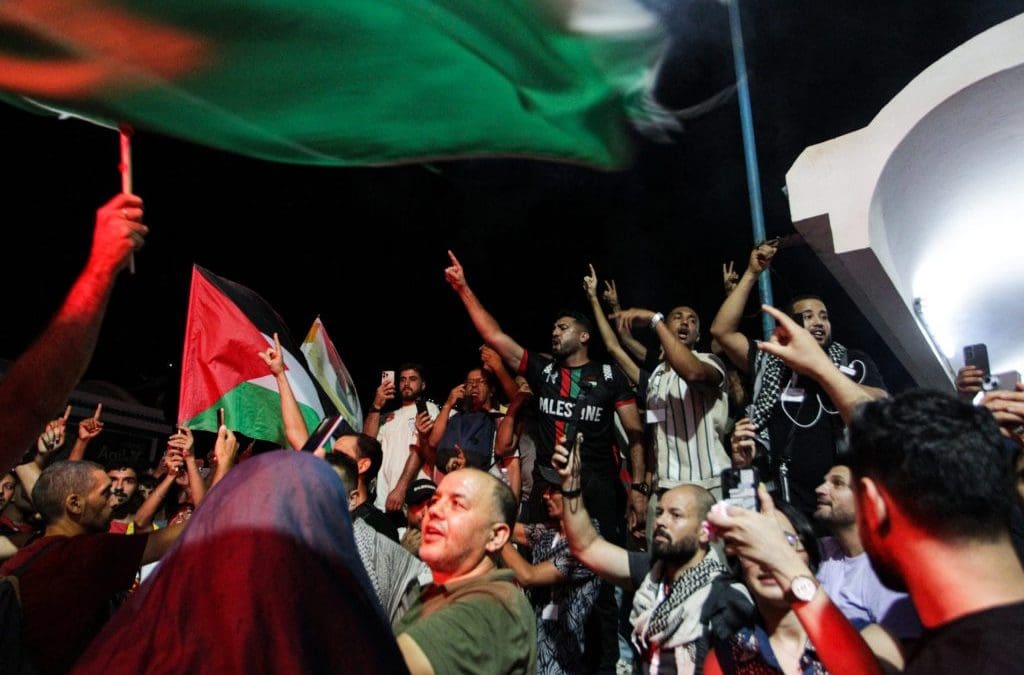
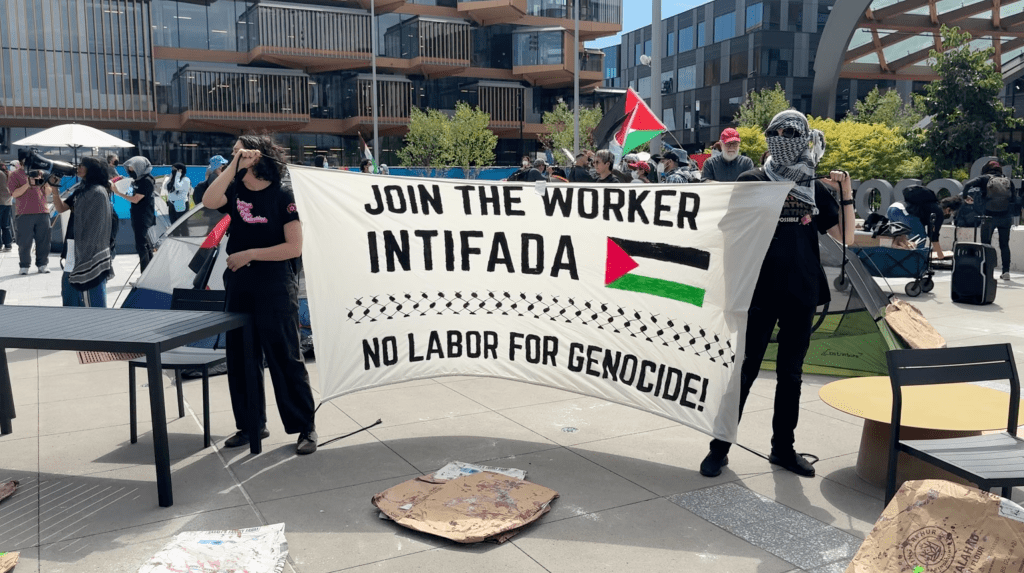
Current and former tech workers with the No Azure for Apartheid coalition continue to disrupt business as usual at Microsoft’s global headquarters in solidarity with Palestinians facing a genocide, and in protest of Microsoft’s contracts with the Israeli military to provide tech that Israel uses to surveil, kill, and retroactively justify the killing of Palestinians. In this episode of Working People, which is a critical follow-up to our last episode, we speak with a panel of five tech workers and No Azure for Apartheid coalition members who have all been fired by Microsoft in the past year in response to their protest actions: Anna Hattle, Joe Lopez, Hossam Nasr, Nisreen Jaradat, and Riki. Even after losing their jobs, however, these workers have vowed not to stop organizing and protesting until Microsoft meets their demands to “fully and perpetually divests from Israel’s economy of occupation, apartheid, and genocide.”
Transcript
The following is a rushed transcript and may contain errors. A proofread version will be made available as soon as possible.
Maximillian Alvarez:
Alright. Welcome everyone to Working People, a podcast about the lives, jobs, dreams, and struggles of the working class today. Working People is a proud member of the Labor Radio Podcast Network and is brought to you in partnership within these Times Magazine and the Real News Network. This show is produced by Jules Taylor and made possible by the support of listeners like you. My name is Maximillian Alvarez and today we are returning to the front lines of what is probably the most important and most sorely undercovered labor struggle happening in the country right now. As you guys know from our last episode and my coverage for the Real News Network, current and former tech workers have been rebelling at one of the biggest and most powerful tech companies in the world putting their jobs, livelihoods, and even their bodies on the line to disrupt business as usual at Microsoft.
Members of the No Azure for Apartheid Coalition have been taking bold and escalating protest actions in solidarity with Palestinians facing a genocide and in protest of Microsoft’s contracts with the Israeli military to provide tech that Israel uses to surveil, kill and retroactively justify the killing of Palestinians and Gaza and the West Bank. In our last episode, you heard audio of speeches, chance and exclusive interviews that I recorded when I was on the ground in Redmond, Washington on August 19th and 20th, where current and former tech workers along with community supporters set up an encampment in the East Campus Plaza of Microsoft’s global headquarters establishing a liberated zone and renaming the plaza. The martyred Palestinian Children’s Plaza Police violently dismantled the encampment on August 20th and arrested 20 members of the no Azure for Apartheid Coalition. Now, local reports initially said that there were 18 arrests, but the coalition publicly clarified that 20 people were arrested.
Then on August 26th when I was already back here in Baltimore, coalition members were back at Microsoft HQ as the coalition posted on the day of their action. Just now, current and former tech workers from Microsoft, Google, Oracle and more have been successfully able to occupy the office of Brad Smith, Microsoft Vice Chairman and President to protest Microsoft’s indispensable role empowering the genocide in Gaza and the mass surveillance of Palestinians. They are presenting their demands to the executives at their place of work as a direct escalation to show that worker pressure has reached a tipping. Point four, Microsoft employees were fired for participating in that sit-in a company spokesperson said in a statement that the firings were quote, due to serious violations of established company policies and our code of conduct, including participating in recent onsite demonstrations that created significant safety concerns for our employees we wish to emphasize.
Again, the statement continued that such conduct is entirely unacceptable and stands in direct opposition to our company values and policies. Now in a news conference after the sit-in, Brad Smith himself spoke about the protests. He even mentioned the no Azure for Apartheid coalition by name, and he addressed the bombshell reports from The Guardian and 9 7 2 Magazine exposing Israel’s use of Microsoft Azure Cloud services to store recordings of millions of mobile phone calls and texts by Palestinians and Gaza in the West Bank. We’re committed to ensuring that our human rights principles and our contractual terms of service are upheld in the Middle East. Smith said at that news conference and he stressed that the company is investigating the revelations from the Guardian report. We are working every day to get to the bottom of what is going on and we will Now, we’ve actually linked to the full press conference video in the show notes for this episode, so you can go watch it for yourself.
But in today’s episode, which is a critical follow-up to our last episode, you’re going to hear directly from a panel of five tech workers who are part of the know Azure for Apartheid Coalition and who have all been fired by Microsoft in the past year. Some were fired after the recent encampment and sit-in, others were fired earlier in the year. But as you’ll hear in our conversation, they do not regrets standing up for Palestinians and for speaking out against big tech’s complicity in their genocide and in Israel’s apartheid system. Even if doing so costs them the jobs that they’ve worked their whole lives to get. And they have vowed not to stop until Microsoft meets their demands to quote fully and perpetually divest from Israel’s economy of occupation, apartheid and genocide. So here we go. This is part two of our deep dive into the tech worker revolt for Palestine at Microsoft.
Anna Hattle:
My name is Anna Hattle. I worked at Microsoft for five years before getting fired recently after being arrested both at the encampments and at the sit-in and Brad Smith’s office.
Joe Lopez:
My name is Joe Lopez or Jose. I worked at Microsoft for around four years before getting fired, after disrupting Sanya Nadal’s keynote speech at Microsoft Build this year.
Hossam Nasr:
Hi, I’m Hossam Nasr. I’m a fired Microsoft worker and an organizer with no Azure for apartheid. I was fired last year in October after organizing a visual for the Palestinians work called Reza on Microsoft’s campus, and I was one of the first organizers with no Azure for apartheid, and I was recently arrested twice over the past couple of weeks, once at the encampment on Microsoft’s campus. And lastly, during the sit-in in Brad Smith’s office,
Nisreen Jaradat:
My name is Nisreen Jaradat. I worked with Microsoft for nearly seven years before being fired for participating in the Liberation Zone encampments and the rally that we did outside during the Brad Smith’s office. And I’m also an organizer with no Azure for Apartheid. Hey,
Riki:
I’m Riki. I’m an organizer with the much for apartheid. I was also fired a couple weeks ago for participating in the sit-in at Brad Smith’s office where we had seven of us arrested. But yeah, excited to be here.
Maximillian Alvarez:
Well, Anna, Joe, Hassan, Rine, Ricky, it’s really an honor to be on this call with you all and my heart’s very heavy just hearing all of these intros and I imagine our listeners are feeling the same because you have all been putting your bodies, your livelihoods, your everything on the line for this cause. And I saw that firsthand when I was there covering the encampment that y’all put up on Microsoft’s campus on August 19th and 20th. But I just wanted to really start by impressing upon folks listening that this is as real as it gets. And we are here talking to folks who, as you heard, have been fired because of the actions that they have taken to try to stop a genocide and to try to stop their employers complicity in that genocide. And you’re going to hear more from them about why they took that step and what has happened since I left Redmond and this struggle continued where the struggle goes from here and what listeners like you can do to help our brothers, sisters and siblings who are being slaughtered across the world in Palestine.
And you guys also recently heard my interview with two Palestinians in Gaza about what they’re going through right now. So that’s what I mean when I say this is as real as it gets. And I am truly grateful to all of you for being here, and I really want to make the most of the time that we have together. So I’m going to keep my portions here short so that folks can hear directly from y’all. So let’s go around the table and have each of y’all tell us a bit more about yourself and how and why you got involved in the no Azure for Apartheid Coalition and this effort to get Microsoft to end its complicity in the genocide and contracts with Israel and take us through the preparations to the encampment and to the days of the encampment itself.
Anna Hattle:
Sure. As far as how I got involved in the campaign, I want to say that coming out of school I had a lot of convictions and thoughts about the world and so on and so forth that I didn’t know what to do with those and I was searching for ways to act on the things that I’d learned. And I think when I came into my job at Microsoft, I was always looking for that. And then when the genocide began, I think all of us and so many people everywhere knew that we had to figure out some way to try to answer the call for Palestine. And when I learned, I think a little over a year ago that there was actually something related to the position that I have at Microsoft and something that was related to something that I felt that I could do something about, I felt like I immediately needed to jump on that.
And I think at that time I didn’t really realize the depth of Microsoft’s complicity. I just thought this is about Palestine, this is something that it’s about Microsoft, so I have context and I can make a contribution I need to join. And I think the campaign quickly educated me on how deeply entrenched Microsoft is in the occupation and genocide. And from there it became something that became so clear that it was worth putting energy into. Yeah, I think the thing that has also been really inspiring for me is connecting with so many other Microsoft workers who feel so strongly about this and working to build collective power around that and then exercise that power to pressure Microsoft. And this is my first time experiencing labor organizing in this way and feeling honestly just in my life, a sense of agency about being able to create the impact that is needed. So I’m really proud of what the campaign and the workers have been able to do together. The encampment that happened in the sit-in are just a testament to the creativity, the hard work, the dedication of so many people and so many of whom are not visible with us right now, but contributed to hopefully something that a tech company like this has never seen before.
Joe Lopez:
Yeah, I will echo that. I think that this is a really special campaign and there’s a lot of people working really hard to try and put an end to this genocide from all many different avenues. But I think Microsoft definitely is very complicit in the ways that they support is real with their technology. And so it’s a really important target for us to attack right now. I would say I’m probably the newest member of No Azure for Apartheid on this call right now. I had been paying attention to the ongoing genocide in Gaza for a while, but not really fully understanding how the company that I worked for was complicit as well. But after seeing Vanya and Al disrupt the 50th anniversary celebration for Microsoft in April, it really forced me to take a closer look and see how entrenched Microsoft really is in the technological backbone that’s being used to surveil Palestinians and to power the Israeli war machine.
And so that kind of set me on the path of knowing that I wanted to leave the company, but also feeling inspired to do something on my way out. And so I reached out to Noah through Instagram actually and just let them know that I wanted to leave Microsoft and if there was a way that I could make an impact on my way out, I wanted to do it. And that’s how I ended up getting involved and eventually disrupting the keynote speech by CEO Satya Nella on May 19th. And since then I’ve still been organizing. I was fired after that, but I participated in the encampments a couple of weeks ago and also to sit-in and I think it’s really important to send a message to Microsoft that they can try and suppress their workers. They can try and fire us and try and shut down our speech, but we’re not going to leave and we’re not going to stop taking action until they decide to actually take an action to end their complicity.
Hossam Nasr:
I think for me, I was born and raised in Egypt and I came here for college. I organized a little bit in my college years before starting my first job at college, which was at Microsoft. I worked there for three years before I was fired. And I think especially being Arab Muslim immigrant, I think a lot of the time you are taught, I was taught to sort of keep my head down, don’t ruffle any feathers, don’t speak out, just lay low, rise up in the ranks and wait until you have more power and more privilege to actually speak up. And I think that I always pushed back against that framing. I’m not here saying that I bought into that, but I did think that there was a balance in my view at the time. I thought that there was a balance between using the privilege and the voice that I did have in this particular moment, and between also trying to somehow stay under the radar and so that I can rise up in the ranks and whatnot.
I think that balance and that calculation for me completely ended on October 7th, 2023 and the start of the genocide that really shook my worldview and that shook my life personally and witnessing the extreme levels of depravity of the genocide and seeing it so clear and contrasting that with the levels gaslighting that I was seeing from every facet of my life, from my school to my employer, to my elected officials, every single facet of my life in this country was just hell bent on convincing me that Palestinian life has no value and I refuse to accept that. So for me, I think it became a thing of I threw that calculation out the window and I refused to abide by that. So I was like, I’m not going to withhold any ounce of privilege or voice. I have to speak up about Palestine and I don’t care about the repercussions.
So I think quickly I tried to do that in every opportunity I saw in the streets here in Seattle or at work. And I was motivated to do that at work because the first thing that I saw when I logged on to Outlook on the first business day after October seven was an email from my leadership saying, we stand with Israel and a big banner with an Israeli flag that says, donate to Israel. And again, no mention of Palestinian people, no mention of the occupation, no mention of any of that. And again, that really angered me. And I started to, I think at first I started to just work within what the so-called proper channels and sending emails to my leadership and talking to my managers and asking questions and all of that. And I think very, very quickly I realized that that’s at that end and that’s not really going to affect any real change.
And quickly, I think I had the conviction that it is the way to affect change is to have external pressure. It’s to not appeal to the humanity of these executives, but to apply pressure on them and that we need to be organized. That was one of the main things that I learned from this genocide in general, is that we are not outnumbered. We are out organized. So it was very important for me that I don’t do something that is just as an individual thing or an individual action of rage, but rather to build an infrastructure, an organization, a community that is bigger than the sum of its parts. And I think quickly I met other workers at Microsoft who felt similarly. And that group, we became organized under the banner of No Tech for Apartheid, which is this campaign that was started by former and current Google and Amazon workers to protest Project Nimbus, the 1.2 billion contract between Google, Amazon, and the Israeli government.
So we were inspired by them and wanted to kind of replicate that campaign for Microsoft. We organized under their banner for a few months starting with our main focus was just understanding Microsoft’s ties to Israel. And our first action was actually releasing that research in the report that we titled Marriage Made in Hell, a play on a quote by Benjamin Netanyahu actually who described Microsoft’s and Israel’s relationship as a marriage made in heaven. So after that, I think that we launched officially no Azure for apartheid as our campaign. We honed in on our demands after we understood more Microsoft’s simplicity and we started doing more actions to again apply pressure on the company. We launched the petition. And I think for me, I was never intentionally trying to get fired, but I realized that eventually that was going to happen as a consequence of my activism, and I was prepared to pay that price.
I didn’t expect that to happen because of a visual of all things, but that’s what ended up being. And I think after that, that was a galvanizing moment for me to again, make sure that this does not have the intended effect that they had, which is to sort of scare people or dissuade them from joining the campaign. I wanted to have the opposite effect. So again, I made sure to invest in the campaign even more to make sure that people feel actually more empowered to join the campaign after that and to not be disempowered by the repression. And I think after that, we, thankfully, our numbers grew even more. Our signatures grew even more and we started having more creative actions to apply pressure in different ways. We started doing these conference disruptions, disrupting keynotes, disrupting the 50th anniversary both on Microsoft campus and in the Seattle State Town Hall.
And I think after a period of that, I think there was kind of leading to your question about the encampments. I think for me and a lot of us in the campaign, there was a moment where it felt like we need to escalate even more and we need to bring the movement to the seat of power to the throne of Microsoft executives at their offices, at their homes. And we took inspiration from the student movement. We were really inspired by the student in Tado and how that galvanized the entire Palestine movement around them and how that really created a moment of deep crisis for not just the universities but for the entire ruling elite that are causing this genocide to persist for so long. And we took inspiration from that and we said that if the students were able to create that level of crisis, if they were able to galvanize the movement in that way, is it time for the labor contingent to do the same? Is it time for our labor organizing rise to rise to the occasion in that way and carry forward the mental of the struggle? So that was really our inspiration behind the encampments and why we set them up in the Marr Palestinian Children’s Plaza, which formerly known as the East Campus Plaza. And unfortunately we were violently swept, but it was unfortunately to be expected given the pattern of behavior we’ve seen from Microsoft.
Nisreen Jaradat:
I joined Microsoft in 2018 and I very much had rose colored glasses at the time. I really believed in Microsoft’s mission and all of that. And I think kind of an awakening moment for me was in 2021, I recall signing a petition that called for a human rights review of Israeli contracts and stuff, and basically nothing happening with that. And then later on we learned that Satya’s response to that was to meet with the head of unit 8 2 0 0 a few months later and approved the mass theft of all Palestinian communications in a 10 minute meeting. And she called an incredibly powerful brand moment. And then after that, there were a lot of things that I was trying to do just on my own very much within the so-called proper channels, so raising HR tickets and going to the legal team and there’s stuff by myself which fizzled out.
And then when this genocide started, I tried to do the same and it was very pretty clear that I wasn’t going to get anywhere. So when I heard that there was this group that was organizing, it’s like, great, I can’t do it on my own. Nobody can do this on their own. I was like, why don’t I join? And it was one of the best decisions of my life to join because I really learned that not only is our labor power, but our collective action is power and we keep each other safe, and it’s been just amazing organizing with this community, and when I started organizing, I wasn’t intending to get fired. There’s a lot of work that people do in the background, critical work for the campaign, which I was doing a lot of. I think that kind of changed for me after Microsoft built and I saw the way that Microsoft was responding to protests that people were getting brutalized and pepper sprayed and just I violently dragged out of sessions for our peaceful disruption.
Also, when Microsoft also decided to respond to that by banning the words Palestine genocide and apartheid, it was clear that they were cracking down on all forms of Palestinian or pro-Palestinian speech, and it became very important for me to respond to that because I wasn’t going to be told that I can’t say the name of my whole Land Palestine and I wasn’t going to be told that I can’t answer this call or that we can’t call a genocide. A genocide and apartheid apartheid. So very trivially bypassed the email restriction and I sent a mass email, which is the exact thing they were trying to prevent, and instantly got suspended for that for about six weeks, and then I came back, they reinstated me and I joined the encampments and a rally outside of Brett Smith’s office where we delivered the petition. When we delivered the petition, we carried a scroll that was 18 feet long.
It had the names of 2000 workers. Microsoft at the time was trying to say that workers were not representative of the liberation zone encampments. That was a complete lie. It was representative of the workers. It was literally an attempt at erasure of Palestinian and pro-Palestinian voices to say that we didn’t count as workers. And so we came and workers gave speeches, including me, I was still a worker at the time, and we delivered the petition scroll with the names of 2000 Microsoft workers who were also calling for Microsoft to divest from genocide and Microsoft security responded by specifically targeting the protesters who were carrying scroll and tore that scroll. Thankfully, they didn’t succeed in carrying the complete scroll, but that is how they responded. They literally violently responded to a piece of paper, so you can just imagine how they treat actual protestors. It was very, very important to me to take part in these encampments and in this rally, even though I knew from the pattern that Microsoft has that being fired was a likely outcome, I thought it was very important because every single moment is the right moment to escalate. There’s no time to wait and say Palestine somebody else’s problem. The time to escalate is right now. My only regret is that I didn’t do something like that sooner.
Riki:
Yeah, I can go into my story of coming into noaa. I graduated from college in 2023 and I had done an internship at Microsoft. I thought of them as one of these evil big tech companies by the least evil of those. I think a lot of people who are in my shoes share that sentiment or that thought that there’s Google and Amazon, they don’t really care anymore that they’re evil. They’re fine with people knowing that. And Microsoft is kind of like, oh, we help hospitals or something.
Maximillian Alvarez:
Jeff Bezos is gone full bond villain, whereas you still got the Microsoft sweater vest aesthetic.
Riki:
Yeah, yeah. It’s very much like, oh, we’re a company that really helps the world. We help people. I think I’ve definitely learned through this campaign that that is a very calculated kind of PR facade that they have been building, especially over the past few years. But I started Microsoft 2023 and then so I have been working there or I was working there for about two years in Azure storage, which is basically the cloud computing. If you want to store some kind of media on Microsoft servers, that’s where that would happen. I actually didn’t know too much about no for apartheid before joining. I actually was just going to lunch on East campus and stumbled into the vigil last November, and I think I had heard about No Tech for Apartheid, which is largely focused on Amazon and Google. I had seen No for Apartheid show up on Instagram, I think, but I didn’t know too much about the campaign, and I ran into the visual there and I was like, it’s like that there’s some protest happening here.
Microsoft and I learned that it was worker led and that they’re trying to bring in workers, and so I joined the campaign through that. I think over the past time that I’ve been with Noah, it’s been very energizing to see how effective we, we’ve moved together and what an awesome kind of organization. This isn’t just like Microsoft is a company of 300,000 workers and one of the highest valued companies in the world, and we are in comparison a small but very mighty group of people who have kind of backed Microsoft into a corner in the present moment. So I’m very proud of being this part of this campaign, and I think we’ve had over this past almost a year that I’ve been a part of this campaign, we’ve had this series of all these different actions. We had the conference disruptions, we had disruptions of the 50th anniversary things or events that Microsoft was trying to put on.
Basically we’ve just been shitting all over Microsoft’s parade every time they try and have one, and I think it’s really cool to see the impact of, they desperately don’t want people to look at what we’re trying to bring to light. And every time they do that, we recent the narrative, I remember after Build, I think a lot of the media sentiment surrounding build was largely focused on the protests, and that was a huge win for our campaign. I think up until this point, I’ve been not helping with the backend operations of the campaign and helping be someone documenting these events and not someone who’s a visible face of this campaign up until the Brad Smith sit in. That was the right time for me to become one of this group of these fired workers, these arrested workers. I think that was, I don’t regret that at all, and I feel like that was the right time for me to play those cards and for me to really step up for Palestine.
I don’t personally have too many ties to Palestine. I certainly have more now after being part of this movement. Currently it’s the center of all the power structures that are trying to oppress a lot of that centers on Palestine, and I think just over the past two years I’ve kind of seen, we’ve taken off the cover and I can kind of see a lot of the wiring underneath all this ways in which the economy of genocide and war pr hearing that is going on as a result and all this propaganda that happens. So that’s kind of why I’m here. Just as someone who cares about the world and wants to see a world in which not only Palestine is free, but all of us are free, I
Maximillian Alvarez:
Think that’s beautifully and powerfully put, and I myself as a journalist, trying to get people to care about this and stop this and to fight for life and humanity and fight against this just inhumane, genocidal slaughter in which all of our souls are being sucked down the drain. What kind of world, what kind of people are we going to be after turning to our children and saying, we allowed this to happen? That’s the kind of thing that I’m sure we’ve all been thinking about over the course of this horrific genocide in Gaza. I am always trying to get folks to just care about that on its own. He’s like, these are human beings. That should be enough for you. Women, children, men, older people, like everyone. This is just life being obliterated. That should be enough for you. But if somehow that’s not enough, then you should care about it for your own fucking sake.
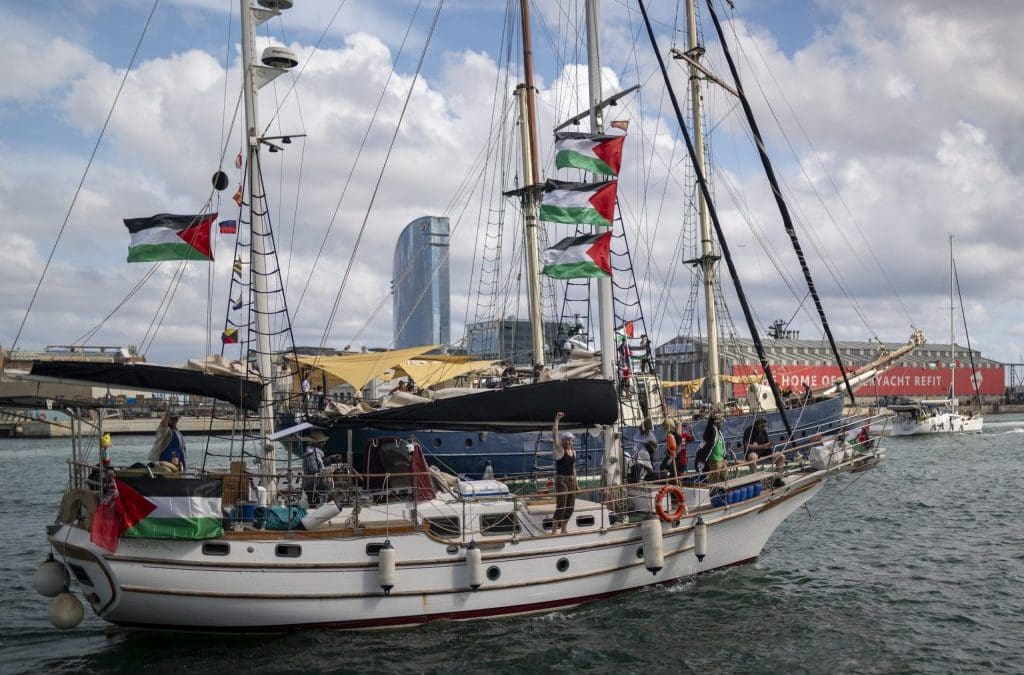
Pardon my French, because now here we are back in the Imperial core and that boomerang’s coming to whip us in the ass ice is going to have access to Israel’s surveillance technology that they’re going to be spying on us with. Do you care about it? Now I’m getting heated, but you could tell from all of us here, me especially that this is the urgency that we’re talking about. This is the urgency that we’re trying to cover at the Real News. Whether it’s students camping out on their campuses, whether it’s tech workers, like taking this brave step to occupy the literal campus of one of the biggest companies in the world, to get that message across and to get others to join that struggle. All of it is important. And all of it is as we’re speaking right now, there is a whole bunch of flotillas like sailing towards Gaza.
That urgency, I think is deeply felt in our listeners and folks around the world, and the more intense that action becomes, it feels like the more intense the reaction from the powers that be is. And so I wanted to, this is by way of getting us to this second portion here where I wanted to kind of talk about that. I wanted to talk about the effect of the actions y’all have been taking, the effect of the organizing you’ve been doing, both in terms of expanding the coalition, making this message more broadly felt understood, impossible to ignore, but also the empire strikes back effect of you losing your jobs of, I mean, I was there holding a camera like 10 feet from Hassam. There were like 10 cops on him, basically hog tying him and then carrying him out while he’s shouting Free Palestine. I saw one of the no Azure for apartheid coalition members get shot at point blank range with a pepper ball gun.
I’m talking two feet away from them, but I didn’t see what happened afterwards. I showed our audience at the Real News. I showed people on YouTube. This is what I saw, but then my perspective kind of went another way while some of y’all were carried off to the police station. I was there with Ms. Reen and interviewed her before she and coalition members left together, and then a goddamn drone was following me back to my car for the next four blocks. Right. I mean, so people have seen my side, but I wanted to ask if y’all could talk about more like, yeah, help us fill in this story on the effects side, what are you hearing from coworkers at Microsoft, other tech workers outside of Microsoft, the reaction and response from Microsoft and the police? How is it impacting you and your life?
Anna Hattle:
Thanks. Yeah, there’s so much to talk about in terms of impact. So I’ll try to summarize asbestos I can. But I think to start with the encampment itself, I think one thing that people were surprised by is honestly the positive reactions that we were getting from workers. Even workers who were scared of what was happening, who were maybe too scared to ever participate or step inside the encampment, for example. But people who were mouthing the chance back to us, people who would put a shy thumbs up as they were walking by people who were taking flyers that were explaining why the encampment was created. And I think that even the campaign is kind of shocked by the underlying, I think support, of course there’s lots of Zionists and lots of opposition, but I think that there’s a sense that undergirding all of that, there is popular support for what we’re doing.
And as far as the company response, I think that these escalations and in particular the ones that we’re talking about now, these most recent ones have built on this series of increased escalations over the past several months, which they’ve already been responding to in force. So for example, I think in May when we sent them the petition with 2000 worker signatures demanding that they cut ties, they that day put out their weak statement where they admitted to additional complicity in the genocide. And so we’ve been seeing already that they have seen this campaign as a force to be reckoned with, but I think now they’re truly in what feels like crisis mode. And I think that this is kind of part of what we anticipated is that there would be a huge amount of repression to onion and preparation and escalation as they’re scrambling to see what we do next.
And I think we saw over the campus overall that there was an increase in security, and especially after the sit-in and the occupation, there are parts of the campus that are now locked down and now people are not able to get in buildings that they aren’t specifically assigned to. And I think that the energy that we’re getting from them is that they’re doing everything they can to stop something like this happening. Again, I’ll maybe let other people speak to this more, but immediately after the sit-in in Brad Smith’s office, he held a press conference, like an impromptu press conference in that same office to talk about what we did and to naming the campaign and trying to disavow what we were doing and making statements that were obviously and verifiably false about what we did, what we were there to do. And so I think that at this point it feels like they are scrambling and also doing work to potentially create a runway for themselves to make actually some progress on meeting certain demands We’ve seen in the past that they’re kind of setting themselves up for a potential divestment action. And so I want to let other folks talk about that a little bit. But yeah, overall I think we are really, I think, happy to see the kind of impact that this has been having. I
Joe Lopez:
Got 50 to a hundred messages on LinkedIn after I did my disruption and sent my email of people from within Microsoft saying, I didn’t know that this was going on. I didn’t know that the company I worked for had these deep ties with the Israeli military. Thank you for doing something and thank you for speaking up and I’m going to look into this. And I know that alone just made it worth it knowing that I lost my job, but I also got people to pay attention. And I think, I know people are scared to act in a public way, but there’s no smallest amount of impact that you can have. Even just signing a petition or taking a pledge that you’re not going to allow your work to support the apartheid regime. Those things matter and they add up. And so just seeing all the workers within Microsoft the way that they’re touched by what we’re doing, it means a lot. And yeah, that’s allow others to speak, but that’s impacted me a lot
Hossam Nasr:
Ultimately having been with the campaign basically sit since hounding, I’ve seen how every single time we do something, Microsoft’s response has always been just to respond with brute force. And as we have escalated our campaign, so has their force and their repression escalated as well. But make no mistake, that’s been their toolbox from the beginning. When we first launched our petition in May of 2024, the first thing they did within a day of publishing that petition was actually try to take down the links, the internal links that we had, that petition when we had the visual. Again, the most simple action that we could think of on campus, I bet now they wish we’d only do visuals now, but back then they fired two of us for organizing that visual. And when we had people in the campaign or work with the campaign to send mass emails in protest or as announcing the resignation, again, the response was to just completely ban the use of the words Palestine visa genocide in any internal email going out from anybody to anyone, even if it’s an email to yourself, which was crazy.
And I think we’ve seen the same thing happen in response to conference protests. They again responded with just insanely militarizing their conference spaces, adding a huge amount of security and even armed retired police and responding with pepper spray to our protests during their latest conference, their biggest conference in May of this year, Microsoft build. And that was no different this time either. And I think this time again, we’ve seen since this was our biggest escalation so far, it was their biggest escalation of their force as well. They responded with extreme force pretty quickly. Like you said, one of our comrades during the encampment was shot with pepper balls seven times in the back with point playing range. Some of us were dragged and tackled and completely unnecessary and unjustified use of force on behalf of the police that Microsoft, again invited to campus against a peaceful encampment against a peaceful group of their workers and former workers who are protesting their complicity and genocide. And I think that’s been coupled also with the repression. It doesn’t just take this form of hard violence, but also takes the form of surveillance and intimidation, weaponizing HR investigations, which has happened to me a lot of the time before I was, I didn’t back down, so they had to fire me. I think that’s happened to a lot of people on this call as well before they were also fired.
Your experience with the drone, that’s been also an experience that we’ve seen more recently on campus. They literally, the drone, when four of us decided to go tabling the Friday after the sit-in at Brad’s office, we were literally just four people on public property trying to table, and they called at least that I saw two police cars, a police van. They sent the drones, they brought out the head of security. They are panicking, and I’m sure you’ve heard they’ve even tried to get the FPI involved and named me specifically by name and communication with the FPI. But I think ultimately the point is, I think when you are at the crosshairs of these imperial forces, you’re doing something right. When you are getting under the skin of these powerful war criminals so badly, you’re doing something right. And when you have the police and even the FBI and Microsoft security weaponized against you in this way, you’re doing something right.
So this has not deterred us. And if anything, I think it’s made us stronger and it simply just doesn’t work. I think the simplest proof of that is that we came back less than a week after our encampment was violently dispersed and we occupied the president’s office and all the people who were arrested during the encampment were also there at the sit-in and were arrested again. And that’s a message that we need to emphasize and we continue to emphasize every single time we can to Microsoft that again, the repression and the violence and that brute force tactic simply does not work. And the only way to stop our movement, the only way to make these to end this crisis that they have created with their own actions is to end their complicity in the genocide. That is the real crisis. That is the real moral test of our time, and that is ultimately the only thing that’s going to make people not show up and not escalate every single time.
Nisreen Jaradat:
I think Microsoft knows that they’re in trouble. I think that Microsoft is scared of their workers discovering and fully understanding that they’ve been misled into abetting a genocide and working for a digital arms manufacturer that is masquerading as a tech company. And I think that that’s why Microsoft responds the way it does with brute force with trying to silence any sort of even vague criticism of its dealings with the Israeli occupation forces forces. And I think that our success is really showing and the fact that they’re clearly scrambling right now. As Anna mentioned, Brett Smith in his press conference said a lot of statements that didn’t even make sense that were wrong while answering his court summons by the way, and the jumping from narrative to narrative that didn’t make any sense. Well, this isn’t worker led, but then firing four workers and tearing the scroll of 2000 signatures, calling the community members who risked so much protesting outside agitators when they’re the ones who live in gated communities surrounded by boats. So it really shows how much they’re scrambling right now, and I think it’s becoming more obvious that the only way to get out of this crisis is to divest from genocide.
Riki:
Yeah, I think like Msre said, Microsoft is kind of backed into a corner right now more so than they’ve ever been from our actions and our continual organizing, the basically unrelenting pressure that we’re trying to put on them both from inside the company and from without. I think we’re in the strongest position we’ve ever been in to negotiate with Microsoft. I think there’s going to be a lot of ’em trying to give us very insufficient wins to try and get us off their tail, just basically symbolic victories. But it all comes back to getting that divestment. I think for me, just as someone who was arrested who was fired, I’ve been doing fine. I also got a lot of mostly positive LinkedIn messages. Some people were just hating for no reason basically.
So yeah, I think it’s important for people who are in positions of privilege like we were to and who are a part of these willingly or not part of these structures that enable this genocide, that enable this current economy of war profiteering. It’s important for us to make those stands and to make our own sacrifices to basically for the people who are not fortunate enough to be able to have a choice in that. So that’s very much what I’ve been thinking about recently where I stand. I’m really hoping that I other worker movements follow in some of our footsteps and the footsteps of students who have sacrificed a lot as well in making these kind of principles and also strategic kind of sacrifices to enable our collective goals.
Maximillian Alvarez:
That’s a perfect sort of segue to this kind of final round here. And I know we only have a few minutes left before I got to let you all go, but I really want to go back around the table and ask y’all to just any final messages that you have for folks out there listening, like the folks who are in unions, folks who are not in unions, folks who work in tech, folks who work outside of tech. I mean all manner of working people listen to this show. And so I want to end with you guys sort of giving final messages about where things go from here for the no Azure for Apartheid coalition, for the no tech, for Apartheid movement, and for what y’all have called the worker in. So that’s what I want us to focus on in this final round. And I guess by way of getting there, I just wanted to kind of share a thought that was kind of welling up in me as I’ve been listening to all of you talk, and it struck me at some point that we could have all grown up together.
I mean, we could have all gone to college together. We’re not that far apart. And to work at a place like Microsoft, I imagine you guys had to bust your asses your whole lives to get there. And you like my immigrant family, they look at me in the degrees that I have as the pride of our family. And I guess what I’m trying to say is I can really deeply understand, but also really only imagine what it must be like to be willing to sacrifice that or put that on the line, the job that you’d worked your entire life to get to for a cause that you believe in so deeply and to put your bodies and all that work, your livelihood, your security, everything like that on the line. As workers, I don’t want that to be lost on people. I feel like so many, after doing hundreds and hundreds of interviews with so many different kinds of working folks over the years, I feel like most of the time the point of those conversations is to get people to see their own value and their worth as human beings, their power as workers.
But you guys are kind of in a different position where it’s like you’re paid according to how valuable you and your work is, and you are using that as way to fight back against a genocide. And that feels, again, really significant and something that I think everyone in the labor world should really take notice of. And really anyone who’s in the labor movement should care about this struggle, frankly. With all that from me, I just wanted to toss it back to y’all and ask again, let’s take this back down to the worker level and you as workers and listeners as working people hearing this, what do you want to leave folks with about where we go from here and any messages to them listening about what they should do to be part of this movement or how they can use their power as workers to fight for life and justice and light?
Anna Hattle:
Thanks, max, to your point, I think after getting fired and after with so many other people facing the reality of state violence and repression, I have so many people reaching out to me expressing care and expressing, I think also what you said, which is that is a huge sacrifice to make. And I think that my initial reaction in my heart is just that I appreciate that care so much, and what I want people to know is I think it would be the greatest honor in my life to give up something so small if it’s in service of this cause it’s such a small price to pay if it can advance even a millimeter, the liberation of Palestine or an end to the genocide. And so of all of the things that I’ve tried to accomplish in my life, I think fighting for this is more of an honor than anything else.
And so I know that I have a certain amount of privileges potentially in my life that might make that true, and not everyone feels that they can or are willing to pay that price. And I would encourage people to think about that if that’s really true. But also even if you’re not there and you can’t do that or you don’t have to be there in order to organize, in order to build collective power and in order to make an impact. And I think that’s something that I really want more people to know both at Microsoft and just elsewhere because there’s so much repression of labor organizing everywhere. Their whole goal is to scare everyone and to feel like they’re threatening your livelihoods and so that you don’t take hold of your power and do something with it. And so there, even if you’re scared and even if you’re not ready or willing to risk those things, there’s so many things you can do.
You just have to get started and you just have to connect to the movement and make steps to plug in. And I think to your point, one of our goals is one, of course to bring more people into the campaign and the movement, Microsoft workers and beyond. And it’s great to also have community support for the things we’re trying to do, whether it’s answering calls to boycott Microsoft or sign petitions or just show the executives that there is huge public pressure in addition to the pressure that workers are exerting on them, but also to all workers. Hopefully we can continue to be in dialogue and inspire each other about creative ways to exert that pressure. And knowing that we’re in a context where, particularly at Microsoft, I think it’s a notoriously kind of anti-union environment. There’s so many anti-union environments in this climate, but making something that as Hasam said before, is greater than the, some of its parts is difficult, but not impossible as you might imagine. And so if we continue to inspire each other and figure out new ways to exert that pressure and to escalate, I think that overall there’s so much potential for unions, for the labor movement, for people at composite companies and entities everywhere to exert that pressure. We know that’s where our power is. And if we were all already organized and all ready to exert that pressure, maybe we wouldn’t have to be here right now. So maybe we’re not there yet, but now’s the time.
Joe Lopez:
Yeah, that’s really well said. And just to add on, I think a lot of people right now, especially in the us, are feeling a sense of frustration. I know at the beginning of this year that really peaked for me with the current administration taking power and I felt so powerless, didn’t really do anything about it. But I hope if one thing people take away from this, our demonstrations and what we’ve achieved so far, I hope it’s that you do have power no matter where you are, every worker across the us, across the globe, you can contribute in some way. And I was not a huge activist before. I had always paid attention to global and US news, but taking ownership of my actions and actually contributing to this movement in some way has been a huge emotional outlet for me. Honestly, I feel like I’m taking back the power that’s been taken away from us over the years. And so if you work in the us, I’m sure the company that you work for has some complicity. If you pay tax dollars in the US, your government has some complicity in this genocide. So take a look at the BDS list of complicit companies, investigate your employer may be contributing to genocide and talk to your coworkers about it and see what you can do, follow our example, and I’m sure you can achieve something amazing.
Hossam Nasr:
Yeah, I think first of all, just thank you for everything that you said, max. And I think to answer your first part of your question, I think like you said, the action that the actions that we took over the past couple of weeks with the encampment and then with the sitin marked a significant escalation in our campaign and our tactics. And that was an intentional, and it was to send a message, and it was also a call to other workers to, like you said, to join the worker in Alda, to take the mental of the revolution of the struggle that the students had carried last year that have really created that deep crisis within the ruling elite. That really was the moment that we came closest as a movement to bring the empire to its sneeze, to force and enter this genocide and to enter the complicity in apartheid.
And I think the reason why, there’s many reasons why we can talk about that forever, but I think part of the reason why this movement was so effective is because it’s really struck at the heart and at the core of the elites, right? There was a reason that it was Columbia. There was a reason that it was Harvard and Stanford and those really elite colleges that made the headlines and then ultimately had the most repression. And I think, like I said, ultimately once you really start to challenge empire, you will face the wrath of the empire. And that is a sign of your success actually. We expect repression to come and we stand undeterred by its prospect, even as someone who is an immigrant in this country, in this climate. But ultimately, I think the message I want to send to every person, every person of conscience, every worker, is that I think, like Anna said, a lot of people say, that’s a big sacrifice.
This is your livelihood, et cetera. I think that is actually a very cheap price to pay. It’s a very, very cheap sacrifice. I don’t think it even rises to the level of the word sacrifice when it’s compared to the meal sacrifices that are being forced upon the Palestinian people in Za every single day. And it’s especially the case when I want everyone to sit with this. We are not mere observers of this genocide. We are all active participants, whether we like it or not, through your labor, through your tax dollars, through simply being part of this country, you are enabling this genocide in one way or the other. Your tax dollars are funding it, your labor is enabling it in one way or the other. So that comes with a moral duty. Honestly. We live in this empire and we enjoy its fruits. The quality of life I have here is probably a lot higher than I would have if I was back home in Egypt.
That is because of I am enjoying the fruits of this global empire. And that comes with a responsibility. And I think that people really need to sit with that and the implications of that and not sort of honestly wave their hands and say, there’s nothing I can do. Because the other thing I want everyone to recognize is that you are not powerless. You have power. Your labor is your power. Your voice is your power. Your body in some cases is your power. And we have a responsibility to use that privilege whenever we have the chance. And I think that the last thing I’ll say is we cannot let fear of repression or retaliation cripple us. For me personally, during the visual in October, 2024, this was a very different time. The campaign was at a different place. We were much smaller in number. That was probably the first thing we ever did on Microsoft’s campus.
And I had no idea at the time that it would lead to my firing. I had no idea before Trump had even gotten elected, that the prospect of the deportation for me would be somewhat of a more real possibility than a theoretical one. But still, I think in that visual, I said a lot of the time I’m asked, are you not scared of being fired? Are you not scared of being arrested? Are you not scared of being deported? And my answer is always, are you not scared? Are you not scared of being complicit in this genocide? Are you not scared of being silent in the face of the Holocaust of our time? Are you not scared of what you will tell your children and grandchildren when they ask you, what were you doing when the genocide imp was happening? So again, I want to leave people with that, and I want them to really to sit with before thinking about the cost of speaking up, think about the cost of not speaking up and think about what will you think of yourself 10 years from now, 20 years from now, when everyone will have been against this?
Nisreen Jaradat:
Wherever you are in the world, it’s both your moral right and your moral responsibility to stand up against the abatement of genocide. And something that I heard a lot from people in this campaign was the sentence we keep each other safe. And throughout my time with this campaign, that’s really, really proved to be true. And it’s something that I really learned. And I agree that it is a cheap excuse and there are things you can do that are not as risky. And like I said, I contributed to some of the critical work for the campaign in the background for a full year before I made the act choice to be more visible. There’s always things that people can do, and there’s always community, and there’s always people that will support you and stand up for you. So my advice would just be to get organized. And we can’t just keep saying, oh, this is going to be somebody else’s problem. Oh, I can’t risk it. There’s always something that you can do.
Riki:
Yeah, I think pretty much what everyone was saying, I would echo, I think the powers that be want us to feel hopeless, to be distracted by other things, to ignore what’s going on, to not realize our own potentials. And I think it is important that we find whatever way we can to contribute. And certainly Noag for Project has been an amazing outlet for that. And I think there’s so many other outlets for that that exist in other places, in that it’s there if you go search for it. And that it’s also important to not do these things alone as well, because with community that helps you build that stamina to keep and to fight against this hopelessness and to be with others that empower you. I think that’s all really important. I think there’s sometimes this idea of there will be someone who will come out of the woodwork and save us all, and I don’t think that’s true. All these movements of the past have been collective and certainly there have been more visible faces in those movements, but we are all kind of drops of water in basically if you imagine a dam, we are all drops of water and eventually there will be enough water to where the dam will break and we will break through and I think I see the cracks forming now on the dam, which is something that’s very galvanizing for me, but it’s something that we have to keep working on.
Hossam Nasr:
Follow at no Azure for apartheids on all social media and sign the petition at no azure for apartheid.com. There’s also ways there on the website if you’re a Microsoft worker to join the campaign or you can fill out the form at noa oaa.cc/join. And if you’re a Microsoft worker, you can also sign the pledge to pledge to not do any work or service, any support for tickets that come from the Israeli military or companies that are working with Israeli military.
Maximillian Alvarez:
All right, gang. That’s going to wrap things up for us this week. I want to thank our guests, Anna Hattle, Joe Lopez, Hossam Nasr, Nisreen Jaradat, and Riki, all fired Microsoft Workers, all members of the know Azure for Apartheid Coalition. And of course, I want to thank you all for listening and I want to thank you for caring. We’ll see y’all back here next week for another episode of Working People and if you can’t wait that long, then go explore all the great work that we’re doing at the Real News Network where we do grassroots journalism that lifts up the voices and stories from the front lines of struggle. Sign up for the real new newsletter so you never miss a story. And help us do more work like this by going to the real news.com/donate and becoming a supporter today. I promise you we really need it and it really makes a difference. I’m Maximillian Alvarez. Take care of yourselves. Take care of each other. Solidarity forever.