by Steve Benen | Jun 11, 2026 | elections, Maddowblog, News, Politics
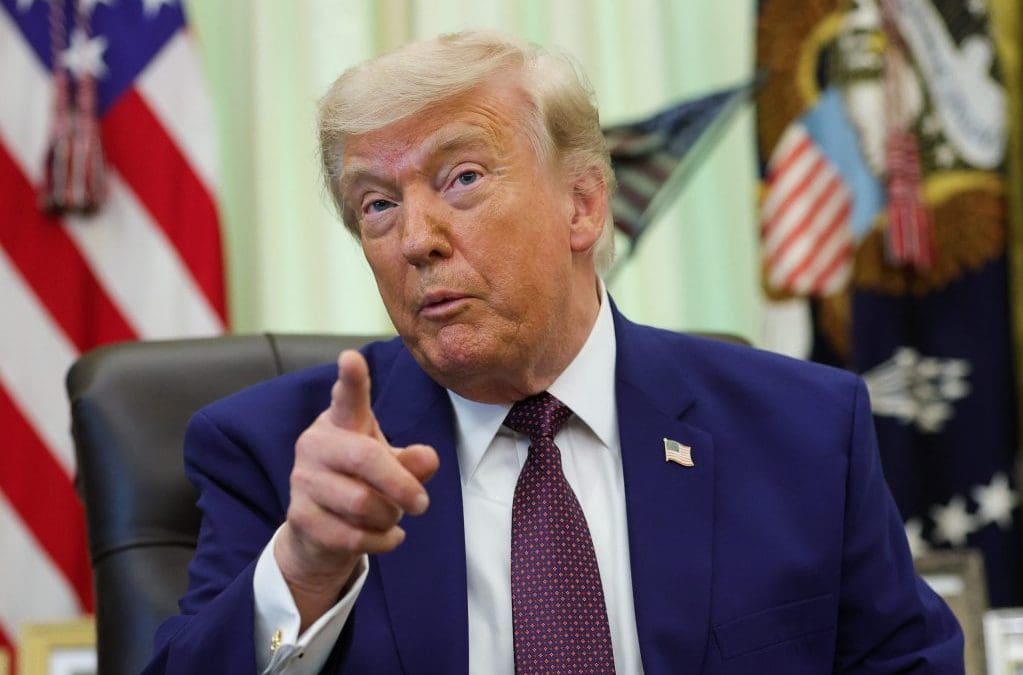
As this week got underway, the public saw Donald Trump abruptly end his latest “Meet the Press” interview when NBC News’ Kristen Welker asked the president whether he had evidence to support his election conspiracy theories. “You’re either crooked or you’re stupid,” the Republican told the host instead of answering the question like an adult who wasn’t making stuff up.
Unprompted, Trump returned to the subject Wednesday at an unrelated White House event, telling reporters:
They rigged the election, the second election, as you probably heard and probably know, most of you know, that happened and now it’s been proven, and it will be proven as time goes by, even more so. We have things that you won’t believe. When we release the full files, you’re not going to believe how crooked the second, the 2020 election was.
He made the comments while surrounded by congressional Republican leaders, who simply nodded along.
Trump: “They rigged the election. Now it’s been proven, and it will be proven even more as time goes by even more so. We have things that you won’t believe. When we release the full files, you won’t believe how crooked the 2020 election was.”— Aaron Rupar (@atrupar.com) 2026-06-10T16:04:29.518Z
There’s probably no point in rehashing what reality-based observers already know: The election wasn’t rigged; it hasn’t been “proven”; Trump and his team haven’t found “things”; there is no “they”; etc.
What I found notable about this, however, was the idea that there might still be people out there who are willing to believe that the president might yet uncover and release some evidence of a conspiracy that did not and does not exist.
Six months
by Brad Reed | Jun 10, 2026 | 2026 midterms, Disenfranchisement, Donald Trump, elections, midterms, National Voter Registration Act, News, Postal Service, USPS, Vote by Mail, Voter Purge, Voter Suppression, Voting Rights
President Donald Trump’s executive order restricting the distribution of ballots by the US Postal Service could effectively end the ability to vote by mail if it isn’t struck down, experts told CNN on Wednesday. The order, which was signed in March, instructs the USPS to not deliver ballots in any states that have not given the federal government access to its voter lists.
Source
by Sydney Carruth | Jun 10, 2026 | elections
Graham Platner prevailed in the Maine Democratic Senate primary, breaking 50% of the vote and clinching the nomination to face Sen. Susan Collins, a Republican whom national Democrats hope to topple on their way to recapturing control of the Senate in November.
Platner had 75 percent of the votes with only 8 percent of the ballots counted when the Associated Press called the race on Tuesday evening, suggesting a dominant performance. Maine Gov. Janet Mills, had just 19 percent. Mills’ name remained on the ballot despite the fact she dropped out of the contest in April.
The oysterman and political newcomer triumphed at the ballot box despite allegations that roiled his campaign before Election Day: that he sexted women outside of his marriage and that he behaved in a demeaning way to some former girlfriends, including two incidents in which he was allegedly physically menacing to one of them.Platner denied those incidents.
“This is the state that raised me. This is the state that saved me,” Platner said at his victory party. “Maine, I love you. I love this state.”
Platner chastised national Democrats, who said he said kept seeking a headline that would tarnish him and were missing the point. “In trying so hard to understand me, they failed to understand this is not about me at all. This is a movement about us.”
“This is the state that raised me. This is the state that saved me,” Graham Platner said at his victory party. “Maine, I love you. I love this state.”
The Democrat will now face Collins, a five-term incumbent who ran unopposed in the GOP Senate primary.
Platner also took harsh aim at
by Steve Benen | Jun 9, 2026 | 2026 election, elections, Maddowblog, News, Politics
Donald Trump has earned a reputation as the nation’s most prominent and powerful election conspiracy theorist, but to the extent that there’s a competition for the silver medal in this ignominious category, House Speaker Mike Johnson is a clear contender.
Indeed, after Trump’s defeat in the 2020 race, it was the Louisiana Republican who took the lead on Capitol Hill, effectively becoming the White House’s congressional point man, doing his best to overturn the results and hand the outgoing president illegitimate power. Johnson even echoed a discredited conspiracy theory involving Venezuela’s Hugo Chávez and Dominion Voting Systems — nonsense that even many Trump acolytes didn’t feel comfortable repeating.
With this in mind, it wasn’t too surprising to see Congress’ top GOP lawmaker echo his party’s baseless conspiracy theories regarding California’s latest elections, though one word in his pitch was of particular interest.
RAJU: But what evidence is there to prove the California election is rigged?MIKE JOHNSON: Look, some of these efforts are so diabolical and so far upstream it’s impossible to prove. But I think everybody knows instinctively that something is wrong here. — Aaron Rupar (@atrupar.com) 2026-06-08T19:56:22.798Z
Apparently comfortable speaking on behalf of the nation, Johnson told reporters on Monday afternoon that “everybody knows” that the process of counting votes in California “stinks to high heaven.”
Asked the obvious question about conspiracy theorists’ lack of evidence, the House speaker added, “Some of these efforts are so diabolical and so far upstream that it’s impossible to prove, but I think everybody knows instinctively, something is wrong here.”
It was an implicit acknowledgment of an inconvenient truth: Johnson and his cohorts simply don’t have any evidence. The

by Taya Graham and Stephen Janis | Jun 8, 2026 | elections, ICE, Inequality Watch, midterms, Politics and Movements: US, video, Voting Rights
Are President Donald Trump and MAGA Republicans publicly signaling that they plan to interfere in—and potentially rig—the 2026 midterm elections? If so, why is the media not taking the threat seriously? In this episode of Inequality Watch, Taya Graham and Stephen Janis investigate the connections between wealth inequality, political power, ICE funding, the influence of Super PACs on elections, and growing concerns about democratic accountability in Trump’s America.
Credits:
Pre-Production: Taya Graham, Stephen Janis
Studio Production / Post-Production: Cameron Granadino, Stephen Janis
Transcript
The following rushed transcript may contain errors. It will be updated as soon as possible.
Taya Graham:
Could President Trump and his MAGA Congress be planning to interfere with the upcoming midterm elections? Well, we have some evidence that might surprise you, which we will unpack on this episode of the Capitol Hill React Report. Hello, this is Taya Graham, myself, along with my reporting partner, Steven Janice, our Capitol Hill correspondence for the Real News Network. We report regularly on what’s happening in the nation’s Capitol, but with a twist. We examine the process of governance through the prism of the most powerful force in today’s politics, economic inequality. Now, before you say, tell you that seems sort of limited. Just let me explain a little bit before we get to the first video. Economic inequality is at its highest point in recent history. Just take a look at the latest report that showed American workers’ share of the economy has fallen to its lowest level since 1947.
That’s right. In 2025, the share of the economy that went to the people who actually make it run was 54% a historic low. Okay. So
by Anna Barrett | Jun 4, 2026 | Alabama, elections, gerrymander, Gerrymandering, News, SCOTUS, Supreme Court, Voter Rights, Voter Suppression
The U.S. Supreme Court Tuesday evening allowed Alabama to use a 2023 congressional map, reversing a lower court’s ruling that repeatedly deemed the map racially discriminatory. In an unsigned 6-3 decision on the case known as Allen v. Milligan, the court wrote that the lower court’s map would not be “more convenient” for Alabama than the congressional map the Legislature passed in 2023.
Source