by Jon Queally | Jan 5, 2026 | Article, Oil, Politics and Movements: International, Politics and Movements: US, Reprint, Venezuela
This story originally appeared in Common Dreams on Jan. 05, 2026. It is shared here under a Creative Commons (CC BY-NC-ND 3.0) license.
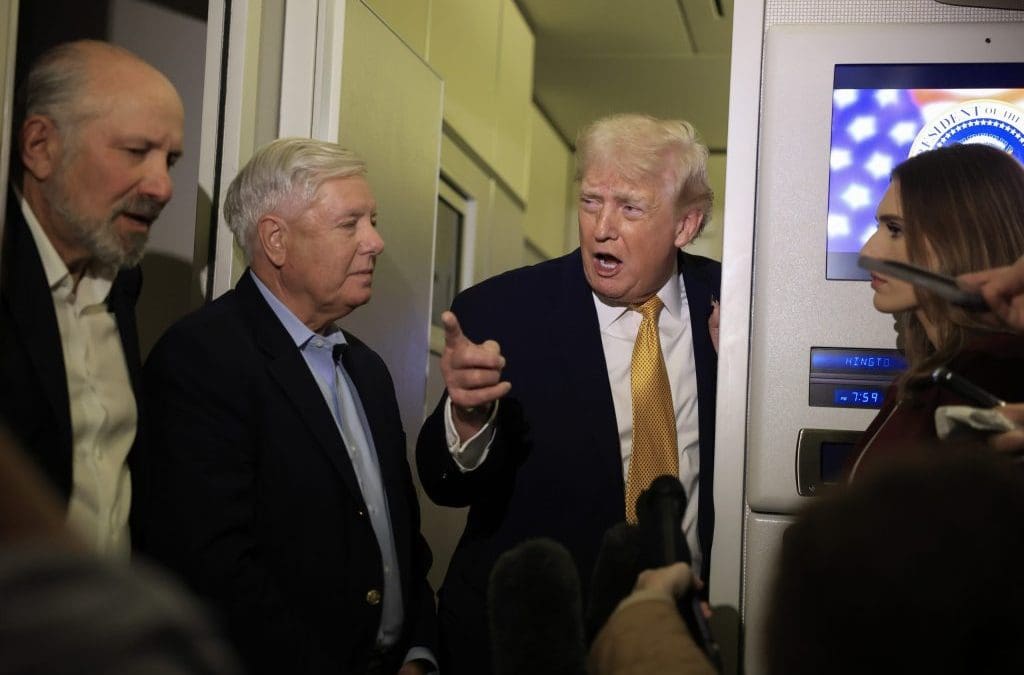
President Donald Trump on Sunday told reporters that the heads of American oil companies were informed of the US military’s attack on Venezuela—described as “brazenly illegal” by scholars and experts—even before it took place.
Trump’s admission, a renowned liar, sparked condemnation because the administration refused to consult with US lawmakers about the operation, citing fears of a leak that would compromise operational security.
“Before and after,” Trump told reporters aboard Air Force One on Sunday when asked if he’d spoken with oil executives or perhaps “tipped them off” about the operation. “They want to go in, and they’re going to do a great job for the people of Venezuela.”
Reporter: Did you speak with the oil companies before the operation? Did you tip them off?Trump: Before and after. They want to go in and they’re going to do a great job. pic.twitter.com/zxOG648Ww0— Acyn (@Acyn) January 5, 2026
Trump’s remarks were condemned by those critical of the president’s actions in recent days, including his failure to consult with or seek authorization from Congress.
“I can’t begin to tell you how insane this is,” said Fred Wellman, an Army combat veteran now running for Congress as a Democrat in Missouri. “He did not inform Congress, but he’s saying he informed the oil companies.”
“Keep in mind who he means,” Wellman added. “The billionaire mega donor that just got control of Citgo. Our service members were used directly to move the interests of Trump’s donors.”
“The oil companies were notified before Congress,” said Melanie D’Arrigo, executive director of the Campaign for New York Health. “This
by Michael Fox | Jan 3, 2026 | Article, Politics and Movements: International, Politics and Movements: US, Under the Shadow, Venezuela
by Medea Benjamin | Dec 17, 2025 | Article, Drones, Opinion, Politics and Movements: International, Politics and Movements: US, Reprint
This story originally appeared in Common Dreams on Dec. 16, 2025. It is shared here under a Creative Commons (CC BY-NC-ND 3.0) license.
In May 2013, as President Barack Obama delivered a major foreign-policy speech in Washington, I managed to slip inside. As he was winding up, I stood and interrupted, condemning his use of lethal drone strikes in Yemen, Pakistan, and Somalia.
“How can you, a constitutional lawyer, authorize the extrajudicial killing of people—including a 16-year-old American boy in Yemen, Abdulrahman al-Awlaki—without charge, without trial, without even an explanation?”
As security dragged me out, Obama responded, “The voice of that woman is worth paying attention to.” Perhaps my questions touched a chord in his conscience, but the drone attacks did not stop.
Just before that incident, I had returned from Yemen, where a small delegation of us met with Abdulrahman’s grandfather, Nasser al-Awlaki—a dignified man with a PhD from an American university, someone who genuinely believed in the values this country claims to represent. He looked at us, grief etched into his face, and asked, “How can a nation that speaks of law and justice kill an American child without apology, without even a justification?”
Under Obama, drone strikes killed thousands of people. Entire communities lived under the constant terror of buzzing drones—never knowing whether a flash in the sky meant death for them, their children, or the neighbors who ran to help.
We heard these horrors firsthand in 2012, when CODEPINK traveled to Pakistan to meet with victims’ families. A tribal leader from Waziristan described attending a peaceful jirga—a gathering of elders—when a US missile obliterated the meeting. Dozens were instantly killed. As survivors rushed to help the wounded, a second missile struck.
Forty-two people died, including elders
by Adam Johnson | Dec 17, 2025 | AI, Article, Economy, Economy and Inequality, Politics and Movements: US
Earlier this month, Vox announced a new vertical dedicated to “growth” that’s funded entirely by the Arnold Foundation, the influence arm of billionaire former Enron energy trader and founder of energy commodity hedge fund Centaurus Energy John Arnold. Arnold has long-donated to center-liberal causes, some seemingly benign (investigative journalism) and others that are, to say the least, controversial (spy planes in poor majority-Black cities, for example). Arnold’s latest ideological—and economic—agenda is to promote so-called Abundance, a vague political movement currently fashionable among wealthy liberals that’s a constellation of conferences, think tanks, political action group, billionaire donors, and best-selling books by New York Times and Atlantic authors. Their primary ethos is “growth” through deregulation of industry. Some of the proposals are sensible (obviously not all regulations make sense and regulations can, and often are, manipulated by other capital actors). But this seed of a decent, if entirely banal, idea has predictably morphed into an all-encompassing politics of deregulation and anti-Left populism that dovetails with the political needs of Silicon Valley, and the ultrawealthy in general.
Aside from the broader ideological aims it’s worth noting that, in a direct and urgent way, the primary focus on “growth” through rapid and broad deregulation aligns neatly with the most direct and urgent needs of Silicon Valley billionaires—including Arnold, and the company whose board of directors he joined in February 2024, Meta (formerly Facebook). Arnold has discussed publicly how he was brought onto Meta’s board specifically to handle the energy crisis facing AI companies, telling Bloomberg’s David Rubenstein in August of last year:
“I think [Meta was] looking for somebody who had some energy expertise. The amount
by Dean Baker | Dec 16, 2025 | Article, Economy and Inequality, health care, Opinion, Politics and Movements: US, Reprint
This story originally appeared in Common Dreams on Dec. 16, 2025. It is shared here under a Creative Commons (CC BY-NC-ND 3.0) license.
During his first term, after repeatedly promising the country a terrific healthcare plan, Donald Trump famously commented, “Nobody knew that healthcare could be so complicated.” In fact, everyone who spent even a few minutes looking at the issue knew that healthcare was complicated. That is why Obamacare ended up being a hodgepodge that was pasted together to extend healthcare coverage as widely as possible. It is also the reason Trump and the Republicans never produced a healthcare plan in Trump’s first term.
The basic problem is that healthcare costs are hugely skewed. Ten percent of the population accounts for more than 60% of total spending, and just 1% accounts for 20% of spending. Most people have relatively low healthcare costs. The trick with healthcare is paying for small number of people who do have high costs.
Individual Choice, Cherry-Picking the Pool, and Screwing Cancer Survivors
The Republicans in Congress, along with Trump on alternate days, are pushing plans that are supposed to give choice to individuals and somehow take it away from insurers. It’s not clear what they think they are saying. They seem to still envision that people will buy insurance, as they do now in the Obamacare exchanges, but somehow that they will have more control in the Republican option.
There is one story they could envision, which would make it much easier for insurers to skew their pool. The Affordable Care Act (ACA) restricted what sort of plans could be offered in the exchanges in order to limit the ability for insurers to avoid high-cost individuals.
It would be possible to relax
by Jessica Corbett | Dec 15, 2025 | Article, Gun Violence, Israel, Palestine, Politics and Movements: International, Reprint