by Aimee Gabay | Apr 26, 2026 | AI, data centers, Indigenous, Indigenous Land, News
Artificial intelligence, or AI, is helping Indigenous communities detect illegal logging, track wildfires, and monitoring of traditional lands. But the data centers powering AI are driving new threats, requiring water, energy, and critical minerals often extracted from Indigenous territories. Now, Indigenous leaders at the United Nations Permanent Forum on Indigenous Issues, or UNPFII…
Source
by Adam Mahoney | Apr 26, 2026 | AI, Atlanta, Cop City, data centers, Mass Surveillance, News
When he drives through his neighborhood now, Brian Page passes rows of police cars and AI‑powered cameras that track nearly every movement. For most of his life, Page, who goes by “Scapegoat Jones,” felt safest in the community that Atlanta officials have since flooded with officers and surveillance technology in the name of “public safety.” He bought a house six minutes from the one he grew…
Source

by Derek Seidman | Apr 20, 2026 | AI, Article, Economy, Economy and Inequality, Politics and Movements: US, Reprint
This article was originally published by Truthout on April 19, 2026. It is shared here under a Creative Commons (CC BY-NC-ND 4.0) license.
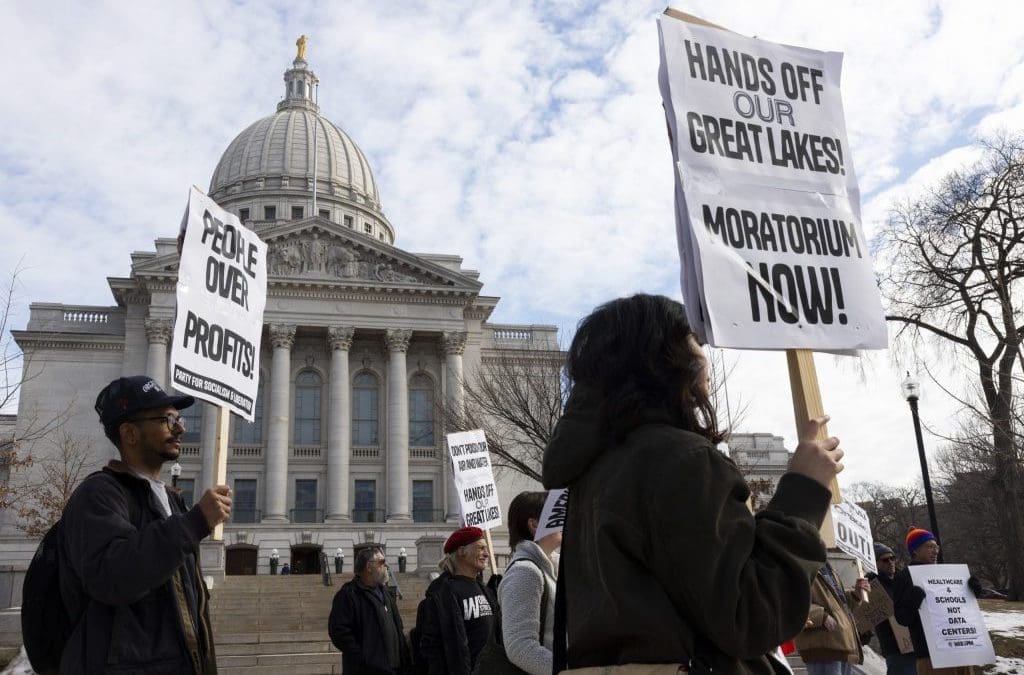
The prolific construction of massive data centers that house the physical computing power for artificial intelligence (AI) is galvanizing resistance in localities across the United States. Communities are fighting back against the billionaire tech and financial power behind these projects and their numerous harms, from their noise and pollution to their hyperconsumption of water and electricity.
Truthout has been covering the corporate interests behind the data center boom and local resistance to data centers. In this roundtable, we brought together representatives from three campaigns across the U.S. to share their experiences and lessons from taking on data centers and AI infrastructure in their areas.
KeShaun Pearson is the leader of Memphis Community Against Pollution (MCAP), based in Memphis, Tennessee, which is focused on fighting for environmental and climate justice in the predominantly Black community of southwest Memphis that’s most impacted by the concentrated pollution from nearby toxic release facilities. MCAP is currently campaigning against Elon Musk’s polluting xAI Colossus supercomputer. Tricia Boehlke is an organizer with No Data Center in DeForest, which recently succeeded in halting a proposed data center that was pushed by a private equity-owned company in a small town outside of Madison, Wisconsin. Lee Ziesche organizes with the Tucson Democratic Socialists of America and the No Desert Data Center Coalition, which has been taking on Project Blue, a huge data center proposed in the Tucson, Arizona, area. The campaign against Project Blue won a victory when Amazon recently pulled out of the project, but its developers are again trying to advance it.
This roundtable has been lightly edited for length and clarity.
Derek
by Derek Seidman | Apr 19, 2026 | AI, Arizona, data centers, Disinformation, Energy, Environmental Justice, Interview, Memphis, misinformation, Organizing, Pollution, Public Health, Resistance, tucson, Water, Wisconsin, xAI
The prolific construction of massive data centers that house the physical computing power for artificial intelligence (AI) is galvanizing resistance in localities across the United States. Communities are fighting back against the billionaire tech and financial power behind these projects and their numerous harms, from their noise and pollution to their hyperconsumption of water and electricity.
Source
by Taya Graham and Stephen Janis | Apr 17, 2026 | AI, Economy and Inequality, Inequality, Inequality Watch, Politics and Movements: US, video
Welcome to Inequality Watch React, where we don’t just talk about inequality, we go straight to the source.
This week, we take you inside the National Press Club, where we spoke with Congressman Ro Khanna about the future of the Democratic Party, economic patriotism, and the growing divide between the powerful and everyone else.
From why Democrats struggle to win, to the unanswered questions surrounding the Epstein files, to whether Silicon Valley is creating a new class of untouchable elites, we break it all down.
Because this isn’t just about politics. It’s about power, and who it protects.
And the big question: can we protect ourselves from its excess and its consequences? Independent journalists Taya Graham and Stephen Janis head down to Capitol Hill to ask these questions. And if you have a question you want us to ask, please leave it in the comments!
Credits:
Written by: Stephen Janis
Produced by: Taya Graham, Stephen Janis
Studio / Post-Production: Cameron Granadino
Transcript
The following is a rushed transcript and may contain errors. A proofread version will be made available as soon as possible.
Taya Graham:
Hello, my name is Taya Graham and welcome to our Inequality Watch React, the show where we discuss not just how this country is ruled by billionaires, but how and why. Reporting that seeks to hold the American aristocracy accountable for the destructive effect unimaginable wealth has had on our politics and on our lives. Now, unlike other YouTubers, we go right to the source to report back to you on America’s historic wealth imbalance, namely our nation’s capital, Washington DC. That’s where my reporting partner and I, hello, Steven.
Stephen Janis:
Hey, how you doing, Taya?
Taya Graham:
We often
by Rebecca Egan McCarthy | Apr 17, 2026 | AI, Environment, GOP, Mining, Minnesota, News
Minnesota’s Boundary Waters comprise a vast stretch of wilderness bordering Canada, with over a million acres of untouched forest and thousands of lakes and streams. Accessible largely by canoe, it is an ecological gem and one of the most popular spots in the country for outdoor recreation. On Thursday, Senate Republicans voted 50-49 to open the area up to mining — passing a resolution that…
Source