by Ja'han Jones | Jul 8, 2026 | Business, Opinion, White House
A public hearing began this week as the Trump administration looks to reinstate one of the most widely hated policies of the president’s second term.
Democratic officials are calling the whole thing a sham. And for good reason.
Tuesday marked the opening of a three-day hearing at the Office of the U.S. Trade Representative on the administration’s proposal to hit dozens of countries with new tariffs on grounds that these countries have failed to combat forced labor. The Trump administration adopted this approach after the archconservative Supreme Court overruled its previous rationale for tariffs.
The administration outlined its newly proposed tariffs in a report last month, accusing numerous countries of hurting American workers by inadequately fighting the scourge of forced labor. Several of these countries and the European Union have denied the claims.
As I explained at the time, there’s ample reason to question the administration’s true commitment to stemming the crisis of forced labor and human trafficking — in part because of the whole Epstein files thing, as well as the fact that many federal programs that fight forced labor and human trafficking have been gutted in President Donald Trump’s second term.
In other words, these new tariffs seem like a ploy to restore Trump’s old tariffs, which polling showed Americans broadly detested and said had cost them money.
On Monday, 22 Democratic state attorneys general submitted a public comment to Jamieson Greer, the U.S. trade representative, that all but assures the tariffs will face a legal challenge if the Trump administration tries to impose them. The officials — including AGs from New York, California, Arizona and Michigan — said the tariffs unlawfully use “sham” unfair
by Tareq S. Hajjaj | Jul 8, 2026 | Dr. Hussam Abu Safiya, Gaza, Health Care Workers, Israel, medical neglect, medical workers, News Analysis, Palestine, Prisons, Solitary Confinement, Torture
On June 10, Dr. Hussam Abu Safiya appeared on a screen before Israel’s Supreme Court via video link. He looked gaunt, visibly emaciated, and his hands and feet were bound. It was one of the few times the public had seen the doctor since Israeli soldiers took him from Kamal Adwan Hospital in northern Gaza nearly 18 months ago, where he had served as Director. He has been held without charge for…
Source

by Ray levy uyeda | Jul 8, 2026 | AI, Article, Climate Change, Climate Crisis, Economy and Inequality, Politics and Movements: US, Reprint
This story originally appeared in Prism on June 29, 2026.
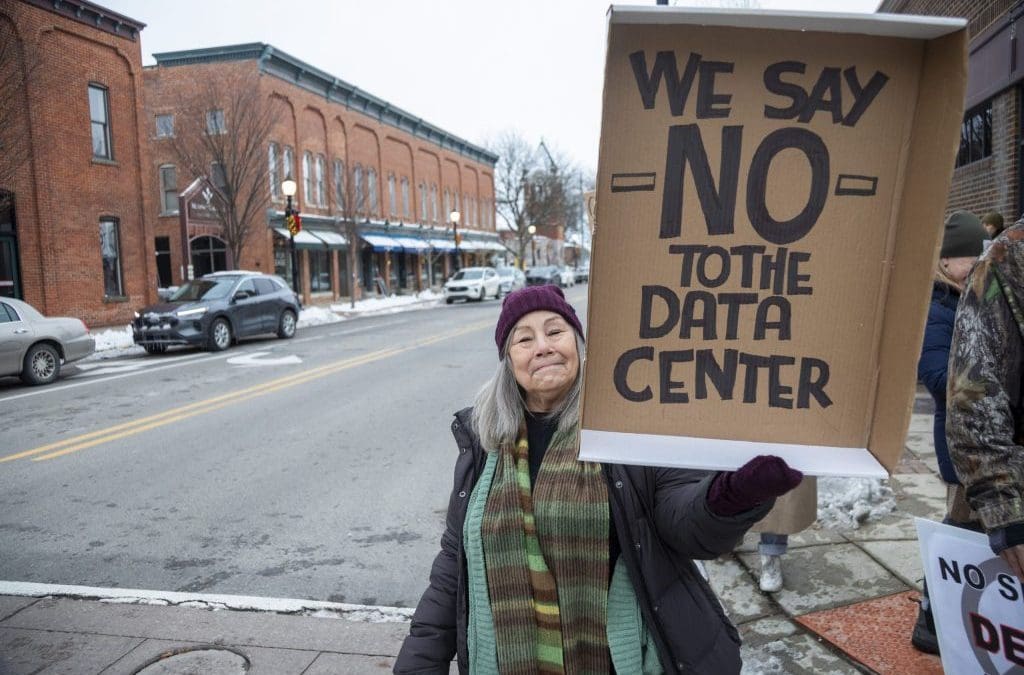
Across the country, politicians are starting to heed the public’s concerns about data centers.
Almost 75% of Americans across the political spectrum oppose constructing data centers near their homes, according to a recent Gallup poll. A majority—63%—are concerned by federal regulatory agencies’ practice of approving projects without first evaluating environmental and public health concerns.
These numbers not only paint a stark picture of the massive backlash to the rapid and rapacious buildout of data processing facilities (some of which consume enough energy to power a midsize city), but they’re also an indicator that the public feels very differently than the corporations pushing for their construction. The country has never been more divided, but on data centers, residents agree: It’s time to pump the brakes.
Communities that are already forced to contend with the consequences of data centers warn of their near-constant noise pollution, voracious consumption of water, and discharge of pollutants into local ecosystems. However, it’s not just environmental concerns that undergird the community-led protests against data center development. Many are also concerned about how data centers come to fruition—often through violations of democratic processes in the form of shadowy backroom deals and nondisclosure agreements. There’s also the continued rise in utility rates at a time when nearly half (49%) of American households don’t make enough money to cover expenses. Americans contend with issues of drought, fossil fuel dependence, and habitat loss. Generational farmland is being gobbled up to prop up acres of data warehouses. The list goes on.
Three years after OpenAI’s artificial intelligence (AI) tool Chat GPT forever changed the world’s orientation to computing, governments are responding
by Shane Burley | Jul 8, 2026 | Activism, Anti-Fascism, Deportation, Fascism, ICE, immigration, Judaism, mass deportation, News Analysis, Organizing, Palestine, Resistance, Trump Administration
As Donald Trump’s administration came to power in 2025, immigrant justice groups were immediately tasked with rapidly adapting to the intensification of immigration enforcement. Neighborhoods around the country began self-organizing, creating rapid response networks to prepare for impending Immigration and Customs Enforcement (ICE) raids. In many of these places, immigration justice organizing was…
Source
by Nayyera Haq | Jul 8, 2026 | Donald Trump, Opinion, World
President Donald Trump is contending with quite a lot on the world stage right now. Europe and NATO are increasingly self-reliant, there’s a quagmire in the Strait of Hormuz as the Middle East realigns without the United States, and the African continent is turning to China for economic development. Yet as the U.S. increasingly goes it alone and loses credibility, its commander in chief insists on projecting his feelings onto a timeworn target of his: women.
Given his track record, the sexism itself should not come as a surprise.
The latest recipient of Trump’s sexist ire is Italian Prime Minister Giorgia Meloni, a conservative leader he once praised as a “beautiful young woman” and who was the only European leader to attend Trump’s second inauguration. She fell from his good graces quickly when she defended Pope Leo XIV from his attacks, something any leader in Italy would need to do to ensure their political survival. The spat has continued, with Trump at one point recently posting a photo of himself and Meloni with the caption “restraining order needed” ahead of the NATO conference in Turkey.
Given his track record, the sexism itself should not come as a surprise, but Trump appears to reserve a special type of denigration for women who are leaders of foreign countries. Perhaps it is because protocol requires female heads of state to be treated as peers and equals; perhaps it is because the women leaders he has targeted are, in many cases, popular with their people in a way Trump isn’t. Armchair psychology aside, though, the pattern of his contempt for women leaders is long-standing.
In many instances it