by Erum Salam | Jul 26, 2026 | Congress, News, White House, World
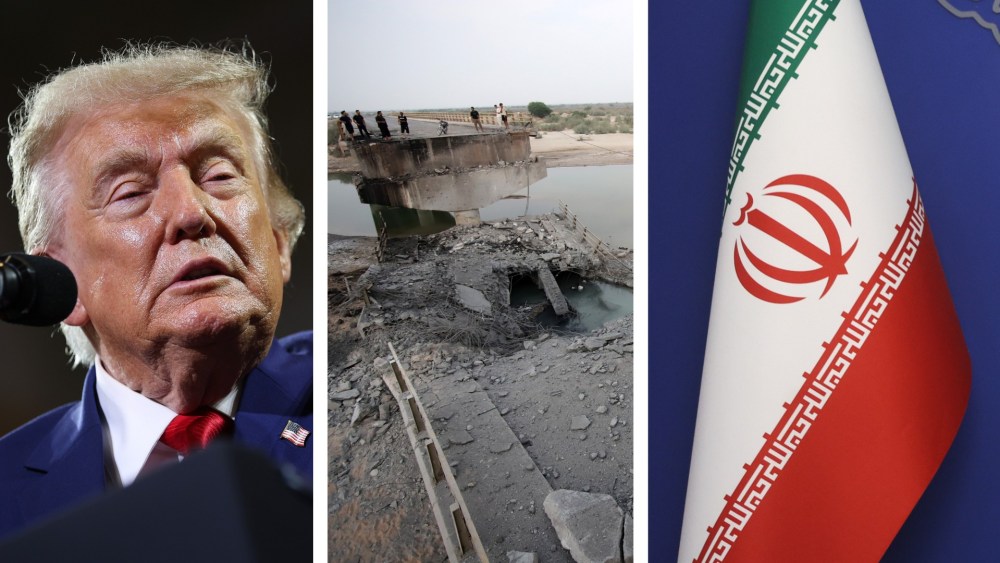
President Donald Trump is giving fragile U.S.-Iran diplomacy “some space” before deciding whether to resume strikes, United Nations Ambassador Mike Waltz said Sunday.
Hours later, however, Trump posted images to social media depicting the U.S. attacking Iran.
Waltz also dismissed concerns over the United States’ diminished munitions stockpiles, even as he conceded that “a lot” of weapons have been depleted, which he said was because of the Russia-Ukraine war and fighting with the Houthis.
“I want to be crystal clear: The U.S. military — and I’ve verified this every which way — has everything that it needs to conduct this campaign as effectively as it needs to be,” Waltz told NBC’s “Meet the Press.”
Waltz’s comments came on the second consecutive day of paused fighting between the United Sates and Iran amid reports of a dwindled U.S. stockpile of Patriot antimissile interceptors, among other munitions.
The New York Times reported Sunday that the depletion of interceptor stockpiles is among the reasons why the administration is wary of resuming major combat operations in a war launched without congressional authorization and which has grown exceedingly unpopular.
But Waltz underscored that the pause in fighting is to allow for an opportunity for peace — not because of an insufficient weapons supply, and warned that those leaking information to the press about the U.S. not having sufficient weaponry “deserve to be in jail.”
“What the president is doing right now, as we’ve seen all along, is giving some talks some space. Talks are ongoing,” Waltz told NBC. “They’re happening at every level, from the more technical aspect of it all the way to the highest levels, of course, within

by Joseph Cirincione | Jul 25, 2026 | Opinion, Science, White House, World
President Donald Trump says he believes nuclear technology is a grave threat in the hands of Iran’s ruling regime, arguing that the country would inevitably use it to create a weapon of mass destruction. And yet, in a new agreement signed Wednesday, Trump agreed to let Saudi Arabia enrich uranium and reprocess plutonium, the two ingredients used in nuclear bombs.
The Saudis promise this will be used only for peaceful purposes, but Saudi Crown Prince Mohammed bin Salman said as far back as 2018 that “without a doubt if Iran developed a nuclear bomb, we will follow suit as soon as possible.”
Trump’s generosity to Saudi Arabia — which has numerous lucrative deals in place with members of his family — could unleash a flood of new nuclear programs. If the Saudis get this technology, others will demand it too.
Nuclear is the most expensive way to produce electricity, and Saudi Arabia sits on an ocean of oil and is ideally suited for much cheaper solar and wind energy production.
Since the dawn of the Nuclear Age, U.S. policy has denied the ability to enrich uranium and reprocess plutonium to other nations because it is a shortcut to nuclear weapons. The huge and expensive facilities can be developed openly and legally until a government takes the quick jump from making fuel rods to making the cores of bombs. With this deal, Trump has effectively just green-lit a Saudi nuclear bomb program.
How did we get here?
In 2013, the Saudis unveiled a plan to build as many as 16 civilian nuclear reactors. Nuclear reactor companies salivated at the prospect of contracts worth hundreds of billions
by Zeeshan Aleem | Jul 24, 2026 | Business, Opinion, White House, World
The Strait of Hormuz remains at a virtual standstill because of President Donald Trump’s foolish war, and now, in what represents a new global energy price nightmare, Houthi militants in Yemen have begun to block a separate corridor that is critical for global oil shipping. On Thursday, oil surged past $100 a barrel for the first time since May in response to the news that the war with Iran is on the brink of expanding to a new front. And Trump’s promise to bomb the Houthis should they continue is unlikely to improve the situation.
Those Houthi militants, who are allied with and supported by Iran, announced Monday that they would were enacting a blockade in the Bab el-Mandeb Strait against Saudi Arabia. The Houthis said their blockade is retaliation for airstrikes against a Yemeni airport intended to prevent an Iranian aircraft from landing. (Yemen’s Saudi-backed government claimed credit for the attack.) On Thursday, the Houthis said they had attacked two Saudi oil tankers and successfully warned 10 more to turn back. (Saudi Arabia’s official news agency confirmed at least one tanker was hit.)
Should the Houthis continue to attack ships, Trump ought to be concerned; his record fighting the scrappy militia is not impressive.
The Houthis’ blockade is a huge deal. Before the Iran war, about a fifth of the world’s oil passed through the Strait of Hormuz. Now it’s effectively closed. Saudi Arabia, which had transported the bulk of its oil through the Strait of Hormuz, started moving oil west through a pipeline. From there, Saudi Arabia was sending its oil out through the Red Sea and the Bab al-Mandab Strait, which connects the Red Sea
by Jen Psaki | Jul 24, 2026 | Donald Trump, The Briefing with Jen Psaki, White House, World
This is an adapted excerpt from the July 22 episode of “The Briefing with Jen Psaki.”
Have you ever been in one of those situations where a friend starts to embarrass themselves — maybe they had a little too much to drink, maybe they said something they shouldn’t have, or maybe they just seem to be having a hard time keeping it together — and you have to gently cajole them into taking a break?
We’ve all been there at some point. And right now, that is exactly what it must feel like for MAGA Republicans trying to deal with President Donald Trump and the war with Iran he started.
A new Politico poll out Wednesday found that the number of self-identified MAGA supporters who think the president’s war is worth the economic costs has dropped 13% in just the last two months.
Just consider the advice longtime Trump supporter and MAGA darling Bill O’Reilly shared on his podcast this week. O’Reilly told the president to “take the next month off.”
“Get into an environment where you, like, golf and relax a little bit,” he said. “You got to deal with Iran — I understand that, everybody understands it — but you can do that on the phone, and you can do that with your people coming. But you need a breather.”
Now, was O’Reilly making that suggestion because he is genuinely concerned that Trump is not OK? Maybe. Or was he making it because he thinks this disastrous war will be easier to bring to an end if Trump isn’t sitting in the Oval Office every day? It’s possible. Or it could be a
by Hayes Brown | Jul 23, 2026 | Opinion, World
The United States and Saudi Arabia signed a tremendously ill-advised agreement Wednesday granting the kingdom access to American nuclear know-how. The Trump administration expressed hope that the deal will funnel billions of dollars to the U.S. nuclear industry and steady a relationship that has been rocked during President Donald Trump’s heedless war against Iran. But that war, which Trump is threatening to escalate further, adds to this already bad deal the element of awful timing.
Even without Iran changing course on its nuclear program, Wednesday’s announcement is poised to roil the geopolitics of a notoriously unstable region.
Despite its shifting objectives in its war with Iran, the Trump administration has consistently said a big goal is preventing Iran from developing a nuclear weapon. In truth, the Islamic Republic was nowhere near the “breakout” point, where a quick rush could convert a civilian nuclear program into one capable of producing weapons-grade highly enriched uranium. But the ongoing attacks from the U.S. and a potentially nuclear Saudi Arabia could change the regime’s calculus. Even without Iran changing course on its nuclear program, Wednesday’s announcement is poised to roil the geopolitics of a notoriously unstable region.
The Wall Street Journal first reported Tuesday night that Trump had signed off on the agreement, prompting a wave of concerns from nonproliferation experts about the potential ramifications. Granted, Saudi Arabia does have every right to pursue nuclear energy. The seminal 1968 Nuclear Nonproliferation Treaty makes plain “the inalienable right of all the Parties to the Treaty to develop research, production and use of nuclear energy for peaceful purposes without discrimination.” A foray into nuclear power is likewise consistent with the
by Zeeshan Aleem | Jul 22, 2026 | Opinion, White House, World
The resumption of hostilities between the United States and Iran has caused an uptick in U.S. casualties. Last week, CENTCOM confirmed the deaths of three more U.S. service members killed in action, and the total number of troops killed during the war currently stands at 18. Meanwhile nearly 100 troops have been injured over the past two weeks as Iran escalates attacks on U.S. bases across the Middle East.
President Donald Trump continues to try to cast the war as an operation of total U.S. domination against a defanged regime, but Iran is striking back, with American lives at stake, making justifications for continuing the unpopular war even harder for Trump. And with the president signaling an openness to escalating the conflict even further in the coming weeks, the human toll is likely to increase. (Iranian casualties are far worse, with at least 1,700 Iranian civilians killed, according to estimates from the U.S.-based Human Rights Activists News Agency.)
It will be nearly impossible for the Trump administration to ward off the reality that casualties make wars less popular.
Already lacking in meaningful transparency, the Trump administration appears to be growing more cagey about releasing information about casualties. But efforts to delay or obscure the information are unlikely to prevent the inevitable — the war will become even more widely despised as more people die.
CNN reported on Monday that the Pentagon has been “slow to disclose injuries to U.S. troops during the ongoing war with Iran, avoiding publicly confirming the fallout from Iranian attacks and mostly reserving totals to a military website that lags events by several days or even weeks.” And its mode