by Adam Johnson | Jan 14, 2026 | Article, Iran, Politics and Movements: International, Politics and Movements: US, Trump, Venezuela
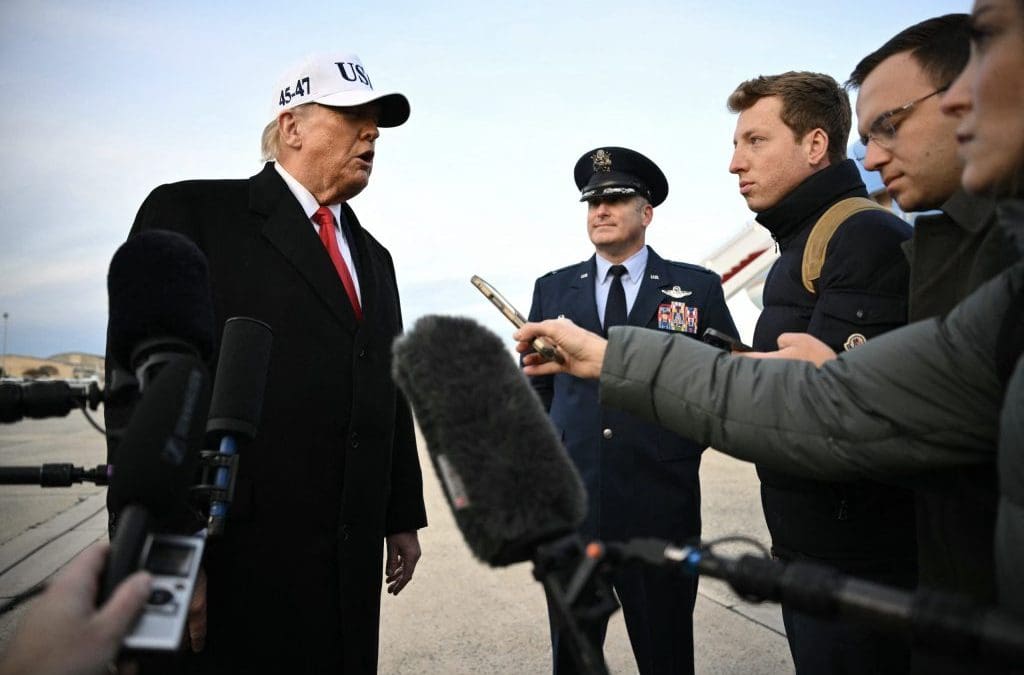
The Trump White House took time out this weekend from openly mocking and threatening Venezuela, and justifying US immigration forces executing an unarmed American woman while ordering the FBI to investigate her widow, to, once again, feign concern for human rights in Iran. And, once again, US media dutifully lined up to repeat this clearly absurd motivation as genuine without any an ounce of critical reporting, context, or pushback.
Almost every major outlet has taken Trump’s alleged motivation for potentially bombing Iran of defending Iranian demonstrators at face value:
Wall Street Journal (1/11/26): “…a sign the president is considering reprimanding the regime for its crackdown on demonstrators as he has repeatedly threatened.”
New York Times (1/10/26): “Mr. Trump has not made a final decision [to bomb Iran], but the officials said he was seriously considering authorizing a strike in response to the Iranian regime’s efforts to suppress demonstrations set off by widespread economic grievances.’
New York Times (1/13/26): “…the Trump administration is simultaneously considering a range of measures, including possible military strikes, to try to prevent further killings of protesters.”
CNN (1/11/26): “President Donald Trump is weighing a series of potential military options in Iran following deadly protests in the country, two US officials told CNN, as he considers following through on his recent threats to strike the Iranian regime should it use lethal force against civilians.”
Washington Post (1/11/26): “The Trump administration is considering military options in response to the crackdown…”
Washington Post (1/13/26): “Trump’s escalating rhetoric and the soaring death toll from inside Iran come as the White House said this week that his administration was weighing diplomatic options while considering potential responses [to the
by Sharon Zhang | Jan 13, 2026 | Boat Strikes, Donald Trump, News, Pentagon, Venezuela, War Crimes
The U.S.’s already highly contested September 2 strike on a boat in the Caribbean Sea was reportedly carried out by an aircraft that the military disguised as a civilian plane, seemingly using the practice of perfidy, a war crime. The initial attack in the U.S.’s boat strike campaign was carried out by a plane that was painted to look like a civilian aircraft — lacking the grey color and…
Source
by Marc Steiner | Jan 13, 2026 | Podcast, Politics and Movements: International, Politics and Movements: US, The Marc Steiner Show, Venezuela
Marc Steiner speaks with Geo Maher, abolitionist scholar and author of We Created Chávez: A People’s History of the Venezuelan Revolution, about the untenable goals behind President Trump’s invasion of Venezuela, and what the US bid to reassert imperial dominance in the Western hemisphere reveals about its declining place on the global stage.
Additional links/info:
Geo Maher Facebook page and Instagram
Geo Maher, Duke University Press, “We Created Chávez: A People’s History of the Venezuelan Revolution”
Geo Maher, Verso Books, “Building the Commune: Radical Democracy in Venezuela”
Mike Fox, Under the Shadow / The Real News Network, “The Americas will never be the same”
Credits:
Production: Cameron Granadino
Audio Post-Production: Stephen Frank
Transcript
The following is a rushed transcript and may contain errors. It will be updated.
Marc Steiner: Welcome to the Marc Steiner Show here on The Real News. I’m Marc Steiner. It’s great to have you all with us. As we begin this conversation, Trump is meeting with all executives from 17 companies. Secretary of State Rubio, Energy Secretary Wright, and Interior Secretary Bergen are looking at a hundred billion dollar investment as US and private corporations are about to seize the oil and the wealth of Venezuela. And as we air, we all know that the Venezuela president, Nicholas Madoro and First 80 Flores have been kidnapped and imprisoned by the United States. So to parse us out today, we’re talking with Geo Maher, who’s an abolitionist, educator, organizer, and writer based in Philadelphia. He’s taught at the University of Pennsylvania, Vassar, Drexel, San Quentin State Prison, and the Venezueela School of Planning in Karacas. He spent a lot of time in Venezuela, he’s taught there and in Mexico.
He’s the author of five books,
by Alma Campos | Jan 12, 2026 | Asylum, Chicago, Migrants, News, Nicolás Maduro, TPS, Venezuela
South Side Venezuelan families are navigating a complicated mix of hope, uncertainty, and fear following Nicolás Maduro’s capture in Caracas and arraignment in New York. Questions about asylum, Temporary Protected Status (TPS), and the safety of loved ones back home have grown more urgent as these residents try to understand what shifting U.S. policy could mean for their lives in Chicago.
Source
by Rodrigo Acuña | Jan 9, 2026 | Donald Trump, News, Nicolás Maduro, Regime Change, Venezuela
“Several helicopters were dropping bombs, and the windows shattered from the shockwaves,” Caracas resident Paola Rosal told Truthout, describing her experience of the U.S. attack on Venezuela on January 3. Rosal, a mother of three who lives in Ciudad Tiuna, a massive government-built housing project located in the Fuerte Tiuna military complex in Caracas, said she was alone getting ready to…
Source
by Michael Fox | Jan 9, 2026 | Podcast, Politics and Movements: International, Stories of Resistance, Venezuela
Transcript
MICHAEL FOX [NARRATION]: “Yankee go home,” that’s the refrain. The crowd sings it in unison in this old black and white video. “Yankee go home. Yankee go home.” The man leading them stands at the mic. He has a thick beard. He plays the Venezuelan quarto. His gaze is defiant… His name is Alí Primera.
He is El Cantor del Pueblo — The People’s Singer
The Venezuelan ambassador of the nueva canción or protest song movement, which spilled across Latin America in the 1960s and ‘70s, and includes others like Mercedes Sosa or Victor Jara.
Alí Primera sings in solidarity. He sings for rights and for justice. He sings in defense of the people… The humble and the working class. He sings against poverty. He sings for change. For social justice. He sings for El Salvador in the 1980s. He sings for Nicaragua. He sings for revolution and for peace.
He sings to demand an end to US imperialism. An end to US intervention and aggression throughout Latin America.
###
Alí Primera was born on Oct. 31, 1941, in Coro, Venezuela. Born into poverty. From a young age, he worked odd jobs to help his family.
He moved to Caracas in 1960 and began singing and writing songs while studying chemistry at the Central University of Venezuela. Songs like this, played here by the Venezuela band Los Guaraguao.
[MUSIC — LOS GUARAGUAO]
Alí Primera wrote this song in 1967. He first performed it at a Festival of Protest Songs that same year. It’s called, “It’s Not Enough Just to Pray.” It’s a brutal critique of inequality and the US war in Vietnam.
“And they pray in good faith / And they pray