by Katya Schwenk | Oct 18, 2025 | DHS, GEO Group, government contractors, ICE, Immunity, News, Private Prisons, sovereign immunity, Supreme Court, Trump Administration
After being sued for violating state-level human trafficking laws, the nation’s largest private prison company is pushing the U.S. Supreme Court to grant private government contractors like itself blanket immunity from such lawsuits and many others. This case — and another involving a military contractor — could deliver sweeping immunity to federal contractors, if they get the ruling they…
Source
by Marjorie Cohn | Oct 18, 2025 | Donald Trump, News Analysis, Separation of Powers, Supreme Court, Tariffs, Unitary Executive
The Supreme Court’s new term, which began last week, presents the court with a monumental opportunity to hand Donald Trump unbridled executive authority and eviscerate the separation of powers enshrined in the Constitution. The court appears poised to rubber stamp many of Trump’s worst abuses, from the imposition of massive tariffs to seizing control of federal agencies created by Congress.
Source
by Stephen Prager | Oct 17, 2025 | 2026 midterms, elections, Gerrymandering, GOP, Louisiana, midterms, News, Racial Justice, Republicans, Supreme Court, Voting Rights, Voting Rights Act
The US Supreme Court will rehear a case on Wednesday that could strike a death blow to the Voting Rights Act and, in the process, virtually guarantee that Republicans hang on to power in the 2026 midterm elections and well into the future. At issue in the case, Louisiana v. Callais, is Section 2 of the VRA, which outlaws racially discriminatory redistricting. Max Flugrath…
Source

by Stephen Prager | Oct 15, 2025 | Article, elections, Politics and Movements: US, Reprint, Supreme Court, Voting Rights
This story originally appeared in Common Dreams on Oct. 15, 2025. It is shared here under a Creative Commons (CC BY-NC-ND 3.0) license.
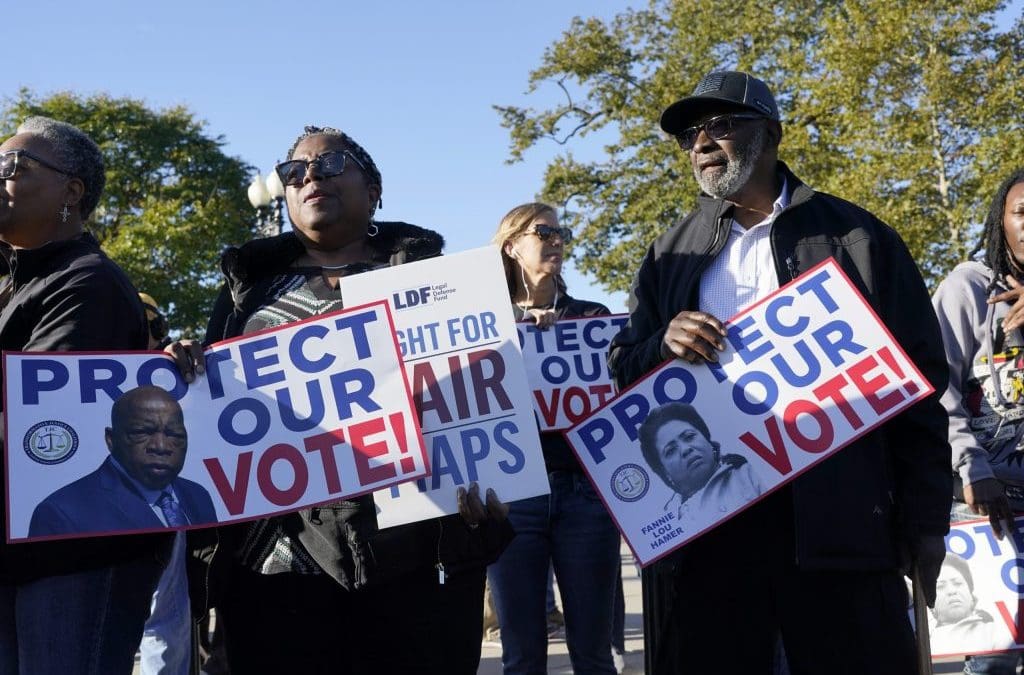
The US Supreme Court will rehear a case on Wednesday that could strike a death blow to the Voting Rights Act and, in the process, virtually guarantee that Republicans hang on to power in the 2026 midterm elections and well into the future.
At issue in the case, Louisiana v. Callais, is Section 2 of the VRA, which outlaws racially discriminatory redistricting. Max Flugrath, communications director for the voting rights group Fair Fight Action, wrote for Slate that “by taking the unusual step of reopening arguments, legal experts believe, the court’s far-right majority may have telegraphed its intent to dismantle Section 2.”
“If it falls, the impact will reverberate far beyond Louisiana, reshaping political power across the entire country,” he said.
According to a report from Fair Fight and Black Voters Matter, if Section 2 is dismantled, it would guarantee Republicans an additional 19 safe seats in the US House of Representatives, and as many as 27 when combined with the GOP’s Trump-led push for mid-decade gerrymandering.
“It’s enough to cement one-party control of the US House for at least a generation,” according to the report.
The origins of the case itself are highly unusual. It began typically enough, with a conservative Fifth Circuit Court affirming a lower court’s ruling that the congressional maps drawn by the state GOP in 2022 constituted an illegal racial gerrymander. Despite Black residents making up roughly a third of Louisiana’s population, many of them were crammed into a single district, while the other five in the state remained majority white.
After the court ruling, Republican Gov. Jeff Landry convened