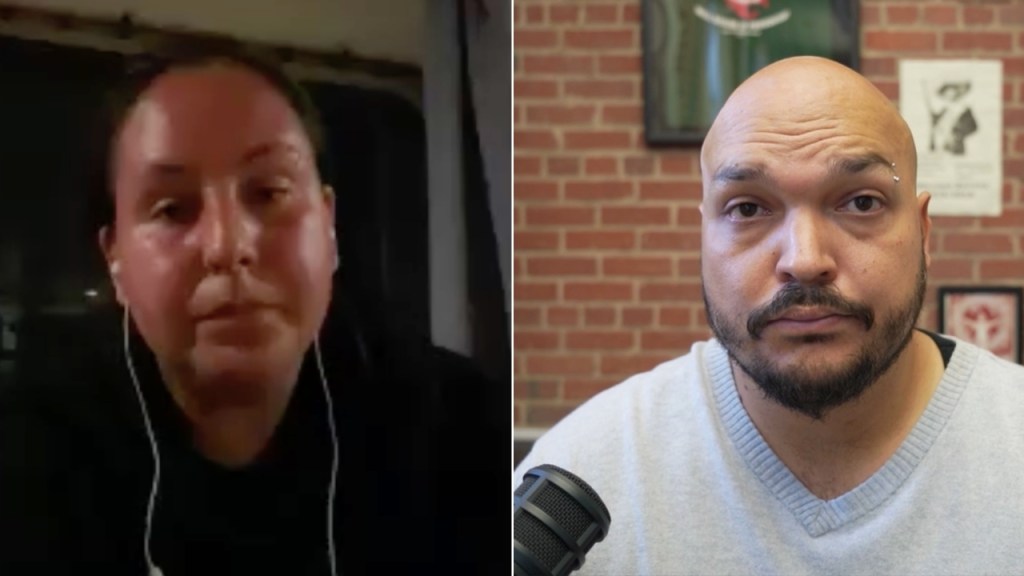
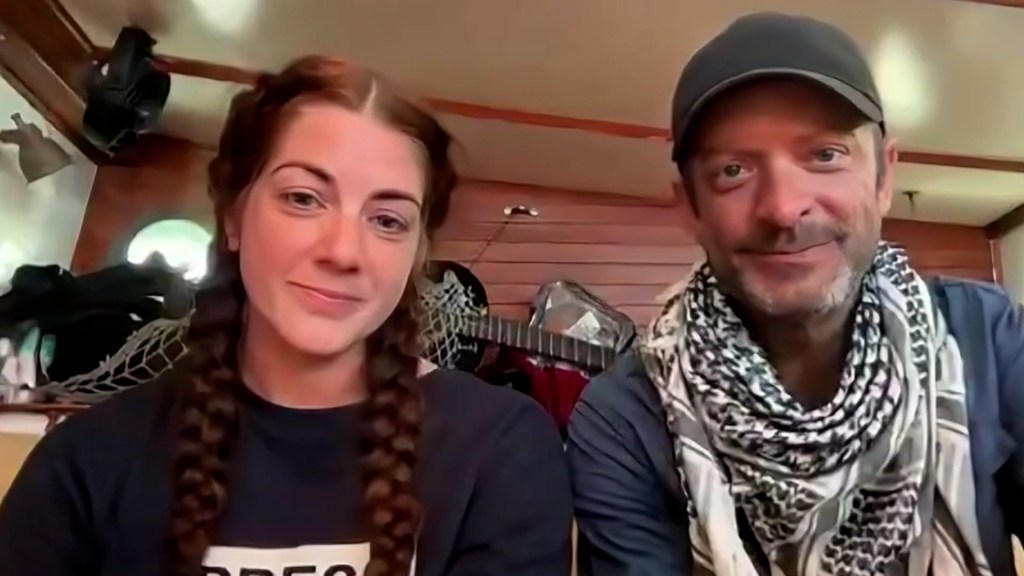
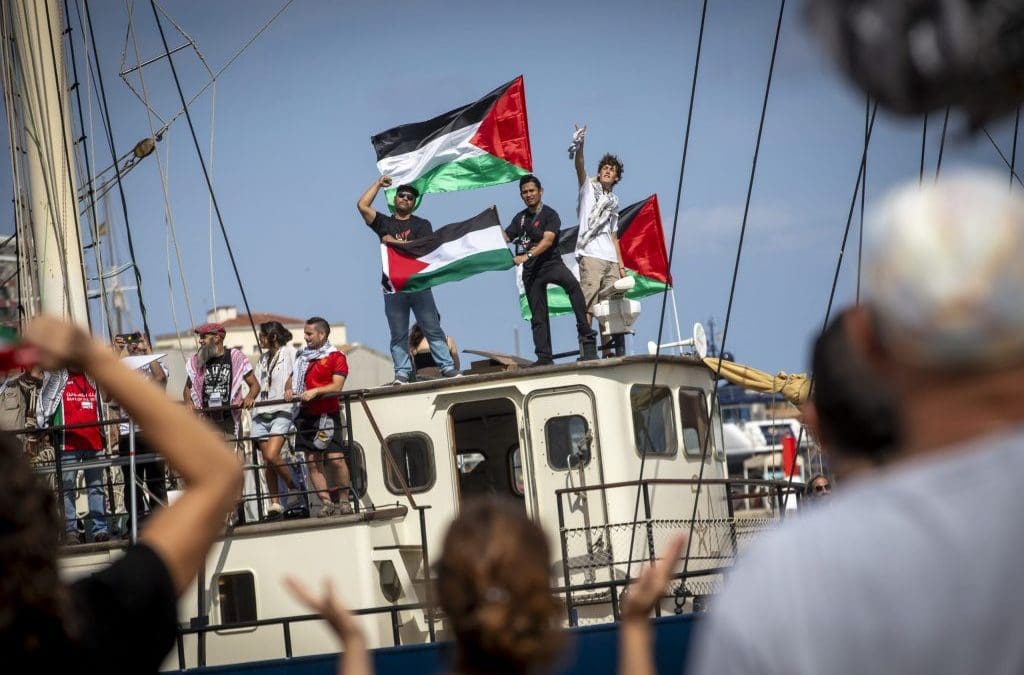
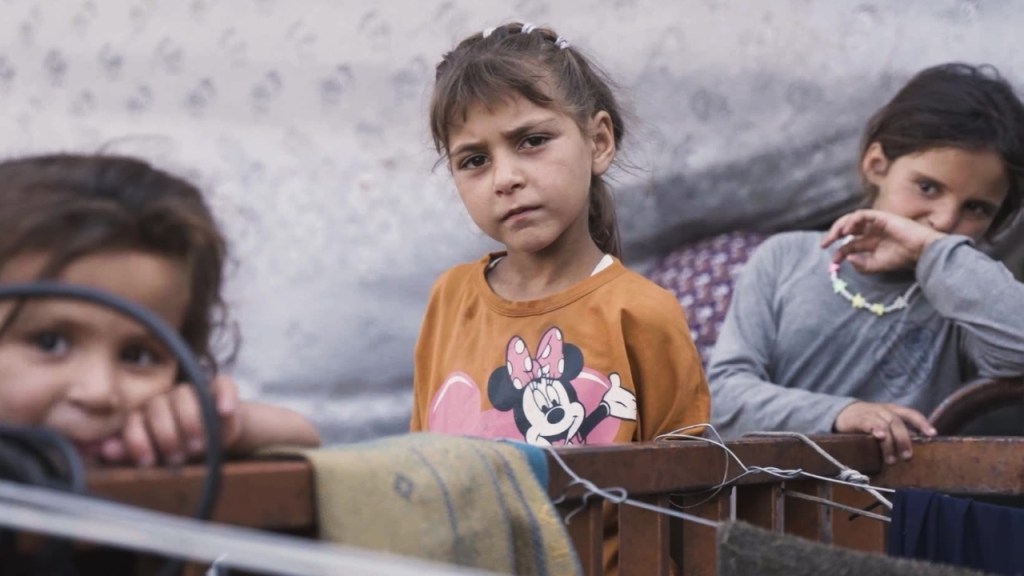
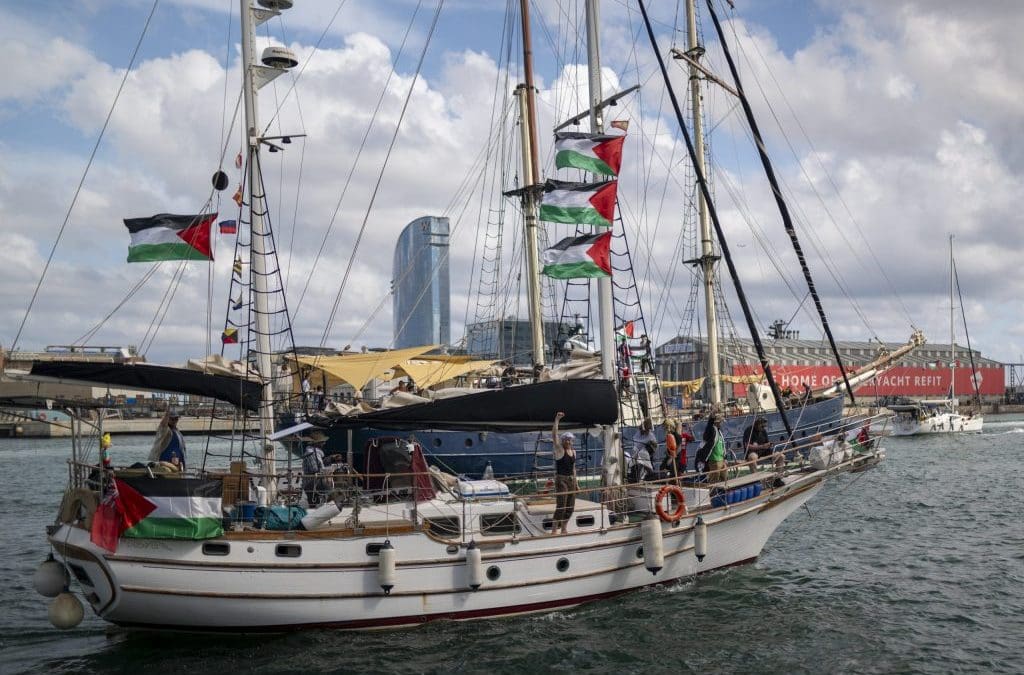
After multiple voyages by the Gaza Freedom Flotilla have been prevented from reaching Gaza’s shores by Israel’s military, a massive fleet of freedom flotillas are currently sailing towards Gaza to deliver life-saving humanitarian aid to Palestinians in the midst of genocide. The Global Sumud Flotilla “brings together a diverse coalition of international participants, including those involved in previous land and sea efforts like the Maghreb Sumud Flotilla, Freedom Flotilla Coalition, and Global Movement to Gaza.” Including over 50 vessels, delegations from at least 44 countries, and activists, organizers, and people of conscience from around the world, the Global Sumud Flotilla is the largest maritime mission in history to break Israel’s blockade of the Gaza Strip. TRNN Editor-in-Chief Maximillian Alvarez speaks with Zue Jernstedt and Zuleyka Morales Rivera, two US military veterans and members of About Face: Veterans Against the War, who are sailing with the Global Sumud Flotilla.
Transcript
The following is a rushed transcript and may contain errors. A proofread version will be made available as soon as possible.
Maximillian Alvarez:
After multiple voyages by the Gaza, freedom Flotilla have been prevented from reaching Gaza shores by Israel’s military, a massive fleet of freedom. Flotillas are currently sailing towards Gaza as we speak their mission to break Israel’s blockade and deliver lifesaving humanitarian aid to Palestinians in the midst of a genocide. This is the largest maritime mission in history to break Israel’s blockade of the Gaza Strip. The Global Saud Flotilla includes small and large vessels, delegations from 45 countries, and activists organiz and people of conscience from around the world. From Greta Thunberg to Man Mandela Nelson Mandela’s grandson. And we are recording on Monday, September 8th. The Global Saud Flotilla is currently docked at the Port of Tice and will be departing on Wednesday en route to Gaza. And joining us on The Real News today from uni are two American military veterans and members of the group about face veterans against the war who are sailing with the global Saud Flotilla. Zue Jernstedt is a US Army veteran, and Zuleyka Morales Rivera is a US Marine veteran and they join us now. Thank you both so much for joining us on the Real News Network. I really appreciate it.
Zuleyka Morales Rivera:
Thank you for having us.
Maximillian Alvarez:
Well, firstly, we’ve been seeing a lot of the videos and photos of this massive fleet of flotillas sailing towards Gaza, but I wanted to ask you both if you could tell us what it actually looks and feels like to be there right now, who is taking part in this? Just give our viewers an on the ground view of this historic effort.
Zue Jernstedt:
Yeah, well, it’s actually pretty crazy because we’re in these very tiny sailboats. This is a humanitarian mission. This is not a military mission. So we’re on these very tiny sailboats with people from all over the world who are just regular people sailing across a giant sea. So when we’re in these boats, it’s actually, we feel quite small and we’re just all stuffed in these tiny boats. And then we’ll look across the vast sea and just see all these little sailboats dotted around us, all flying Palestinian flags. So it feels so surreal to be on a giant ocean with all these tiny little boats bobbing around all with Palestinian flags. And it feels like we’re very separate almost at times. And then we can see the solidarity online and the people in Gaza who are talking about waiting for us, the actions back home of people saying they’re with us, and we realize how big it actually is from being seasick alone in our boat too, being connected with everyone around the world.
Zuleyka Morales Rivera:
Yeah, it feels very surreal. I think it’s one of those moments where you don’t realize just how big it is until months have passed and it finally sinks in and you’re like, wow, I can’t believe that this is actually happening or this actually is happening.
Maximillian Alvarez:
And I guess just on that note, what was the reception like in uni when you guys got there?
Zue Jernstedt:
Well, actually we got here a bit later than everyone else. When the first boats came in, the streets were so crowded that people couldn’t get through, and there was just parties and dancing and singing, and yeah, it was completely crushed with people supporting. We didn’t get until very, very late last night. So by that time, everyone was sleeping and we were just happy to get to the hotel.
Zuleyka Morales Rivera:
Even as we were sailing in maybe six hours out from actually arriving in Tunis, there’s a boat of civilians that came up to our boat and just started screaming Free Palestine. Free Palestine, and stopped by each boat and just kept saying, thank you, free Palestine. So the solidarity that we feel in this movement is pretty incredible.
Maximillian Alvarez:
Wow. Yeah. What does that feel like?
Zuleyka Morales Rivera:
It’s unlike anything that we’ve ever experienced before because it’s on such a large scale globally, 44 countries that are sailing to Gaza. To be part of that is something that I’ve never felt before.
Maximillian Alvarez:
Yeah, I can only imagine. And I wanted to ask as individual American military veterans and as a group representing about face against the War, because there’s a contingent of you sailing towards Gaza now, I wanted to ask if you could tell us more about why you all decided to join the global Saud Flotilla?
Zue Jernstedt:
Yeah, so actually most of the people on the boat are about face members. Most of us are also veteran for peace members. We’re all pretty much all anti-imperialist activists because we believe that the struggle in Palestine is interconnected with anti imperialism. But I joined personally because my Palestinian American friend who I met in the West Bank last year while doing protective presence, asked me if I knew any boat people, any captains or anything, and I said no. And then they said, Hey, there’s a veterans boat. And I said, sign me up here. Absolutely. I want to be a part of this. And then sent the information to other people. And about face
Zuleyka Morales Rivera:
Mine is somewhat similar. I actually took part in the march to Gaza that took place in June and we weren’t able to get very far. But it really opened my eyes to the layers of systemic oppression that is not only against the Palestinian people, but against a lot of the global south and the people of the world. And so I had a comrade that was also in the March to Gaza that called me and asked me, they’re doing another Flotilla and it’s going to be dozens of boats. Would you like to go? And immediately I said, of course we have to make it to Gaga.
Maximillian Alvarez:
Is there anything about your identities as veterans, as people who took the oaths that you took and have gone through, what you’ve gone through? Is there anything about being a veteran of the US military that made you feel even more compelled to speak out about this?
Zue Jernstedt:
Yeah, absolutely. I’m someone who served in Afghanistan in 2009, and I feel like it’s my duty now to stand up against imperialism because I was a foot soldier of imperialism. I spread pain and violence through the world, upholding this American ideal and resource stealing. So I feel like I also now have to stand against it now that I see what’s going on, now that I have privilege in America for being a veteran, that it’s very important for us to say, Hey, no, we see what’s happening. We won’t take part anymore. We can change the narrative. We don’t have to follow orders. We don’t have to be these people. We don’t have to march to their tune. We are the people, we have the power.
Zuleyka Morales Rivera:
For me, I joined the Marine Corps straight out of Puerto Rico. I was born in Puerto Rico, the oldest colony in the world, and I wasn’t aware of the oppression and the second class citizen that we had. And as I opened my eyes when I got out of the military, I realized these systems are designed to be put against us and we have to do something. So it’s intertwined in our everyday lives and just had to do something about it.
Maximillian Alvarez:
Well, I spoke to Chris Smalls when he was on board the Last Freedom Flotilla, and we had that conversation about a day or so before the Flotilla was captured, and Chris himself was separated, beaten, and detained by Israeli forces. And Chris knew that he was putting his safety and possibly even his life at risk for this cause. And I know that everyone on this mission is fully aware of those risks as well. But I wanted to ask, what are you expecting the response from Israel to be like, we’ve never seen a fleet like this before, but we’ve seen how Israel has responded to individual missions before. So how are y’all prepared for the different range of outcomes here, including the possibility of violence and hostility from the Israeli military?
Zue Jernstedt:
Well, I just want to start with the violence and hostility from the Israeli military will be nothing compared to what the people of Gaza and the people in the West Bank face every day. So for us, it’s not, yeah, it means so much that they’re going through this that does not worry us. It’s nothing compared to what they’ve been facing for the last 700 days and since 1948 and before. So that isn’t our main concern. Our main concern is what are they going to do? Because they do not follow humanitarian law. They do not follow the Geneva Convention. They do not follow the ICC. They do not follow the IHL. So we are completely unsure. They’re a rogue state. They’re a complete wild card. So we are making all these scenarios up of what we could do in each way, but we really cannot say because they do not follow the laws and they’re inhumane and they are committing a genocide against the Palestinian people.
Zuleyka Morales Rivera:
And based off what we’ve witnessed and the slaughter that’s been going on in Gaza for over 700 days, we can honestly expect anything from them because that’s just how they are. Nobody sets limits on them. So we go over scenarios on a regular basis. Daily we have meetings, we talk about what if this happens or what if this happens or what would you do if you see this happen to another person? How do we remain calm? How do we deal with situations like that, which we most likely aren’t really prepared for, but we’re preparing as much as we can.
Maximillian Alvarez:
Just the very fact of this fleet existing. It really is a testament to the age old organizing principle that there is strength in numbers, and we’re even hearing about ways that others who are not on those ships are preparing to aid your effort, including the Italian dock workers who are saying that they will shut down the ports if you all are harmed. So it sounds like, and please do tell us if there’s more in that vein that folks should know about, but it does sound like the strength in numbers principle is being applied in its full force here from the amount of ships sailing towards Gaza to the amount of support around the world to protect those ships.
Zue Jernstedt:
Yeah, absolutely. The people are waking up and we are aware of American imperialism now. We are aware of billionaires controlling resources, and the people are waking up to say no more. This is multinational. We are coming together to say, it doesn’t matter how much money you have, you don’t have the numbers that we have. And the people of the world stand for humanity. The people of the world stand for Palestine. The people of the world stand for Congo. The people of the world stand for Sudan. The people of the world stand for Puerto Rico. We’re not going to take it laying down anymore, and we are all going to join up. And everyone can do their little part. You don’t have to be on a flotilla. You can do things in your everyday life that will subvert what they’re doing and show them that they don’t have the power of us over us and we can make changes.
Zuleyka Morales Rivera:
And I think that’s the difference with this movement is that it’s so big. Maybe we don’t realize it because we’re on a small ship, but it’s so big that I feel like this time people actually can feel like they can be in solidarity with us, even if it’s just sharing or sharing the voices in Gaza or sharing a post or speaking about it with their families or joining the discourse, or even the smallest little bit of effort that is put towards standing in solidarity with the people of Gaza and the Palestinian people all around the world is very different than the movements in the past.
Maximillian Alvarez:
Well, and on that note, I mean that hits very deeply, and I just wanted to make my own appeal to anyone watching this that please share the dozens of documentary reports that we’ve been publishing from Gaza itself, from the West Bank, our reporter in Gaza, ruida Amer, a brilliant documentary filmmaker, is starving, her family is dying. We are talking to her every day. I beg you, if you’ve been watching those documentaries, just know that the person behind them is dying like everyone else in Gaza. And that is where this urgency to do something is coming from. On my podcast Working People last week, which we published here in The Real News, I interviewed two Palestinians in Gaza talking about the horrific circumstances that they are living through and trying to survive in. This is as real as it gets. That is why this massive fleet is sailing towards Gaza this week. And so I wanted to end on that note because I know I have to let you both go. You’ve got a long week ahead of you. But while I still have you, I wanted to ask if you had any final messages about what you all and the rest of the Flotilla Coalition are advising people to do to help, and if you had any final messages to the world that you want to share here before we let you go?
Zue Jernstedt:
Oh, yes, absolutely. I mean, the biggest thing is what you were just saying of Center the Voices and Gaza Center, the voices on the West Bank, sure, we have this Flotilla, it’s a big media thing, but where’s the media for Gaza? Where’s the media for the West Bank? Those are the people who are going through it, are suffering under it. Those are the people you need to be listening to. One thing I would like to say is 26,000 people tried to get on the Flotilla and we didn’t have the room, but there’s other organizations that you can work with in solidarity with the Palestinian people. I was in the West Bank with ISM, the International Solidarity Movement. They need people in the West Bank. They’re undergoing right now some horrific, horrific ethnic cleansing, where they’re destroying the olive trees. They’re shooting people. They need observers from around the world to be there to keep them from doing these crimes without having anyone international to intervene. Like, please, please, there’s more ways of solidarity than just the flotilla.
Zuleyka Morales Rivera:
And I think it’s just important to realize that in our thousands, in our millions, we’re all Palestinians. And I really mean that We can’t look away from the suffering of Palestinian children. We can’t look away from the suffering of Gaza that has been going on for so long. It is one fight. It’s one fight, and it’s a fight of the whole world. And the more of us that there are, the better.