I, in large part, criticize liberal media for a living. Not the “liberal media” of Rush Limbaugh and Fox News paranoid imagination, but liberal with a small “l,” liberal media that largely leans Democratic in its preferences but first and foremost sees its role as policing populist and radical elements. A liberal media that is, in the aggregate, racist and reactionary but still reserves 10% of its resources for the occasional genuine piece of journalism covering workers, or the poor, or the plight of Palestinians, or corporate and government abuses. A media that still feigns interest in liberal credibility, with institutional validation, scientific accuracy, and a baseline––to use a popular buzzword from eight years ago––shared reality. This liberal order is a deeply flawed framework, pernicious precisely because it uses the veneer of objectivity and universalism. As I’ve spent the better part of 10 years documenting, this framework uses selective empathy, excludes dissenting or marginalized voices, and employs loaded rhetorical frameworks like fake concern for “human rights” and a host of other sophisticated modes of propaganda to protect the status quo and promote US imperial and capital dictates. But it did, at least, pretend to care about shared reality and institutional credibility. It at least sought approval from academia, international rights groups, and other liberal validators. It at least pretended to care about universal ideals.
This pretense, this last 10%, seems to be on its way out. Without commenting on whether shedding this pretense will be good or bad in the long run for the world’s poor and dispossessed, it’s essential to document its demise, and the grim media landscape it portends.
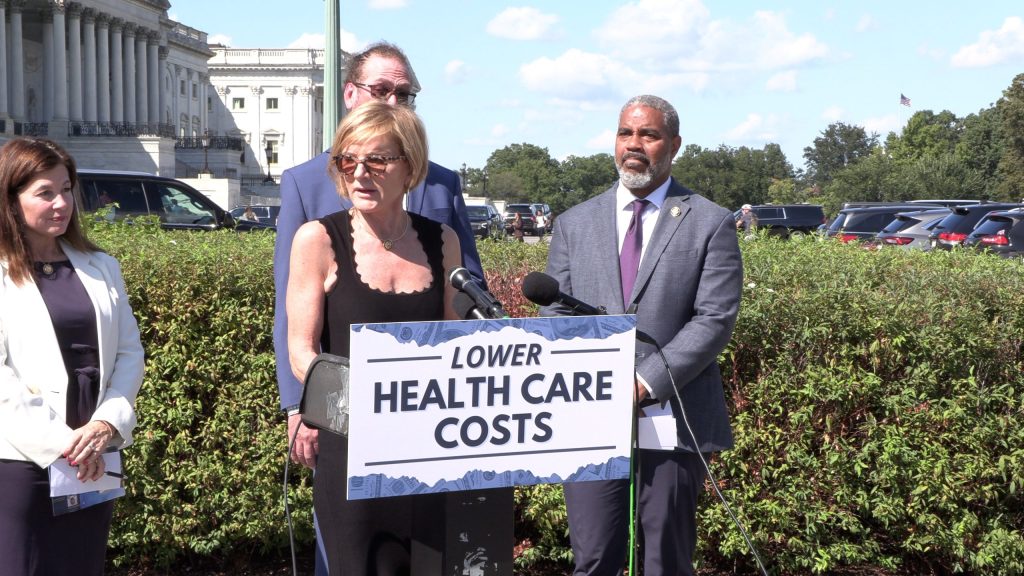
The meager collection of congressional Democrats standing outside the Capitol last Thursday belied the gravity of the policy on the agenda: the pending elimination of Obamacare tax credits.
“This isn’t a small thing, this isn’t something that is only going to impact the people who claim those credits,” Nevada Congresswoman Kristen McDonald Rivett argued.
“What we are going to see is that this is going to affect the cost of insurance of every single American.”
This has all the makings of a crisis. Which is why McDonald – Rivett and two other members of Congress stood in a hot September sun pleading with Republicans to renew them as part of a deal to fund the government.
“When Republicans repealed the tax credits for the Affordable Care Act, Republicans basically said we don’t care about Americans losing their health insurance,” Nevada Representative Susie Lee said.
But there’s a big difference between this policy dispute and conflicts in the past. This time, Republicans need Democratic votes to pass a looming spending resolution. Democrats have leverage.
The question is, will they use it?
The biggest obstacle is in the Senate. Republicans hold just 53 seats, seven short of the number need to bypass the filibuster and pass legislation.
House Republicans did approve a bill that would fund the government through November, but it failed in the Senate. Congress has until the end of the month to pass legislation to keep the government open.
Still, when we asked if they were willing to support a shutdown to force Republicans to restore the credits, the elected officials on hand were circumspect, if not muted.
“That’s the Republicans’ choice,” explained Rep. Steven Horsford (D-7), another Nevada Democrat house member who attended the press conference. “They have the power.”
And therein lies the rub. Because truthfully, in this case, Democrats are not without power. They just seem reluctant to wield it.
“Look, it’s the Republicans shutting down the government,” Schumer told CNN anchor Dana Bash. “What we are asking very simply is bipartisan negotiation.”
It’s a cautious approach that has proven ineffective for Democrats in the past. While Trump has indiscriminately issued dozens of executive orders, wielding power like a king, the Democrats have done little to counter him.
To be fair, Democrats might be playing their cards close to the vest. Openly threatening a shutdown now could be premature, and allow Republicans to portray them as obstructionists.
But Democrats have substance on their side, and the power to do something about it. The loss of ACA subsidies has real implications for real people
. Forcing a shutdown would provide a stage to make this clear to the public. At the very least, people would know who to blame for the increase in health premiums if Republicans refuse to budge.
That’s what’s at stake for the Democrats. Trump and his Republican cohorts have grown accustomed to winning. He’s so confident he’s willing to fight on any political stage to prove it.
To beat him, the Democrats have to be willing to do something he does all the time: take risks and be bold. The shutdown is a good place to start. The Democrats need to figure that out before it’s too late.
Last week on Capitol Hill, a press conference unfolded unlike any other. Victims of sexual abuse by the wealthy and powerful stepped forward to share their stories—some for the first time. Their voices cut through the usual political noise, revealing decades of manipulation and violation by Jeffrey Epstein.
The event drew a crowd of chanting protesters and reporters, but amid the chaos, one fact stood out: the Epstein scandal continues to grow, and Donald Trump’s attempts to silence it are failing.
That became clear when Marjorie Taylor Greene, a staunch Trump loyalist, unexpectedly appeared to support a discharge petition that seeks to force the House to subpoena the Justice Department for all files related to Epstein’s crimes. Greene’s attendance wasn’t announced beforehand, but her presence signals to Trump’s detractors that there are limits to his control over his MAGA supporters.
Trump has tried to suppress the scandal. The Justice Department re-released already public documents to conservative influencers, drawing ridicule. The administration sought access to grand jury transcripts from Epstein’s 2019 indictment—a request a judge denied, as expected. And Trump dismissed the entire controversy as “a Democratic hoax.”
Unlike many elites who have bowed to Trump’s authoritarianism, these survivors are holding him accountable.
But victims disagree
. “This is not a hoax, and it’s not going away,” said Epstein survivor Marina Lacerda.
Trump’s struggles reveal the limits of his usual tactics. His strategy—harnessing the anger caused by inequality to deflect blame—has faltered here. To understand why, we must look beyond Epstein as a predator to examine the system that protected him.
Documents recently released from Epstein’s estate expose the extent of his aristocratic immunity. In a 2008 plea deal, prosecutors agreed not to charge his alleged co-conspirators and gave Epstein a list of victims who had come forward—a list that victims describe as a “hit list,” provided by law enforcement.
Compare this leniency to Jean Roussel Eloi
, a man convicted of internet solicitation of a minor in the same jurisdiction received 30 years in federal prison. Epstein, after pleading to state charges of procuring a person under 18 for prostitution and solicitation of prostitution, served just 13 months in a private wing of a minimum-security jail, working in his upscale office during the day—and allegedly receiving female visitors.
This deference to wealth echoes the broader inequalities that helped propel Trump’s rise. For nearly a decade, Trump has exploited economic anxiety by casting opponents and institutions as characters in his own reality show. Like on The Apprentice, he “fires” his targets, blaming them for a rigged economy.
This inequality theater taps into real grievances: medical debt drives 60% of personal bankruptcies; middle-class wages have stagnated; and since 1975, $89 trillion has shifted from lower earners to the top 1%.
Ironically, Trump has wielded the very inequalities he helped deepen. America’s failures in healthcare, housing, and justice have created a frustrated electorate eager to blame someone. Trump has redirected that anger away from himself—until now.
The Epstein scandal has flipped the script. Salacious photos, videos, and even a birthday card allegedly sent by Trump to Epstein have placed Trump on the wrong side of the story. The victims are now directing the narrative.
That’s why their stories matter. Their painful testimonies expose the consequences of inequality upheld by Trump, Epstein, and other billionaires. Unlike many elites who have bowed to Trump’s authoritarianism, these survivors are holding him accountable.