by Dean Baker | Dec 16, 2025 | Article, Economy and Inequality, health care, Opinion, Politics and Movements: US, Reprint
This story originally appeared in Common Dreams on Dec. 16, 2025. It is shared here under a Creative Commons (CC BY-NC-ND 3.0) license.
During his first term, after repeatedly promising the country a terrific healthcare plan, Donald Trump famously commented, “Nobody knew that healthcare could be so complicated.” In fact, everyone who spent even a few minutes looking at the issue knew that healthcare was complicated. That is why Obamacare ended up being a hodgepodge that was pasted together to extend healthcare coverage as widely as possible. It is also the reason Trump and the Republicans never produced a healthcare plan in Trump’s first term.
The basic problem is that healthcare costs are hugely skewed. Ten percent of the population accounts for more than 60% of total spending, and just 1% accounts for 20% of spending. Most people have relatively low healthcare costs. The trick with healthcare is paying for small number of people who do have high costs.
Individual Choice, Cherry-Picking the Pool, and Screwing Cancer Survivors
The Republicans in Congress, along with Trump on alternate days, are pushing plans that are supposed to give choice to individuals and somehow take it away from insurers. It’s not clear what they think they are saying. They seem to still envision that people will buy insurance, as they do now in the Obamacare exchanges, but somehow that they will have more control in the Republican option.
There is one story they could envision, which would make it much easier for insurers to skew their pool. The Affordable Care Act (ACA) restricted what sort of plans could be offered in the exchanges in order to limit the ability for insurers to avoid high-cost individuals.
It would be possible to relax
by Ja'han Jones | Dec 16, 2025 | MS NOW Opinion, Opinion
FBI Director Kash Patel is learning the pitfalls of running an agency chock-full of conspiracy theorists like himself.
The director, who was seemingly nominated for the role primarily because of his sworn allegiance to President Donald Trump and a habit of pushing MAGA conspiracy theories, has become the movement’s whipping boy ever since he assumed his position — largely over his failures to provide evidence supporting MAGA conspiracy theories.
Last week, this came to a head when Patel fired Stephen Friend, a far-right influencer, FBI agent and former Patel ally who gained fame among the MAGA faithful after being suspended from the agency under the Biden administration for reportedly sympathizing with Jan. 6 insurrectionists.
In a letter sent to Friend last Friday, Patel told the agent he was fired “effective immediately” for “unprofessional conduct and poor judgment.” The letter cited multiple public claims Friend made fueling baseless allegations of a government-led cover-up related to the apparent Trump supporter authorities allege to have been behind two attempted pipe bombings targeting Republicans and Democrats in Washington on Jan. 5, 2021.
Patel’s letter also cites a bigoted rant Friend delivered on a Dec. 5 podcast episode hosted by right-wing influencer and former FBI Agent Kyle Seraphin, in which Friend appeared to threaten Patel and baselessly suggest the FBI was lying about the identity of the person charged with planting the pipe bombs.
Friend said:
You better pray to Gaia, Vishnu or whatever your maker is that RealSteveFriend is never in a position to be an instrument of God’s wrath, because I will be merciful. I’ll allow you to breathe every breath that your body will have for the rest
by Anthony L. Fisher | Dec 16, 2025 | Opinion
Bari Weiss opened the CBS News town hall that aired Saturday — featuring Turning Point USA CEO Erika Kirk, widow of the assassinated MAGA activist and podcaster Charlie Kirk — by directly addressing the audience at home: “If you’re watching this or you’re sitting here in this room with me, you know what I know, which is that we live in a very divided country. A country where many people feel that they can’t speak across the political divide. … And one of the goals of the new CBS News is to change that.”
It was apparently with a “new CBS News” in mind that Weiss last week made “CBS Mornings” co-host Tony Dokoupil the next anchor of the “CBS Evening News,” the first major host elevation since Weiss was hired in the freshly created role of editor-in-chief by CBS’ new corporate parent Paramount Skydance. In a statement, Weiss said Dokoupil is the person to win back the public’s trust in the news media “because he believes in old school journalistic values: asking the hard questions, following the facts wherever they lead and holding power to account.”
By contrast, Weiss’ town hall with Kirk showed little of the “old school journalistic values” she so admires in Dokoupil.
There was no digging beneath the superficial edifice, just generic questions, frequently featuring strawmen bad guys in their premises.
The broadcast was entirely deferential and incurious. Charlie Kirk’s critics were painted in broad strokes as badly motivated. Kirk’s long track record of making statements such as “Islam is the sword the left is using to slit the throat of America” (which he posted the day before
by Keith Reed | Dec 16, 2025 | Opinion, Sports
When future sports historians wax poetic about the Kansas City Chiefs’ dynasty and the remarkable championship era of the NFL team’s star quarterback Patrick Mahomes, there’s a great chance they’ll recall Dec. 14, 2025, as the end date for both. Even though we have every reason to believe the three-time Super Bowl MVP and two-time NFL MVP will be back, it’s harder to imagine him returning to a Chiefs team that will look the same as it does now: on the field or on the sideline.
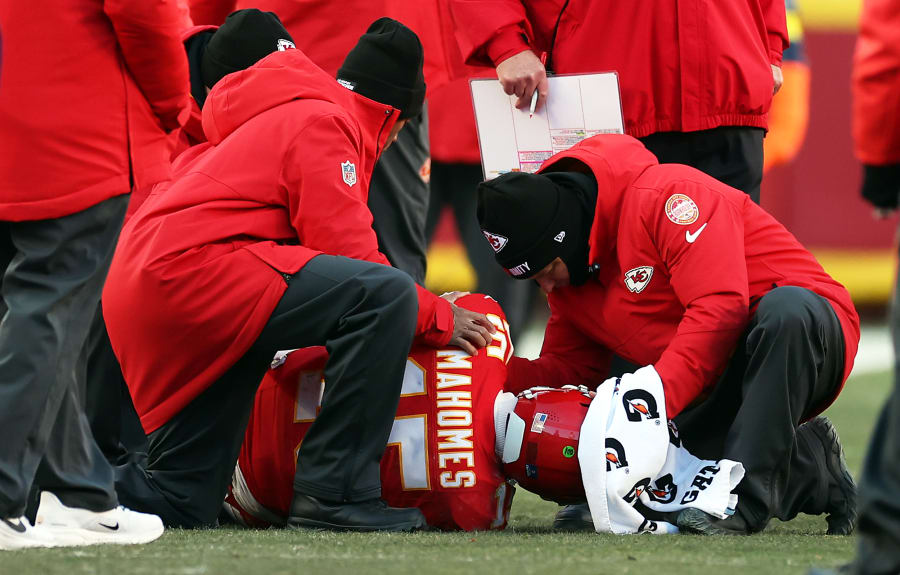
In the fourth quarter in a losing effort against the Los Angeles Chargers on Sunday, the 30-year-old Mahomes, one of the most electrifying athletes of his NFL generation, tore the anterior cruciate ligament, or ACL, in his left knee, the team announced.
ACL tears, which damage the ligament that stabilizes the knee, are catastrophic for any athlete, but especially devastating for an NFL signal caller known for creating huge, sometimes jaw-dropping, moments that start with him using his legs to extend plays.
Mahomes, one of the most electrifying athletes of his NFL generation, tore the anterior cruciate ligament, or ACL, in his left knee.
And that’s what Mahomes was doing before he was hurt Sunday: extending a play. With the Chiefs trailing by three in the fourth quarter and their playoff hopes dangling, Mahomes eluded a defensive pass rush and threw the ball away just before he was hit.
His knee buckled awkwardly. He writhed on the turf, clutching his injured leg. But because he walked off the field, he gave Chiefs fans a glimmer of hope that the injury wasn’t as bad as it looked. A postgame MRI
by Ja'han Jones | Dec 16, 2025 | Opinion
President Donald Trump’s Justice Department is applying legal pressure to try to end minority teacher programs in Minneapolis.
Assistant Attorney General Harmeet Dhillon has faced backlash —including mass defections at her agency and rebukes from hundreds of former officials — for perverting the DOJ’s Civil Rights Division into a tool that’s being used to dismantle civil rights, enable segregation and pursue bogus claims that diversity programs constitute anti-white discrimination.
We got a prime example of this last week, when the DOJ announced a federal lawsuit against Minneapolis Public Schools over baseless allegations that teacher diversity initiatives amount to racist discrimination.
Basically, in response to data showing that nonwhite teachers were disproportionately affected during mass layoffs — which in Minneapolis are supposed to be based on seniority — the school system reached an agreement with the local teachers union in 2022 to create protections that shield some members from such layoffs if they are “a member of a population underrepresented among licensed teachers.”
As the Minnesota Reformer explained at the time:
The policy doesn’t mention race, which better positions the district and union, experts say. The language could apply to Latino teachers, as well as LGBTQ, low-income and multilingual teachers.
In other words, the policy was created to curb discrimination, and it was deliberately written to avoid legal challenges.
Nonetheless, the DOJ’s lawsuit contends the policy is discriminatory by relying largely on other statements the school system has made about its reported goals of increasing the number of Black, Indigenous and other people of color on staff. The Justice Department also accuses the school system of discrimination over an effort to increase its number of Black male
by Hayes Brown | Dec 15, 2025 | Congress, Opinion
Congress works best on a deadline. The need to have the threat of impending doom looming before anything can get done is honestly one of the most relatable things about America’s lawmakers. But the dwindling calendar is doing little to spur the legislative branch into action on some major issues.If this Monday is included, there are four legislative days until the Obamacare subsidies lapse and 16 legislative days before the federal government plunges into another shutdown.
Two dates ought to be circled in red on the calendars of House Speaker Mike Johnson, R-La., and Senate Majority Leader John Thune, R-S.D. Dec. 31 is when a set of expanded Affordable Care Act subsidies expire. Without new legislation, health-care costs will skyrocket for millions of their members’ constituents.
Jan. 30 is the expiration date of the short-term funding bill lawmakers passed to reopen the government in November. Absent another continuing resolution or an appropriations bill for the rest of the fiscal year, we’ll find ourselves right back in another shutdown.
The dwindling calendar is doing little to spur the legislative branch into action on some major issues.
Given that the last shutdown was the longest in federal history — and tied to the expiring Obamacare subsidies — you might expect that lawmakers would feel some urgency to deal with these problems. Maybe even make some sort of extended effort to hammer out a workable solution before the year ends.
You’d be wrong.
Congress won’t be around when the Obamacare subsidies’ funding runs dry. This is the last week on the House and Senate’s legislative calendars before everyone clears out of Washington. And it’s not even a five-day workweek for most