by Ja'han Jones | Apr 4, 2026 | Opinion
The State Department announced “reforms” to its foreign service training program, including requiring or recommending the writings of far-right figures who have pushed white supremacist theories.
A fact sheet about the U.S. Foreign Service “modernization efforts,” published Wednesday, lists numerous changes the department is making under the banner of “Preparing the U.S. Foreign Service for the 21st Century.” More than 13,000 people work for the U.S. Foreign Service, which carries out the country’s diplomatic efforts abroad.
Among the newly announced changes is a plan to implement a “comprehensive basic training program” featuring “required and recommended” readings from “George Washington, John Quincy Adams, and James Monroe, selections from the Federalist Papers, and works from George Kennan, Angelo Codevilla, and Samuel Huntington.”
Those last three in particular are popular among white nationalists due to their unabashedly racist and illiberal rhetoric.
Kennan was a former influential diplomat at the State Department who served as an ambassador twice. He also once supported authoritarian rule in the United States, and his racist worldview has been touted by white supremacists.
Huntington was a political scientist who served in the White House, but later turned from scholarship to fueling hysteria toward Mexican immigrants. His 1993 “Clash of Civilizations” essay has helped fuel MAGA world’s anti-immigrant ethos.
The New Republic reported on Huntington’s last book before his death, titled “Who Are We?”:
‘Cultural America is under siege,’ he wrote. ‘Mexican immigration is leading toward the demographic reconquista of areas Americans took from Mexico by force in the 1830s and 1840s,’ he wrote. Huntington suggested that Mexican culture and values were different from American ones, citing observers who believed ‘Hispanic traits’ included mistrust of people outside the

by Evette Dionne | Apr 4, 2026 | culture, Opinion
When actor and singer Brandy Norwood was 16 years old, she was the star of the prime-time sitcom “Moesha,” a coming-of-age series in which the teenager in Los Angeles’ Leimart Park neighborhood navigates typical teenage crises, including being pressured to have sex by her crushes and eventually figuring out how to get a prescription for the birth control pill. According to “Phases,” a memoir the 47-year-old Norwood released this week, even as her character Moesha was secretly dating the boys her dad, Frank, forbid her to see, Brandy was keeping the truth from her real-life parents that she was in a sexual relationship with Boyz II Men’s Wanya Morris, who was then 22 years old.
Morris has not responded to multiple news outlets asking him to confirm or deny Brandy’s claims, but he has always denied that he slept with her before she was 18 years old. During a 2020 Instagram Live video, he said he and Norwood were “hanging around each other so much that there became to be some sort of connection, an intimate connection,” but there was no sex until Brandy was “of age.”
“You can ask Brandy, she will tell you the same story,” Morris said then. But that’s not what Brandy’s saying now.
“You can ask Brandy, she will tell you the same story,” Morris said then. But that’s not what Brandy is saying now.
In her book, she writes that Morris “took advantage” of her.
“I was in over my head,” she writes in “Phases.” “Sneaking around with Wanya and lying to my parents had become a constant. They barely liked the idea of me dating at all and
by Duncan Levin | Apr 3, 2026 | Opinion
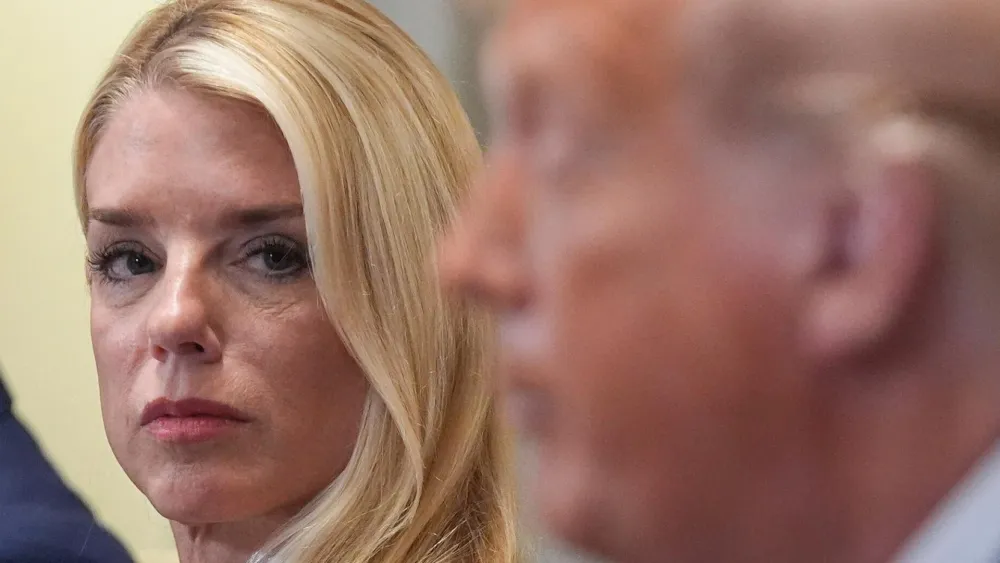
In a remarkably short tenure as attorney general, Pam Bondi helped drag one of the country’s most respected institutions deeper into grievance, spectacle and political retaliation.
Even that was not enough for Donald Trump.
Bondi’s ouster on Thursday says something important about what happened to the Justice Department on her watch. Pressure behind her removal was driven not only by her handling of the Epstein files, but also reportedly by the view that she had not moved aggressively enough against Trump’s political adversaries. Her immediate replacement is Todd Blanche, Trump’s former personal defense lawyer who had been deputy attorney general.
For generations, the Department of Justice stood for something larger than politics. Bondi helped replace that culture with something smaller and more cynical.
Bondi’s tenure was brief but revealing. For generations, the Department of Justice stood for something larger than politics: rigor, discipline, restraint and the idea that immense state power should be exercised by people trying — however imperfectly — to get things right. Bondi helped replace that culture with something smaller and more cynical: a department in which grievance became mission, public performance displaced internal rigor and loyalty to the president eclipsed loyalty to the institution.
The corrosion began at the level of tone and expectation. Bondi did not arrive sounding like someone who believed she was inheriting an institution whose independence needed protecting. She talked about rooting out internal opponents, embraced Trump’s rhetoric of “weaponization” and responded to allegations of politicized law enforcement with more politicized law enforcement. What was packaged as a campaign to restore integrity looked, from the start, like an effort to revisit Trump’s resentments about prosecutors, investigators and
by Abdaljawad Omar | Apr 3, 2026 | Article, Israel, Opinion, Palestine, Politics and Movements: International, Prisons and Policing, Reprint
This story originally appeared in Mondoweiss on April 02, 2026. It is shared here with permission.
The picture of Israeli National Security Minister Itamar Ben-Gvir jubilantly trying to open a champagne bottle on the Knesset floor over the passing of a death penalty law for Palestinians will be anchored in history as one of those photographs that needs no caption.
It’s the image of a country that has never truly left the colonial moment into which it was born. It didn’t simply inherit British practices, but kept them alive for over 70 years. It now reaches back to retrieve one of the darkest of these practices.
Israel’s new death penalty law, which exclusively targets Palestinians, did not come out of nowhere. It was passed down from a scaffold the British had already built on the same land, testing it on the same people under the same sky. In his study of Britain’s “pacification” of Palestine, Matthew Hughes, a military historian at Brunel University, shows how the military courts established by the British Mandate in November 1937 were built for speed above all else — a terror performed so quickly that no one had time to appeal or look away. Shaykh Farhan al-Sa’di, an elderly Qassamite revolutionary leader and one of the principal field commanders of the 1936 uprising, was captured on a Monday, tried on a Wednesday, and hanged on a Saturday. It’s the same law Israel reintroduced today.
What those courts also reveal is that British execution policy was, from the beginning, applied differently depending on who stood before the judge. Palestinians were hanged for carrying four bullets; Jews received prison sentences for firing weapons. The courts were equal on
by Hayes Brown | Apr 3, 2026 | Opinion
When Pam Bondi agreed to be attorney general under President Donald Trump, she knew what was being asked of her. Trump made no secret of his desire to transform the Justice Department from an impartial, independent law enforcement agency into a weapon for revenge against his political adversaries. She was to treat Trump’s enemies as targets of the U.S. government.
Bondi showed no hesitation in that regard and hit the ground running once confirmed — but it was not enough for Trump. On Thursday, she became the second member of Trump’s Cabinet to be fired this year. MS NOW’s Ken Dilanian reported Bondi was fired mostly because Trump “grew dissatisfied with her inability to deliver on prosecuting his perceived enemies.”
Notwithstanding Bondi’s multiple glaring errors and own goals, most of the forces working against her were outside of her direct control.
Notwithstanding Bondi’s multiple glaring errors and own goals, most of the forces working against her were outside of her direct control. Even as she failed in Trump’s main objective for her, in her desperate attempts to make good on the president’s wishes, she still managed to do serious harm to the DOJ. The choices Bondi made in the name of appeasing Trump damaged its reputation, hollowed out its staff, and left her successor even less poised to uphold the nations’ laws fairly and evenly.
For all Trump’s ire about Bondi’s failures to prosecute his perceived enemies, it’s hard to see what more she could have done to slake his thirst for revenge. After all, her hands were tied by a simple fact: There is no law against making the president mad. Bondi still
by Jessica Calarco | Apr 3, 2026 | Opinion
President Donald Trump may be a self-proclaimed “student of history,” but he probably should have paid closer attention in class.
At a lunch on Wednesday at the White House, Trump argued that “The United States can’t take care of day care” because “we have to take care of one thing: military protection — we have to guard the country.” Essentially, Trump thinks the federal government can’t afford to invest in child care because we’ve got a war to fight. Yet history shows that the one time the U.S. government did “take care of day care,” we did it because of a war, and we used the defense budget to pay the bill.
During World War II, the U.S. could not find enough women to fill factory jobs. Therefore, Congress used funds allocated for defense infrastructure under the Lanham Act to build child care centers in more than 600 communities across the U.S. Those investments led to a dramatic increase in maternal employment because they offered moms access to full-time, high-quality care for young children, as well as summer and after-school care for older kids, all for less than the equivalent today of $10 per day.
Families in the U.S. pay, on average, more than $1,000 a month per child.
After that war, we could have expanded federal child care centers across the U.S. That is what moms wanted — and what our European allies did. Instead, fiscal conservatives and allied religious leaders convinced U.S. policymakers that child care programs were not worth the investment if families — and especially mothers — could be forced to provide or pay for that care themselves.
In 1971, for example,