by Hayes Brown | Oct 1, 2026 | Congress, elections, Opinion
Susan Collins of Maine is locked in one of the toughest campaigns an incumbent Republican senator faces this cycle. Her campaign pitch to her constituents leans, in large part, on her seniority and status atop the Senate Appropriations Committee. Like many of her GOP colleagues, President Donald Trump and his administration’s policies have proved more of a hinderance than help to Collins’ message, and the latest, likely illegal move out of the White House undercuts her appeal even further.
Thursday marks the beginning of a new fiscal year in Washington and the expiration of the previous year’s federal funding. The federal government will shut down unless Congress has passed 12 annual appropriations bills ahead of this turning point. That fate was averted thanks to a short-term funding bill passed in September locking in current spending levels until December. As the lead Republican appropriator in the Senate, Collins was crucial in making sure that the federal government wasn’t shut down during campaign season, while budget negotiators wait to see how the dust settles after the election.
The subtext: get rid of me, potentially lose out on millions of dollars in federal project funding.
The executive branch’s various departments and agencies are required to spend appropriated funds in the ways that Congress’ funding laws instruct them. Office of Management and Budget Director Russell Vought disagrees. For the last two years, he’s refused to follow the legislative branch’s clear directions — appointing himself the final arbiter on which programs are worthy of funding. In the process, Vought has compiled a sizable bag of tricks to dodge the Impound Control Act, a law that prevents the White
by Jake Traylor | Oct 1, 2026 | elections, News, White House
President Donald Trump has promised to campaign in the 35 most competitive races before Election Day. But his midterm blitz opens this week in friendly territory — Texas, Oklahoma and Alabama — and that may be by design.
Trump visiting a swing district would “be a net negative for the candidate there,” said a White House official, granted anonymity to discuss political strategy candidly. “The closer the race, the more the [Republican candidate] is trying to break from President Trump.”
Others inside and around the White House describe the same logic: keep Trump away from contested races, where moderate voters who are unenthusiastic about him cast the decisive ballots.
Friendly territory also suits Trump himself. “The rallies are like a sacred thing for President Trump, and they always have been,” the White House official said. “He would rather spend his last election cycle having big MAGA rallies — and you get those in Oklahoma and Texas and in Alabama and Florida.”
The tour begins Thursday at a truck factory in Denton, Texas. Next comes a rally in Durant, Oklahoma, where Republican gubernatorial hopeful Mike Mazzei is expected to win comfortably, and a stop in Mobile, Alabama, in a Democratic-held House district newly redrawn to lean Republican.
It follows a relatively light September on the campaign trail. Trump held the GOP’s first-ever midterm convention in Texas and a rally in North Carolina, but otherwise spent much of the month on international relations. He traveled to Ireland, met world leaders at the U.N. General Assembly and hosted Chinese President Xi Jinping at the White House.
That’s a slower start than the last time Trump faced a midterm election
by Steve Benen | Sep 30, 2026 | elections, Maddowblog, Media, White House
With five weeks remaining in the midterm election cycle, Donald Trump and his White House team have unveiled three propagandistic campaign ads, which are being financed entirely by American taxpayers and which appear to ignore federal law that prohibits the use of public funds for “propaganda purposes.”
The most recent installment in the series is the most brazen: It simply recycles one of the president’s 2024 campaign ads and includes the phrase “Paid for by the U.S. government” at the end.
To date, the price tag for these campaign ads is nearing at least $2.5 million, which is coming from money the Republicans’ domestic policy megabill had directed to Customs and Border Protection.
Any chance the Federal Communications Commission might take an interest in such a brazen abuse? Apparently not. Deadline reported:
The chairman of the FCC on Wednesday dismissed concerns about the White House use of taxpayer money to pay for a series of ads promoting President Donald Trump.
Noting that the administration has defended the spots as public service announcements “that you see all the time,” Carr told reporters, “I don’t think there’s anything unique or different about it, other than being a normal PSA, the types of PSAs that the government naturally and normally runs.”
The suggestion that these campaign ads are public service announcements is ridiculous to the point of being insulting. Most Americans have seen public service announcements, which, by definition, are designed to advance the public’s interests, usually by promoting causes related to safety and health. Ads encouraging people to wear seat belts, steer clear of illicit drugs, curtail pollution and avoid drunk driving, for example, are classic examples. Some
by Steve Benen | Sep 30, 2026 | Congress, elections, Maddowblog
When JD Vance appeared on a prominent podcast a couple of weeks ago, the vice president had an opportunity to pitch his message for the midterms. It didn’t go especially well.
Asked what he would tell voters who were disappointed by what had transpired since early last year, the Ohio Republican said: “Give us another chance, or give us another couple of years, to continue to work on the amazing things that we’ve been doing for the past two years.”
The phrasing was widely and swiftly panned — Democratic Sen. Brian Schatz of Hawaii called it “the most mind-boggling midterm pitch I’ve ever heard in my life” — in large part because “give us another chance” was an inherently defensive, and rather pitiful, message.
But the latter part of the vice president’s message stood out too: Vance apparently wants voters to believe total Republican control of the government in 2025 and 2026 has led to “amazing things.”
In other words, with time running out in the midterm cycle, the vice president tried to appeal to those who were simply delighted with the current status quo in the United States — and Vance apparently isn’t the only one.
Mike Johnson on what Republicans will do if they hold the House: “What we would do in the next two years is exactly what we have been doing already”— Aaron Rupar (@atrupar.com) 2026-09-29T12:32:47.855Z
House Speaker Mike Johnson sat down with CNBC’s “Squawk Box” hosts on Tuesday, and the Louisiana Republican sketched out a vision for governance after the midterms.
“What we would do in the next two years is exactly what we have been doing already,” Johnson said.
Congress’ top GOP
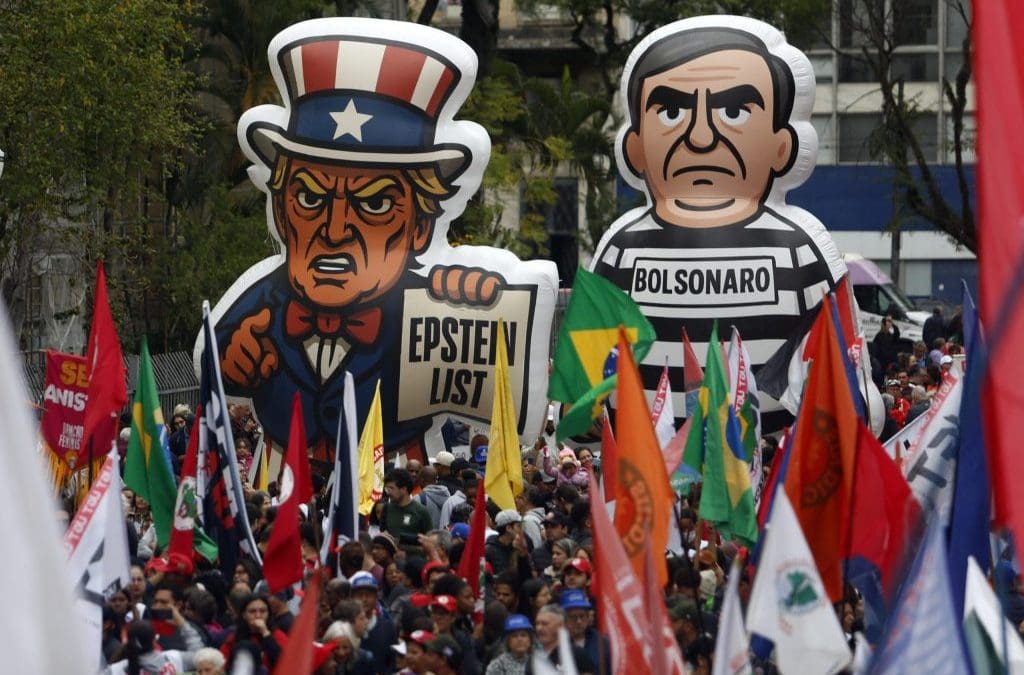
by Miguel Manso | Sep 30, 2026 | Article, bolsonaro, brazil, elections, Politics and Movements: International, Politics and Movements: US, Reprint, Trump
This story originally appeared in Panamerican Dispatch on Sep. 29, 2026, and is shared here with permission.
The close relationship between the Bolsonaro family and key figures in the international far right like Steve Bannon and U.S. President Donald Trump has been public knowledge for over eight years. In this article, tech specialist Miguel Manso looks at the state of that relationship, right now, just days before Brazil’s first-round presidential elections. – ed.
Just days before the first round of Brazil’s presidential election, a confidential report from the Brazilian Intelligence Agency (Abin) warns that the United States is influencing the country’s electoral process. Titled “Threats to the 2026 Electoral Process,” the report was sent in late August to the presidency, the Superior Electoral Court and the Justice Ministry, warning that U.S. interference has reached a “critical” level.
Sen. Flávio Bolsonaro’s campaign has become the target of legal action over claims that it benefited from paid ads and mass messaging originating in the United States.
The coalitions backing Luiz Inácio Lula da Silva of the Workers’ Party and Renan Santos of the Missão party asked the Superior Electoral Court and the Supreme Federal Court to investigate the senator for economic and political abuse of power and foreign interference.
The court filings allege the following:
Foreign amplification: U.S.-based right-wing profiles and influencers, including American political figures, allegedly ran paid campaign content on X in support of Flávio Bolsonaro.
Paid partnerships: The posts, labeled “paid partnership,” cited figures from the foreign betting platform Polymarket to claim that Bolsonaro was the favorite, distorting the actual state of Brazilian polling.
Prohibited financing: The parties allege that this amounts to the use of funds
by Lisa Song | Sep 30, 2026 | Disability, Disabled Voters, elections, News, Office of Management and Budget (OMB), Russell Vought, Save America Act, Voter Registration, Voting
Without Amy Miller, some elderly and disabled people wouldn’t be able to vote. The attorney for Disability Rights Nebraska travels the state, investigating the quality of nursing homes and assisted living facilities. As she reminds the residents how they can report abuse or neglect, she also offers voter registration forms. Last month, she helped a veteran with a traumatic brain injury fill…
Source