by Steve Benen | Nov 4, 2026 | 2026 election, Congress, elections, Maddowblog
It’s easy to forget that after a group of House Republicans successfully ousted then-Speaker Kevin McCarthy three years ago, his successor, Louisiana’s Mike Johnson, was not the GOP’s first choice.
Or the party’s second choice. Or its third. Or its fourth.
Rather, Johnson was the Republicans’ fifth choice when he was elected, stumbling into a job for which he was not fully prepared. He nevertheless managed to hang on to his gavel, largely by becoming a rather pitiful lapdog to Donald Trump.
But as the midterm elections approached, and it appeared all but certain that the GOP would lose its House majority, Johnson faced awkward questions about whether (and how) he would maintain his Republican leadership post in the aftermath of failure.
As recently as three weeks ago, the House speaker told CBS News, “In the unlikely scenario where we lost the majority, I would expect my colleagues would ask me to continue leading this conference, even if we have divided government.”
The morning after a historic voter smackdown, his colleagues did not ask Johnson to continue leading the conference. On the contrary, as MS NOW confirmed with two House GOP leadership sources, the outgoing House speaker told his staff on Tuesday morning that he wouldn’t run for House minority leader, ending his tenure as a congressional leader.
Whether Johnson intends to abandon his congressional seat altogether is not yet clear, but for now, the Louisianan is paying a real price for failure.
There will be plenty to say about his hapless time with the speaker’s gavel, but in the short term, there’s a more immediate question to consider: Who will lead the House Republican minority in
by Erin Reed | Nov 4, 2026 | 2026 Elections, 2026 midterms, Abdul El-Sayed, Alabama, Anti-trans, campaign ads, Democrats, elections, Elon Musk, Gender-Affirming Care, James Talarico, LGBTQ Rights, Michigan, midterms, Montana, Op-Ed, Republicans, Texas, Trans Rights, trans youth
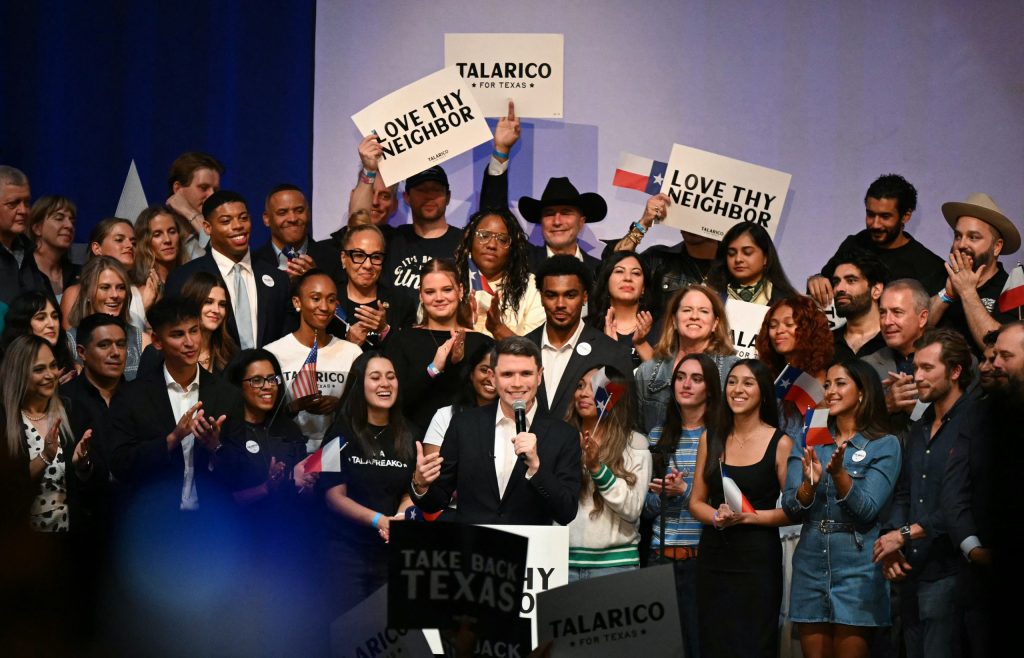
By now, you have likely seen the results of the 2026 midterms: a wave election for Democrats the likes of which we have not seen in years. Republicans and their allies spent nearly $200 million on anti-transgender ads alone, bankrolled in part by billionaires like Elon Musk. Virtually every Democrat in a highly contested race was the target of these kinds of ads. And what did it buy the Republican…
Source

by Jake Johnson | Nov 4, 2026 | Article, Economy, Economy and Inequality, elections, midterms, Politics and Movements: US, Reprint, Texas
by Derek Seidman | Nov 4, 2026 | 2026 midterms, AIPAC, Billionaires, Campaign Finance, Democratic Socialism, DSA, elections, News, Super PACs
The U.S. midterm elections are rapidly approaching, and it’s no secret that the Republican Party and Donald Trump want to destroy the rising electoral left in the United States. But as democratic socialist and movement-tied candidates continue to win Democratic primaries — building momentum and distinguishing their dynamic, grassroots campaigns from consultant-molded establishment politicians — a…
Source
by Steve Benen | Nov 4, 2026 | 2026 election, elections, Maddowblog, White House
About a week ago, The New York Times’ Nate Cohn, the newspaper’s top elections data analyst, reviewed four possible scenarios for the midterm elections. The fourth was easily the worst-case scenario for the Republican Party.
In this scenario, Cohn wrote, Democrats would win a large majority in the House, “maybe 250 seats,” and 53 or more Senate seats, marking “the beginning of a new chapter of American politics.”
“In today’s polarized era,” the analysis added, “it can be hard to believe that any party could win in this kind of tsunami.”
As the dust settles on Election Day 2026, according to MS NOW’s projections, Democrats are on track to hold at least 250 House seats and at least 54 Senate seats. The outcome that seemed “hard to believe” has actually happened.
The magnitude of the Democratic victories is so stunning that the political world is struggling to settle on the best disaster metaphor. “Wave” is common but insufficient. “Tsunami” works, and I’ve seen a lot of “earthquake” headlines. The National Review, a prominent conservative magazine, went with “Armageddon,” which certainly brought a dramatic flair, and Punchbowl News embraced a related theme, describing the results as “an extinction-level event for President Donald Trump’s party on Capitol Hill.”
In the coming hours, days, weeks and months, Republicans will try to absorb their historic smackdown, fixating on counterfactual “what if” questions.
What if Trump had spent his first two years working on border security and his golf game, while letting the strong Biden-era economy continue to hum along?
What if “Liberation Day” hadn’t happened, there had been no White House trade tariffs and the economy had been able to grow
by Rep. Ro Khanna | Nov 4, 2026 | Congress, elections, Opinion
Tuesday was a great day for democracy. Millions of Americans voted against war, corruption and a broken economy.
Tens of millions of Americans have been struggling to pay for basics — healthcare, housing, childcare, food and energy. Millions more have lost hope for a better future. And while so many Americans are struggling to get by, the wealth of the country’s 935 billionaires — the top 0.001% of households –– rose 21% in 2025.
While the midterm results provide much to celebrate, they also present a big question: Where do Democrats lead from here?
Play
DNC Chair: ‘We’re going to tackle this affordability crisis’ and ‘take on this corrupt system’
November 3, 2026 / 05:14
President Donald Trump’s policies have worsened our inequality, and the current direction of artificial intelligence is deepening our economic divisions. But this destructive inequality predates the current corrupt administration and emerging technologies. This path traces back more than four decades, to the 1981 Economic Recovery Tax Act, through the gutting of antitrust enforcement and Nafta, and the so-called One Big Beautiful Bill Act.
The midterm outcomes present an opportunity for a new direction guided by an affirmative agenda.
That reaffirmation begins with a common national purpose. To close the economic gulf, Democrats need to develop an ambitious economic project with the same “bold, persistent experimentation” that guided Franklin D. Roosevelt through the New Deal. Business, workers, universities and government need to join together to foster economic development and revitalization.
The economic patriotism I’m talking about is not a gauzy slogan. But it is America’s Next New Deal.
Play
Georgia voters speak out about affordability: ‘Things are getting worse’
November 3, 2026 / 09:40
Let’s start with public