by Steve Benen | Jun 11, 2026 | Economy, Maddowblog, News, Politics
Headed into this week, analysts expected to see another surge in inflation, and on Wednesday morning, those projections proved true: The consumer price index climbed to its highest level since April 2023, and inflation continued to outpace wage growth, exacerbating the affordability crisis.
The data left the White House not only with a policy challenge but also with a political one. How would Donald Trump and his team try again to convince the American public that the unpopular and unnecessary war in Iran is worth the economic sacrifice?
As it turned out, the president decided not to even make the effort. Instead, when asked for his reaction to the latest discouraging news, the Republican said the latest inflation data was “great,” adding, “I love the inflation.”
Reporter: Are you concerned, Mr. President, about the latest inflation number which came out this morning?Trump: No, I love it. I love the inflation.— Acyn (@acyn.bsky.social) 2026-06-10T16:09:56.011Z
He later told The New York Post about the point he was trying to convey. “The numbers are going to be phenomenal because what’s showing is that despite the fact that we’re in a war, the numbers are much lower than anticipated, and when we’re out of that war, the numbers will be at lower numbers than they were even before it started,” the president said.
There were substantive problems with the defense — there’s no evidence to suggest that the “anticipated” inflation hike was even worse than the status quo, for example — coupled with the fact that Trump noticeably failed to provide this context when he was talking to the White House press corps, on the record and on camera.
by Steve Benen | Jun 10, 2026 | Economy, Maddowblog, News, Politics
For months, Donald Trump and White House officials had a habit of insisting that the president had delivered an economy with “no inflation.” The public has heard a lot less such talk lately, and there’s no great mystery as to why. CNBC reported:
The consumer price index, a broad gauge of goods and services costs across the U.S. economy, rose at a seasonally adjusted 0.5% for the month, putting the annual inflation rate at 4.2%, the Bureau of Labor Statistics reported Wednesday. Both numbers were in line with the Dow Jones consensus.
Inflation climbed above 4% for the first time in three years, though the increase met expectations amid concerns over how much the surge in energy prices would impact the economy. The level was the highest since April 2023 and above the 3.8% level from April.
The figures were entirely in line with a variety of related metrics related to the rising cost of living, including the Personal Consumption Expenditures index, the core personal consumption expenditures price index and wholesale prices, all of which recently hit three-year highs.
All that related data, incidentally, was released shortly before White House deputy chief of staff Stephen Miller told Fox News that Trump had transformed the U.S. into an “extraordinary paradise.”
As for what’s driving the discouraging data, it is — to the surprise of no one — energy costs that are pushing prices higher, which is the direct result of the war with Iran.
Perhaps most importantly, NBC News’ report emphasized that inflation’s rise “has surpassed wage growth,” which necessarily exacerbates the affordability crisis gripping American consumers.
The White House has not yet commented on the new data,

by Brad Reed | Jun 4, 2026 | AI, Article, Climate Change, Climate Crisis, Economy, Economy and Inequality, Politics and Movements: US, Reprint
This story originally appeared in Common Dreams on June 04, 2026. It is shared here under a Creative Commons (CC BY-NC-ND 3.0) license.
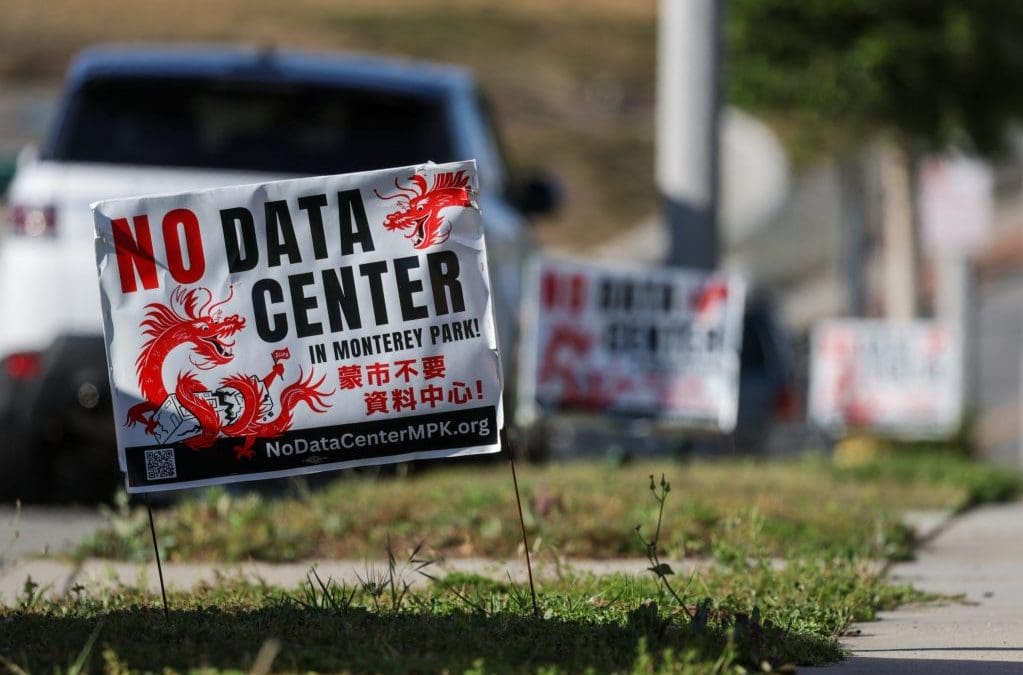
Voters in Monterey Park, California on Tuesday overwhelmingly approved a permanent ban on data centers within city limits, becoming the first city in the US to prohibit the power-hungry facilities via a ballot initiative.
In total, the anti-data center resolution passed with 86% voter support, with only 14% of voters opposed. The resolution’s text said that a ban was necessary to “protect air quality, drinking water resources, and public health” and “prevent impacts to electricity and water rates.”
Steven Kung, a leader of the local initiative, told ABC 7 Eyewitness News that the result was “a landslide victory.”
Kung listed multiple reasons why residents in the city resoundingly rejected building data centers in their community.
“The noise pollution, the air pollution, the rise in the electricity rates,” he said, “the deal just didn’t make sense and it doesn’t make sense for most, if not all, cities data centers go to.”
In an interview with Politico, Monterey Park Mayor Elizabeth Yang predicted that her city would be far from the last to pass data center bans, noting data center projects have spurred protests across the country.
“A lot of the other cities that are facing data center proposals are going to follow suit,” said Yang. “There’s [a] bad reputation across the board, across the country, from other data centers that have been built in neighborhoods.”
Monterey Park city councilmember Jose Sanchez expressed a similar sentiment, telling The Guardian that he hoped his city would become a inspiration to others.
“We hope that other communities will use the model set by residents here in Monterey Park,” said Sanchez, “as inspiration to stop
by Chris Walker | Jun 2, 2026 | Donald Trump, Economy, Inflation, K-shaped economy, Kevin Hassett, News, Polls
In a Fox News interview on Sunday morning, Kevin Hassett, director of the National Economic Council, disregarded Americans’ current ill feelings on the economy, instead suggesting that factors like rising prices are proof that Americans are “optimistic.” “People are spending more on gas, but they’re also spending more on everything else,” Hassett claimed in the interview.
Source
by C.J. Polychroniou | Jun 2, 2026 | Climate Crisis, Economy, Environment, Fossil Fuels, Interview, Just Transition
The evidence for rapid human-caused climate change keeps piling up, yet the world continues to flood the atmosphere with greenhouse gases amid a political backlash against the struggle for a future free of fossil fuels. Greenhouse gas emissions continue to grow, which means humans are continuing to make the climate crisis worse. Global average temperatures are expected to stay at record levels for…
Source
by Steve Benen | Jun 1, 2026 | Economy, Maddowblog, News, Politics
When Donald Trump sat down with Fox News’ Lara Trump for an interview that aired over the weekend, the president seemed eager to brag to his daughter-in-law about the state of the U.S. economy, which he said is “booming.” The Republican added, “We have a war going on and the economy is good. You know, today, we just hit another number: No. 69 is all-time high.”
To the extent that economic realities are still relevant to the White House, the economy is most certainly not “booming.” Indeed, in recent days, the administration has released fresh data showing American families struggling with weak economic growth, weak job growth and an affordability crisis.
As for the significance of “No. 69” reaching an “all-time high,” I tend to keep a pretty close eye on economic data, and I haven’t the foggiest idea what he was referring to. The only “69” I’m aware of is the percentage of Americans who disapprove of Trump’s handling of the economy, which is probably something he should avoid bragging about.
Trump, however, isn’t the only Republican struggling to come up with coherent talking points about the state of the economy. Kevin Hassett, the director of the White House National Economic Council, appeared on “Fox News Sunday,” and when host Shannon Bream asked about Americans’ reliance on credit cards to “get through necessities” because they can’t afford the cost of living, Trump’s chief economist tried to put a positive spin on the affordability crisis.
Hassett: “People are spending more on gas, but they’re also spending more on everything else — not just groceries, but restaurants and so on. I think that’s a sign