There’s a popular and recurring chant that echoed throughout the recent No Kings protests several weeks ago: “This is what democracy looks like.”
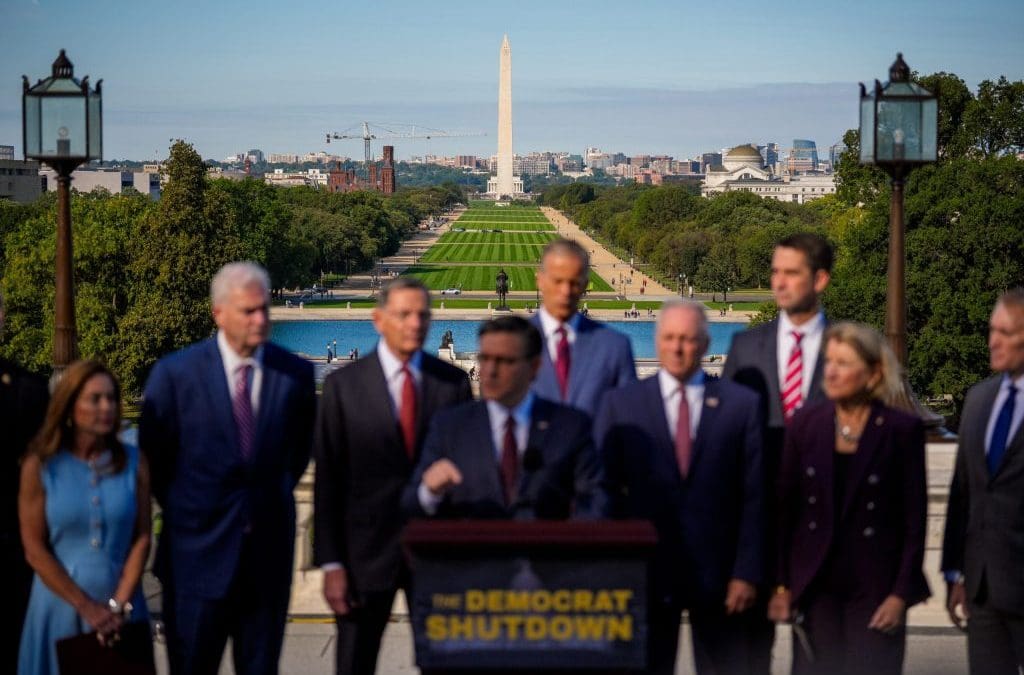
But on Capitol Hill over the past four weeks, during a protracted government shutdown, Republicans have been displaying the opposite.
The quiet, moribund center of American government looks anything but like a democracy. The deserted hallways and empty offices portend something radically different: a future where the messy work of legislating on behalf of the public is replaced by the whims of a ruling oligarchy.
In other words, Republicans are showing us what autocracy looks like.
To understand why, and the implications for the body politic, it’s critical to recount how their handling of the ongoing shutdown has been remarkably anti-democratic.
It began when Democrats refused to vote for a continuing resolution to fund the government last month. Democrats wanted Republicans to reauthorize expiring Obamacare tax credits, subsidies enacted during the pandemic to make insurance premiums more affordable for millions of Americans. Republicans allowed them to lapse in the so-called “Big Beautiful Bill.”
Democrats have called the end of these credits a crisis. The Congressional Budget Office estimates that 2.2 million people will lose health insurance if the subsidies aren’t renewed.
But instead of getting to work and negotiating, House Speaker Mike Johnson sent the entire legislative body home. It was not just an impractical move; it made the possibility of brokering any kind of deal exponentially more difficult.
Importantly, many of Johnson’s own constituents depend on the very programs his party has refused to fund. His district has one of the highest percentage of Medicaid recipients for a Republican controlled district in the country.
This week, Rep. Rob Garcia (D-California), the ranking Democrat on the House Committee on Oversight and Government Reform, announced that they will be creating a website to collect information on Immigration and Customs Enforcement (ICE) activities in an effort to track potential human rights violations. “We’re establishing a misconduct tracker to systematically document abuse and civil…
Source
As the current government shutdown enters its fourth week with no end in sight — making it the second-longest U.S. shutdown in history — two new polls suggest that most Americans are faulting Republicans for the standoff, with a plurality saying they support Democrats in Congress demanding negotiations on health care. President Donald Trump has thus far refused to discuss a possible solution…
Source
The top Democrat on the House Armed Services Committee has called for a hearing on the Trump administration’s strikes in the Caribbean after the White House officially escalated its aggression to target Colombia as well as Venezuela, completely bypassing Congress. Rep. Adam Smith (D-Washington) said in a statement that, over a month after the strikes first began, the Trump administration has…
Source
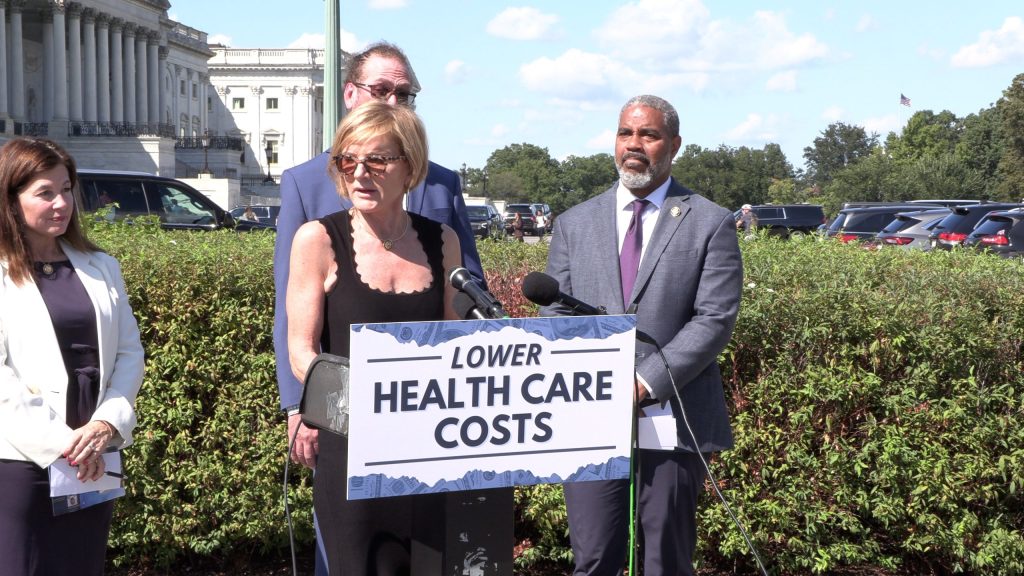
The meager collection of congressional Democrats standing outside the Capitol last Thursday belied the gravity of the policy on the agenda: the pending elimination of Obamacare tax credits.
“This isn’t a small thing, this isn’t something that is only going to impact the people who claim those credits,” Nevada Congresswoman Kristen McDonald Rivett argued.
“What we are going to see is that this is going to affect the cost of insurance of every single American.”
This has all the makings of a crisis. Which is why McDonald – Rivett and two other members of Congress stood in a hot September sun pleading with Republicans to renew them as part of a deal to fund the government.
“When Republicans repealed the tax credits for the Affordable Care Act, Republicans basically said we don’t care about Americans losing their health insurance,” Nevada Representative Susie Lee said.
But there’s a big difference between this policy dispute and conflicts in the past. This time, Republicans need Democratic votes to pass a looming spending resolution. Democrats have leverage.
The question is, will they use it?
The biggest obstacle is in the Senate. Republicans hold just 53 seats, seven short of the number need to bypass the filibuster and pass legislation.
House Republicans did approve a bill that would fund the government through November, but it failed in the Senate. Congress has until the end of the month to pass legislation to keep the government open.
Still, when we asked if they were willing to support a shutdown to force Republicans to restore the credits, the elected officials on hand were circumspect, if not muted.
“That’s the Republicans’ choice,” explained Rep. Steven Horsford (D-7), another Nevada Democrat house member who attended the press conference. “They have the power.”
And therein lies the rub. Because truthfully, in this case, Democrats are not without power. They just seem reluctant to wield it.
“Look, it’s the Republicans shutting down the government,” Schumer told CNN anchor Dana Bash. “What we are asking very simply is bipartisan negotiation.”
It’s a cautious approach that has proven ineffective for Democrats in the past. While Trump has indiscriminately issued dozens of executive orders, wielding power like a king, the Democrats have done little to counter him.
To be fair, Democrats might be playing their cards close to the vest. Openly threatening a shutdown now could be premature, and allow Republicans to portray them as obstructionists.
But Democrats have substance on their side, and the power to do something about it. The loss of ACA subsidies has real implications for real people
. Forcing a shutdown would provide a stage to make this clear to the public. At the very least, people would know who to blame for the increase in health premiums if Republicans refuse to budge.
That’s what’s at stake for the Democrats. Trump and his Republican cohorts have grown accustomed to winning. He’s so confident he’s willing to fight on any political stage to prove it.
To beat him, the Democrats have to be willing to do something he does all the time: take risks and be bold. The shutdown is a good place to start. The Democrats need to figure that out before it’s too late.
It’s clear that the Democratic Party, and the Liberal-Left more broadly, is in total disarray. As the Trump administration continues to erode liberal norms, worker protections, due process, free speech, and civil liberties, there’s a broad consensus that the most impactful way to push back against Trump’s unprecedented power grab is at the ballot box in 2026 and 2028. The stakes for these elections couldn’t be higher, and thus the approach Democrats take to do so couldn’t be any more salient. Attempting to get ahead of this narrative, and steer the party away from anything with even the vaguest whiff stench of Left populism, are a recent constellation of think tanks, PACs, and “movements” designed to keep the fundamentally neoliberal, billionaire-approved Democratic Party fundamentally neoliberal and billionaire-approved.
But simply appealing to the status quo wouldn’t be credible after the Democratic Party has fallen to their lowest point in over 40 years (if not 100). So these factions are creating pseudo-worldviews and political frameworks that are meant to appear bold and forward-looking, but are ultimately just a rebranded defense of the party establishment. And we know this because, to the person, they are funded by the same billionaire donors that have shaped democratic politics for decades and are working in concert with party leaders looking to deflect blame for their own repeated failures.
There have been several centrist efforts hatching in the marshes of DC this year, but for the purposes of this essay we will focus on three high-profile ones that launched in 2025: the so-called Abundance Movement, Majority Democrats PAC, and the Searchlight Institute. They differ somewhat in approach and branding but all operate under the same false premise: that Vice President Kamala Harris lost to Trump last November not because the party had become too centrist, or too inauthentic, or spent decades alienating labor, or campaigned too much with Liz Cheney, or threw too many constituencies under the bus, or was backing a horrific, generation-defining genocide
. Instead it was because Harris—and the party brand in general—had somehow gone too far to the Left. The evidence for this premise, as I will lay out, is wanting. But it’s become conventional wisdom in elite liberal circles, first and foremost, because it lets everyone in elite liberal circles off the hook.
Indeed, it’s an exceedingly convenient narrative for the billionaires backing these factions. Post-2024 loss, if I’m a Democratic consultant or “strategist” wanting to hoover up money to “rebuild the party” and polish my personal brand, I won’t find much funding by telling wealthy liberal donors that the problem with the party is that it sold out the working class and didn’t do nearly enough during the Biden years to win them back, or that it needs to embrace bold redistributive policies like Medicare for All or stronger labor unions, or that it needs to embrace Sanders-Mamdani-style politics of class conflict, less hawkish foreign policy, and unapologetically progressive stances on “social issues.” Obviously, this would not only prevent me from getting millions to start my own “institute” or “movement” and being featured in glossy puff pieces in the New York Times, it would actively upset these donors and effectively ice me out of funding networks.
Thus, the buyer’s market for supposedly new “thinkers” and “movements” that will repackage the existing power structure as edgy, bold, and new is hotter than ever. Enter: these three projects.
The Abundance Movement – Broad Network/Buzzword
Unlike the other two factions on this list, the Abundance faction isn’t a specific group, but a deliberately vague, supposedly post-ideological worldview that, its supporters claim, can include everyone from socialists to the far right. In practice, however, the movement is textbook neoliberalism. Primary boosters of this “movement” include Silicon Valley and Wall Street-funded organizations like the Niskanen Center, Arnold Ventures, Open Philanthropy, Emergent Ventures, increasingly many elements within the Koch Brothers network, the overtly rightwing American Enterprise Institute, and a smattering of other billionaire-backed organizations and passthroughs. Henry Burke of the Revolving Door Institute recently published a detailed report
laying out each blade in the sprawling carpet of astroturf.
Since its two primary thought leaders, the New York Times’ Ezra Klein and the Atlantic’s Derek Thompson, published their book, Abundance in March 2025, the movement, such as it is, has received largely fawning, uncritical coverage in our media due in large part to the movement’s so-vague-as-to-be-unobjectionable premise. Their pitch goes something like this: The reason why liberalism is falling out of favor is because it “no longer builds” anymore. It’s a tempting solution and one that not only rejects class politics as a path out of the woods, but embraces its opposite: further enriching and empowering the wealthy through deregulation so they can “innovate” and “build” us back to prosperity. They will sometimes throw in “building state capacity” rhetoric as an appeal to left-leaning types to throw them off the neoliberal stench, but it’s—at best—an afterthought.
If this sounds like “the Good Things Plan”, a politics so generic and devoid of serious rigor that it can basically be anything to anyone, that’s because it is. This genericness, combined with its total lack of class politics and heavy emphasis on deregulation, is a major reason why it has sucked up so much billionaire money and elite media buy-in. Adding urgency to this dynamic, and a good explanation for the gobs of Silicon Valley cash backing it, is the rapidly increasing AI energy demands
that the US can, by its backers’ own admission, only meet by massively “streamlining” safety, climate, and environmental review for new energy production, including that of new fossil fuel extraction. Which, once again, worked out well for those in power.
Majority Democrats – PAC
A rebrand of previous centrist initiatives, Majority Democrats pins the blame for Democratic Party woes on “woke.” They vaguely gesture toward the Democrats shedding support in the working class, but largely chalk up this loss to “cultural” factors (see: changes that won’t offend billionaire donors) rather than the party takeover by corporate forces.
“These Younger Democrats Are Sick of Their Party’s Status Quo,
” reads the obligatory New York Times launch puff piece, framing the astroturf effort as an organic youth movement. “Majority Democrats, a new group of elected officials from all levels of government, has outsized ambitions to challenge political orthodoxies and remake the party,” the New York Times informs its readers.
How exciting! What bold new subversive project is Majority Democrats doing to win over working class and younger voters? Ending US support for genocide in Gaza? Medicare for All?
Again, when one needs to repackage More Of The Same donor-friendly politics but make it seem new and fresh and subversive (most often in opposition to a fictitious Woke Establishment), there’s really only one place to go: become more bigoted.
Alas, the New York Times piece is light on specifics. There’s a lot of “trading best practices” and “debating and developing ideas,” but little moral or political vision on offer. (“Majority Democrats has yet to issue policy prescriptions,” The Times notes, as if it’s an afterthought.) The group is said, however, to be embracing the advice of “Seth London, an adviser to major Democratic donors,” which is a somewhat incomplete biography in that it omits that Seth London is a multimillionaire venture capitalist
. But, we are told, he has access to donors, which is not seen as a conflict of interest that could, perhaps, undermine their nominal aim of “winning back working-class voters.” Instead, this access is presented as a mark of Seriousness.
In paragraph 19, the New York Times spells out what’s really going on:
“In some ways, the group’s structure resembles that of the Democratic Leadership Council, the once-influential group that successfully pushed the party to the middle in the Clinton era.
But while many of the officials involved in Majority Democrats similarly come from the center-left, organizers insist there is no ideological litmus test to join.”
Once again, they are aware of the branding problem of neoliberalism and its previous avatar, the Democratic Leadership Council. They want to gesture towards it to assure wealthy donors it’s a fundamentally centrist project, but throw in vague rhetoric about how they “don’t have an ideological litmus test” despite all its members being down-the-line pro-Israel centrists.
Again, when one needs to repackage More Of The Same donor-friendly politics but make it seem new and fresh and subversive (most often in opposition to a fictitious Woke Establishment), there’s really only one place to go: become more bigoted. There’s two general philosophies on how best Democrats can “win back working-class voters”: (1) what we can generally call the Bernie-Mamdani wing, becoming more aggressively Left, economically populist, and more anti-war (which the working class overwhelmingly is
); or (2) turn up the racism, transphobia, and anti-immigrant dial from 5 to 8 without any Left economic populism. Which one of these paths is more likely to appeal to wealthy donors? The answer, and thus the rhetoric and diagnosis of Democratic failures from these factions, is obvious.
Searchlight Institute – Think Tank
What if Democrats’ brand is in the toilet not because wealthy donors, Silicon Valley, or Wall Street have outside influence on their policies and made them divorced from Labor, pro-“free trade,” and run by dead-eyed lawyers, but it was, instead, because far-Left activists were manipulating the party behind the curtain and forcing candidates into taking unpopular positions? This is the general theory being promoted by Sen. John Fetterman’s former Chief of Staff Adam Jentleson and his team of centrist operators, who last week launched the Searchlight Institute, a new “think tank” making a similar pitch to that of Majority Democrats PAC: that Democrats’ central problem is they have become too Woke. Specifically, Jentleson pins Harris’ loss on “the groups,” namely the ACLU, which asked Harris in 2019 if she supported healthcare for incarcerated trans people, which she did—a stance, it is now dogma in elite circles, that significantly contributed to her defeat by Trump, despite this claim having little to no empirical basis. But it vaguely feels true and, most essential of all, blames a fairly powerless constituency instead of the consulting class and their billionaire patrons.
This latest effort to rebrand neoliberalism, like Majority Democrats PAC, is clever enough to gesture towards populism, but does so in a superficial and class-flattening way. Indeed, the evercynical Jentleson keeps attempting
to take ideological credit for the success of New York City Democratic mayoral nominee Zohran Mamdani, despite the fact that Jentleson never supported his candidacy and has been openly hostile
and smug
towards the pro-Palestine movement that made up the backbone of Mamdani’s early, evangelical volunteer core
.
In the New York Times obligatory launch puff piece for Searchlight
, published last week, they would, per usual, allow these centrist operators to advance the entirely unfounded idea that Mamdani’s primary win somehow proves their centrist theory of change works because something something “affordability.” (Abundance partisans use this gambit
as well, because Mamdani said he is open to market-rate housing, despite the fact they oppose basically everything else in his platform. But victory, as they say, has a thousand fathers.)
Since Ms. Harris’s loss, many in the party have adopted a more economic-focused message while avoiding social issues. Some prominent Democrats, like Gov. Gavin Newsom of California, have backtracked on prior support for transgender rights and open immigration policy. The most prominent liberal candidate to capture the party’s imagination this year, Zohran Mamdani, decisively won the Democratic primary for mayor of New York with an intense focus on the affordability of housing, groceries and child care.
Reading this, one would think Mamdani, like Newsom, also “avoided social issues,” but he very much did not. In addition to being openly combative with ICE
during the campaign, repeatedly pledging to defend trans New Yorkers
, and promising to defend abortion
, Mamdani put on fundraising events with Mahmoud Khalil, the former Columbia Gaza protest leader targeted by Trump. Indeed, Mamdani is exhibit A on how one marries robust Left economic populism and progressive “cultural” stances seamlessly, without needing to throw either under the bus. But the New York Times, without any basis, accepts Jentleson’s dishonest narrative and presents Mamdani as the opposite.
This is a popular sleight of hand, and one also advanced by influential centrist pollster David Shor
: the conflation of “focusing on affordability” grounded in clear class-oriented left populist politics—in Mamdani’s case born out of the Democratic Socialist of America—and what Jentleson and Shor are doing when they say Democrats need to “focus on affordability,” which is mainly a rhetorical box-checking exercise untethered from broader class politics. Neither Jentleson nor Shor push for renewing labor, bringing union leaders into the fold, or pushing for major redistributive policies that would meaningfully empower the working class such as Medicare for All—all of which Mamdani does. They instead act as if the working class can be tricked into voting Democrat with tweaks around the margins, more acceptance of bigotry, and better “messaging” that uses the right “affordability”-adjacent language.
In paragraph six, the New York Times casually mentions the rub with Jentleson’s Searchlight Institute: “The organization is subsidized by a roster of billionaire donors highlighted by Stephen Mandel, a hedge fund manager, and Eric Laufer, a real estate investor.”
The use of “roster” and “highlighted” implies there are several more billionaire donors. TRNN emailed Searchlight to find out who these other billionaire donors were. Searchlight did not reply to our request for comment.
But this is the buyer’s market right now: DC operators and careerists seeking support from a handful of mega-donors to “remake the Democratic Party” into an equally zionist, slightly more populist-sounding, exceedingly more racist and transphobic version of its 2024 self. And our media, ever indifferent to the broader structural forces backing these overnight “groups” and “movements,” treats all of this as largely organic, with no class interests, much less conflicts of interest. Everything is presented as good faith, simply Concerned With Pragmatic Necessities of Winning, and neoliberalism is rebranded as something novel and grassroots. And everyone in party leadership, big donor circles, and the wealthy consultancy class in power gets to, once again, remain in power.