by Lauren Harper | Aug 1, 2026 | Congress, Opinion
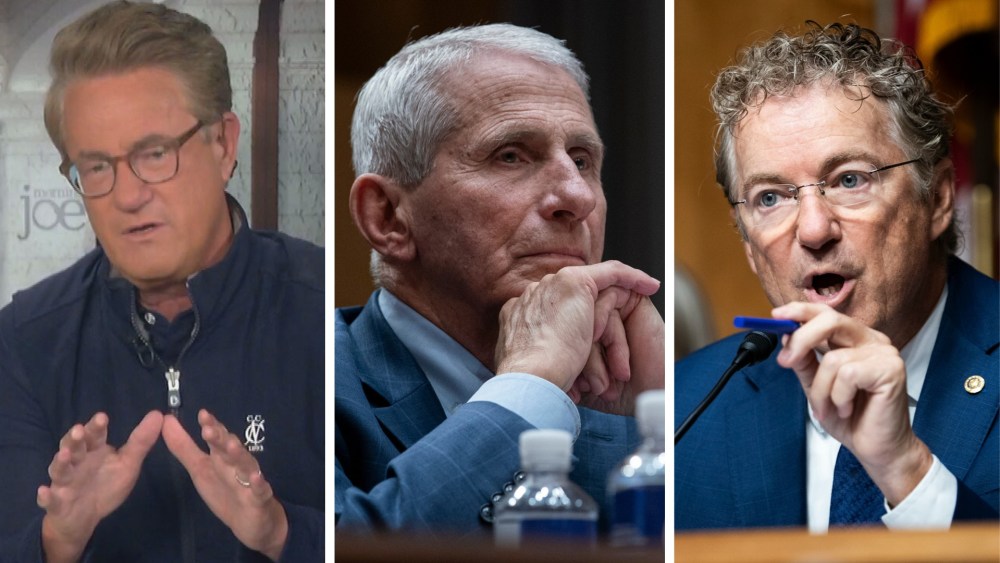
Dr. Anthony Fauci’s refusal to answer questions during this week’s hearing on the origins of the Covid-19 pandemic dominated headlines. But an underappreciated irony of the controversial hearing is that we are only capable of debating Fauci’s accounting for his pandemic performance because he preserved his records in the first place.
This same level of public scrutiny is rapidly becoming impossible across the rest of the federal government. Rather than engaging in genuine transparency, the Trump administration is selectively releasing records that align with its political priorities while actively shredding its own paper trail.
This week’s hearing focused on over a thousand pages of diary entries written by Fauci between 2019 and 2022 — which Fauci argued were personal — that were obtained by Sen. Rand Paul, R-Ky., from Health and Human Services Secretary Robert F. Kennedy, Jr., and published online days before the hearing.
While the administration publishes Fauci’s unredacted diaries, it is simultaneously proposing a government-wide nondisclosure agreement to muzzle federal workers from sharing the very kinds of information Paul released.
Fauci condemned the release as an invasion of his privacy, and while it’s true that the government should never release information without proper vetting, the preservation of Fauci’s records on government servers complicates claims that the records were purely personal. It’s also worth noting that some entries were already memorialized in Fauci’s 2024 memoir, or reiterated in media interviews, making them fair game for disclosure and demonstrating genuine public interest in the records.
A far better way to balance privacy rights and public interest in the records would have been through the Freedom of Information Act, where career professionals could redact sensitive
by Brian Lowry | Aug 1, 2026 | culture, Opinion
In his comic book origin story, Spider-Man, aka Peter Parker, painfully learns that “with great power comes great responsibility.” The focal point of “Spider-Man: Brand New Day” is a corollary of that truism: True heroism often requires selflessness and sacrifice. Those old-fashioned values resonate all the more forcefully in this era of social media’s showboating and clout-chasing influencers.
Tom Holland’s fourth solo outing as Spider-Man features the requisite action sequences, including the best use of the Hulk on screen that we’ve seen in some time. At the movie’s core, however, we see a hero wrestling with loneliness, having given up relationships with his closest friend and the woman he loves in the previous installment, “Spider-Man: No Way Home.”
At the movie’s core, we see a hero wrestling with loneliness, having given up relationships with his closest friend and the woman he loves.
Those action sequences notwithstanding, “Brand New Day” is a more deeply personal film, and it comes at a particularly fraught time both for the comic book movie and — without sounding too high-handed about it — America. “Brand New Day” appears destined to become a big fat hit — to the anticipated tune of more than $250 million in North America for its opening weekend, and better than twice that worldwide — and to provide Marvel a lift before the larger-scale “Avengers: Doomsday.” For the country, it offers a welcome distraction from a seemingly endless barrage of dreary headlines and general anxiety.
The central theme empowering “Brand New Day” is subtle, but it shouldn’t be overlooked. Thanks to Holland’s sensitive performance as Peter Parker/Spider-Man, a genuine angst permeates the film, reflecting the
by Michael Steele | Aug 1, 2026 | Opinion
It’s not a great time to be the head of the Democratic National Committee.
With fewer than 100 days until the crucial midterm elections, DNC Chairman Ken Martin is dealing with the fallout from a devastating New York Times story about the “troubled, broke” committee, comparing the party’s $2 million in debt to the Republican National Committee’s formidable campaign war chest.
Based on interviews with more than two dozen Democrats, the article includes some brutal allegations: the DNC asking vendors not to send bills until after the election to mask its debt problem, Martin throwing a phone at a junior aide and a staff paralyzed by fear of leaks.
I may not be a Democrat, but I feel Martin’s pain. As chairman of the Republican National Committee during the 2010 midterms, I faced similar criticism from the usual array of backseat drivers and Monday morning quarterbacks.
Rush Limbaugh lectured me to “go behind the scenes” and said “tens of millions of conservatives and Republicans” wanted “nothing to do” with the RNC under my leadership. Rep. Tom Cole — the former chairman of the National Republican Congressional Committee — demanded that I “apologize and resign” for questioning the war in Afghanistan. Major donors loudly announced they wouldn’t give money to the RNC as long as I led it. The Washington Post ran a report characterizing me as an “albatross for the GOP.”
Given all that, you would think we were headed for a historic loss.
Given all that, you would think we were headed for a historic loss. Instead, the opposite happened.
That cycle, the committee raised $164 million, even without having a president to help raise money.
by Ja'han Jones | Aug 1, 2026 | Opinion
Tens of thousands of Virginians have had their voting rights restored thanks to a move from Democratic Gov. Abigail Spanberger, her office announced on Friday.
Elections have consequences, to quote the truism. And as Republicans nationwide launch schemes to winnow the pool of eligible voters ahead of the midterms, it’s important to note that one consequence of Democrats’ victory in Virginia’s gubernatorial race last year is that many people who had been barred from voting will get to participate in the franchise this year.
Spanberger announced Friday that her office has restored voting rights for more than 66,000 people who have served their punishments after being charged with crimes.
In the announcement, the Secretary of the Commonwealth’s Office also said that it “is also accepting restoration of rights applications from Virginians through a streamlined, online system that removed unnecessary questions added during the Youngkin Administration,” which can be found at restore.virginia.gov.
NEW: Since taking office, we have restored the right to vote for more than 66,000 Virginians who served their time.Voting is foundational to who we are as Americans. These Virginians deserve to make their voices heard and take hold of their second chance.…— Governor Abigail Spanberger (@GovernorVA) July 31, 2026
As writer Dean Mirshahi explained for Virginia Public Media:
Virginia is one of three states that automatically strip someone’s right to vote after they’re convicted of a felony. The governor has sole authority to give someone these rights back, either through the restoration process once they’ve completed their felony sentence or via a pardon. Spanberger sharply criticized the process used by her predecessor, Republican Glenn Youngkin, who faced intense scrutiny over a case-by-case review system
by Ja'han Jones | Aug 1, 2026 | Opinion, White House, World
Donald Trump’s war on education, and intelligence in general, is ramping up with a xenophobic edge.
The president — who has said he loves “the poorly educated” — has launched a crusade on American universities in an effort to bring them under his control.
In his second term, Trump’s anti-intellectual campaign has intersected with his anti-immigrant agenda. A prime example of this came last year, when his administration suspended and canceled research grants and sought to revoke some student visas — which has led to a so-called brain drain from scientific fields.
And on Thursday, The Wall Street Journal reported that the administration is considering a $100,000 fee for foreign students looking to work in the U.S. after graduation. According to the Journal:
The Trump administration is considering attaching a $100,000 price tag on international students’ ability to work in the U.S. after they graduate from an American university, according to people familiar with the matter, a move that would make it much less attractive for foreigners to study in the U.S.
If enacted, the fee would significantly advance President Trump’s efforts to restrict nearly all forms of legal immigration. It would particularly harm universities, which rely on recruiting international students as a reliable source of revenue, as well as top Silicon Valley and Wall Street firms, which disproportionately hire international college graduates to fill technical roles.
A DHS spokeswoman told the Journal: “No policies should be considered final until formally announced. At DHS we are always having conversations about how to use all tools in our arsenal to protect the integrity of our legal immigration system.”
To be clear, I’ve seen nothing that suggests this proposal
by Anthony Coley | Jul 31, 2026 | Congress, Criminal Justice, Opinion
Acting Attorney General Todd Blanche would have us believe the story ended when he declared President Donald Trump’s proposed $1.8 billion “anti-weaponization” fund dead. It didn’t. Recent news this week shows the administration may not need that fund at all.
Two days before the Senate Judiciary Committee was set to vote Blanche’s nomination to be attorney general, the Justice Department announced a seven-figure payout to Paul Vaughn, an anti-abortion activist whom Blanche has described as a victim of Biden-era weaponization. Vaughn is not a Capitol rioter, and his case is not theirs. But The New York Times reported the settlement for what it is: proof that this DOJ is willing to use an existing federal statute — the Federal Tort Claims Act, or FTCA — to compensate people it believes were victims of political prosecution.
The DOJ doesn’t need a new commission or a special compensation fund to if it chooses to compensate Jan. 6 defendants.
No commission. No $1.8 billion fund. No press conference about “victims of lawfare” seeking redress. Just a settlement, quietly reached, through the same legal machinery that hundreds of Jan. 6 defendants are now lined up to use.
That machinery didn’t appear this week. It was there before there was a fund, and it will be there long after Blanche has finished talking about the fund as though it were the whole story.
Congress enacted the FTCA to compensate people harmed by government negligence or misconduct. It has been used to resolve claims involving everything from medical malpractice at Veterans Affairs hospitals to the FBI’s failures preceding the massacre at Mother Emanuel AME Church. It was designed to compensate victims