by Michael Steele | Aug 1, 2026 | Opinion
It’s not a great time to be the head of the Democratic National Committee.
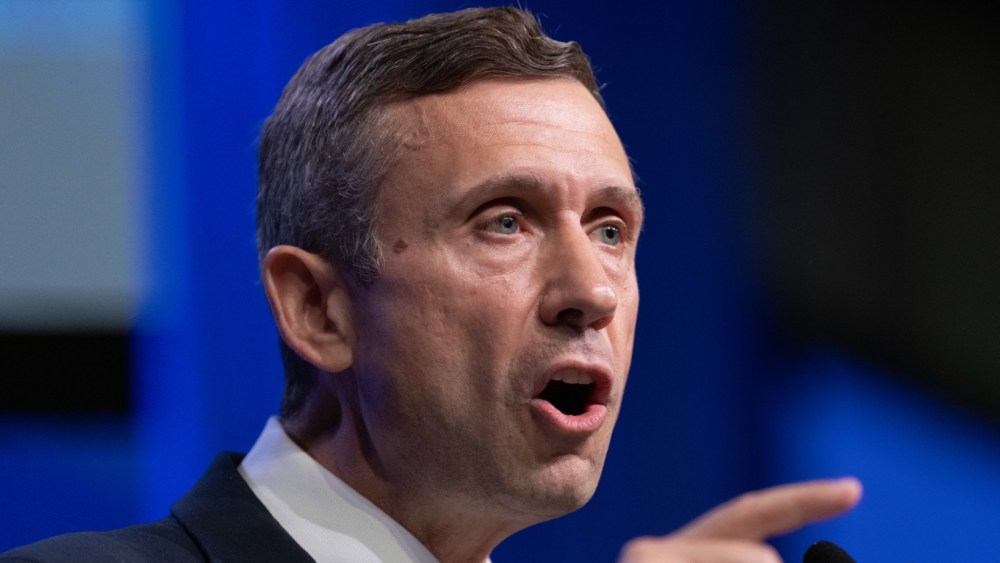
With fewer than 100 days until the crucial midterm elections, DNC Chairman Ken Martin is dealing with the fallout from a devastating New York Times story about the “troubled, broke” committee, comparing the party’s $2 million in debt to the Republican National Committee’s formidable campaign war chest.
Based on interviews with more than two dozen Democrats, the article includes some brutal allegations: the DNC asking vendors not to send bills until after the election to mask its debt problem, Martin throwing a phone at a junior aide and a staff paralyzed by fear of leaks.
I may not be a Democrat, but I feel Martin’s pain. As chairman of the Republican National Committee during the 2010 midterms, I faced similar criticism from the usual array of backseat drivers and Monday morning quarterbacks.
Rush Limbaugh lectured me to “go behind the scenes” and said “tens of millions of conservatives and Republicans” wanted “nothing to do” with the RNC under my leadership. Rep. Tom Cole — the former chairman of the National Republican Congressional Committee — demanded that I “apologize and resign” for questioning the war in Afghanistan. Major donors loudly announced they wouldn’t give money to the RNC as long as I led it. The Washington Post ran a report characterizing me as an “albatross for the GOP.”
Given all that, you would think we were headed for a historic loss.
Given all that, you would think we were headed for a historic loss. Instead, the opposite happened.
That cycle, the committee raised $164 million, even without having a president to help raise money.
by Ja'han Jones | Aug 1, 2026 | Opinion
Tens of thousands of Virginians have had their voting rights restored thanks to a move from Democratic Gov. Abigail Spanberger, her office announced on Friday.
Elections have consequences, to quote the truism. And as Republicans nationwide launch schemes to winnow the pool of eligible voters ahead of the midterms, it’s important to note that one consequence of Democrats’ victory in Virginia’s gubernatorial race last year is that many people who had been barred from voting will get to participate in the franchise this year.
Spanberger announced Friday that her office has restored voting rights for more than 66,000 people who have served their punishments after being charged with crimes.
In the announcement, the Secretary of the Commonwealth’s Office also said that it “is also accepting restoration of rights applications from Virginians through a streamlined, online system that removed unnecessary questions added during the Youngkin Administration,” which can be found at restore.virginia.gov.
NEW: Since taking office, we have restored the right to vote for more than 66,000 Virginians who served their time.Voting is foundational to who we are as Americans. These Virginians deserve to make their voices heard and take hold of their second chance.…— Governor Abigail Spanberger (@GovernorVA) July 31, 2026
As writer Dean Mirshahi explained for Virginia Public Media:
Virginia is one of three states that automatically strip someone’s right to vote after they’re convicted of a felony. The governor has sole authority to give someone these rights back, either through the restoration process once they’ve completed their felony sentence or via a pardon. Spanberger sharply criticized the process used by her predecessor, Republican Glenn Youngkin, who faced intense scrutiny over a case-by-case review system
by Ja'han Jones | Aug 1, 2026 | Opinion, White House, World
Donald Trump’s war on education, and intelligence in general, is ramping up with a xenophobic edge.
The president — who has said he loves “the poorly educated” — has launched a crusade on American universities in an effort to bring them under his control.
In his second term, Trump’s anti-intellectual campaign has intersected with his anti-immigrant agenda. A prime example of this came last year, when his administration suspended and canceled research grants and sought to revoke some student visas — which has led to a so-called brain drain from scientific fields.
And on Thursday, The Wall Street Journal reported that the administration is considering a $100,000 fee for foreign students looking to work in the U.S. after graduation. According to the Journal:
The Trump administration is considering attaching a $100,000 price tag on international students’ ability to work in the U.S. after they graduate from an American university, according to people familiar with the matter, a move that would make it much less attractive for foreigners to study in the U.S.
If enacted, the fee would significantly advance President Trump’s efforts to restrict nearly all forms of legal immigration. It would particularly harm universities, which rely on recruiting international students as a reliable source of revenue, as well as top Silicon Valley and Wall Street firms, which disproportionately hire international college graduates to fill technical roles.
A DHS spokeswoman told the Journal: “No policies should be considered final until formally announced. At DHS we are always having conversations about how to use all tools in our arsenal to protect the integrity of our legal immigration system.”
To be clear, I’ve seen nothing that suggests this proposal
by Anthony Coley | Jul 31, 2026 | Congress, Criminal Justice, Opinion
Acting Attorney General Todd Blanche would have us believe the story ended when he declared President Donald Trump’s proposed $1.8 billion “anti-weaponization” fund dead. It didn’t. Recent news this week shows the administration may not need that fund at all.
Two days before the Senate Judiciary Committee was set to vote Blanche’s nomination to be attorney general, the Justice Department announced a seven-figure payout to Paul Vaughn, an anti-abortion activist whom Blanche has described as a victim of Biden-era weaponization. Vaughn is not a Capitol rioter, and his case is not theirs. But The New York Times reported the settlement for what it is: proof that this DOJ is willing to use an existing federal statute — the Federal Tort Claims Act, or FTCA — to compensate people it believes were victims of political prosecution.
The DOJ doesn’t need a new commission or a special compensation fund to if it chooses to compensate Jan. 6 defendants.
No commission. No $1.8 billion fund. No press conference about “victims of lawfare” seeking redress. Just a settlement, quietly reached, through the same legal machinery that hundreds of Jan. 6 defendants are now lined up to use.
That machinery didn’t appear this week. It was there before there was a fund, and it will be there long after Blanche has finished talking about the fund as though it were the whole story.
Congress enacted the FTCA to compensate people harmed by government negligence or misconduct. It has been used to resolve claims involving everything from medical malpractice at Veterans Affairs hospitals to the FBI’s failures preceding the massacre at Mother Emanuel AME Church. It was designed to compensate victims
by Zeeshan Aleem | Jul 31, 2026 | Congress, elections, Opinion
Reflecting on his time taking a wrecking ball to the government last year, Tesla CEO Elon Musk recently confessed to The Economist that he believes he “got a little too involved in politics, got carried away, frankly.” But not so carried away, apparently, so as to deter him from trying again.
Axios, citing sources with knowledge of the plan, reported that Musk is “jumping into the midterms with a huge investment in a plan to boost Republican voter turnout.” He’s doing that by “resuscitating his dormant super PAC, America PAC, which spent more than $260 million to help get President Trump elected in 2024.” (An America PAC spokesperson told Axios that “we’re excited to again be part of the team.”) Musk’s backing of the operation gave him the plutocratic distinction of being the single-biggest political donor in a political cycle in American history.
Even as Musk seeks to boost the fortunes of the GOP, he also comes with potential political costs.
But that doesn’t mean his money will be as effective this time around. Musk has revealed himself since then to be erratic and frequently self-defeating in his political maneuvering. And given that his favorability has tanked and is underwater, he provides Democrats with a ready-made villain in the election cycle.
So far, Musk has reportedly authorized America PAC to spend $100 million to $120 million. But it cannot be assumed that the commitment is rock solid, nor should we expect that it will necessarily rise to match the amount he committed in 2024. He has shown himself to be a fickle friend, and he might not be as invested in the outcome as
by Ja'han Jones | Jul 31, 2026 | Opinion
Officials around the world are looking to curb the scourge of artificial intelligence-generated porn and sexually explicit images online, some of which has been shown to be disturbingly childlike. And many have run into a common obstacle: Elon Musk.
Musk, whose brand of internet humor includes volunteering to “give” Taylor Swift a child and cracking jokes about a sexual misconduct allegation against him, has never really seemed serious about stemming creepy sexual behavior on his social media platform, X. And he has come under fire after X launched a tool that allowed users to generate nonconsensual sexually explicit imagery through the platform’s AI chatbot, Grok.
Despite pressure from the Trump administration on Musk’s behalf, the backlash over that tool led to several countries launching investigations. And in Minnesota, lawmakers overwhelmingly passed a law designed to stop AI from being used to stop what’s called “nudification” technology. As CBS Minnesota reported in May:
The bill “prohibits the access, download, or use of nudification technology, except when the website, app, or software requires the substantial application of technological or artistic skill by a human creator directing and controlling the output,” according to the House. It targets programs that use AI to fabricate a nude photo or pornographic video from someone’s image.
Now, Musk’s company xAI is suing to kill the law before it goes into effect in August. Musk and President Donald Trump — both of whom have personally invested in AI companies — have tried to prevent states from regulating them.
As The Associated Press reported:
In the 38-page lawsuit, xAI – whose AI model chatbot and image generator Grok is available on the social media platform