by Branko Marcetic | Mar 11, 2026 | Article, Iran, Israel, Politics and Movements: International, Politics and Movements: US, Reprint, Trump, War
This story originally appeared in Jacobin on Mar. 10, 2026. It is shared here with permission.
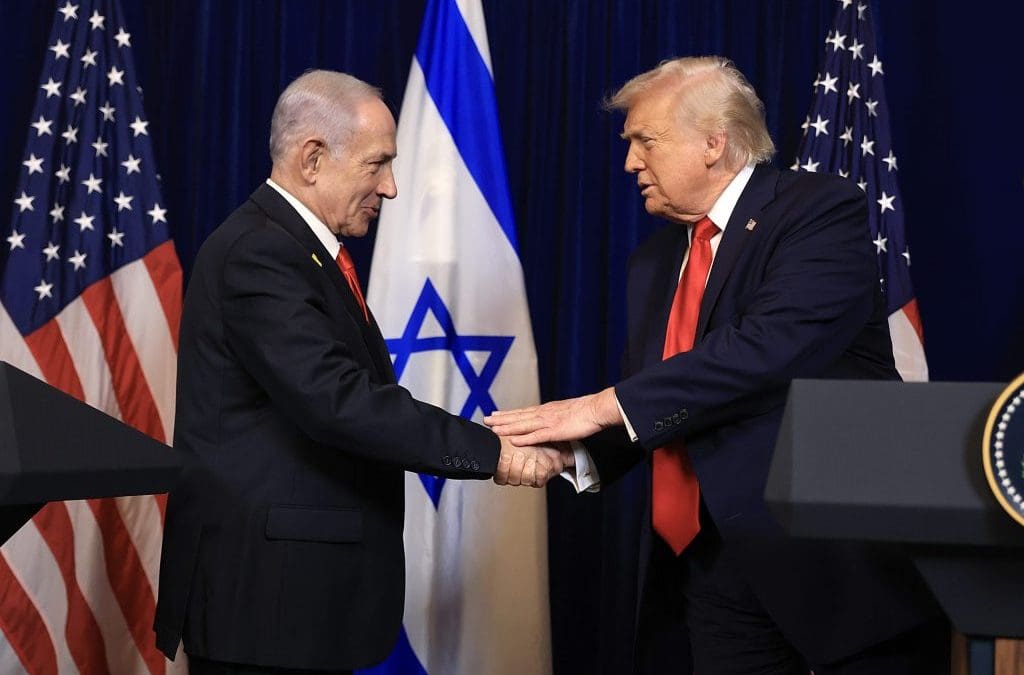
Over the weekend, the Washington Post was the latest to publish a claim that Israeli prime minister Benjamin Netanyahu used the threat of launching a war with Iran solo as a way to pressure Donald Trump into the disastrous war he has now embroiled the United States in. It’s at least the fifth piece of evidence now suggesting that the United States was pushed into this war by Israel, and that the very military support that Washington provides Israel has served as the mechanism to do it.
It’s tempting to see this as a deliberate way to dump responsibility for this horror show onto Israel and divert it away from the US president, who ordered it, and the US foreign policy establishment as a whole, which has salivated over a war with Iran for decades. But we have mounting evidence that Israel bears a huge amount of responsibility. Which raises the question: If Israel was indeed able to successfully trigger a US-Iran war, is any ceasefire or lasting peace possible here without Israel’s approval? This is particularly relevant to an American public that foots the bill for Israel’s war-making.
According to the Post, Netanyahu, “increasingly alarmed” that Trump might actually solve the Iran issue peacefully, repeatedly rushed to Washington over the past few months to make sure he went to war instead. A “key component of his drive to war,” reports the Post, was telling Trump that Israel would go ahead and attack Iran with or without his help, which “led Trump to believe an Israeli attack was inevitable” and that his best
by Sharon Zhang | Mar 10, 2026 | Defense Contractors, Donald Trump, Iran, Israel, News, Pentagon, Pete Hegseth
The U.S. dropped nearly $6 billion worth of munitions on Iran in just the first two days of the U.S.-Israeli assault, officials say, giving a sense of the staggering scope of the carpet bombing campaign as the Trump administration sweeps aside affordability crises at home. Three U.S. officials told The Washington Post that the U.S. dropped $5.6 billion in the first two days of its…
Source
by Amy Goodman | Mar 10, 2026 | Air Pollution, Fossil Fuels, Interview, Iran, Israel, Oil, Strait of Hormuz, Tehran, Trump Administration, Ukraine
Oil prices surged past $100 a barrel this week as the U.S.-Israeli war against Iran threatens global energy supplies and the broader economy. Iranian officials say no oil will be allowed to leave the Middle East until the bombardment stops, raising fears of disruptions in the Strait of Hormuz, the waterway through which about 20% of the world’s oil and gas flows. This comes as Israel has struck…
Source
by Sharon Zhang | Mar 10, 2026 | Donald Trump, Iran, Israel, News, Oil, Pete Hegseth, Stocks
President Donald Trump claimed that his war on Iran is “very complete” just before markets closed on Monday, causing oil prices to calm — then contradicted himself a few hours later, promising to “not relent” as the U.S. and Israel carried out some of worst bombardments of the war all the while, locals said. In an interview with CBS on Monday afternoon, Trump said, “I think the war is very…
Source
by Sasha Abramsky | Mar 10, 2026 | AfD, Alternative for Germany (AfD), Asylum, Asylum Seekers, Deportation, Deportations, Europe, far right, France, Germany, immigration, Iran, Israel, Italy, Nigel Farage, Op-Ed, Reform U.K. Party, Refugees, Spain, UK
Earlier this week, as the U.S.-Israeli war on Iran intensified, U.K. Reform Party leader Nigel Farage doubled down on his anti-immigrant and anti-refugee stances. If, he declared, refugees start leaving Iran in large numbers, they will have to be housed in the Middle East; Britain simply can’t take in any more. Farage spoke about the U.S.-Israeli operation in Iran in glowing terms.
Source
by Amna Ahmed Dmeida | Mar 10, 2026 | Displacement, Famine, Gaza, Genocide, Israel, Op-Ed, Palestine, Ramadan
For decades throughout Gaza, Ramadan had a familiar shared rhythm: the smell of soup rising from kitchens, the sound of plates being set, and children hurrying to the place where everyone would meet. For my family, that place was always my grandma’s house. Now everything feels different. Ramadan still arrives, but something essential is missing. This is the first Ramadan we’ve observed…
Source