by Steve Benen | Jul 23, 2026 | Iran, Iran Tensions, Maddowblog, News, Politics
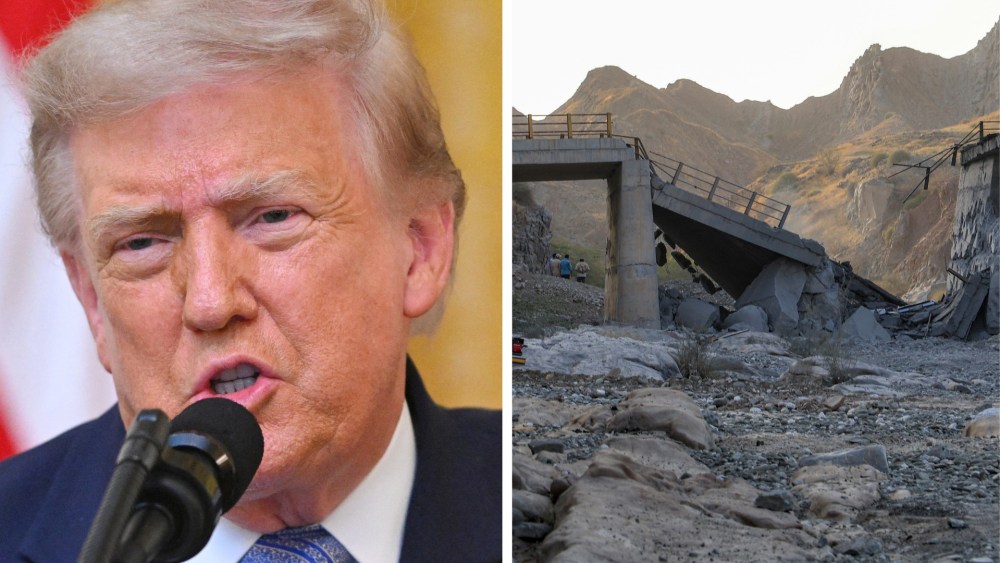
During a brief Q&A with reporters on Wednesday morning, Donald Trump was reminded that most Americans oppose the war in Iran. The president immediately pushed back against the assertion.
Q: Americans are firmly against this war—TRUMP: Well, Americans aren’t against the war. A poll just came out. Americans don’t want high gasoline prices, but they’re not against the war. That just came out loud and clear in a poll.— Aaron Rupar (@atrupar.com) 2026-07-22T13:54:36.364Z
“Well, Americans aren’t against the war,” he said. “A poll just came out: Americans don’t want high gasoline prices, but they’re not against the war. That just came out, loud and clear, in a poll.”
Trump has spent much of his political career referring to survey data that exists only in his imagination — up to and including making up approval ratings for himself, citing data that he thinks ought to exist. So when the president told reporters about a poll that “just came out,” he didn’t elaborate, probably because he was making stuff up again.
To the extent that reality matters, plenty of polls show just how wrong the Republican is about public attitudes toward the ongoing military operations.
Last week, for example, the latest Washington Post-Ipsos poll found that 68% of Americans believe the war was not worth fighting. The wars in Iraq and Afghanistan were also unpopular, but according to previous Washington Post polls, public opposition to the current war in Iran is even worse than attitudes toward those other recent conflicts.
Similarly, the latest Fox News poll found 66% of Americans disapprove of Trump’s handling of U.S. policy toward Iran.
It’s possible the president discards such data because the surveys
by Steve Benen | Jul 23, 2026 | Iran, Iran Tensions, Maddowblog, News, Politics
When it comes to U.S. service members who have made the ultimate sacrifice during the Iran war, Donald Trump has struggled to know what to say — and how to say it.
In early March, for example, the day after he launched combat operations, the president posted a prerecorded video to social media in which he tried to comment on the deaths of U.S. troops. “Sadly, there will likely be more,” Trump said. Appearing to break from the text on his teleprompter, he added, “Before it ends, that’s the way it is.”
A few days later, Time magazine asked the president whether Americans should be worried about possible retaliatory attacks from Iran. “I guess,” Trump replied. By the end of the first week of the war, the president had attended the dignified transfer of six fallen U.S. service members as they were returned home, but he defied American tradition and wore a baseball cap as caskets were carried from the plane.
The image that came into focus was a leader who appeared to be approaching his responsibilities with an unmistakable mix of disrespect and a blasé attitude about developments that he should have taken with a sobriety that he just couldn’t muster.
This week, as the U.S. death toll reached 18, the Republican appeared to use his social media platform to suggest that the total number of fatalities wasn’t that bad because other modern wars were even deadlier. On Wednesday morning, he again traveled to Dover Air Force Base to attend another dignified transfer (he didn’t wear a hat this time), but before departing for the event, the president spent a couple of minutes
by Steve Benen | Jul 22, 2026 | Maddowblog, News, Politics
In early June, when Donald Trump announced that he wanted Jay Clayton, the U.S. attorney for the Southern District of New York, to succeed Tulsi Gabbard as the director of national intelligence, it seemed easy to imagine congressional Democrats pushing back against the nomination in a serious way.
After all, not only does Clayton fail to meet the statutory qualifications for the position, but he’s also spent recent months targeting the president’s political opponents and defending absurdities such as the administration’s defunct $1.766 billion compensation fund.
But almost immediately, Democrats largely had the opposite reaction. Relieved to see Gabbard go, many key Democratic officials said they saw Clayton as a credible figure who would likely garner bipartisan support.
So much for that idea.
On Tuesday, Republican Sen. Tom Cotton of Arkansas, who chairs the Senate Intelligence Committee, announced that the panel had voted, 9-8, to advance Clayton’s nomination to the floor for a confirmation vote. (Because the Intelligence Committee often operates under secrecy, the vote was held behind closed doors.) The New York Times and Politico separately confirmed that Clayton received unanimous support from the panel’s GOP majority and unanimous opposition from the Democratic minority.
So what happened? What did Clayton do to alienate Democratic members who, just one month ago, were otherwise inclined to support his nomination? As it turns out, we know the answer: His confirmation hearing changed everything. MS NOW’s David Rohde reported last week:
Jay Clayton, President Donald Trump’s nominee to be director of national intelligence, appeared to speak to an audience of one in his confirmation hearing on Capitol Hill on Wednesday. That person was not one of the Republican or
by Steve Benen | Jul 22, 2026 | 2026 election, Maddowblog, News, Politics
Texas Attorney General Ken Paxton had already earned a reputation as the most scandal-plagued U.S. Senate candidate in recent memory, though the Republican’s troubles have managed to take a turn for the worse.
Just over the last couple of weeks, Paxton has been accused of using an address where he did not live while voting in recent elections and faced allegations that he and his estranged wife declared three separate homes as their primary residence in mortgage documents — a practice that his party has, in other situations, characterized as an outrageous abuse.
Complicating matters, property records now suggest the state attorney general, either in his personal capacity or through his trusts, now owns at least 15 properties worth roughly $9 million.
The good news is, Paxton finally held a press conference Tuesday — a “rare” occurrence for a politician who doesn’t seem to care for questions — offering journalists an opportunity to ask the Texan about his many controversies. The bad news is, Paxton didn’t want to answer any questions about his many controversies, and he then abruptly abandoned his own event when reporters treated him like a Senate candidate.
Wow — Ken Paxton and his team abruptly shut down a news conference and bail after journalists try to ask him about his various scandals— Aaron Rupar (@atrupar.com) 2026-07-21T18:41:31.642Z
“General, I wanted to give you a chance to respond to [Democratic state Rep. James Talarico] and his campaign,” one reporter said. “They’ve made a lot about the reports that have come out, one in The New York Times about you acquiring properties worth—”
At that point, Paxton, surrounded by 22 local sheriffs who support his

by Lt. Col. Rachel E. VanLandingham (ret.) | Jul 22, 2026 | Opinion, Politics, White House
In its recent strikes in Iran, the United States widened its targeting aperture to bomb sites directly serving the Iranian population, such as electrical power plants, bridges, railway stations and roads. By doing so, the U.S. deliberately chose to inflict greater suffering on Iranian civilians. Over 500 Iranians have reportedly been injured this month, and more than 50 people, including children, have been killed. And those numbers don’t capture the full harm, such as sheer terror, caused by the destruction of items and resources vital to daily civilian life.
Attacking facilities and places that contribute to Iranian military action or are expected to do so in the future, and whose destruction provides the attacker military advantage, can be lawful — even if on a day-to-day basis such facilities and places serve ordinary civilians. That is, strikes are lawful if U.S. commanders reasonably assess that such targeted infrastructure meet the law of war’s “effective contribution to military action” test and that expected harm to civilians isn’t excessive.
Regardless of legality, the U.S. targeting Iranian infrastructure used by civilians is likely to cause far more civilian deaths than those caused by targeting purely military objects.
According to the law of war, “military action” is quite broad and can be indirect, such as a war-supporting activities and, for the U.S, even so-called war-sustaining activities. Power plants can be considered lawful military objectives even if they don’t directly serve a military base, because, according to the Department of Defense’s Law of War manual, they “are generally recognized to be of sufficient importance to a State’s capacity to meet its wartime needs of communication, transport, and industry so
by Jarvis DeBerry | Jul 20, 2026 | Congress, Opinion, Politics, White House
Sen. Bernie Moreno, R-Ohio, and President Donald Trump proclaimed themselves furious that smoke from Canadian wildfires blanketed much of the Northeast and Midwest last week. How dare Canada be on fire and let its smoke waft across the border, when making it harder for Americans to breathe is a domestic responsibility?! This country has plenty of polluters ready and willing to burn our nostrils, eyes and throats. Americans should be choking on smoke made in the USA.
Last week, I was in northeastern Ohio, where the disturbingly hot weather was exacerbated by a smoky haze. Canadian smoke also diminished visibility when my family drove into Cleveland three summers ago. But here’s the thing: Some Ohioans report that there have been instances of sight-clouding pollution for much longer. Indeed, Mark Naymik, an editor at Signal Cleveland, wrote Thursday on X, “I don’t want to downplay the seriousness of the wildfire smoke, but I will to sound very Cleveland. A slightly more cynical colleague remarked, ‘This is what Cleveland looked like every day in 1977. And smelled worse.’”
How dare Canada let its smoke waft across the border when making it harder for Americans to breathe is a domestic responsibility?!
About 90 minutes later, Moreno responded to Naymik, in some of his first comments about the smoke.
“I’ll be introducing a bill next week to sanction Canada and the responsible Canadian government officials for this atrocity,” he said.
Slow down, senator. Atrocity? Let’s reserve that term for large-scale acts of wickedness, not disputes among neighbors regarding accusations of poor forest management.
The president further ramped up the senator’s hyperbole on Friday on his social media site. Trump wrote