by Lt. Col. Rachel E. VanLandingham (ret.) | Oct 1, 2026 | Opinion, Politics, White House
Secretary of Defense Pete Hegseth’s typical culture war-laden, right-wing manosphere-infused sophomoric rhetoric was on full display Wednesday during his disturbing State of the Force address to midlevel enlisted service members and military officers assembled at Quantico.
Exactly a year ago Hegseth had used Quantico as a bully pulpit to ridicule and deride almost the entire cadre of then-serving generals and admirals — calling them fat; extolling a hypermasculine “warrior culture” seemingly ripped from the historic Christian Crusades that included a “war on woke”; excoriating past efforts at promoting diversity, equity and inclusion within the ranks; and goading senior officers who didn’t agree with his attacks on meritocracy or his campaign to erode the military’s apolitical nature to resign.
Play
Iraq War Vet Rieckhoff calls Hegseth’s speech a ‘SNL cold open’
October 1, 2026 / 08:03
Such rhetoric should be taken seriously. Hegseth has been busy turning such rhetoric into reality, reversing decades’ worth of professionalism and efficacy gains in the armed forces, degrading national security in the process. Further, Hegseth exercises huge influence within the Trump administration — he reportedly counseled President Donald Trump to attack Iran — and has been floated as Trump’s heir apparent to the White House. His words cannot be ignored.
Now, a year after his initial Quantico address and numerous Hegseth-led assaults on the U.S. military — including a purge of 10% of senior officers (he’s now promised 20%); the subversion of merit-based senior leader promotion processes along gender, racial and ideological lines; the expulsion of thousands of experienced transgender members with critical skill sets; a suppression campaign against non-MAGA-aligned service member speech; and far more — it wasn’t much of
by Reynold Verret | Sep 29, 2026 | education, Opinion, Politics
This week’s deadline for some student borrowers to exit a government loan program before their bills could double or triple is likely reigniting concerns about whether a college education brings a sufficient return on investment. This conversation is not new, but the Trump administration raised the significance when the U.S. Department of Education announced new rules this summer that tie a university’s access to student loans to how much that school’s graduates earn.
Even without that announcement, American families are increasingly questioning the value of a college education as an investment, and higher education institutions must address that concern with seriousness and transparency. Families deserve assurance from those of us who lead colleges and universities that what we provide will make their students’ lives better. Those students and their families invest years of their lives and substantial financial resources in higher education, and they have every reason to expect higher education institutions to demonstrate that their investment produces meaningful results.
If we make the salary a graduate earns the principal measure of the value of a college education, then we risk replacing all the benefits of that education with what is easiest to count.
Xavier University of Louisiana, where I serve as president, is one of the Top Four producers of pharmacists in the United States, and our school is also a leading producer of Black graduates who earn medical degrees.
However, if we make the salary a graduate earns the principal measure of the value of a college education, then we risk replacing all the benefits of that education with what is easiest to count.
A paycheck is indeed a good measure of the
by Adam Hudacek | Sep 27, 2026 | Iran, News, Politics
The U.S. is expected to start another round of peace talks with Iran this week, President Donald Trump said Sunday, just one day after nixing an Iranian proposal aimed at ending the months-long conflict.
The comment marked a slight softening from Saturday, when Trump said his administration rejected new terms proposed to them by Iranian negotiators.
“They want to make a deal, but it is not the deal that I want to make,” he told Axios in a phone call Sunday. “It is what we would have maybe agreed to a year ago. They overplayed their hand.”
The prospect of renewed negotiations could offer a sliver of hope for a number of Republicans running in tight races, many of whom have recently called for a decisive end to the unpopular war before voters head to the polls in November.
U.S. envoys Steve Witkoff and Jared Kushner had held indirect negotiations with Iranian officials during the U.N. General Assembly in New York last week, but the two sides remain far from a compromise. Iran is focused on the U.S. naval blockade complicating shipping through the Strait of Hormuz, the critical waterway it commandeered at the start of the war, while the Trump administration insists its priority is concessions in Tehran’s nuclear program.
The indirect negotiations were also occurring against the backdrop of Trump’s speech made on the General Assembly floor, during which he wondered aloud if he should “annihilate the Islamic Republic.”
Trump has frequently hinted at new rounds of productive talks, virtually since the U.S. and Israel launched strikes on the Middle Eastern nation in February.
Administration officials initially said the operation would last about six weeks,
by Jeremy Busby | Sep 27, 2026 | Opinion, Politics
In the summer of 2023, 65-year-old Bernie Tiede, the former mortician serving a life sentence for a murder that inspired Richard Linklater’s dark comedy “Bernie,” suffered a stroke. He was housed in a cell without air conditioning in a Texas prison. With the assistance of several high-profile celebrities, including Linklater and Matthew McConaughey, Tiede filed a civil rights lawsuit demanding air conditioning for everyone incarcerated in the Texas prison system. Over 21 other incarcerated individuals and several criminal justice reform groups joined the litigation.
On Tuesday, their efforts paid off.
U.S. District Judge Robert Pitman ordered Texas prison officials to “immediately create and implement a plan” that would provide air conditioning to the entire incarcerated population by the end of 2029.
I watched numerous men pass out in the common areas, the dining hall, or inside their cells from heat-related illnesses. Some even died.
For those who have endured more severe heat waves and other extreme weather, climate change may have only recently evolved from an abstract concern into a full-fledged crisis that directly impacts them.
But for those incarcerated inside of the nation’s prisons and detention centers, extreme weather has been a crippling health emergency for decades.
Hundreds of thousands of incarcerated individuals are literally being cooked to death inside carceral facilities across the U.S. that largely operate without universal air conditioning.
Incarcerated people in southern states like Texas, Louisiana, Mississippi, Georgia and Florida have been the most vulnerable.
For almost three decades, I have watched each notoriously hot Texas summer become more unbearable and deadly than the last for the nearly 140,000 men and women held inside of the state’s prison system — including myself.
I entered
by Anthony Coley | Sep 27, 2026 | Opinion, Politics
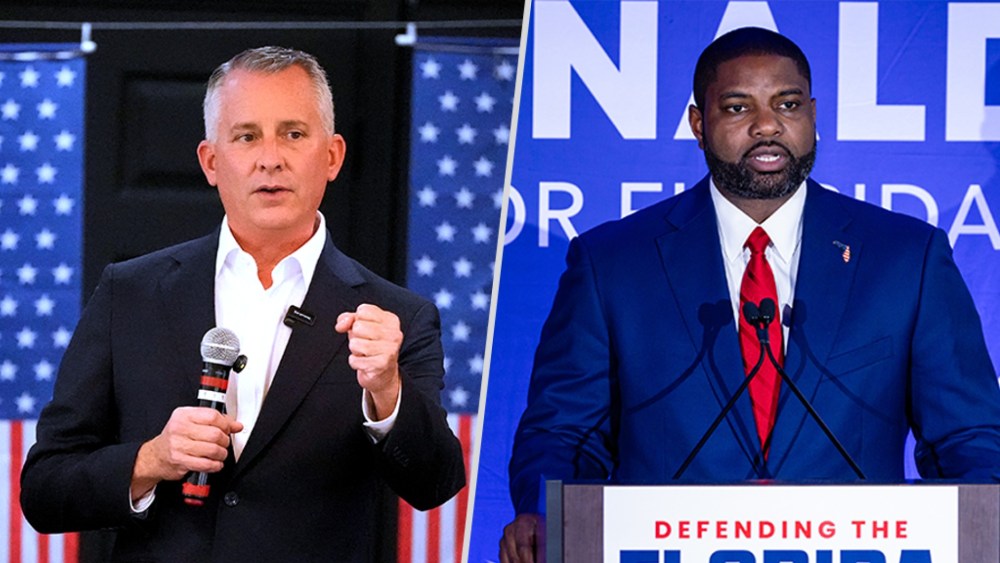
On paper, Florida looks like the perfect place for Rep. Byron Donalds to make history as the country’s first elected Black Republican governor.
Republicans have won every Florida governor’s race this century. President Donald Trump carried the state three times. Gov. Ron DeSantis won re-election by nearly 20 points. Republicans now hold a voter registration advantage of roughly 1.5 million.
Donalds, meanwhile, has nearly everything he’d seem to need: a national profile, formidable fundraising operation and close ties to the sitting president.
I’m still not convinced he’ll win.
Republicans have proved willing to nominate Black candidates for governor. But they haven’t yet found a candidate who can overcome the racial resistance some voters bring to the ballot box and assemble the general election coalition required to win.
Republicans have proved that they are willing to nominate Black candidates for governor. But they haven’t yet found a Black gubernatorial candidate who can defy political gravity, overcome the racial resistance some voters bring to the ballot box and assemble the general election coalition required to win.
Despite all the advantages listed for Donalds mentioned above, last week, Decision Desk HQ moved the governor’s race to a toss-up, the third forecaster in recent days to shift it toward Democrat David Jolly. A recent St. Pete Polls survey showed a statistical tie.We’ve seen this movie before, or at least the start of it: Ken Blackwell in Ohio and Lynn Swann in Pennsylvania in 2006; Daniel Cameron in Kentucky in 2023; Mark Robinson in North Carolina in 2024; and Winsome Earle-Sears in Virginia in 2025. Each of those Black candidates was held up by the GOP as proof that the party
by Charles F. Coleman Jr. | Sep 25, 2026 | culture, Opinion, Politics
The first episodes of Netflix’s reboot of “A Different Word” feel like they were ripped from recent headlines. The fictional Hillman College, which we were first introduced to almost 40 years ago on NBC, is struggling with federal budget cuts to historically Black colleges and universities, with what’s called enrollment management and dilapidated facilities. There are also nods to the current geopolitical consciousness of today’s students, who are protesting and demonstrating in keeping with the radical tradition of HBCU students of past years. We see them complaining about the same crumbling dormitories their parents occupied decades earlier and dealing with “purge day,” when those who can’t pay their tuition are unenrolled.
There’s also the star athlete whose father — a prominent character in the original series — worries that his son is forsaking better opportunities by playing for Hillman and would have access to better facilities and NIL money if he played at a predominantly white school. In this way, the series lays bare the realities that many HBCUs and the students themselves are grappling with.
When I was at Howard University at the turn of the millennium, I had classmates who decided to attend an HBCU because they’d watched “A Different World” every week as kids.
When I was at Howard University at the turn of the millennium, I had classmates who decided to attend an HBCU because they’d watched “A Different World,” a spinoff of “The Cosby Show,” every week as kids. According to The Atlanta Journal-Constitution’s UATL, “From 1986, the year before ‘A Different World’ premiered, to 1994, the year after it ended, HBCU enrollment rose from about 223,000 to