by Steve Benen | Jun 3, 2026 | Crime & Courts, Criminal Justice, Maddowblog, News, Politics
Two weeks after Election Day 2024, Republican Sen. Tommy Tuberville of Alabama assured the public that Donald Trump wouldn’t choose “a criminal” to serve in any key positions. Soon after, the president (himself a convicted felon) started adding politically aligned ex-cons to his administrative team.
But of particular interest are the Jan. 6 rioters who’ve been hired by the Republican administration, despite — or quite possibly, because of — the role they played in the attack on the U.S. Capitol.
Last summer, for example, Trump’s Justice Department hired Jared Wise, a former FBI agent who not only participated in the Jan. 6 riot, he was also filmed urging his fellow insurrectionists to “kill” police officers. (Though Wise was criminally charged, federal prosecutors didn’t have time to proceed with the case before Trump started handing out pardons to rioters, including violent felons who clashed with police officers.)
Wise parted ways with the administration a couple of months ago, but as it turns out, he wasn’t the only Jan. 6 rioter to get a job on Team Trump. The Washington Post reported:
A convicted Jan. 6 rioter who later said that he regretted his participation in the U.S. Capitol attack has been hired by the Trump administration to work inside a Pentagon office that manages highly classified military operations, according to four people familiar with the matter.
The appointment of Elias Irizarry, who was 19 at the time of the riot in 2021, to a post in the Defense Department’s Special Operations and Low Intensity Conflict office has raised alarm internally among staff who question how anyone convicted in the assault on American democracy could be trusted
by Steve Benen | Jun 2, 2026 | Maddowblog, News, Politics
When Donald Trump nominated former Rep. Tulsi Gabbard to serve as the director of national intelligence, there were a variety of obvious problems, including the inconvenient fact that she was spectacularly unqualified. During her confirmation hearings, however, the former Hawaii congresswoman was at least able to point to some handling of intelligence during her military service.
This satisfied Senate Republicans who confirmed her to the role, though Gabbard announced her resignation two weeks ago.
There’s been some speculation about her possible successor, and while the president hasn’t formally announced his new nominee, on Tuesday morning he published a statement on his social media platform alerting the public to his acting DNI choice. The missive read in its entirety:
I am appointing the Director of the Federal Housing Finance Agency, and Chairman of Fannie Mae/Freddie Mac, William J. Pulte, to serve as Acting Director of National Intelligence. William has deep experience managing the most sensitive matters in America, the safety and soundness of the Markets, and over 10 Trillion Dollars at Fannie Mae/Freddie Mac, a substantial increase from where it was just 12 months ago. During this period, he will remain Director of the Federal Housing Finance Agency, and Chairman of Fannie Mae/Freddie Mac. Congratulations to Director Pulte!
When identifying the single most outlandish personnel move of Trump’s second term, the competition is admittedly fierce, though this has to be near the top of the list.
Pulte has no experience whatsoever working in or around the U.S. intelligence community, no experience in the military or national security, and has earned a reputation as a hyper-partisan Trump loyalist who’s tried to use his office to target the White House’s political
by Steve Benen | Jun 1, 2026 | Maddowblog, News, Politics
The first step was taken in September. President Donald Trump ordered a deadly military strike against a civilian boat in international waters, and according to the White House, the operation killed 11 people. Two weeks later, there was another, followed by a third strike four days later.
Week after week, month after month, the operations kept going, as the administration continued to target these boats and kill much of their crews. The Associated Press reported late Friday on the latest strike, and the crossing of a stunning fatality benchmark:
The U.S. military said it carried out another strike Friday on a boat accused of smuggling drugs in the eastern Pacific Ocean, killing three men in the third attack this week and pushing the overall death toll above 200 people.
U.S. Southern Command announced the latest strike in the monthslong campaign against alleged drug boats traversing the Caribbean Sea and eastern Pacific with its usual language that the vessel was “engaged in narco-trafficking operations” and operated by a designated terrorist organization. It provided no evidence.
According to The New York Times’ updated tally, Friday’s strike was the 62nd since the campaign began in September, and the overall death toll now stands at 205.
When the number of strikes against civilian boats in international waters first started climbing, the entire policy didn’t just generate front-page headlines, it also faced foundational questions about the propriety of the military campaign.
Roughly nine months later, the strikes have become so common that the coverage has moved off front pages, but the underlying questions haven’t changed.
They also haven’t been answered.
We don’t know whether there have been other strikes that haven’t been disclosed.
by Steve Benen | Jun 1, 2026 | Economy, Maddowblog, News, Politics
When Donald Trump sat down with Fox News’ Lara Trump for an interview that aired over the weekend, the president seemed eager to brag to his daughter-in-law about the state of the U.S. economy, which he said is “booming.” The Republican added, “We have a war going on and the economy is good. You know, today, we just hit another number: No. 69 is all-time high.”
To the extent that economic realities are still relevant to the White House, the economy is most certainly not “booming.” Indeed, in recent days, the administration has released fresh data showing American families struggling with weak economic growth, weak job growth and an affordability crisis.
As for the significance of “No. 69” reaching an “all-time high,” I tend to keep a pretty close eye on economic data, and I haven’t the foggiest idea what he was referring to. The only “69” I’m aware of is the percentage of Americans who disapprove of Trump’s handling of the economy, which is probably something he should avoid bragging about.
Trump, however, isn’t the only Republican struggling to come up with coherent talking points about the state of the economy. Kevin Hassett, the director of the White House National Economic Council, appeared on “Fox News Sunday,” and when host Shannon Bream asked about Americans’ reliance on credit cards to “get through necessities” because they can’t afford the cost of living, Trump’s chief economist tried to put a positive spin on the affordability crisis.
Hassett: “People are spending more on gas, but they’re also spending more on everything else — not just groceries, but restaurants and so on. I think that’s a sign

by Anthony Coley | May 30, 2026 | Opinion, Politics
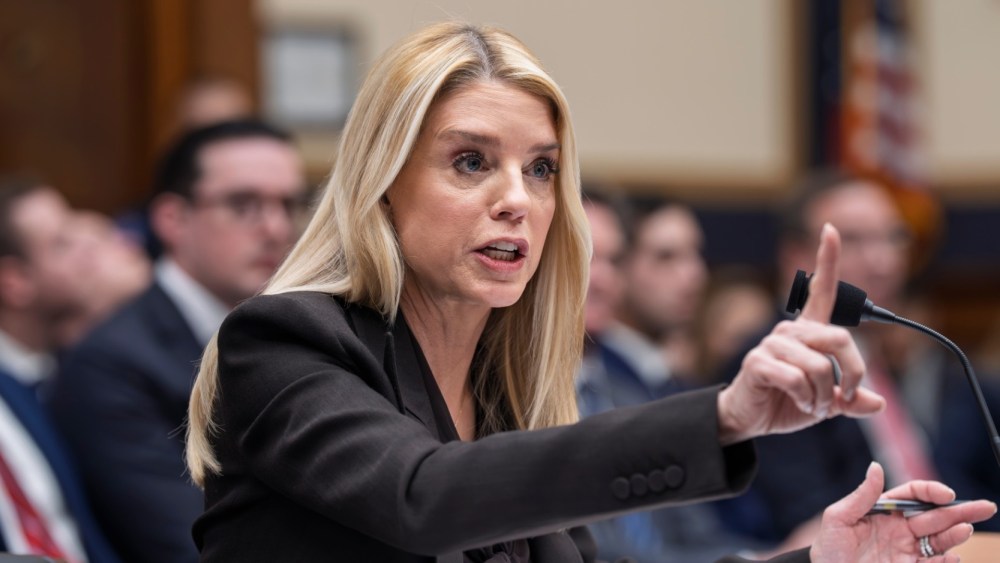
Former U.S. attorney general Pam Bondi demonstrated Friday that she would rather the public believe the controversy surrounding the Justice Department’s handling of the Epstein files belongs to someone else now — perhaps acting Attorney General Todd Blanche or FBI Director Kash Patel.
It doesn’t.
Bondi owns every decision she made as attorney general. And before she was ousted by Trump in April, she ran a department that refused to meet with Epstein survivors, stalled disclosure demands and fought transparency even after Congress overwhelmingly ordered it.
Survivors can’t get a meeting but a GOP member of Congress gets the Situation Room. That tells us everything about the Justice Department’s priorities under Bondi’s leadership.
But the decision to refuse meetings with Epstein survivors and their attorneys stands out. Those survivors are women, many of whom were victimized as children, and they have spent years fighting a legal system and a political system that protected their abusers. They asked for a meeting. Bondi said no. She refused to even acknowledge their presence at her last congressional hearing.
Something else that stands out is a meeting Bondi’s Justice Department did make time for. Last November, Rep. Lauren Boebert was summoned to the White House Situation Room, a space usually reserved for matters of national security, where she was pressured not to support a discharge petition that would force a floor vote on disclosing the Epstein files. Think about that. Survivors can’t get a meeting but a GOP member of Congress gets the Situation Room.
That tells us everything about the Justice Department’s priorities under Bondi’s leadership.
Bondi once made accountability her brand. As Florida’s attorney general, she worked to clear a backlog
by Steve Benen | May 30, 2026 | Maddowblog, News, Politics
Donald Trump has probably grown accustomed to losing important legal fights, but as this week comes to an end, the president has suffered back-to-back setbacks in court.
On Friday morning, a federal judge blocked the administration from moving forward with its $1.776 billion compensation fund, which has been panned by members of both parties as a “slush fund,” and then on Friday afternoon, a different federal judge blocked a separate effort to add Trump’s name to the Kennedy Center for the Performing Arts.
U.S. District Court Judge Christopher Cooper said in a 94-page ruling, “The Kennedy Center’s organic statute makes crystal clear that the Center is to be named for President Kennedy, and it cannot bear any other formal name or public memorial based on the Board’s unilateral say-so. Congress gave the Kennedy Center its name, and only Congress can change it.”
The president’s allies apparently tried to convince the judge the rebranding was little more than adding an informal nickname, but Cooper, an Obama appointee, didn’t buy it. From the ruling:
The rechristening is not, as Defendants suggest, like calling the “Bureau of Consumer Financial Protection” the “Consumer Financial Protection Bureau,” which is merely a clerical rearrangement. Nor is it akin to calling the Federal National Mortgage Association “Fannie Mae,” which, as even the Defendants admit, is simply a “play on the pronunciation of its acronym.” The administration’s efforts to alter the names of other institutions — calling the Department of Defense the “Department of War,” for example — are beside the point. Most fundamentally, none of these examples implicate a presidential memorial that was legislatively intended to honor a specific public figure.