by Lauren Harper | Jul 21, 2026 | Congress, Opinion
Even as the Trump administration makes no secret of persecuting whistleblowers and cracking down on the press, the Defense Department is, with much less fanfare, seeking to curtail public access to unclassified records. While its latest move has drawn relatively little attention, it may pose the greatest systemic threat to accountability.
A proposal submitted to Congress last month would empower the military to exempt “Controlled Unclassified Information” from the federal Freedom of Information Act — effectively putting millions of files beyond the reach of taxpayers, and open-records laws, potentially forever.
The new rule could bury the vast majority of documents the Pentagon creates.
This unacceptable overreach could effectively shroud unclassified records in even more darkness than classified ones. It’s also part of a coordinated campaign to shield the administration from embarrassment and accountability.
So far, the administration’s go-to tactic to keep the public in the dark had been aggressively silencing journalists and their sources. The government subpoenaed several New York Times journalists this month, as well as their phone records and family communications, for reporting on security concerns over the luxury jet President Donald Trump accepted from Qatar. Rather than answering questions about the wisdom and legality of accepting the plane, the DOD and the Justice Department instead launched a joint leak task force to deploy the “full force of the law” against whistleblowers and leakers.
This follows the Pentagon’s attempts to institute an unconstitutional media access policy to curtail reporting (a move that prompted most of its press corps to turn in their badges); the DOJ’s rollback of Biden-era guidelines that protected journalists during leak investigations; prompting all federal employees to sign nondisclosure agreements;
by Jarvis DeBerry | Jul 20, 2026 | Congress, Opinion, Politics, White House
Sen. Bernie Moreno, R-Ohio, and President Donald Trump proclaimed themselves furious that smoke from Canadian wildfires blanketed much of the Northeast and Midwest last week. How dare Canada be on fire and let its smoke waft across the border, when making it harder for Americans to breathe is a domestic responsibility?! This country has plenty of polluters ready and willing to burn our nostrils, eyes and throats. Americans should be choking on smoke made in the USA.
Last week, I was in northeastern Ohio, where the disturbingly hot weather was exacerbated by a smoky haze. Canadian smoke also diminished visibility when my family drove into Cleveland three summers ago. But here’s the thing: Some Ohioans report that there have been instances of sight-clouding pollution for much longer. Indeed, Mark Naymik, an editor at Signal Cleveland, wrote Thursday on X, “I don’t want to downplay the seriousness of the wildfire smoke, but I will to sound very Cleveland. A slightly more cynical colleague remarked, ‘This is what Cleveland looked like every day in 1977. And smelled worse.’”
How dare Canada let its smoke waft across the border when making it harder for Americans to breathe is a domestic responsibility?!
About 90 minutes later, Moreno responded to Naymik, in some of his first comments about the smoke.
“I’ll be introducing a bill next week to sanction Canada and the responsible Canadian government officials for this atrocity,” he said.
Slow down, senator. Atrocity? Let’s reserve that term for large-scale acts of wickedness, not disputes among neighbors regarding accusations of poor forest management.
The president further ramped up the senator’s hyperbole on Friday on his social media site. Trump wrote
by Carole House | Jul 20, 2026 | Opinion, Politics, White House
We are living through a technological transformation as significant as the birth of the internet, and the decisions Washington makes now will determine who bears responsibility when that technology is used to cause harm. Right now, however, Congress is getting its bill to rein in crypto dangerously wrong.
The CLARITY Act, sponsored by lawmakers who say it is needed to give federal regulators clear jurisdiction over crypto markets that currently fall through the cracks between the SEC and the CFTC, would create a separate regulatory framework for cryptocurrency. The bill may be well-intentioned, but it is riddled with dangerous loopholes that can be exploited by bad actors. For example, even if the bill were to become law, Iran’s Revolutionary Guard could continue laundering funds through decentralized finance platforms, which run on code rather than traditional banking rails, to fund proxy militias. Cartels, meanwhile, could continue using the same platforms to obscure proceeds from narcotrafficking.
Is it OK to deliberately design a system where nobody bears the responsibility?
Think about it this way: When something goes wrong in a powerful automated system, should there be someone responsible, or is it OK to deliberately design a system where nobody bears the responsibility? Under the CLARITY Act, the more a crypto or artificial intelligence system spreads control across algorithms, token holders and automated contracts, the less accountable it becomes. Under such a law, distributing responsibility would stop being a technical choice and become a legal choice to ensure that when fraud happens, when sanctions are evaded, when markets are manipulated, nobody is left holding the bag.
In short, the bill creates exemptions from financial accountability for
by Sen. Angus King | Jul 19, 2026 | Opinion, White House
Foreign adversaries have been working for years to divide Americans and, especially, to undermine public trust and confidence in our democratic system. Thursday night, President Donald Trump gave these efforts a tremendous boost, not to alert Americans to danger but to build a case for his takeover of our elections.
In some respects, the president’s speech was a big yawn. But it’s worth considering what he did and didn’t say to understand where we are and where things may be headed.
Play
Fact-checking Trump’s speech on alleged election tampering
July 16, 2026 / 09:37
Here are my key takeaways:
1. The intelligence specter that wasn’t. Despite breathless buildup by the White House before the speech, the big reveal was that China hoovered up voting lists and contemplated some kind of influence operation in the 2020 presidential election … and the 2016 election and the 2018 midterms and every election since. This has been reported by the U.S. intelligence community frequently over the past 10 years. The critical thing is that China didn’t carry out interference operations, which also has been previously known and widely reported.
2. The speech was purposely confusing. The president talked about the Chinese acquisition of voter databases without mentioning that anyone can buy voter information in most states. That followed by the suggestion that the Maduro regime manipulated voting tabulations in Venezuela in 2020 implied that China has done something similar here. The intelligence is unanimous that China didn’t.
Since Trump returned to office last year, his administration has set about deliberately sabotaging the capacity of the federal government to protect our election infrastructure.
3. The speech was massively hypocritical. Since Trump returned to office last year, his administration has set about deliberately sabotaging the capacity of the federal government to protect
by Lindsay Beyerstein | Jul 19, 2026 | Opinion, White House
“[A] lot of the people who are going and getting four-year degrees, they’re not like engineers and doctors. They have effectively fake jobs,” Vice President JD Vance told podcast host Mike Rowe last week. This is ironic, given that the Constitution doesn’t even give the vice president a full-time job. The position carries just two responsibilities: breaking ties in the Senate and not dying. Every vice president has to decide how to fill the rest of their time. Al Gore championed emerging technologies and the environment. Dick Cheney massively expanded the surveillance state. Vance goes on podcasts to spread conspiracy theories.
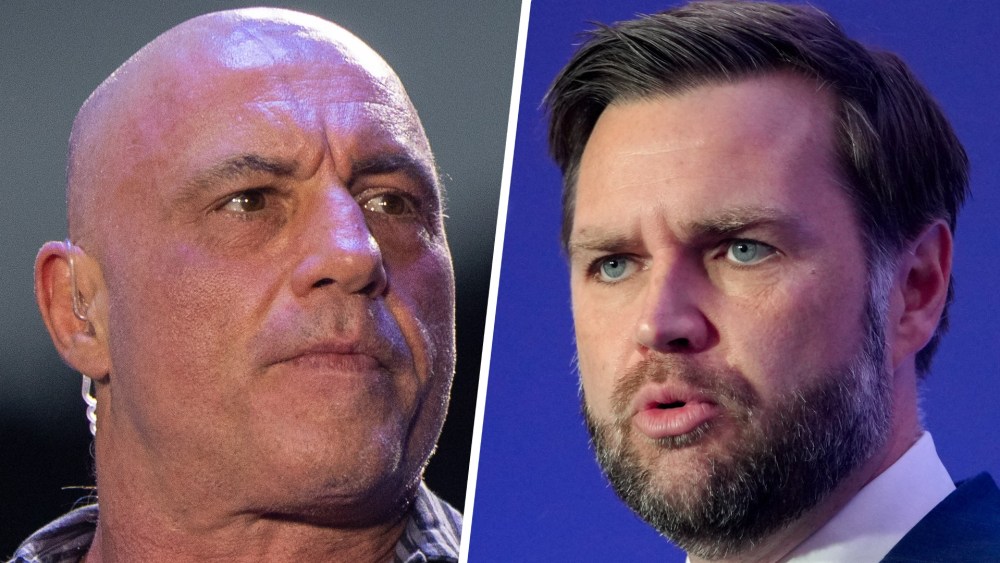
In his 2016 memoir, “Hillbilly Elegy,” Vance denounces conspiracy theorists as “fringe lunatics.” But once a paranoid ethos became nonnegotiable for an ambitious Republican, he changed his tune. Now, Vance appears to be the administration’s chief conspiracy communicator. This week, Vance went on Joe Rogan’s podcast to discuss the big lie of voter fraud, aliens, the deep state, Jeffrey Epstein and why so many people have accused him of being an antisemite.
“So I have, like, effectively unlimited access to information,” Vance boasted. But there’s a catch.
Vance’s mission is to keep low-propensity male voters and their idols, like Rogan, in the MAGA fold despite Trump hiding the Epstein files, breaking his promise of no new wars and failing to release any juicy details about extraterrestrials or the Kennedy assassination. That means walking a delicate line between validating the paranoids’ worldview and praising his boss.
“What is it like being the vice president?,” Rogan asked, hard-hitting as ever, “Like how much access do you have to information?
“So I have, like, effectively unlimited access
by Zeeshan Aleem | Jul 19, 2026 | Opinion, White House, World
I visited Russia with friends for the 2018 FIFA World Cup, and it was one of the great trips of my life.
Entering the country was a breeze. Between chasing matches in three cities, we drifted about with no particular agenda other than entertaining ourselves. We wandered through parks, drank vodka, admired the beautiful architecture, temporarily picked up smoking cigarettes, looked at art and partied day and night. Russia is not known for a warm public culture, but it was easy in such a festive atmosphere to make local friends — some of whom I stayed in touch with long after that summer. The experience went so smoothly, and I felt so good about the experience, that between returning to the States and the end of the World Cup, I somehow found myself rooting for Russia’s team (alongside others) as it progressed, even suspiciously so, in the tournament. When I think back on the trip, I remember the rich Russian culture that rarely gets covered in the Western press.
A political scientist might describe my fond memories of my Russia World Cup trip as a perfect example of the efficacy of sportswashing — that is, governments staging sports events to launder their reputation and divert attention from their misdeeds. The World Cup brightened my perspective on Russia: A well-run tournament, organic social connections and pleasant vibes improved my feelings toward the country. I spent little time thinking about Russia’s vicious ruler or authoritarian repression, and my stories about the fun surrounding the games I saw likely encouraged others to consider traveling there, or at least to think of the country a bit