by Jill Fordyce | Sep 20, 2026 | Civil Rights, immigration, Opinion
In fall 2025, I began volunteering with the Acacia Center for Justice, a nonprofit legal advocacy group, in its Witness for Justice program. It’s an initiative that trains people to observe immigration court proceedings to restore visibility and accountability to a system that operates largely out of public view — and to ensure that no one faces immigration court alone and unseen.
Eventually, I found my way to the “detained children’s docket,” something I still can’t quite believe exists in the United States. I observed children appearing on camera for their immigration hearings from detention centers and shelters — children who do not speak English, who do not have lawyers, who are in the country alone. These children consistently state that they are afraid of returning to their home countries, yet they are not provided with counsel. They are accountable for finding a lawyer and filing claims for asylum on their own.
On one of my first children’s dockets, half of the cases resulted in the judge ordering the children — age 5 to 17 — removed from the U.S. without giving them an opportunity to have their asylum claim heard. Instead, this particular judge repeatedly ruled that the children were not entitled to present evidence, and that they did not qualify for relief as a matter of law. In one case, a 16-year-old girl had been sexually assaulted by a gang member in Honduras and feared that if she returned, she would be assaulted, kidnapped and enslaved by the gang. The court stated that those fears are “not a basis for protection in the U.S.” and ordered her removal.
Play
ICE prepares to
by Jessica Levinson | Sep 20, 2026 | Opinion, Supreme Court
As we hurtle toward the midterm elections, Democrats are confronting two contradictory sets of numbers. Their poll numbers are surging, and their fundraising numbers are woefully behind the GOP’s. Recent filings showed that the Democratic National Committee had approximately $16 million cash on hand and almost $18 million in debt, while the Republican National Committee had $130 million and no debt.
A monetary advantage does not always translate into an electoral win. But money in politics matters deeply. If it didn’t, candidates, political parties and outside groups would stop raising and spending it.
A monetary advantage does not always translate into an electoral win. But money in politics matters deeply.
Now voters in Montana may soon try to stem that tide of money in their state. A ballot initiative would allow Montana voters to decide whether to bar corporations from spending money in elections. Supporters of the initiative argue that corporations are created by state statutes, and states can decline to give their own creations the ability to spend money in elections.
Except there is a huge problem with this ballot initiative, and it’s called the First Amendment. The Supreme Court has long held that money given and spent in elections is the equivalent of speech, and therefore that restrictions on giving and spending in campaigns are subject to First Amendment review. And then of course in 2010 the Supreme Court handed down its landmark decision in Citizens United: A thin majority of the court concluded that when it comes to spending on campaigns, the identity of the speaker (aka spender) does not matter, and corporations should be treated the same way as individuals.
Play
Meet
by Rebecca Ritzel | Sep 20, 2026 | culture, Opinion, White House
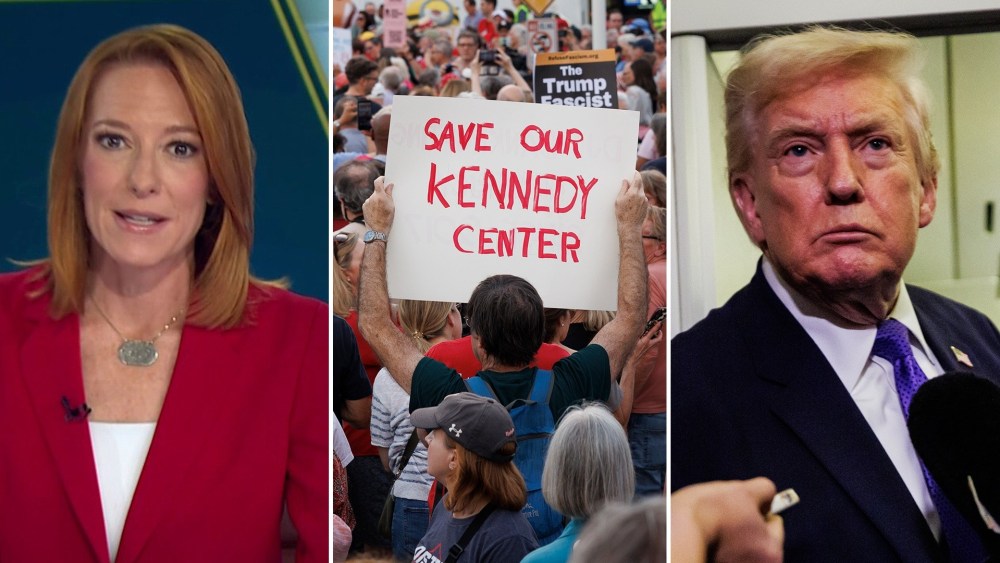
It was a tumultuous week on the marble arts center beat. Last Tuesday, a federal judge ruled against the Kennedy Center’s latest bid to put President Donald Trump’s name on the building. Judge Christopher Cooper’s determination did not require parsing arcane legalese; as 1983 federal legislation states, “no additional memorials or plaques in the nature of memorials shall be designated or installed in the public areas of the John F. Kennedy Center for the Performing Arts.”
Congress could also, the judge noted, change the law.
Trump responded to Cooper’s ruling with a social media diatribe, asserting without evidence that the Washington cultural center was “losing hundreds of millions of dollars” and “destined to doom.” He pledged to withhold a $257 million congressional appropriation intended for deferred Kennedy Center maintenance, particularly to repair HVAC issues. If the courts do not allow his name to go up on the building, the president wrote on social media, “the Reconstruction and Renovation of The Kennedy Center will not take place.”
Because it’s a nonprofit chartered by Congress, its bankruptcy would look much different than any the president has experienced — and he does have plenty of bankruptcy experience.
More ominously, on Wednesday, a Getty photographer zoomed in on Trump looking at a large photograph appearing to be emblazoned with the heading “Kennedy Center DEMOLISHED.”
The all-caps proposition prompted lawyers for Rep. Joyce Beatty, the Ohio Democrat who serves as an ex officio Kennedy Center trustee, to sprint back to Cooper. Late Thursday, the judge granted discovery rights into the alleged planned demolition, and warned that any changes to the Kennedy Center’s current plan for a face-lift must come before
by Kaivan Shroff | Sep 20, 2026 | Opinion, White House
“This is clearly a fake photo,” a White House official told The Daily Beast earlier this week. The statement came after days of online speculation about an image that appeared to show President Donald Trump kissing his executive assistant, Natalie Harp, on his golf course in Ireland.
The image of Trump and Harp does not survive a close inspection. Snopes reported that the clearest version of the image was watermarked as having been edited with artificial intelligence tools. Harp’s hand in the image has six fingers.
Debunking a claim when a falsehood spreads so quickly is already a challenge. Asking people to question what they have just seen with their own eyes is even harder.
But Harp’s close relationship with Trump has been widely reported in recent weeks, including reverential letters, in which she calls him her “Guardian and Protector in this Life,” and his $45,000 gift to her and two other aides. That was all the fuel the fake image needed to spread like wildfire. Its existence was consequential enough that it merited an official denial from the White House.
No one in American politics has done more than Trump to make fake imagery a routine tool of political communication — and now, fittingly, it has been turned back on him.
In fact, the pattern is familiar. Just days before this story went viral, on Aug. 30, Trump posted an AI-generated video of explosions on Iran’s Kharg Islands with the caption “Kharg Island being blown to smithereens!!! President DJT.”
Play
‘Grift and corruption’ Dems ready to probe Trump’s $45K gift to Natalie Harp
September 9, 2026 / 08:23
“There was no other evidence that the Iranian energy hub was
by Christine Leuenberger | Sep 20, 2026 | culture, Opinion, World
President Donald Trump has generated a steady stream of headlines since returning to office by renaming the Gulf of Mexico the “Gulf of America” and Lake Ontario “Lake America,” while also calling for other changes to the maps Americans use every day. At the recent GOP midterm convention, he whipped up the crowd with a recitation of cartographic modifications, including the as-yet-aspirational transformation of New Mexico to “New America.”
It’s easy to dismiss these moves as political theater, just more fodder for social media outrage or late-night comedy. But history teaches us that maps and the names, territories and landmarks they include or exclude always have political consequences, shaping identities, cultural belonging, territorial claims, education and international relations. Maps may appear to be objective and unbiased representations of the world, but they are inevitably, inherently selective.
For example, throughout history, governments have used the practice of naming territories and bodies of water to advance nationalist goals and assert territorial claims and aspirations. With Russia’s occupation and annexation of Crimea in 2014, Russian maps were remade to include Crimea as part of Russian territory to assert political authority. Trump’s effort to remake maps similarly speaks to their power to advance particular territorial visions and his expansionist “America First” agenda.
Throughout history, governments have used the practice of naming territories and bodies of water to advance nationalist goals and assert territorial claims and aspirations.
This muscular nationalist agenda can also be found in the way Trump is going about his renaming project. Traditionally, geographic name changes in the United States are reviewed by the U.S. Board on Geographic Names and, if approved, enter the Geographic
by Anthony L. Fisher | Sep 19, 2026 | Civil Rights, culture, Opinion
It was the social media post that launched a MAGA civil war over what is the appropriate way to demonize immigrants.
Bo French, the Republican candidate for Texas railroad commissioner, shared a photo last Sunday depicting ecstatic University of Texas students cheering the school’s football team — some of them possibly of South Asian descent — with the text, “I heard UT graduation this year looked like this. I didn’t believe it. The problem is now obviously far worse than anyone imagined.” French probably didn’t realize it, given most Republicans’ adoration for the unabashedly racist President Donald Trump, but he kicked a hornet’s nest on the right, sparking a pitched fight over “heritage Americans” and the MAGA struggle to package its xenophobia in more polite terms like “Western civilization.”
A number of influential conservatives and elected Republicans condemned French’s post for presuming a bunch of seemingly non-Caucasian Longhorns fans were “foreigners” rather than Americans, possibly the children or grandchildren of immigrants. Ben Shapiro posted to X, “Wait, why are we supposed to be upset that some kids of Indian ethnicity were cheering the UT football team on Saturday? WTF?” (It should be noted that the ethnicities of the scores of students in the picture have not been confirmed.)
Ultimately, this intra-GOP battle over “civilized” xenophobia versus crude, uncouth racism is a pointless morality play.
There were also condemnations from Texas’ Republican House Speaker Dustin Burrows, who posted to X, “You can oppose immigration policy without demeaning people because of their race or ethnicity.” The National Review’s editorial board slammed French’s “repulsive online attack,” but he also added, “Too much immigration — even when the