by Selena Kuznikov | Jun 29, 2026 | News, Supreme Court, White House
Justice Sonia Sotomayor delivered a fiery dissent Monday in the Supreme Court’s decision backing President Donald Trump’s power to fire members of independent federal agencies, describing the Republican-appointed majority’s ruling as one that cuts away at the Constitution.
Inside the chambers, Sotomayor spent nearly 20 minutes reading from the bench her dissenting opinion in Trump v. Slaughter — an uncommon practice for a dissenting justice.
In a defiant tone, and with palpable anger, she described the decision held as one that “reshapes the structure of government in a fundamental way,” by giving the president “a power unknown even to the English Crown against which the Founders revolted, elevating him above his once-coequal branches.”
The decision allowing Trump to fire Rebecca Slaughter, a Democratic member of the Federal Trade Commission, without cause upends a 1935 precedent that had protected the independence of agencies.
In doing so, Sotomayor said, the court is transforming the president’s “duty to take care that the laws be faithfully executed into a license to act in defiance of those very laws.”
Sotomayor said the court is furthering an “absolutist” view of presidential power, and that there should be a “counterbalance” to it. She called the ruling a “profoundly destabilizing result.”
Sotomayor, an Obama appointee, read from her dissent in a different case last week when her Republican colleagues allowed the Trump administration to turn away asylum seekers who have not set foot on U.S. soil.
Fallon Gallagher and Jordan Rubin contributed reporting.
This is a developing story. Check back for updates.
The post Sotomayor blasts court’s ruling allowing Trump to fire agency heads appeared first on MS NOW.

by Noella Williams | Jun 29, 2026 | Article, Florida, LGBTQ, Politics and Movements: US, Pride, Reprint, The Cultural Front
This story originally appeared in The Progressive Magazine on June 18, 2026. It is shared here with permission.
Florida has a magic that only Floridians truly understand. The mix of whimsy, bravery, and devotion you find here is unique, as is the land itself: lush acres of forest and marshy wetlands, puppy like creatures found in springs and slow-moving rivers, beaches of white sand, and off-the-beaten-path trails.
It’s tough to be from here—we’re plagued with hurricane season, mocked with GIFs like Bugs Bunny sawing from the rest of the country, and absurd “Florida man” jokes reflecting the tired 2010s-era cliché that our state is a den of drug-addled chaos and bizarre misadventure. If you mention Florida in conversation, you’re often met with a disgusted or concerning gaze.
The state has also long served as the country’s playground—or, as scholar Julio Capó Jr. describes it in his history of queer Miami culture, a “fairyland” that lures in tourists with the promise of a quick getaway surrounded by Disney animatronics and dreamy beaches. It may be unrecognizable to visitors from outside of the state, but Florida has always been a little queer, even beyond the periphery of the gay club scene in Miami.
In the past several years, however, Florida has become increasingly known for being hostile to queer people. Republican Governor Ron DeSantis—whose term began in 2019, less than three years after the June 2016 mass shooting at Orlando’s Pulse nightclub that killed forty-nine people—is fixated on decimating Florida’s queer population and crushing the morale of our indomitable spirit. In 2021, DeSantis signed into law a provision that redefined a public demonstration of more than three people who “commit a breach of
by Jordan Rubin | Jun 29, 2026 | Deadline: Legal Blog
The Supreme Court declined to hear Alan Dershowitz’s defamation appeal against CNN, marking the court’s latest refusal to reconsider the landmark 1964 press freedom ruling in New York Times v. Sullivan.
The court has consistently declined to hear appeals seeking to weaken or overturn the precedent that makes plaintiffs who are public figures meet the demanding “actual malice” standard. Under that standard, plaintiffs must show the defendants’ knowledge of, or reckless disregard for, the falsity of statements they publish.
In line with the court’s typical practice, there was no explanation for Monday’s denial of Dershowitz’s petition. It takes four justices to grant review.
Justices Clarence Thomas and Neil Gorsuch dissented from the denial, echoing their previous calls for the court to revisit Sullivan and the actual malice standard.
Dershowitz’s suit against CNN stemmed from his representation of Donald Trump during his first impeachment trial in his first term. The president was accused in 2019 of abusing his power by urging Ukraine to announce an investigation of Joe Biden, against whom Trump would run in the 2020 election. (The Senate acquitted Trump in that trial as well as in his second impeachment trial, where he was accused of inciting the Jan. 6, 2021, insurrection in a bid to subvert the election he lost to Biden.)
Dershowitz said CNN defamed him in its coverage of his statement about the scope of impeachable offenses. During the Senate trial, Sen. Ted Cruz, R-Texas, asked the longtime law professor, “As a matter of law, does it matter if there was a quid pro quo? Is it true that quid pro quos are often used in foreign policy?” Dershowitz responded, in
by The Associated Press | Jun 29, 2026 | News
DUBAI, United Arab Emirates (AP) — President Donald Trump said Monday on social media that Iran had requested a meeting with U.S. counterparts, though Iranian officials said no such meeting was scheduled.
The U.S. president has tried to preserve an increasingly fragile interim deal as hostilities have mounted in the Strait of Hormuz in recent days, which could cause oil prices to rise and undermine Trump’s claims to voters that inflation in America was easing.
Trump said the meeting with Iran would happen on Tuesday in Doha, Qatar.
Earlier on Monday, Iran’s president said that $6 billion in frozen Iranian assets would be released by Qatar, as negotiations with the United States were challenged by attacks across the Persian Gulf this weekend.
Masoud Pezeshkian’s mention of the funds appeared aimed at selling the Iranian public on the interim deal, particularly as its grip on the Strait of Hormuz has been tested by efforts to open Oman’s territorial waters to both inbound and outbound traffic from the Persian Gulf.
Iran’s attacks and threats stopped cargo ships and tankers from moving through the strait, in which about a fifth of all traded oil and natural gas passed in peacetime, creating a global energy crisis.
The strait has long been considered an international waterway despite its location in Iran and Oman’s territorial waters. In recent days, Iran has twice attacked vessels going through a route near the Omani side, drawing retaliatory American airstrikes and concerns that negotiations to reach a formal end to the war could be disrupted. Iran launched drone and missile attacks targeting Bahrain and Kuwait on Sunday.
Pezeshkian says $6 billion coming to Iran
Pezeshkian offered praise for the interim deal in comments published
by Susan Rinkunas | Jun 29, 2026 | Civil Rights, Opinion
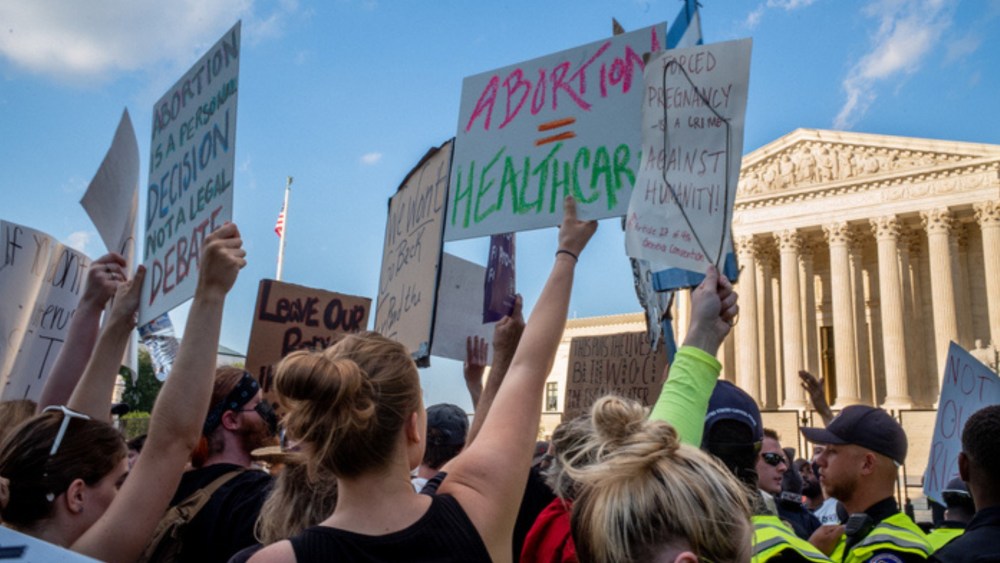
Four years after the Supreme Court overturned Roe v. Wade, some abortion opponents are unhappy. Though 19 states have abortion bans early in pregnancy, the number of abortions has actually increased since the Dobbs decision, due in part to the availability of medication abortion. Eight states passed so-called shield laws, which protect providers from criminal or civil investigations if they prescribe abortion pills to people in states with bans, and now nearly 15,000 medication abortions per month are provided under those laws.
A faction of the anti-abortion movement argues that criminal bans for abortion providers aren’t enough. The only way to actually stop abortions in states where they’re banned, these activists argue, is to prosecute women for homicide. This faction, though small, is vocal and gaining influence. On the anniversary of Roe’s fall, a group of more than 60 conservatives shared a resolution calling on lawmakers to “remove legal immunities” for women who have abortions. They said laws to protect life from the moment of fertilization would put fertilized eggs on the same legal plane as the person carrying them.
Prosecuting abortion seekers used to be a third rail in the anti-abortion movement.
But there’s a telling aspect to the list: Of the 24 signatories who lead anti-abortion organizations, just four are women. It appears that, to get more women signatories, they had to branch out to conservative influencers, including anti-transgender activist Riley Gaines and podcast host Allie Beth Stuckey. The gender dynamics at play cannot be ignored when under this framework, pregnant women could be prosecuted for ending their pregnancies or even having a miscarriage.
Prosecuting abortion seekers used to be a third rail