by Sydney Carruth | Jul 25, 2026 | Business, Iran, News, White House
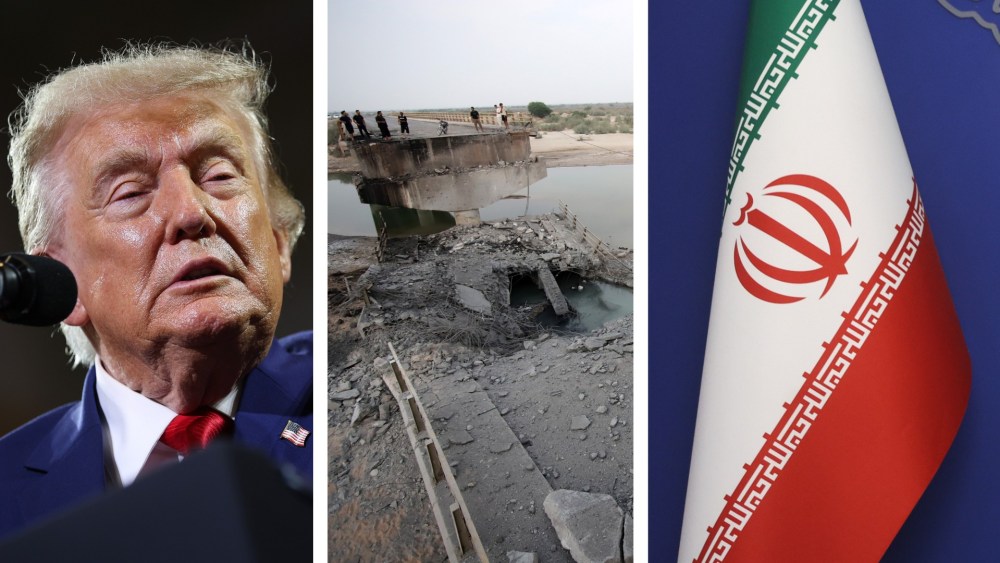
As his new tariffs went into effect and gas prices climbed on Saturday, President Donald Trump said he’s not ruling out a full-scale war.
In a phone interview with French journalist Sonia Dridi, Trump said he’s “absolutely” considering resuming full-scale war with Iran if the U.S. doesn’t “get 100% of what we want.”
The president told reporters in the Oval Office on Friday the U.S. is “talking” to Iran, adding that he believes Iran is “getting more and more serious as the days go by” but “that doesn’t mean we get there.” Friday night was the first in 13 consecutive nights that the U.S. did not strike Iran.
The national average gas price rose slightly Saturday to $4.11 a gallon as Trump’s newly imposed tariffs on goods from more than 80 countries threatened to heap further financial strain on Americans ahead of the midterms. The reporter said when she asked Trump whether he would follow through with his threat to levy “substantial” new tariffs on the European Union, which he has accused of “robbing” American tech companies, he declined to comment.
The tariffs, which took effect Friday and have already been challenged in court, could cost American households an extra $1,100 annually, according to an analysis by The Budget Lab at Yale University. That comes at a time when consumers are already shelling out more for necessities, including gas and groceries, as the Iran war drives inflation and energy prices upward.
Play
Politico: 46% say high gas prices will impact their vote
July 24, 2026 / 06:43
Gas price averages in the United States surpassed $4 a gallon on July 20 for the first time in more
by Jacques Berlinerblau | Jul 25, 2026 | Opinion, Politics, White House
Friday night’s redo of the White House Correspondents’ Association dinner had three things in common with April’s doomed event, which was cut short after the intrusion of a gunman identified by authorities as Cole Tomas Allen. The first was a beaming President Donald Trump, delighted to be holding court among the journalists whom he habitually abuses, insults and subpoenas. The second was the presence of the aforementioned journalists, who in their gowns and tuxedos looked like runway models in a Stockholm syndrome-themed fashion show. And the third was the absence of a comedian entrusted with making jokes about the leader of the free world.
Roasting the commander in chief was once a venerable WHCA tradition. But like so many American institutions subjected to a MAGA stare-down or shakedown, the organization abandoned its principles.
Roasting the commander-in-chief was once a venerable WHCA tradition.
In 2025, the WHCA disinvited comedian Amber Ruffin, presumably because her barbs might have scratched the president’s thin skin. This year, the WHCA didn’t invite a comedian at all. With professional comics absent from the dais, roast master Donald was poised to fill the void.
In the lead-up to the April event, Lara Trump, the president’s daughter-in-law, mentioned that he was working with joke writers to hone his act (though she insinuated that he didn’t really need their help because he’s so darn funny on his own). Hours before the spring gathering, White House press secretary Karoline Leavitt gleefully brayed that “there will be some shots fired tonight.” Then actual shots were fired. Afterward, the president sighed, “I was all set to really rip it.” “I said to my people,” he continued to
by Joseph Cirincione | Jul 25, 2026 | Opinion, Science, White House, World
President Donald Trump says he believes nuclear technology is a grave threat in the hands of Iran’s ruling regime, arguing that the country would inevitably use it to create a weapon of mass destruction. And yet, in a new agreement signed Wednesday, Trump agreed to let Saudi Arabia enrich uranium and reprocess plutonium, the two ingredients used in nuclear bombs.
The Saudis promise this will be used only for peaceful purposes, but Saudi Crown Prince Mohammed bin Salman said as far back as 2018 that “without a doubt if Iran developed a nuclear bomb, we will follow suit as soon as possible.”
Trump’s generosity to Saudi Arabia — which has numerous lucrative deals in place with members of his family — could unleash a flood of new nuclear programs. If the Saudis get this technology, others will demand it too.
Nuclear is the most expensive way to produce electricity, and Saudi Arabia sits on an ocean of oil and is ideally suited for much cheaper solar and wind energy production.
Since the dawn of the Nuclear Age, U.S. policy has denied the ability to enrich uranium and reprocess plutonium to other nations because it is a shortcut to nuclear weapons. The huge and expensive facilities can be developed openly and legally until a government takes the quick jump from making fuel rods to making the cores of bombs. With this deal, Trump has effectively just green-lit a Saudi nuclear bomb program.
How did we get here?
In 2013, the Saudis unveiled a plan to build as many as 16 civilian nuclear reactors. Nuclear reactor companies salivated at the prospect of contracts worth hundreds of billions
by Steve Benen | Jul 24, 2026 | Congress, Maddowblog, News, Politics, White House
There’s one word Donald Trump clearly doesn’t like to hear: “No.” And yet, it’s precisely what Senate Majority Leader John Thune has been forced to tell the president quite a bit over the past year or so — not because the South Dakota Republican necessarily disagrees with the White House’s agenda, but because Thune hasn’t had the votes to give Trump everything he wants.
One GOP senator, who requested anonymity to discuss the internal dynamics, told MS NOW last month that Trump and Thune “have an awkward relationship.” The lawmaker added, “It’s awkward for everybody.”
This is especially true of the president’s top legislative priority, a sweeping voter suppression package he has labeled the SAVE America Act that Republicans have already conceded they can’t pass. Trump, apparently furious by Congress’ inability to meet his demands, has increasingly turned against his own party’s Senate leader.
During a campaign-style event in Georgia this week, the president told supporters, “[House Speaker] Mike Johnson and Congress have done a great job, but we’re having a hard time in the Senate. The Senate, what they’re doing, it’s just not right.” The Republican added, “It’s like the Senate is where you send things you want them to die. We’re not going to be able to take it much longer.”
He didn’t elaborate as to what would happen after he’s no longer content to “take it,” though Trump specifically told attendees to “call John Thune” and demand that the GOP-led Senate pass the president’s anti-voting legislation.
White House press secretary Karoline Leavitt echoed the message during Thursday’s briefing.
Leavitt on Trump’s views on Thune: “His patience is running out”— Aaron Rupar (@atrupar.com) 2026-07-23T15:46:36.874Z
Asked
by Zeeshan Aleem | Jul 24, 2026 | Business, Opinion, White House, World
The Strait of Hormuz remains at a virtual standstill because of President Donald Trump’s foolish war, and now, in what represents a new global energy price nightmare, Houthi militants in Yemen have begun to block a separate corridor that is critical for global oil shipping. On Thursday, oil surged past $100 a barrel for the first time since May in response to the news that the war with Iran is on the brink of expanding to a new front. And Trump’s promise to bomb the Houthis should they continue is unlikely to improve the situation.
Those Houthi militants, who are allied with and supported by Iran, announced Monday that they would were enacting a blockade in the Bab el-Mandeb Strait against Saudi Arabia. The Houthis said their blockade is retaliation for airstrikes against a Yemeni airport intended to prevent an Iranian aircraft from landing. (Yemen’s Saudi-backed government claimed credit for the attack.) On Thursday, the Houthis said they had attacked two Saudi oil tankers and successfully warned 10 more to turn back. (Saudi Arabia’s official news agency confirmed at least one tanker was hit.)
Should the Houthis continue to attack ships, Trump ought to be concerned; his record fighting the scrappy militia is not impressive.
The Houthis’ blockade is a huge deal. Before the Iran war, about a fifth of the world’s oil passed through the Strait of Hormuz. Now it’s effectively closed. Saudi Arabia, which had transported the bulk of its oil through the Strait of Hormuz, started moving oil west through a pipeline. From there, Saudi Arabia was sending its oil out through the Red Sea and the Bab al-Mandab Strait, which connects the Red Sea
by Lisa Rubin | Jul 24, 2026 | News, White House
The Justice Department on Thursday withdrew the subpoenas it issued to three reporters for The New York Times who reported on security concerns about the new Air Force One gifted to President Donald Trump by the Qatari royal family. The department also withdrew subpoenas to phone service providers for call records.
The withdrawal comes after the Times moved to quash the subpoenas last week, arguing that they “represent a brazen effort to intimidate the press” and “violate the most basic First Amendment protections for newsgathering activity.”
Press freedom groups, including the White House Correspondents’ Association, also condemned the issuing of the subpoenas, alleging that the government issued them due to officials’ embarrassment over the negative press rather than on any legitimate legal basis. The DOJ argued that the journalists were not the targets of the subpoenas and that they were instead seeking to identify who the government said leaked what it described as national defense or classified information.
In court on Thursday, Judge Arun Subramanian started by asking the government if it would withdraw the subpoenas and, when the DOJ declined, invited their lawyer to argue otherwise. In response, Sean Buckley, the former deputy U.S. attorney and current chief counsel to U.S. Attorney Jay Clayton, argued for the better part of an hour that the subpoenas were lawfully issued and said they were authorized by acting Attorney General Todd Blanche. However, Buckley also admitted that the subpoenas erroneously sought information from a parent and spouses of the reporters as “a consequence of trying to move quickly.”
Later, after conferring with his co-counsel, Buckley said “the government is prepared unilaterally to withdraw these subpoenas at this time,” according to