by Steve Benen | Mar 25, 2026 | Iran Tensions, Maddowblog, News, Politics
In the early days of the war with Iran, leading Republican officials were divided over the basic issue of whether to call the war a war.
When Donald Trump initially announced the military offensive in the Middle East, his prerecorded video message included this line: “The lives of courageous American heroes may be lost, and we may have casualties. That often happens in war.” One day later, then-Sen. Markwayne Mullin (before the Oklahoma Republican became the Homeland Security secretary) appeared on Fox News and told viewers, “We are not at war with Iran.”
These divisions were common in GOP politics for days, with some party leaders, such as Defense Secretary Pete Hegseth, insisting that the United States is at war and other party leaders, such as House Speaker Mike Johnson, arguing the opposite.
At one point, the White House distributed talking points to congressional Republicans that addressed some common questions. The document included a straightforward line — “Is the U.S. at war with Iran?” — but it did not include an answer.
Three weeks later, not only is the debate ongoing, but the president himself has positioned himself on both sides of the question.
At an event on Monday, for example, Trump said, in reference to Democrats, “They call it a war, we call it a military operation.” A day later, in the Oval Office, the Republican echoed the phrase, word for word.
Trump: “They call it a war. I call it a military operation.”— Aaron Rupar (@atrupar.com) 2026-03-24T18:43:27.360Z
Ten minutes later, at the same White House gathering, the president added, “People don’t like me using the word ‘war,’ so I won’t, but the Democrats call it
by Steve Benen | Mar 25, 2026 | 2026 election, Maddowblog, News, Politics
The day after a series of closely watched elections in Texas, North Carolina and Arkansas earlier this month, Donald Trump published a seemingly endless series of items to his social media platform, highlighting candidates who won primaries after receiving his endorsement.
The president ultimately concluded, “My Endorsements within the Republican Party have been virtually insurmountable! It is such an honor to realize and say that almost everyone I Endorse WINS, and wins by a lot.”
Strictly speaking, that wasn’t true at the time, and three weeks later, the boast appears even more misplaced — because the single most-powerful GOP policymaker in North Carolina had Trump’s backing, which wasn’t enough to keep him in office. The Associated Press reported:
North Carolina government’s most influential politician, Republican state Senate leader Phil Berger, conceded the primary race for his seat to Sam Page on Tuesday, shaking the power structure in the ninth-largest state and likely soon ending Berger’s preeminence as the state’s top conservative architect.
Berger trailed Page, the Rockingham County sheriff, in their March 3 primary by only 23 votes. He has been Senate leader since 2011 when Republicans took full control over the General Assembly for the first time in 140 years.
Commenting on the outcome, Bolts magazine’s Daniel Nichanian and The Downballot’s Stephen Wolf used the same word to describe Berger’s unexpected primary defeat: “earthquake.”
Berger wasn’t just a legislative leader in North Carolina, he was the GOP’s most powerful figure in state politics for over a decade, overseeing what The New York Times described as a “far-reaching network of lobbyists, corporate executives and government allies.” What’s more, the outgoing state Senate leader was also his

by Jarvis DeBerry | Mar 25, 2026 | Opinion, Politics
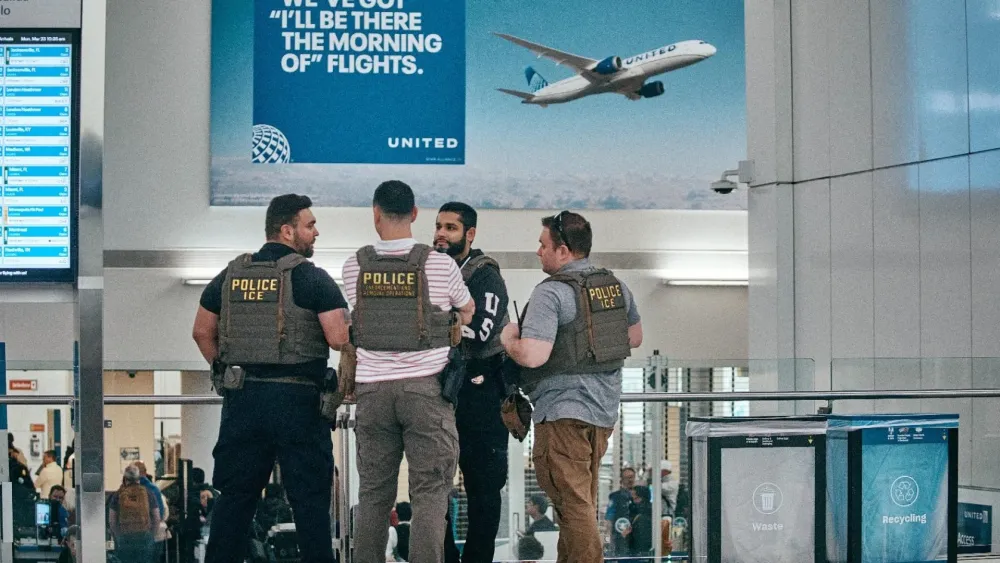
Immigration and Customs Enforcement agents wear masks, President Donald Trump and his supporters have insisted, because if they have to show their faces, then they will be doxxed. More specifically, Republicans have argued, bystanders could take photos of agents’ faces, identify them and use that information to harm them. But after dispatching ICE to 14 major U.S. airports where unpaid Transportation Security Administration workers are quitting or calling out sick, Trump said Monday on social media that “I would greatly appreciate…NO MASKS” at the airports.
That makes no sense. Set aside the fact that ICE agents don’t have the training to do what TSA agents do; if there were a legitimate threat to ICE agents who show their faces outside airports, that threat would be just as legitimate when ICE agents were inside airports.
Trump’s social media post on Monday signaled to Democrats that talk of doxxing was always a ruse.
During the ongoing shutdown of the Department of Homeland Security, Democrats have demanded reforms that include requiring ICE agents to show their faces. Trump’s social media post on Monday signaled to Democrats that talk of doxxing was always a ruse and that facial coverings for ICE officers aren’t non-negotiable, as Republicans have previously insisted.
But we always knew it was a ruse. An untold number of law enforcement officers in the U.S. go to work every day not only with their faces visible but also with their names on their chests. To argue that ICE agents are vulnerable to doxxing by showing their faces is to argue that all law enforcement officers who show their faces are. But other law enforcement officers work with
by Steve Benen | Mar 23, 2026 | Iran Tensions, Maddowblog, News, Politics
As the war in Iran enters its fourth week, there’s ample evidence of broad public opposition to the conflict. Indeed, while recent history suggests wars usually enjoy support at the outset, only to see public attitudes turn negative as operations drag on, the conflict in Iran is unique: It was unpopular from the start.
The latest national CBS News/YouGov poll offered fresh evidence of the larger trend: 57% of Americans believe the war is going badly; 63% believe the military offensive will make the economy worse in the short term; 60% disapprove of the U.S. taking military action against Iran; and 66% see the conflict as a war of choice. The results were largely in line with other recent national polling.
Confronted with the data, the White House and its allies have a few options. They could argue that the polls will change in time. They could try to say that Donald Trump believes in pursuing his agenda whether it’s popular or not. They could even make up alternative polling data that doesn’t exist, as the president has been known to do.
But on CBS News’ “Face the Nation,” U.S. Ambassador to the United Nations Mike Waltz, Trump’s former White House national security adviser, went in a very different direction.
BRENNAN: 60% of Americans disapprove of military action against Iran. 57% think the conflict is going badly. How do you tell the American people they’re wrong?WALTZ: Well, I could quote a whole slew of polls that show, for example, self-described MAGA Republicans give the president 100% approval— Aaron Rupar (@atrupar.com) 2026-03-22T14:46:59.640Z
When host Margaret Brennan presented Waltz with the latest polling results, the Republican official
by Steve Benen | Mar 23, 2026 | 2026 election, Maddowblog, News, Politics
In late October, Donald Trump had nothing but positive things to say about Republican Rep. Jeff Hurd of Colorado. In a statement published to his social media platform, the president said the incumbent congressman has been an “incredible” lawmaker with “a strong Record of SUCCESS.” Trump concluded, “Jeff Hurd has my Complete and Total Endorsement for Re-Election — HE WILL NOT LET YOU DOWN!”
Roughly four months later, the president did something he does not often do: He unendorsed a Republican he’d already backed, withdrawing his support for Hurd after the GOP lawmaker criticized the administration’s tariffs, among other things. As part of the same lengthy online missive, the president also threw his support behind Hurd’s primary rival, local nurse practitioner Hope Scheppelman.
That was last month. On Friday, Trump came full circle, reversing his reversal. The New York Times summarized:
In a statement on social media, Mr. Trump said Ms. Scheppelman would be leaving the campaign to join his administration in a ‘capacity to be determined.’ The president added that Mr. Hurd ‘should in no way, shape, or form, be impeded from winning’ re-election in his conservative-leaning swing district, which covers much of the western half of Colorado.
‘I will be fully supporting Jeff’s Re-Election to the House of Representatives, giving him my Complete and Total Endorsement!’ Mr. Trump wrote. ‘Every true MAGA supporter and Republican, if they truly care about saving our Country, will do everything in their power to unify together.’
The wild swings have been unusual, but they’re worth appreciating in a larger context.
The congressman has found himself in a difficult position. Hurd is a GOP incumbent in a blue state,
by Imran Khalid | Mar 19, 2026 | Opinion, Politics
U.S. and Israeli military strikes have killed several high-profile Iranian officials, with notable deaths this week including Intelligence Minister Esmail Khatib, security official Ali Larijani and Gen. Gholam Reza Soleimani, commander of the Basij paramilitary force. But before welcoming Khatib’s elimination as a decisive blow to the clerical regime, Washington should understand: Rather than inducing the collapse of the regime, these high-level assassinations are rapidly dismantling Iran’s institutional bureaucracy — and risk handing total control to hard-liners.
So far, the U.S. and Israeli war-fighting strategy has appeared to center on decapitation: removing the veteran bureaucrats and intelligence chiefs who provide the state’s institutional memory, and presumably the regime’s ability to coordinate complex regional operations will wither. This assumes that the Iranian state functions like a traditional Western hierarchy. But Iran is not a traditional state. Iran has a dual system where a formal government exists alongside a parallel military and ideological structure that has spent four decades preparing for this kind of attrition.
The United States and Israel are inadvertently clearing the path for Iran’s most radical elements, including those in the Islamic Revolutionary Guard Corps.
By targeting such institutional figures as Khatib and Larijani, the United States and Israel are inadvertently clearing the path for Iran’s most radical elements, including those in the Islamic Revolutionary Guard Corps. Khatib, Larijani and other slain high-ranking officials represented the “deep state” in its traditional sense; they were men who understood the nuances of diplomacy and the necessity of maintaining certain backchannels, even during periods of intense hostility. Larijani in particular, a former Revolutionary Guards commander who was once speaker of Iran’s Parliament and Iran’s chief