by Steve Benen | May 7, 2026 | Maddowblog, News, Politics
The original plan for Donald Trump’s White House ballroom vanity project was to spend $200 million, and every penny would come from private donations. Three months later, the price tag grew to $250 million. Soon after, it was $300 million. Late last year, it was up to $400 million — though again the official line was that American taxpayers wouldn’t be on the hook for the costs at all, even as the White House went out of its way to hide the identities of donors.
This week, however, everything changed: Congressional Republicans unveiled a budget reconciliation package, which Democrats would be powerless to stop, that set aside $1 billion in taxpayer funds for the ballroom project with the costs to be added to the budget deficit.
On Wednesday morning, the president used his social media platform to present a defense of sorts. The online piece read, in part:
The only reason the cost has changed is because, after deep rooted studies, it is approximately twice the size, and a far higher quality, than the original proposal, which would not have been adequate to handle the necessary events, meetings, and even future Inaugurations. … It will be magnificent, safe, and secure!
Or, as New York magazine’s Nia Prater summarized, Trump wants the public to believe the ballroom will cost more “because it’s more awesome.”
A White House official told MS NOW the project will still be paid for with the private funds already raised and that the $1 billion will be used to “better secure the White House complex.”
That might sound vaguely compelling, were it not for the legislative text of the GOP bill that specifically

by Kevin B. Blackistone | May 7, 2026 | Opinion, Politics, Sports
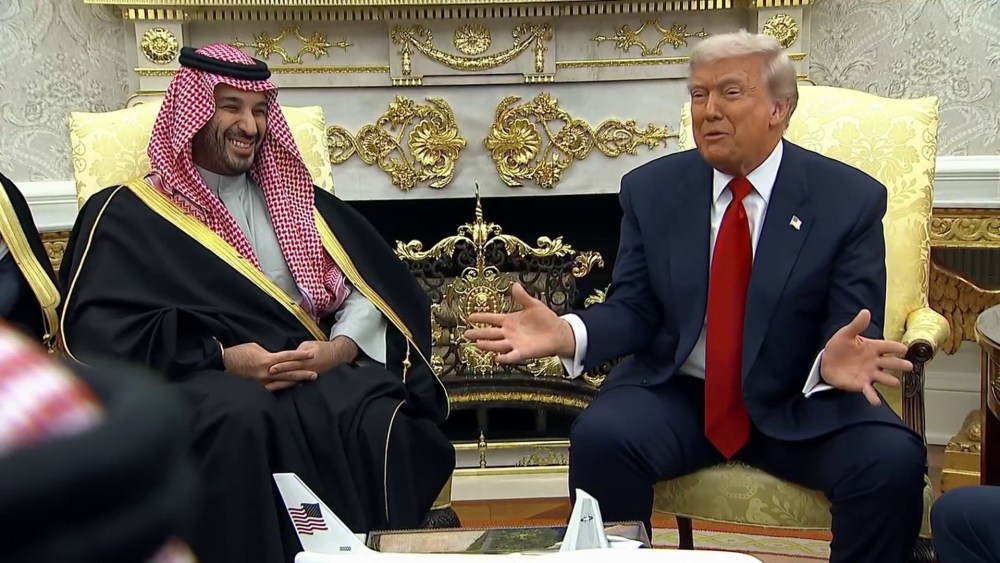
The LIV Golf tournament is scheduled to tee off its U.S. tour Thursday at Trump National Golf Club in Virginia, a week after the Kingdom of Saudi Arabia — whose oil- and blood-soaked Public Investment Fund created LIV five years ago — announced it would pull out. The Saudis created LIV as a rival to the PGA Tour and reportedly burned at least $5 billion on it, but now they are leaving LIV to fend without their help.
Where better to prop up what remains of the tournament than a Trump-owned property in a suburb of our nation’s capital? In other words, the tournament will be played virtually in the lap of the Saudis’ biggest apologist after U.S. intelligence implicated Saudi Crown Prince Mohammed bin Salman in the assassination of Washington Post journalist Jamal Khashoggi.
Where better to prop up what remains of the tournament than a Trump-owned property in a suburb of our nation’s capital?
The kingdom has fomented a yearslong war against Yemen that has killed or contributed to the deaths of more than 250,000 people while creating arguably the world’s worst humanitarian crisis. Saudi Arabia is also the birthplace of 15 of the 19 men who carried out the 9/11 attack. Despite that indisputable fact, when Americans who lost loved ones in the attack criticized President Donald Trump for hosting a LIV tournament on one of his properties four years ago, he said, “Well, nobody’s gotten to the bottom of 9/11, unfortunately, and they should have.”
Trump can’t shake his Saudi infatuation.
Indeed, The Washington Post reported the day Trump went to war with Iran that the Saudi crown prince helped convince Trump to
by Steve Benen | May 6, 2026 | Maddowblog, News, Politics
By all appearances, Donald Trump wanted to see officials change the name of Washington Dulles International Airport, just outside of the nation’s capital, so that it bore his name. The president was so eager to make that happen that he was prepared to execute a scheme in hopes of forcing the hand of Democratic officials.
That effort ultimately failed, though he received a consolation prize of sorts: In Florida, Republican Gov. Ron DeSantis recently signed a bill to rename Palm Beach International Airport after Trump, as part of a larger, partisan glorification crusade that has reinforced concerns that much of the GOP has turned into a personality cult.
But while the debate over the propriety of Florida Republicans’ decision is worthwhile, there was a separate issue that lingered as the process advanced. Shortly before GOP state legislators advanced the renaming proposal, the Trump Organization filed trademark applications for “President Donald J. Trump International Airport” and “Donald J. Trump International Airport,” as well as the possible “DJT” airport code.
Obvious questions soon followed. For example, would the president’s family business try to profit from Florida’s decision to rename the Palm Beach International Airport after him, either through royalties or licensing fees? The answers are coming into focus.
The New York Times reported that commissioners in Palm Beach County approved a trademark and licensing agreement with the president’s family business this week, and the practical implications are striking. From the article:
Under the new agreement, the Trump family won’t profit from branded merchandise sold at the airport. But the agreement does not prevent the family from profiting off any such merchandise sold outside the airport’s premises, according
by Steve Benen | May 6, 2026 | Iran Tensions, Maddowblog, News, Politics
Secretary of State Marco Rubio spoke to reporters Tuesday from the White House briefing room, apparently with a single goal in mind: talk up the administration’s new policy in the Strait of Hormuz.
Asked, for example, about whether the United States would have to acquire all Iranian nuclear material in order to end the war, Rubio suggested that the war had already come to an end.
“The operation is over,” the secretary claimed. “Epic Fury, as the president notified Congress, we’re done with that stage of it, OK? We’re now on to this Project Freedom.”
Hours earlier, Defense Secretary Pete Hegseth and Gen. Dan Caine, the chairman of the Joint Chiefs of Staff, held a briefing at the Pentagon and stressed the same point. Hegseth referred to “Project Freedom” in his first sentence and mentioned it another 10 times over the course of the briefing, insisting that it is “separate and distinct” from the 10-week-old war. For his part, Caine referred to “Project Freedom” a half-dozen additional times.
The point was not subtle: The Trump administration’s line du jour was to argue that the war that began on Feb. 28 has, for all intents and purposes, run its course. The new priority was a maritime security initiative involving U.S. ships escorting other ships through the strait. To hear Rubio and Hegseth tell it, anyone focusing on the war was behind the times. All that matters now, they argued, was Project Freedom.
A couple of hours after Rubio wrapped up his Q&A at the White House, Donald Trump put the “project” on ice. MS NOW reported as part of its live blog coverage:
Trump announced the U.S.
by Steve Benen | May 6, 2026 | Justice Department, Maddowblog, News, Politics
Among the most scandalous developments that have unfolded at Donald Trump’s unraveling Justice Department is the frequency with which federal prosecutors have investigated and indicted the president’s perceived political foes. But nearly as important as the cases the DOJ has pursued are the cases that federal prosecutors have dropped.
Take the latest developments in Tennessee, for example. WTVF, the CBS affiliate in Nashville, reported:
The U.S. Department of Justice appears to be preparing to drop a nearly two-year criminal investigation of Tennessee Congressman Andy Ogles, agreeing to return or destroy evidence seized from the diehard MAGA Republican before the FBI ever got a chance to review it.
That criminal investigation had focused on potential fraud involving campaign finance reports filed by the Maury County Republican during his first run for Congress in 2022.
A press statement from the far-right congressman’s defense attorneys confirmed that the Justice Department did, in fact, agree to return the phone federal agents had seized from Ogles, as well as destroy the information the DOJ had obtained from his phone and Google account.
In the recent past, this outcome would’ve seemed unrealistic.
Ogles was already a scandal-plagued congressman when WTVF reported in late 2023 that the congressman’s financial reports showed he had made a $320,000 personal loan to his 2022 campaign. That might not have been especially problematic, since candidates routinely make such loans, were it not for the fact that Ogles’ financial disclosures suggested he didn’t have $320,000.
Months later, the Republican effectively conceded that his earlier claims weren’t true. In his revised version of events, he said he’d actually loaned his campaign $20,000, not $320,000, though it remained an open question
by Nicholas Mitchell | May 6, 2026 | Opinion, Politics
For Black Americans, the Supreme Court decision in Louisiana v. Callais is an especially poignant moment of outrage. There are millions of Black people who survived the full violent might of Jim Crow to secure the Voting Rights Act only to outlive the protections of the law that their friends and family were maimed and murdered to secure. Eddie Glaude succinctly described this rage when he told MS NOW’s Nicolle Wallace that “you get tired of people playing fast and loose with your dead.”
It is important to note that the Supreme Court did not rule that minority-dominant districts or Section 2 of the Voting Rights Act is unconstitutional per se. The 6-3 opinion written by Justice Samuel Alito changed the criteria for proving racial discrimination in drawing congressional districts. In brief, the ruling declared that any lawsuit claiming that a congressional district is racially discriminatory under Section 2 of the Voting Rights Act must be able to prove discriminatory intent from the people drawing the district; proving discriminatory effect would be insufficient.
There are millions of Black people who survived the full violent might of Jim Crow to secure the Voting Rights Act only to outlive the protections of the law.
It is that change that has led scholars, pundits, activists and Justice Elena Kagan herself to declare that the Voting Rights Act, which is one of the two laws that ended Jim Crow, is a dead letter.
While the damage to the Voting Rights Act was immediately apparent, and voters, candidates and political parties are grappling with its results, the logic introduced in Callais can just as wrongly be applied to the