by Richard Westmoreland, Lt. Col. Marine Corps (Ret.) | Jul 4, 2026 | Opinion, Politics
This piece is part of “America in the balance: The fight for our history and future,” a special series from MS NOW that explores where we are as a nation as we commemorate the 250th anniversary of the signing of the Declaration of Independence.
When I flew over countries like Iraq and the former Yugoslavia as a Marine Corps F/A-18 pilot, I often wondered how they came to be ruled by authoritarians. During our conflicts with those countries, I read every book I could to help me understand the culture, history and more recent events that led up to the U.S. military darkening their skies.
I spent 20 years of my life as a Marine Corp fighter pilot, and I savored every minute of my time wearing my nation’s uniform. The memories of my service still fill me with pride. Not only was I honored to help defend our nation’s ideals, but I enjoyed the camaraderie of educated, confident and highly driven individuals who were honored to do the same.
I spent 20 years of my life as a Marine Corp fighter pilot, and I savored every minute of my time wearing my nation’s uniform.
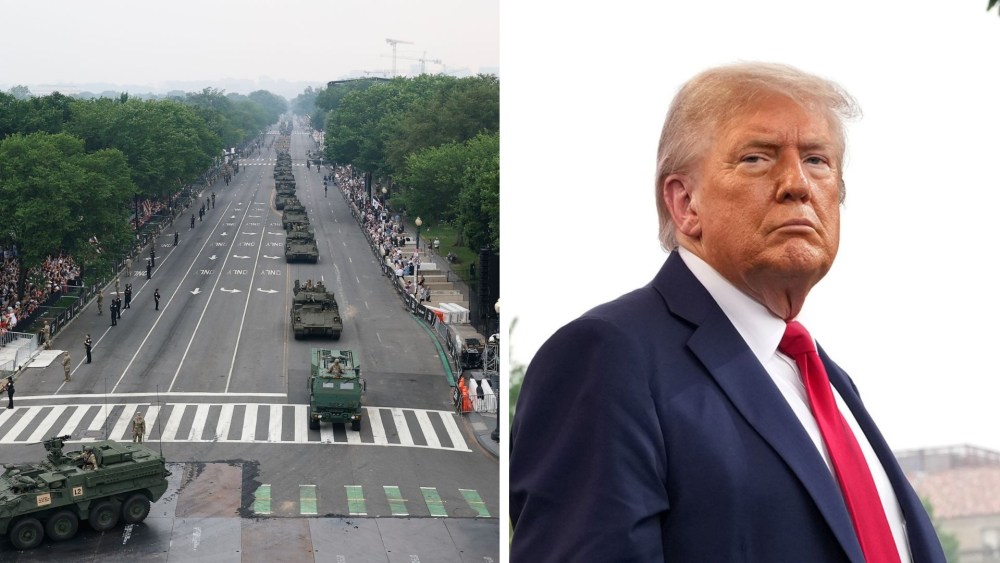
If you had asked me before I retired in 2005 how I’d feel on July 4, 2026, the 250th anniversary, I would have imagined I’d be feeling every bit of the pride I felt when I was in international skies defending our country, but the creeping authoritarianism of the last decade, and the willingness of so many Americans to accept it, has me worried.
More than five years ago, after insurrectionists (including some with military training) stormed the Capitol, I wrote a column expressing
by Deborah N. Archer | Jul 3, 2026 | Opinion, Politics
This piece is part of “America in the balance: The fight for our history and future,” a special series from MS NOW that explores where we are as a nation as we commemorate the 250th anniversary of the signing of the Declaration of Independence.
The Declaration of Independence promised liberty to people it enslaved, and at the 250th anniversary of that signing, Americans are confronted with uncomfortable questions, among them, why the civil rights framework we built to enforce our founding document’s promise of liberty continues to fall short.
The answer is in our civil rights architecture. We built a jurisprudence that, by identifying violations and punishing wrongdoers, mostly seeks to bring a halt to discrimination after it occurs. To be sure, that architecture has produced indispensable gains, but our country declared racism illegal while leaving in place the infrastructure that produces racial inequality: the land use decisions that segregate neighborhoods, the transportation systems that isolate communities from opportunity, the housing and lending policies that concentrate wealth and poverty, the schools that reflect those patterns of exclusion and the public institutions that distribute resources unevenly across race and place.
The civil rights framework we built to enforce our founding document’s promise of liberty continues to fall short.
As long as those systems continue to shape where people live, learn, work, travel and access opportunity, discrimination will continue to be reproduced, even when individual acts of bias are prohibited.
The evidence is clear that by itself, prohibiting discrimination cannot fulfill our founding promises. Racial inequality, which persists in 2026, was built from the ground up, so the system of racial justice to combat it must be built from the ground up, too.
by Steve Benen | Jul 2, 2026 | Maddowblog, News, Politics
On a daily basis, Donald Trump says all kinds of offensive things, but during remarks at Joint Base Andrews two weeks ago, he said something that nearly everyone could agree with. Unveiling the latest Air Force One, a luxury jet he received from Qatar, Trump said, “A normal president wouldn’t do this.”
Unlike so many of the Republican’s public comments, this had the benefit of being entirely true: A normal president most certainly would not have accepted a luxury jet from Qatar — a Middle Eastern country that Trump used to accuse of supporting terrorism — which he apparently intends to “donate” to his presidential library after leaving the White House. (Since receiving the plane, the president and his administration have cozied up to Qatar to a remarkable degree, even unilaterally extending a NATO-like security guarantee to the nation.)
On Wednesday, the president took his first flight on the plane, but before boarding, he took a little time to talk to reporters, one of whom asked how much it cost American taxpayers to upgrade the jet.
Q: How much did it cost American taxpayers to upgrade the plane?TRUMP: It cost very little relative to what it would cost if we did it a different way. This was a gift from a country that’s treated us very well.— Aaron Rupar (@atrupar.com) 2026-07-01T12:39:48.770Z
“Well, it cost very little relative to what it would cost if we did it a different way,” Trump responded cryptically. He added, “Frankly, we couldn’t build a plane like this.”
I’m not sure who counts as “we,” but the jet was built by Boeing, which is an American company that built the plane
by Steve Benen | Jul 2, 2026 | Maddowblog, News, Politics
As a presidential candidate, Donald Trump had a habit of accusing his rivals of trying to capitalize on public office. Exactly 10 years ago last week, for example, the Republican argued that Hillary Clinton had “perfected the politics of personal profit.” In 2020, he similarly declared, “Politicians ran for office, promising to protect American workers. But then they went to Washington, and they lined their pockets.”
Vote for him, Trump said, and he’d be different. Vote for the man who’s already wealthy, his party said, and he wouldn’t even have to try to profit from the presidency.
So much for that idea. MS NOW reported:
President Donald Trump reported more than $1.4 billion in cryptocurrency-related income in his latest annual financial disclosure released Tuesday, with digital assets emerging as the largest source of his personal earnings during his second term.
The 927-page disclosure, covering 2025 and filed with the U.S. Office of Government Ethics, shows Trump earned more than $500 million from World Liberty Financial, the cryptocurrency company he co-founded in 2024 with his sons, Eric Trump and Donald Trump Jr. He also reported another $635 million in income tied to sales of the $TRUMP meme coin.
A related New York Times report noted, “All told, the president pulled in at least $2.2 billion, a figure that includes other parts of his vast holdings, such as his real estate assets. That compares to a minimum of $622 million his enterprises pulled in for all of 2024, before he returned to the presidency.”
Cynics who might think this is somehow normal, as if every president takes advantage of power to amass vast personal wealth, are mistaken. A
by Steve Benen | Jul 2, 2026 | Economy, Maddowblog, News, Politics
Expectations heading into this week showed projections of about 115,000 new jobs being created in the United States in June. As it turns out, according to the new report from the Bureau of Labor Statistics, the totals fell far short of those expectations. CNBC reported:
The U.S. economy saw job creation cool sharply heading into the summer, the Bureau of Labor Statistics reported Thursday.
Nonfarm payrolls for June increased by a seasonally adjusted 57,000 for the month, slower than the downwardly revised 129,000 added in May and worse than the 115,000 Dow Jones consensus forecast.
The unemployment rate inched lower to 4.2%, which is still low by historical standards, though it’s still higher than it was when Donald Trump’s second term began.
Also discouraging were the revisions for April and May, which subtracted a combined 74,000 jobs from previous estimates.
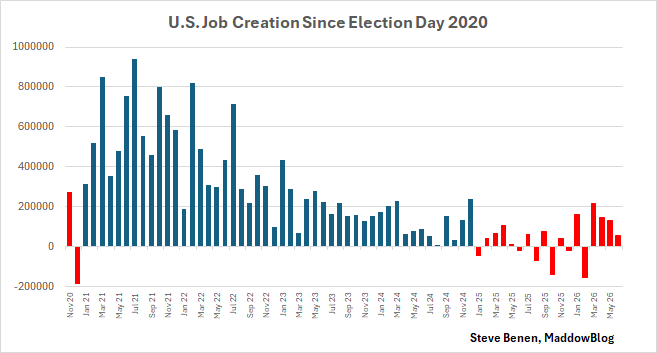
As 2026 reaches the halfway point, the U.S. economy has created 552,000 jobs so far this year — a monthly average of 92,000 — which is an underwhelming total that plainly contradicts Donald Trump’s frequent claims that the domestic economy is now the strongest it’s been in American history.
All told, the U.S. economy has added 668,000 jobs over Trump’s 18-month second term. Over the previous 18 months, the economy added over 2.4 million jobs. To date, the White House hasn’t even tried to explain why the domestic job market worsened after the Republican president took office.
To contextualize the data, I put together this chart to show month-to-month totals since the 2020 election. The blue columns point to Biden’s presidency, while the red columns point to Trump’s.
This post updates our related earlier coverage.
The post Job numbers
by Steve Benen | Jul 1, 2026 | Maddowblog, News, Politics
As a rule, JD Vance seems to go out of his way to say whatever Donald Trump wants him to say, but from time to time, contradictions emerge between the president and the vice president.
Take the recently passed housing bill, for example, which arrived at the White House earlier this week.
JD Vance criticizes Dems for not working on bipartisan housing legislation as Trump tanks bipartisan housing legislation — Aaron Rupar (@atrupar.com) 2026-06-30T23:32:35.388Z
As part of an interview Tuesday night with Fox News’ Laura Ingraham, the Ohio Republican said, “Frankly, Laura, I would love it if Democrats were willing — you know, not that they will agree with Republicans all the time — but if they were willing to work with us on lowering housing prices, on lowering gas prices, on actually making the lives of American citizens better. You know, we could have some real bipartisan compromise. That’s not what they’re talking about.”
I realize the vice president must be very busy, but it really isn’t that difficult to keep up with the basics of current events. In this case, when Vance said Democrats are unwilling to work with Republicans on priorities such as “lowering housing prices,” he turned reality on its head. It was literally last week when Democrats offered unanimous support for a bipartisan bill to address housing prices — legislation that members such as Democratic Sen. Elizabeth Warren of Massachusetts helped to write.
Democrats recognized that doing so would offer the GOP some election-season bragging rights, but Democrats did it anyway because they have prioritized governing and “actually making the lives of American citizens better” over partisan considerations.
But Vance didn’t