by Jacques Berlinerblau | Jul 25, 2026 | Opinion, Politics, White House
Friday night’s redo of the White House Correspondents’ Association dinner had three things in common with April’s doomed event, which was cut short after the intrusion of a gunman identified by authorities as Cole Tomas Allen. The first was a beaming President Donald Trump, delighted to be holding court among the journalists whom he habitually abuses, insults and subpoenas. The second was the presence of the aforementioned journalists, who in their gowns and tuxedos looked like runway models in a Stockholm syndrome-themed fashion show. And the third was the absence of a comedian entrusted with making jokes about the leader of the free world.
Roasting the commander in chief was once a venerable WHCA tradition. But like so many American institutions subjected to a MAGA stare-down or shakedown, the organization abandoned its principles.
Roasting the commander-in-chief was once a venerable WHCA tradition.
In 2025, the WHCA disinvited comedian Amber Ruffin, presumably because her barbs might have scratched the president’s thin skin. This year, the WHCA didn’t invite a comedian at all. With professional comics absent from the dais, roast master Donald was poised to fill the void.
In the lead-up to the April event, Lara Trump, the president’s daughter-in-law, mentioned that he was working with joke writers to hone his act (though she insinuated that he didn’t really need their help because he’s so darn funny on his own). Hours before the spring gathering, White House press secretary Karoline Leavitt gleefully brayed that “there will be some shots fired tonight.” Then actual shots were fired. Afterward, the president sighed, “I was all set to really rip it.” “I said to my people,” he continued to
by Luke Russert | Jul 25, 2026 | Opinion
The State Department recently convened a high-level diplomatic meeting with representatives from 66 nations to discuss the resurgence of what they term political terrorism. But some Trump administration officials who spoke at the event employed the same kinds of dehumanizing and inflammatory rhetoric that experts say can fuel the political violence the conference was meant to address.
White House Deputy Chief of Staff Stephen Miller’s speech at the event could have served as a case study in the very kind of rhetoric the conference should have been discouraging.
“It’s not a coincidence that when you look at these violent antifa demonstrations and you see any photograph of those who were assembled — to be blunt, not one of the people that is demonstrating looks like a normal person,” he said. “Not one looks normal. They’re all deformed in some way — in their appearance, in their dress, in their mannerism.”
At other points, he described protesters against the administration’s immigration sweeps as “radical leftists,” “political terrorists” and a “cancer” on civilization (three times); argued that “left-wing terrorism” would lead to gulags, “mass imprisonment of political enemies” and “the stripping of their rights and freedoms”; and said the protesters had “scarred their body and their appearance” to the point that “in many different ways, to the point in which “their outer appearance becomes a manifestation of their inner hatred.”
In just a few minutes, Miller’s speech employed many of the rhetorical patterns that scholars of political violence and authoritarianism have long identified as warning signs: portraying opponents as an existential threat, equating dissent with terrorism, using dehumanizing and disease-based language, making apocalyptic predictions and suggesting
by Joseph Cirincione | Jul 25, 2026 | Opinion, Science, White House, World
President Donald Trump says he believes nuclear technology is a grave threat in the hands of Iran’s ruling regime, arguing that the country would inevitably use it to create a weapon of mass destruction. And yet, in a new agreement signed Wednesday, Trump agreed to let Saudi Arabia enrich uranium and reprocess plutonium, the two ingredients used in nuclear bombs.
The Saudis promise this will be used only for peaceful purposes, but Saudi Crown Prince Mohammed bin Salman said as far back as 2018 that “without a doubt if Iran developed a nuclear bomb, we will follow suit as soon as possible.”
Trump’s generosity to Saudi Arabia — which has numerous lucrative deals in place with members of his family — could unleash a flood of new nuclear programs. If the Saudis get this technology, others will demand it too.
Nuclear is the most expensive way to produce electricity, and Saudi Arabia sits on an ocean of oil and is ideally suited for much cheaper solar and wind energy production.
Since the dawn of the Nuclear Age, U.S. policy has denied the ability to enrich uranium and reprocess plutonium to other nations because it is a shortcut to nuclear weapons. The huge and expensive facilities can be developed openly and legally until a government takes the quick jump from making fuel rods to making the cores of bombs. With this deal, Trump has effectively just green-lit a Saudi nuclear bomb program.
How did we get here?
In 2013, the Saudis unveiled a plan to build as many as 16 civilian nuclear reactors. Nuclear reactor companies salivated at the prospect of contracts worth hundreds of billions
by Ja'han Jones | Jul 25, 2026 | Opinion
The Republican Party’s ceaseless quest to impose white supremacist rule over the U.S. government and American society as a whole is trudging along.
Apparently not satisfied with her party’s endorsement of racist policing tactics, its documented assault on Black history and civil rights, and its suppression of Black voting rights through gerrymandering gambits over the past year, Rep. Nancy Mace, R-S.C., introduced a resolution on Thursday that would ban congressional groups that serve minority populations, including the Congressional Black Caucus, the Congressional Hispanic Caucus and the Congressional Asian Pacific American Caucus.
Mace, the scandal-plagued Republican who has fallen out of President Donald Trump’s favor in recent years, recently placed fifth in South Carolina’s GOP primary for governor. All this is to say: It’s fair to guess that this puerile ploy is a desperate grasp for relevance from an increasingly inconsequential lawmaker whose time in office ends in less than six months. It also seems Mace, whose proposal calls on the Committee on House Administration to revoke and prevent the registration of such caucuses, doesn’t have a clue what it actually does.
Take this excerpt for example:
“Race-based caucuses are not about diversity. They are segregation sanctioned by the legislative branch of the federal government,” said Congresswoman Mace. “You do not get to lecture America about inclusion while running an organization checking skin color at the door or advocating for Americans of one race over another.”
None of these caucuses — or any of the others Mace suggested ought to be forbidden — engage in, as she said, “segregation,” base entry on skin color or advocate “for Americans of one race over the other.” If that
by Evan Greer | Jul 24, 2026 | culture, Opinion, Science
Earlier this month, an investigative journalist revealed that buried in a trove of hacked documents from Madison Square Garden, there was a three-page dossier about … me.
It was in a folder titled “Facial Recognition Activists,” and time-stamped screenshots made it clear that someone had been keeping close tabs on me.
As a public-facing activist, this isn’t my first time being targeted by powerful people I’m trying to hold to account. But the incident should raise alarm bells, even for those who don’t spend their days tussling with CEOs and lobbyists.
Madison Square Garden’s surveillance capabilities rival those of some small countries — but there are far fewer rules governing how they can be used.
In recent weeks, several outlets have reported on Madison Square Garden owner James Dolan’s unapologetic use of high-tech surveillance, including a detailed report from Wired that his company uses the technology to track critics who visit the venue, monitor activists and celebrities, and in some cases ban attorneys from firms who have sued him or his organizations.
Seemingly undeterred by a lawsuit filed by Madison Square Garden over an earlier report that said MSG used technology to track LGBTQ+ celebrities. (The venue alleges that the outlet published “false and defamatory statements and implications”; Katie Drummond, the magazine’s global editorial director, has called the lawsuit “baseless and ridiculous.”) Wired this week published a piece reporting that MSG temporarily turned off its controversial facial recognition system during the star-studded wedding of Taylor Swift over the Fourth of July weekend. Swift did not comment on the report. When contacted for comment, a representative from Madison Square Garden said the venue is unable to comment on
by Zeeshan Aleem | Jul 24, 2026 | Business, Opinion, White House, World
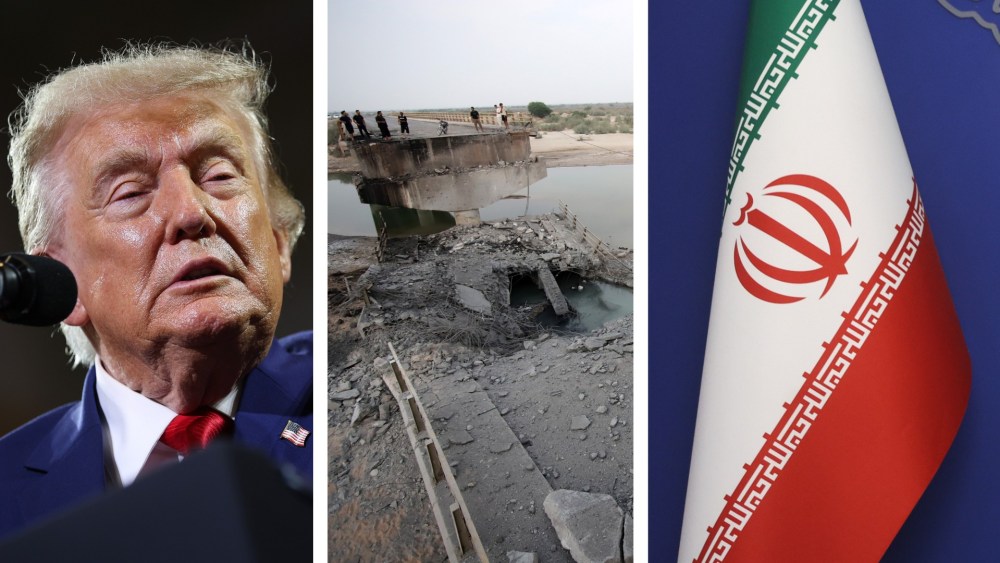
The Strait of Hormuz remains at a virtual standstill because of President Donald Trump’s foolish war, and now, in what represents a new global energy price nightmare, Houthi militants in Yemen have begun to block a separate corridor that is critical for global oil shipping. On Thursday, oil surged past $100 a barrel for the first time since May in response to the news that the war with Iran is on the brink of expanding to a new front. And Trump’s promise to bomb the Houthis should they continue is unlikely to improve the situation.
Those Houthi militants, who are allied with and supported by Iran, announced Monday that they would were enacting a blockade in the Bab el-Mandeb Strait against Saudi Arabia. The Houthis said their blockade is retaliation for airstrikes against a Yemeni airport intended to prevent an Iranian aircraft from landing. (Yemen’s Saudi-backed government claimed credit for the attack.) On Thursday, the Houthis said they had attacked two Saudi oil tankers and successfully warned 10 more to turn back. (Saudi Arabia’s official news agency confirmed at least one tanker was hit.)
Should the Houthis continue to attack ships, Trump ought to be concerned; his record fighting the scrappy militia is not impressive.
The Houthis’ blockade is a huge deal. Before the Iran war, about a fifth of the world’s oil passed through the Strait of Hormuz. Now it’s effectively closed. Saudi Arabia, which had transported the bulk of its oil through the Strait of Hormuz, started moving oil west through a pipeline. From there, Saudi Arabia was sending its oil out through the Red Sea and the Bab al-Mandab Strait, which connects the Red Sea