by Michael A. Cohen | Jan 14, 2026 | Congress, Opinion
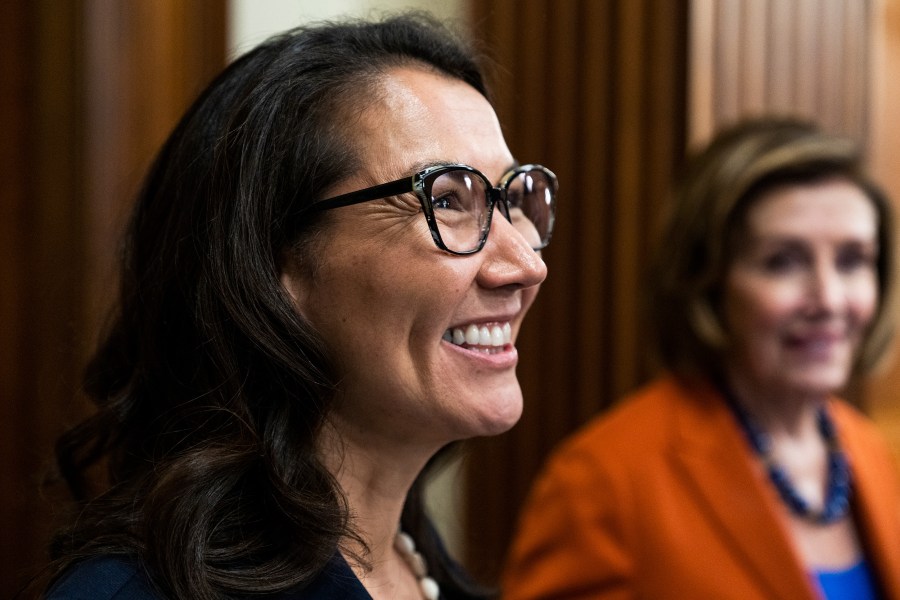
On Monday morning, Democrats received a belated Christmas present: Former Rep. Mary Peltola announced that she is challenging incumbent Republican Dan Sullivan in the Alaska Senate race this fall. Peltola, who already won two statewide House races in Alaska in 2022, but lost reelection in 2024, is undoubtedly the only Democrat who could make this a competitive Senate race.
Peltola’s entry into the race is yet another feather in the recruiting cap of Senate Minority Leader Chuck Schumer, D-N.Y., who has shown once again that he is one of the best Democratic congressional leaders in recent memory.
That statement will no doubt cause many of you to recoil. Schumer is regularly vilified by rank-and-file Democrats for his poor communication skills and alleged passivity in standing up to President Donald Trump.
Schumer’s job is to put Democrats in the best possible position to take back the Senate, and on that front, he deserves praise.
But that misunderstands Schumer’s role in our political system and disregards his unique political skills. There’s only so much any Democrat can do to stop a lawless president like Trump when Congress is controlled by craven Republicans. Schumer’s job is to put Democrats in the best possible position to take back the Senate, and on that front, he deserves praise.
While Schumer’s critics have taken turns rhetorically pummelling him, he has quietly assembled as good a slate of Senate candidates as Democrats could have hoped for more than a year ago when they lost control of the chamber to Republicans.
In North Carolina, he recruited the state’s popular former two-term governor, Roy Cooper, to run for the state’s open Senate seat following the retirement
by Ja'han Jones | Jan 14, 2026 | Business, Opinion
Happy Tuesday! Here’s your Tuesday Tech Drop, the week’s top stories from the intersection of technology and politics.
Social media MAGA-fication
Meta’s monthslong MAGA rebrand continued this week as the social media platform hired Dina Powell McCormick, a former adviser to Donald Trump, as its new president. McCormick worked on Trump’s National Security Council in his first term and was seen as a close ally to the president’s son-in-law Jared Kushner. McCormick is married to Sen. Dave McCormick, R-Pa., whom Trump endorsed in his 2024 Senate race.
In recent years, prominent politicians have falsely accused Meta’s platforms of viewpoint censorship, and ahead of the 2024 election, Trump publicly threatened to throw CEO Mark Zuckerberg in jail. More recently, the company and its leaders have made efforts to ingratiate themselves with MAGA world. One might see McCormick’s hiring as another way for Meta to curry favor with the administration as it faces allegations that its platforms are harmful to children and society writ large — allegations the company disputes. Indeed, Trump celebrated the news, posting in part on his social media platform that McCormick is “A great choice by Mark Z!!! She is a fantastic, and very talented, person.”
McCormick represents yet another data point in the MAGA-fication of American social media. Meta, already cozying up to MAGA, is handing executive power to a former Trump administration official, joining TikTok (to be sold into the control of Trump donor Larry Ellison) and X (owned by Trump donor Elon Musk).
Read more on CNBC here.
Grok sparks global outrage
There’s a growing global push to ban Musk’s artificial intelligence tool, Grok, after a new feature allowed users to create nonconsensual
by Kareem Crayton | Jan 14, 2026 | Opinion
Chief Justice John Roberts famously said the U.S. Supreme Court’s role is “calling balls and strikes,” suggesting a narrow mandate of doing just enough to enforce constitutional rules. But in redistricting cases, the court’s conservative supermajority has gone further, wielding its power in ways that have entrenched decidedly partisan outcomes, largely at the expense of voters of color. This troubling pattern has been evident in recent rulings, and we may see more of it this term.
Last month, the Roberts Court upheld Texas’ redrawn maps despite evidence that the Republican legislature diluted Latino and Black voting power. And in a case to be decided this term, Louisiana v. Callais, the justices are considering whether to strike down Section 2 of the Voting Rights Act, a critical protection against discriminatory maps. Eliminating the federal law that outlaws policies and practices whose effects discriminate against voters of color could undo four decades of civil rights enforcement.
A court that only calls balls and strikes might show restraint in a case like this.
A court that only calls balls and strikes might show restraint in a case like this. But this court’s tendency is quite different.
Perhaps the most prominent voting rights decision in the Roberts Court record is its 2013 ruling in Shelby County v. Holder. This decision ended the practice of “preclearance,” effectively dismantling another key part of the Voting Rights Act that required federal approval for voting changes in places with a history of racial discrimination. More than half the changes blocked under this system have involved election maps.
The Shelby County ruling declared that such discrimination was no longer a pressing concern and that the review provision was no longer
by Austin Sarat | Jan 13, 2026 | Opinion
On Jan. 8, the White House announced the creation of a new division in the Department of Justice for “national fraud enforcement,” to be headed by an assistant attorney general. What makes this move notable is that it will be run out of the White House, under the direct supervision of President Donald Trump and Vice President JD Vance. Never before has the politicization of justice been so blatant or so dangerous.
Having a prosecutor directly answerable to the president and vice president crosses a line that no other administration has dared to cross. It is the kind of thing one might expect in an autocratic or totalitarian regime, but not in the United States.
Who does the vice president have in mind when he talks about the “bad guys”?
The New York Times rightly calls Trump and Vance’s intention to directly oversee a senior DOJ official “one of the administration’s most brazen efforts to date to toss out the traditional boundaries that have long existed between the White House and investigations conducted by federal law enforcement.”
And how did Republicans in the Senate, which will be responsible for confirming the nominee to head the new division, react? Majority Leader John Thune said that the person “would be confirmed swiftly.”
Thune’s response is a clear dereliction of duty. It will now be up to his colleagues in the Senate to resist this dangerous power play.
Explaining why the administration is creating the new position, Vance said, “This is the person who is going to make sure we stop defrauding the American people. When we get the bad guys, we want to make sure we get
by Ja'han Jones | Jan 13, 2026 | Opinion
On Monday, a group of House Democrats asked a federal judge to intervene and stop the Trump administration’s newly announced restrictions on lawmakers conducting oversight at immigrant jails being run by the Trump administration.
The Trump administration has repeatedly blocked Democratic officials from conducting oversight at Immigration and Customs Enforcement facilities across the country amid a litany of abuse claims lobbed by detainees and their advocates. Democrats had already legally challenged the lack of access, but they went back to court on Monday to push for an emergency hearing as Homeland Security Secretary Kristi Noem ordered even more restrictions on visits. This all comes after an ICE agent fatally shot a woman named Renee Good in Minneapolis last week.
A federal law requires that lawmakers be granted entry to conduct oversight at the jails without notice, but Noem and her department have argued in court — unsuccessfully so far — that their heightened restrictions are justified because some of the funding being used to operate the facility comes from a pool of money not authorized under the law.
Monday’s court filing, which lists Rep. Joe Neguse, D-Colo., as a plaintiff, says the new DHS restrictions defy U.S. District Court Judge Jia Cobb’s decision last month to put the previous restrictions on hold. As for the department’s funding argument, the filing argues that it’s “practically impossible” for DHS to be implementing the new restrictions “without using a single dollar of annually appropriated funds subject to” the oversight law.
The filing says the oversight visits are necessary — and need to come soon — because Congress is currently negotiating DHS’ budget for the fiscal year ahead.
by Philip Bump | Jan 13, 2026 | Opinion
President Donald Trump was pleased to report last week that the federal government was nearly 200,000 employees smaller by the end of 2025 than when he took office. (He was perhaps a bit too pleased to report it, leaking private data from the December jobs report 12 hours before it went public.) From its earliest, Elon Musk-flavored days, Trump’s second term in office has prioritized slashing headcount, to great effect.
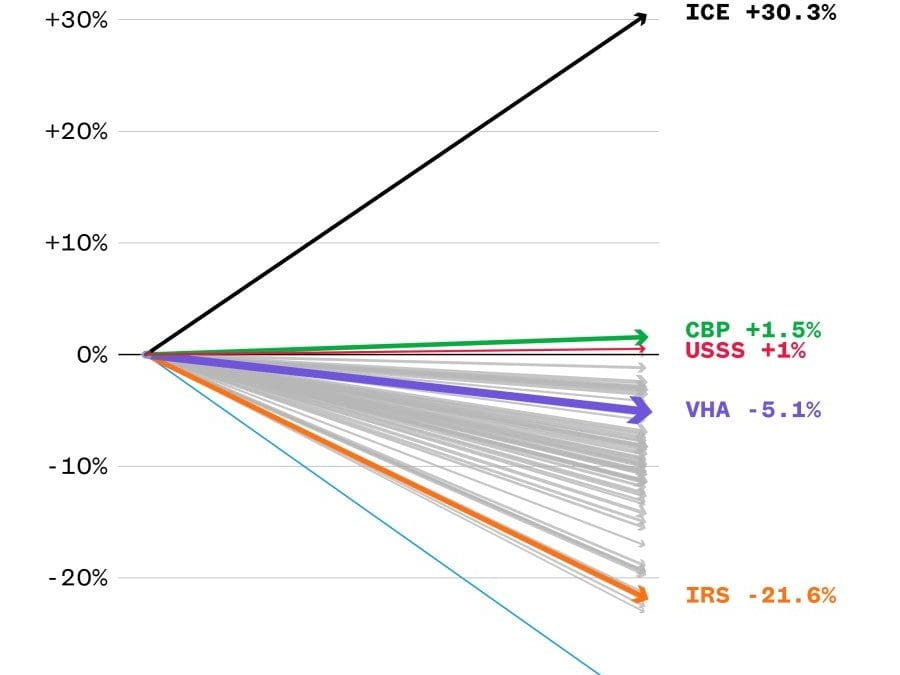
Those cuts are not uniform. Federal data shows that, of the 60 departments with the most employees at the end of the year, three saw employment rise since January. The Secret Service, for example, grew slightly. Customs and Border Protection, or CBP, had 1.5% more employees as the year ended.
And then there’s Immigration and Customs Enforcement, or ICE. The agency that’s taken the lead on enacting Trump’s sweeping deportation agenda — with underrecognized support from CBP —was 30% larger at the end of the year than it was at the beginning.
Analysis of data from the Office of Personnel Management. Philip Bump / MS NOW
This was, in part, thanks to an infusion of funding from the goofily named One Big Beautiful Bill Act, or OBBBA, a piece of legislation that rolled several of Trump’s central policy priorities into one funding package. ICE received about $10.4 billion in funding last fiscal year, a total that carried over into this one, thanks to the agreement that curtailed the government shutdown by agreeing to continue funding at last year’s levels.
But OBBBA gave ICE (and other immigration-related departments) far more than that: $45 billion over four years to expand its detention facilities and about $30 billion