by Adam Johnson | Jan 22, 2026 | Article, ICE, Minneapolis, Opinion, Politics and Movements: US, Prisons and Policing
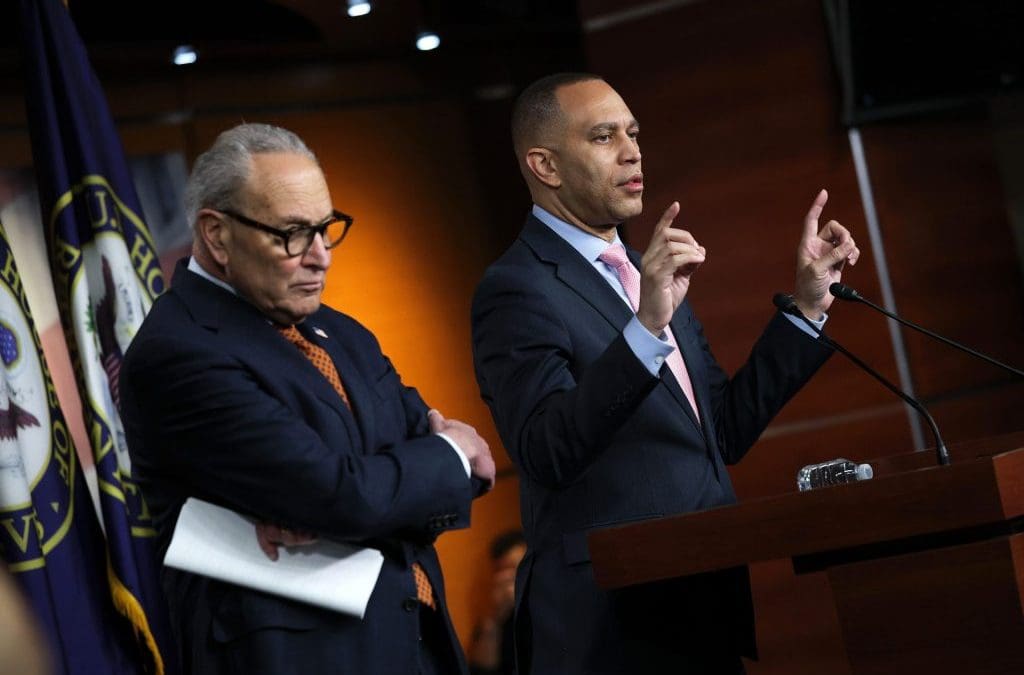
In response to the January 7 ICE murder of Renee Good and the broader, untenable ICE terror campaign Trump unleashed on Minneapolis—and other major US cities—congressional Democrats are under increasing grassroots pressure to do something, anything, to fight back against the lawlessness and brazen violence of Trump’s deportation machine.
Democratic leadership, who yesterday refused to fund an upcoming DHS bill because it did not “do enough to rein in ICE,” have spent the past few weeks establishing their line in the sand. And what they appear to have settled on is a typical suite of pseudo-reforms, cosmetic PR and HR tweaks, body-worn cameras, and more money for “training,” all of which will do nothing to meaningfully alter the calculus for the Trump White House or ICE. Democrats are running through the motions of opposition in exchange for “guardrails” that will do little to nothing to address the central issues, while refusing to meaningfully tackle the source of ICE’s power—namely, its immunity from prosecution and obscene funding levels. Put another way: Democrats are responding to the killing of Renee Good by pushing reforms that would have done nothing to prevent the killing of Renee Good, and thus will do nothing to prevent future killings of other Renee Goods.
Democrats are running through the motions of opposition in exchange for “guardrails” that will do little to nothing to address the central issues, while refusing to meaningfully tackle the source of ICE’s power—namely, its immunity from prosecution and obscene funding levels.
The exact prescriptions offered by Democrats are difficult to pin down. House Minority Leader Hakeem Jeffries, in particular, has remained vague about what his demands
by Michael A. Cohen | Jan 22, 2026 | Opinion
America’s Western allies have had enough — or so they say.
This week at the World Economic Forum in Davos, Switzerland, one world leader after another expressed frustration with the United States over its increasingly hostile behavior toward them and called for a new path forward.
According to European Commission President Ursula von der Leyen, it’s time for Europe to seek a permanent break with the U.S. “Nostalgia will not bring back the old order,” said von der Leyen. “It’s time to seize this opportunity and build a new independent Europe.”
If all this talk sounds familiar, it’s because we’ve heard it before.
“So many red lines are being crossed,” said Belgian Prime Minister Bart De Wever in response to President Donald Trump’s threat to impose tariffs over Greenland, “that you have the choice between your self-respect — being a happy vassal is one thing. Being a miserable slave is something else.”
“Europe has very strong tools now, and we have to use them when we are not respected,” huffed French President Emmanuel Macron.
But perhaps the most direct criticism of Trump — and call for a new world order — came from Canadian Prime Minister Mark Carney, who told the assembled global elite, “We are in the midst of a rupture, not a transition.” Carney declared that “great powers … using economic integration as weapons, tariffs as leverage, financial infrastructure as coercion, supply chains as vulnerabilities to be exploited,” cannot continue.
“We live in an era of great-power rivalry,” said Carney. “The rules-based order is fading,” and “middle powers [such as Canada] must act together because if we’re not at the table, we’re on the menu.”
These
by Hayes Brown | Jan 22, 2026 | Opinion
The House Judiciary Committee may be inviting former special counsel Jack Smith to testify Thursday in an attempt to undercut the legitimacy of Smith and his investigation, or in the attempt to catch him in a lie. Chairman Jim Jordan, R-Ohio, has framed the hearing as necessary oversight of the longtime prosecutor’s decision to charge President Donald Trump with a multitude of federal crimes in 2023. But whatever House Republicans’ intentions, by inviting Smith’s public testimony, they’re giving him the public platform to make the case that juries never got to hear.
The last time there was this much buzz for a special prosecutor’s testimony was July 2019. Former FBI Director Robert Mueller sat for two days of hearings before the House Intelligence and Judiciary Committees to present the results of his investigation into the Trump campaign’s Russia ties and, crucially, the subsequent attempts to obstruct his work. There were certainly damning parts in Mueller’s two-volume report, including 10 episodes of potential obstruction of justice from Trump in trying to block or otherwise impede the Russia investigation. But what followed was a two-day snoozefest for anyone hoping for explosive testimony from Mueller.
As Smith said in his closed-door deposition, his office “believed that we had proof beyond a reasonable doubt for all the charges and that we would have gotten convictions at trial.”
Mueller had ultimately decided that he had no jurisdiction to indict a sitting president and had told reporters that if asked to testify before Congress, “any testimony from this office would not go beyond our report. It contains our findings and analysis, and the reasons for the decisions we made.”
by Ja'han Jones | Jan 22, 2026 | Opinion
The Trump administration is trying to discredit Africa’s top health organization as the Department of Health and Human Services, or HHS, faces rebuke for backing a vaccine program that has drawn comparisons to the racist Tuskegee experiment.
Under the control of anti-vaccine conspiracy theorist Robert F. Kennedy Jr., HHS has become a hotbed for crackpot health theories and has seen disturbing moves — especially with regard to vaccine schedules. After he was nominated to lead the agency, many people — such as Sen. Angela Alsobrooks, D-Md. — specifically warned about Kennedy’s antiscientific bigotry and its risk to our country’s public health when she took him to task for his false claims about Black people not needing the same vaccines white people get.
As I wrote at the time, Kennedy’s views are best understood within the context of our country’s “sordid and well-documented history of medical racism, including white health officials denying health care to Black people.” That history includes the Tuskegee experiment, which saw hundreds of Black men denied treatment for syphilis for decades in Alabama in the name of medical experimentation, starting in the 1930s.
And health experts are warning that a similar project appears to be unfolding in Guinea-Bissau, where an HHS-funded study was set to withhold a hepatitis B vaccine from some infants in order to revisit the efficacy of a vaccine that has already proved to be safe and effective. The experiment has been derided by numerous health experts — such as Dr. Jeremy Faust, who wrote about the study on his Substack, and Dr. Paul Offit, a former adviser to the U.S. Food and Drug Administration who rebuked the
by Austin Sarat | Jan 21, 2026 | Opinion, Politics
Progressive Democrats turned up the heat last week in their effort to convince party leaders to start impeachment proceedings against President Donald Trump. Among other things, they cite as impeachable offenses the president’s unprovoked attack on Venezuela and his use of the Justice Department to target his political opponents.
ABC News quotes Kat Abughazaleh, who is running for Congress in Illinois, calling for Democratic leaders to “‘grow a f—ing spine.” Abughazaleh, who says political leaders have helped convince Americans that we “shouldn’t take measures toward a future that we want to live in,” calls impeachment “just another tool in the accountability machine.”
President Trump has committed impeachable offenses, but that does not mean that impeachment is the best remedy.
President Trump has committed impeachable offenses, but that does not mean impeachment is the best remedy. It would be, at best, a distraction from Trump’s real vulnerabilities, and even if it succeeded in elevating JD Vance to the highest office in the land, it would not spare the nation from the plague of cruelty and corruption we have experienced since Jan. 20, 2025. That is, it would not save American democracy.
Even though this isn’t the time to actively pursue impeachment, that doesn’t mean Democrats should be silent or fail to talk about why impeachment is warranted. Failing to do so normalizes the president’s abuses of authority and, as they accumulate, habituates people to them.
But, contrary to what Abughazaleh is doing, Democrats definitely shouldn’t make impeachment a part of their platform. The best chance Democrats have to check the president’s lawlessness, corruption and abuses of power is to win control of the House of Representatives and/or
by Hayes Brown | Jan 21, 2026 | Opinion
As another funding deadline looms over Capitol Hill, the biggest question was how lawmakers would approach the bill to fund the Department of Homeland Security. The answer came Tuesday when House and Senate appropriators released the final set of full-year funding bills. A look at the Homeland Security Appropriations Act showcases how unpopular President Donald Trump’s immigration crackdown has become — and how few options Democrats have available to force new constraints onto it.
The four bills included in the so-called mini-bus package come pre-negotiated between the House and Senate, helping smooth their passage through both chambers. In all, the bill would provide $64.4 billion in funding to the Department of Homeland Security for the current fiscal year. As Senate Appropriations Committee vice chair Sen. Patty Murray, D-Wa., noted in her bill summary, that’s a $600 million overall decrease compared to last year.
The main hang-up in securing the bill’s passage has been wrangling over Immigration and Customs Enforcement’s budget. Given ICE’s multistate rampage over the past year, Democrats haven’t been keen on simply letting the status quo remain in place.
Last week, the Congressional Progressive Caucus came out with a list of demands for reforms — short of abolishing the agency — that would draw their support. On the other hand, Republicans who control both chambers of Congress have been loath to add strings to ICE’s spending, which most GOP lawmakers would like to have seen once again boosted.
Many of the requirements set to be enacted seem easy to ignore for an administration that clearly regards Congress’ direct orders as guidelines at best.
The final bill appears to be a compromise between the two