by Steve Benen | Apr 3, 2026 | Maddowblog, News
Donald Trump could really use some kind of win right about now. The president is woefully unpopular, the war he started in Iran isn’t exactly going to plan, and polls show the public is souring on the Republican’s handling of practically every issue and on his priorities generally. Nailing down a victory on an important issue ahead of the midterm elections would do Trump and his party a world of good.
All he has to do is take advantage of an opportunity that he appears to care nothing about.
The Senate last month did something it hasn’t done in a long while: It advanced bipartisan legislation on a key national priority. In an 89-10 vote, the chamber approved the largest piece of housing legislation in a generation, which was co-authored by the top two members of the Senate Banking Committee, Republican Sen. Tim Scott of South Carolina and Democratic Sen. Elizabeth Warren of Massachusetts.
Overhauling federal housing policy is tricky (there’s a reason Congress hasn’t passed major housing legislation in more than three decades), but there’s plenty to like in the package, called The 21st Century ROAD to Housing Act. As a New York Times report summarized, the package would “streamline production, modernize federal programs, improve financing options, ease regulations and set limits on large institutional investors,” all as part of an effort to drive down housing costs by boosting supply.
Instead of scrambling to help the bill through the House, the president reportedly told GOP leaders to disregard housing policy and instead to focus on the so-called Save America Act, which would make it harder for Americans to register to vote and cast
by Jake Bittle | Apr 3, 2026 | Arizona, Clean Energy, dam, farmland, hydropower, News, Phoenix, The Salt River Project, Turning Point USA
In a country characterized by antiquated systems for regulating how electricity is produced and transported to homes and businesses, one utility in Arizona may be the most outdated. In 1903, almost a decade before Arizona became a state, a group of landowners around Phoenix secured a federal loan for a dam on the Salt River. The dam collected water to irrigate farms and produce hydroelectric power…
Source
by Steve Benen | Apr 3, 2026 | Congress, Justice Department, Maddowblog, News, Politics
While many of the officials ousted by Donald Trump are given some kind of consolation prize (more often than not, an ambassadorship), outgoing Attorney General Pam Bondi will receive no such treat. When the president fired her on Thursday following 14 months of failure, he said she’d move to an unspecified “important new job in the private sector.”
At that point, the Florida Republican might’ve thought that she’d exit public office and wait for history to decide whether she was the worst attorney general in American history or merely among the worst attorneys general in American history.
But on Capitol Hill, some lawmakers aren’t done with Bondi just yet.
Rep. Jamie Raskin of Maryland, the top Democrat on the House Judiciary Committee, issued a lengthy and brutal statement about the attorney general’s firing on Thursday afternoon, highlighting the scope and scale of Bondi’s dreadful tenure atop the Justice Department, which included this paragraph:
Pam Bondi used the machinery of federal law enforcement not to pursue justice, but to carry out political vendettas at the direction of the President. Her firing today is long overdue, but it does not erase the damage done and it does not absolve her of accountability. Democrats in Congress will continue to investigate, expose, and hold Pam Bondi and others at DOJ accountable for their serial abuses of power and their betrayals of the Constitution.
This is not an uncommon sentiment. Rep. Robert Garcia of California, the top Democrat on the House Oversight Committee, similarly said in a statement on Bondi, “She will not escape accountability.”
Indeed, the oversight panel that Garcia helps lead was scheduled to depose Bondi on April 14

by Steve Benen | Apr 3, 2026 | Economy, Maddowblog, News, Politics
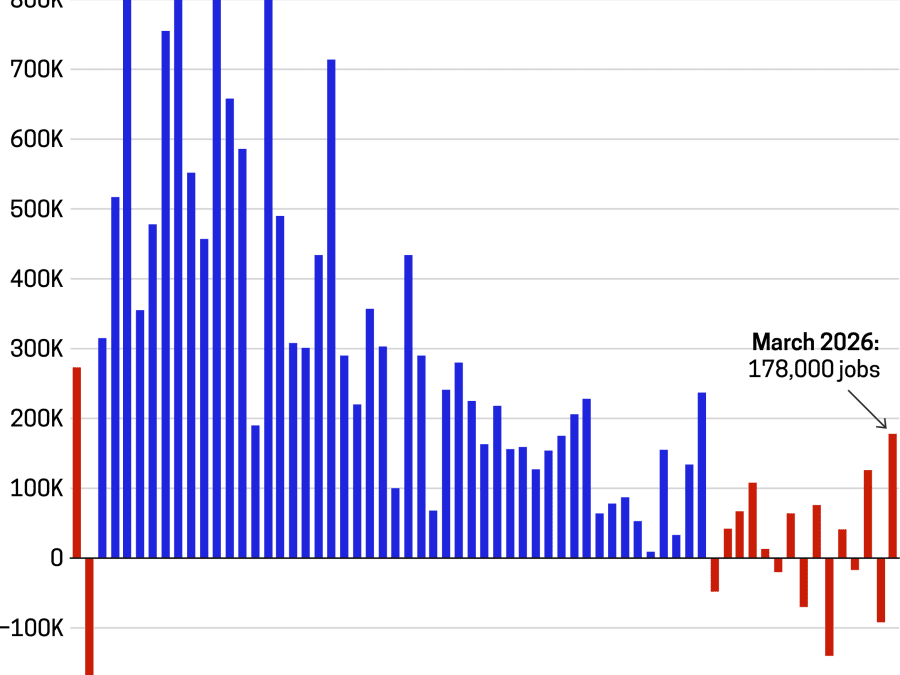
Expectations heading into this week showed projections of about 59,000 new jobs being created in the United States in March. As it turns out, according to the new report from the Bureau of Labor Statistics, the totals exceeded those expectations. CNBC reported:
Nonfarm payrolls rose a seasonally adjusted 178,000 during the month, a reversal from the 133,000 decline in February and better than the Dow Jones consensus estimate for 59,000, the Bureau of Labor Statistics reported Friday. February’s number was revised down by 41,000 while January was revised up by 34,000 to 160,000, putting the three-month average around 68,000.
With job creation higher, the unemployment rate edged lower to 4.3%.
It’s worth emphasizing for context that a major nursing strike in California and Hawaii depressed payrolls in February by tens of thousands of jobs, and now that those labor disputes have been resolved, those now count as new jobs in March. Still, 178,000 is a good overall number.
Indeed, though the data will be revised in the coming months, the preliminary totals suggest that March showed the best job growth of Trump’s second term, though the 178,000 jobs falls short of the 237,000 jobs created in December 2024 — the last full month of Joe Biden’s term.
All told, the U.S. economy has added 321,000 jobs over Donald Trump’s 15-month second term. Over the previous 15 months, the economy added roughly 1.9 million jobs.
While March’s totals are certainly a step in the right direction, the overall picture still reflects a stunning reversal, which the Republican administration has made no credible effort to explain or justify.
To contextualize the data, I put together this chart to show
by Mychael Schnell | Apr 3, 2026 | News
House Speaker Mike Johnson, R-La., may have won the battle, but Senate Majority Leader John Thune, R-S.D., won the war — just not before President Donald Trump left both men politically bruised.
The Department of Homeland Security shutdown, and the Republican efforts to resolve it, exposed deep fractures between Johnson and Thune.
The Senate leader appeared to have broken the impasse early Friday morning, when the Senate unanimously backed a deal to fund most of the agency and leave only the most contentious parts of DHS to a future reconciliation bill. It looked like a workable compromise.
Play
How Republicans ended up owning the DHS shutdown
March 31, 2026 / 05:15
Just minutes after the Senate passed the bill on Friday, at 2:41 a.m. to be exact, Thune sounded cautiously optimistic about Trump’s support.
“Do you think he will be supportive of this and eventually sign it?” MS NOW asked.
“I hope so,” Thune replied. “I never speak for him, but I think he understood where we were. Hopefully this gets across the finish line.”
It didn’t, at least not right away — and not before Johnson played a key, and previously unreported, role in derailing the legislation.
Speaker-phone
Later that morning, during a House GOP leadership meeting, Johnson called Trump to say his conference could not pass the Senate deal, according to two sources familiar with the conversation.
With the president on speakerphone, Johnson pitched Trump on a short-term stopgap to fund all of DHS through May 22 — an idea Democrats had repeatedly rejected.
During the call, Trump suggested attaching the SAVE America Act — legislation requiring voter ID and proof of citizenship to vote — to the DHS bill. But Johnson
by Peggy Helman | Apr 3, 2026 | News
A federal judge is weighing whether the Trump administration can legally build a 250-foot arch just across the Potomac River from the Vietnam and Lincoln memorials, as three veterans who fought in Vietnam have argued the project would violate federal law and permanently alter one of the country’s most sacred landscapes.
Judge Tanya Chutkan declined on Thursday to issue a preliminary injunction, instead asking the parties to report by 5 p.m. on Friday whether they can agree to halt groundbreaking while the case proceeds. If no agreement is reached, she will ask the executive branch to provide supplemental sworn declarations disclosing any awards, grants, contracts, permits or other relevant information related to the arch’s construction.
The suit was brought by three Vietnam War veterans and an architectural historian, who argued the project would obstruct views of the Vietnam War and Lincoln memorials from Arlington National Cemetery. The plaintiffs contended the planned arch would violate federal laws governing historic sites and monuments, and the White House cannot lawfully proceed without congressional authorization.
The plaintiffs cited Trump’s various Truth Social posts and public statements to support their claim that construction is underway, pointing to design specifications, a target completion date of July 4 and renderings backed by a White House fact sheet. They also argued the National Park Service must sign off on any use of the land before construction begins.
President Donald Trump told reporters in January that his proposed arch “will be the most beautiful in the world,” and is already “being built.” He also shared renderings of the arch on his Truth Social account.
The government’s attorney, Bradley Craigmyle, argued that Trump’s media and