by Will McDuffie | Jul 21, 2026 | elections, News
This week was supposed to decide Maine’s Democratic Senate nominee. Instead, after former state Sen. Troy Jackson all but cleared the field over the weekend, it has become the unofficial start of the general election against Republican Sen. Susan Collins.
Over a two-day marathon of county meetings, Democratic voters chose the roughly 500 delegates who will select the nominee at a hastily arranged convention this weekend. The vast majority were Jackson supporters, drawn from a slate of delegate candidates his campaign had published last week.
The overwhelming result prompted Jackson’s leading opponents to withdraw by Sunday night, upending a process the Maine Democratic Party had scrambled to build in the three weeks since primary winner Graham Platner dropped out amid scandal.
Political observers in Maine credited Jackson’s organizing power — aided in part by supporters of Platner. Democrats in the state are betting that grassroots enthusiasm can carry Jackson, a logger from the northern part of the state who ran unsuccessfully for governor this year, past Collins in a contest national party leaders see as a prime pickup opportunity in their drive for a Senate majority.
“I think [Jackson’s win] speaks to the organization of the Platner campaign,” said Marcia Myers, chairwoman of the Democratic Party in Hancock County. “They had people together, they identified who they wanted” as delegates.
Andrew Rudalevige, a political science professor at Bowdoin College, told MS NOW that Jackson took advantage of a delegate selection system that allowed the campaigns to identify their hard-core supporters and promote them as potential delegates — even though all delegates remained nominally unpledged.
“There were some folks in the party who said we’ll elect folks who

by Zeeshan Aleem | Jul 21, 2026 | Congress, elections, Opinion
Establishment Democrats have been panicking that an uptick in democratic socialist candidates within their party could make it easier for Republicans to win by painting the entire party as extreme. But a new poll showing that MAGA ideology is less popular than democratic socialism should help allay fears that the Democrats’ left wing is a toxic liability in the upcoming midterm elections.
According to the CNBC All-America Economic Survey released Friday, which polled 1,000 registered voters from July 8 to 12, American voters are more likely to support a democratic socialist candidate than a candidate who identifies as part of the MAGA movement or is endorsed by President Donald Trump.
Democratic socialism isn’t particularly popular in mainstream America, but it is less unpopular than MAGA politics. The survey found that if a candidate self identifies as a democratic socialist, 32% of voters say they are more likely to vote for that candidate, while 50% are less likely. If a candidate is endorsed by Trump, 29% of voters are more likely to vote for them, and 52% are less likely. And if a candidate self-describes as MAGA, then 27% of voters are more likely to vote for them, while 57% are less likely to vote for them.
The far left is somewhat more acceptable to a broader swath of the public than Trump and his movement.
Taken together, the results suggest the far left is somewhat more acceptable to a broader swath of the public than Trump and his movement. Neither side commands a majority. But democratic socialists appear to excite roughly a third of the electorate, while MAGA affiliation excites closer to a quarter. Both
by Hunter Woodall | Jul 18, 2026 | 2026 election, elections, News, White House
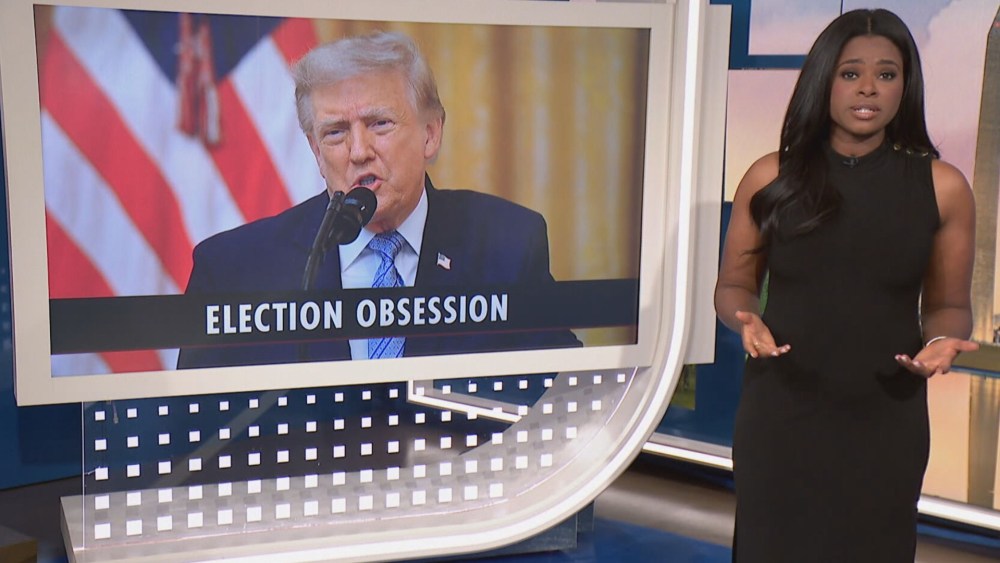
RAPID CITY, S.D. — On the night President Donald Trump walked into the East Room of the White House and once more undermined faith in elections, many of the people responsible for running those contests were standing at Mount Rushmore, waiting for four famous faces to light up against the dark.
Few offices in the Trump era have proved as consequential, or as politically exposed, as that of a state’s chief election official. And it was by chance that most of the nation’s secretaries of state were in South Dakota for a long-planned conference on the same day Trump spoke — trading notes on their work, then scrambling to navigate the latest turn from the man who has fundamentally remade it.
Faces of former presidents offered them a brief distraction in granite, after the current one threatened to upend their work all over again.
“There’s a disconnect between the White House’s obsession with old grievances and the real facts and reality on the ground among those who actually oversee elections,” said Steve Simon, Minnesota’s Democratic secretary of state. “That’s the bottom line to me. There’s a real disconnect. It’s unfortunate. It’s ugly. It’s political.”
In a naked political sense, whatever Trump had said would be derided by Democrats and navigated with differing amounts of unease and acquiescence within Republican circles.
Election officials don’t have that luxury. Once the rhetoric comes down from on high, they are the ones left trying to convince voters that their ballots still count — a case each of them is eager to make in their own state, about their own system.
“There’s no third world country that has elections like we
by Brad Reed | Jul 18, 2026 | 2026 Elections, 2026 midterms, DHS, elections, Markwayne Mullin, midterm elections, midterms, News, Trump Administration
US Homeland Security Secretary Markwayne Mullin on Friday threatened state election officials with prison time if they do not comply with the Trump administration’s “mandatory” changes to how they run their elections. During a press conference, Mullin said that the Trump administration was making so-called “security enhancements” to US elections “mandatory,” adding that any uncooperative…
Source
by Zeeshan Aleem | Jul 18, 2026 | Congress, elections, Opinion
Sen. John. Fetterman, D-Penn., has broken from and criticized his own party so often over the past year that in May, he felt compelled to write an op-ed in The Washington Post clarifying that he had “no plans to leave” the Democrats. He said he valued being an independent voice within the caucus and that he believed he’d be “a terrible Republican.”
But in an interview Thursday with NBC News, Fetterman appeared to change his tune. He laid out for the first time a specific reason he would leave the party: Israel policy.
“If they put that in our platform — no aid for Israel — and officially become the anti-Israel party, then yeah, that’s a red line for me,” Fetterman said. “Democrats, we always should support Israel [sic], that’s our special ally, you know? … In the only democracy in the entire region, that’s Israel. So I’m always proud to stand with Israel.”
Fetterman’s warning foreshadows a tectonic shift on the electoral left — and a positive one.
Fetterman did not say whether he would become an independent or join the Republican Party if he were to leave. But his departure from the party in order to support Israel would still be a remarkable development for a politician who was once widely — and, in my opinion, misguidedly — hailed as an exciting exemplar of populist progressivism. His threat of an exit also reflects how quickly the Democratic Party is reorienting on Israel policy, and growing less hospitable to those who advocate for backing the country’s government unconditionally.
There’s been no indication that the Democratic Party plans to add cutting off aid to Israel
by Nina Jankowicz | Jul 18, 2026 | elections, Opinion, White House
2026 has been a difficult year for President Donald Trump. He is losing a deeply unpopular war. Gas prices are still painful. Federal law enforcement officers have killed multiple people in cold blood. His approval numbers have reached historic lows ahead of this fall’s midterm elections.
In his address to the nation Thursday, Trump returned to a favorite topic: conspiracy theories about the 2020 presidential election. The president made sweeping claims about a broad Chinese campaign to access voter records, agitate against his candidacy and interfere in the election. But the claims are not borne out by the evidence, including the intelligence documents he declassified as “proof.” The speech was a desperate attempt to undermine confidence in our democratic system and lay the groundwork for an unprecedented and illegal attempt to control elections from the White House itself.
The U.S. intelligence community, researchers and journalists have recognized China as a threat for years.
Americans who might be confused about the president’s claims should know a few things. First, the U.S. intelligence community, researchers and journalists have recognized China as a threat for years. China is one of our country’s most advanced cyber adversaries and is constantly probing IT systems of the U.S. government, the private sector and influential individuals for vulnerabilities. Beijing also deploys influence operations to attempt to change American policy in its favor.
However, the Office of the Director of National Intelligence’s 2020 Election Threat report assessed with high confidence (the highest level of confidence assigned) “that China did not deploy interference efforts” — attempts to change voter rolls or tallies — “and considered but did not deploy influence efforts intended to