by Christine Leuenberger | Sep 20, 2026 | culture, Opinion, World
President Donald Trump has generated a steady stream of headlines since returning to office by renaming the Gulf of Mexico the “Gulf of America” and Lake Ontario “Lake America,” while also calling for other changes to the maps Americans use every day. At the recent GOP midterm convention, he whipped up the crowd with a recitation of cartographic modifications, including the as-yet-aspirational transformation of New Mexico to “New America.”
It’s easy to dismiss these moves as political theater, just more fodder for social media outrage or late-night comedy. But history teaches us that maps and the names, territories and landmarks they include or exclude always have political consequences, shaping identities, cultural belonging, territorial claims, education and international relations. Maps may appear to be objective and unbiased representations of the world, but they are inevitably, inherently selective.
For example, throughout history, governments have used the practice of naming territories and bodies of water to advance nationalist goals and assert territorial claims and aspirations. With Russia’s occupation and annexation of Crimea in 2014, Russian maps were remade to include Crimea as part of Russian territory to assert political authority. Trump’s effort to remake maps similarly speaks to their power to advance particular territorial visions and his expansionist “America First” agenda.
Throughout history, governments have used the practice of naming territories and bodies of water to advance nationalist goals and assert territorial claims and aspirations.
This muscular nationalist agenda can also be found in the way Trump is going about his renaming project. Traditionally, geographic name changes in the United States are reviewed by the U.S. Board on Geographic Names and, if approved, enter the Geographic

by Anthony L. Fisher | Sep 19, 2026 | Civil Rights, culture, Opinion
It was the social media post that launched a MAGA civil war over what is the appropriate way to demonize immigrants.
Bo French, the Republican candidate for Texas railroad commissioner, shared a photo last Sunday depicting ecstatic University of Texas students cheering the school’s football team — some of them possibly of South Asian descent — with the text, “I heard UT graduation this year looked like this. I didn’t believe it. The problem is now obviously far worse than anyone imagined.” French probably didn’t realize it, given most Republicans’ adoration for the unabashedly racist President Donald Trump, but he kicked a hornet’s nest on the right, sparking a pitched fight over “heritage Americans” and the MAGA struggle to package its xenophobia in more polite terms like “Western civilization.”
A number of influential conservatives and elected Republicans condemned French’s post for presuming a bunch of seemingly non-Caucasian Longhorns fans were “foreigners” rather than Americans, possibly the children or grandchildren of immigrants. Ben Shapiro posted to X, “Wait, why are we supposed to be upset that some kids of Indian ethnicity were cheering the UT football team on Saturday? WTF?” (It should be noted that the ethnicities of the scores of students in the picture have not been confirmed.)
Ultimately, this intra-GOP battle over “civilized” xenophobia versus crude, uncouth racism is a pointless morality play.
There were also condemnations from Texas’ Republican House Speaker Dustin Burrows, who posted to X, “You can oppose immigration policy without demeaning people because of their race or ethnicity.” The National Review’s editorial board slammed French’s “repulsive online attack,” but he also added, “Too much immigration — even when the
by Zeeshan Aleem | Sep 18, 2026 | culture, Opinion, White House
The Trump administration, bereft of any serious ideas of its own, excels at scaring up some concept or faction on the left — wokeism, DEI, socialism, communism — and then frantically warning it will trigger America’s descent into a hellscape. Now, in an unexpected twist, President Donald Trump’s government is turning its attention to “effective altruism,” a niche philosophical and social movement focused on the idea of maximizing efficient giving often by arguing against traditional charities and focusing on “doing the most good possible for the most people.” If a 2023 poll still holds true, the overwhelming majority of Americans know nothing about it.
As Axios reported, this week the Defense Department has posted messages on X calling for “Americanism, not effective altruism.” Defense Department Undersecretary Emil Michael slammed the ideology on Fox News, calling it “dystopian,” and then the Defense Department boosted the clip on X. The focus on hammering effective altruism appears to be part of Trump’s strategy for opposing regulation of artificial intelligence. Many figures in the effective altruism movement favor regulating AI toward the end of doing good for humanity, whereas Trump’s position is that no regulation other than the instincts of a “SMART (High IQ!) PRESIDENT” will ensure AI is used appropriately.
The administration’s focus on effective altruism is a head-scratcher. Effective altruism is not widely known. Moreover, the administration’s quest to try to fearmonger about it is likely to be a heavy lift and bound to make it look more callous and out of touch with Americans on one of the hottest policy issues of the day: how to rein in AI.
When explained in basic terms,
by Howard Polskin | Sep 17, 2026 | culture, Opinion
Let’s come right out and state the obvious. “Run, Hide, Fight: Infidels,” the new film produced by the right-wing website The Daily Wire, isn’t going to be the crossover action movie hit that the right has insisted mainstream audiences want — if only their entertainment diet weren’t limited to “woke” Hollywood content.
Ben Shapiro, co-founder of The Daily Wire and a producer of the film, said in August that this is the film “Hollywood refused to make.” Specifically, a film where Muslims are presented as the bad guys and, as he put it, “the type of folks who have perpetrated the vast majority of terror attacks on planet Earth and who are currently migrating en masse to the West with the help of a compliant left and now are infiltrating our institutions.”
Shapiro must view standard Hollywood fare as unsubtle political propaganda — because that’s what “Infidels” is. Despite decent action movie production values, its jackhammer political messaging will most likely limit its appeal to those already in the MAGA choir or teenage boys hooked on video games.
Perhaps the creators of “Infidels” think audiences are yearning for nonstop political signaling, because that’s what they provide.
The film centers on a small group of armed Muslim terrorists who invade fictitious Laughton University in Virginia and hold dozens of students and administrators hostage. Unsurprisingly, a good number of the hostages are cartoonishly portrayed as stock stereotypes.
In one of the opening scenes, far-left pro-Palestine student demonstrators have taken over the campus quad chanting “ICE Out, Gaza In” and “Free, Free Palestine.” The setup is so obvious they might as well wear T-shirts that read “Sitting Duck.”
by Brian Moylan | Sep 17, 2026 | culture, Opinion, White House
Vice President JD Vance took time out of his busy schedule this week to make a social media video about the most pressing pop cultural artifact of the moment: “Emily in Paris.” The show’s fifth season launched last December and the sixth (and final) season will premiere this Christmas Eve, but Vance had something he had to get off his chest right now.
“You have to watch ‘Emily in Paris,’” he told his legions of fans. “It is, at the risk of overstating it, the Shakespeare of our time.”
For those without a Netflix account or a teenage daughter, “Emily in Paris” is the story of Emily Cooper (Lily Collins), an American marketing executive who moves to France to take a job meant for her boss when said boss gets pregnant. She shares a tiny apartment with Chinese nepo baby Mindy (Ashley Park) and meets her neighbor Gabriel (Lucas Bravo). There is instant chemistry between the two, but Gabriel has a girlfriend. So instead, Emily and Mindy date a string of incredibly handsome and fabulously wealthy gentlemen while going to brand activations and pop-up events in the chicest villages across Europe. There is singing and occasionally berets. It’s a frothy, wannabe influencer’s dream. (But is it Shakespeare? TBD.)
View this post on Instagram
Despite its relatively simple premise, “Emily in Paris” is a surprisingly polarizing show. The series has plenty of detractors and a steady, albeit sometimes self-conscious fandom. But Vance doesn’t love this hit for its stunning locations, its comedic storylines or the outrageous outfits (OK, no one loves it for the Carrie Bradshaw fashion roadkill outfits). He loves it because
by Jacques Berlinerblau | Sep 16, 2026 | Business, culture, Opinion
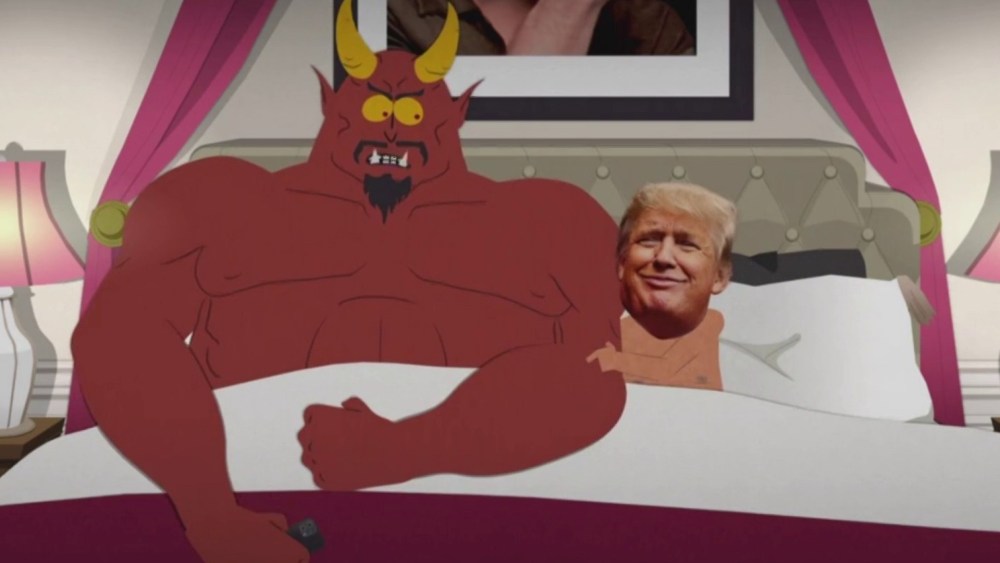
“South Park,” or, per recent rebranding, “South America,” kicks off its 29th season Wednesday night. The name change, according to the show’s creators, was “inspired by the bravery and patriotism of Apple and Google,” tech giants who valiantly obeyed President Donald Trump’s decree that we henceforth refer to Lake Ontario as Lake America.
If “South America” stays true to “South Park” form, I predict three things will transpire in the new season. First, Trump, his administration and his enablers are going to be ceaselessly, mercilessly skewered. Second, the skewering is going to be of the oh my God I can’t believe they just joked about that! variety. And third, the mockery will be so relentlessly vulgar that we will all wonder if “South Park” is daring this government to retaliate.
What makes me nervous is that this government just might.
The mockery will be so relentlessly vulgar that we will all wonder if “South Park” is daring this government to retaliate.
I’m a little less concerned (but concerned nonetheless) about the effects that such relentless partisan sniping may have on the quality of the comedy itself. Then again, it would likely be even more troubling if the animated series suddenly stopped dropkicking its target in the White House; that would be an example of the same “capitulation,” in the words of the show’s creators, Trey Parker and Matt Stone, that they see in their parent company Paramount’s engagement with the Trump administration.
So, roast or retreat? If the series keeps up its pace of lampooning Trump, it risks falling into an obsessive rut of comedic predictability. If it backs off, it’s a dereliction of artistic