by Nicholas Grossman | May 13, 2026 | Opinion
Iran responded on Sunday to President Donald Trump’s latest peace proposal with demands of its own. The United States asked Iran to agree in principle to forfeit its nuclear program and reopen the Strait of Hormuz while it negotiates the details. Iran rejected that, asking the U.S. to pay war reparations and acknowledge Iran’s sovereignty over Hormuz, by which Iran is blocking around 20% of the world’s oil and gas supply. With both countries acting like they have the upper hand, a war-ending deal is impossible.
Trump has insisted Iran has been “defeated militarily” and reassured that “as soon as the war is over, which will not be too long, you’re going to see oil prices drop.” Wall Street has appeared similarly confident. For example, JP Morgan’s latest guidance said, by June, oil shortages will “force the reopening of the Strait of Hormuz, one way or another … following a clear and credible announcement ratified and confirmed by both sides.”
But no politicians or bankers have explained how this will happen, and their complacent insistence that it will work itself out delays the hard choices necessary to resolve the war. Resource shortages are growing, and in the coming months, they will likely get so impactful that they’re impossible to dismiss.
Play
Trump: ‘I don’t think about Americans’ financial situation. I don’t think about anybody.’
May 12, 2026 / 09:56
U.S.-Iran negotiations are in the same place they were last month, when I wrote that Iran was in a stronger strategic position than the U.S. and Trump’s only options were a humiliating surrender or military escalation (which could end in a more costly humiliation). Trump has chosen
by Kevin Frey | May 13, 2026 | News
With the U.S. war with Iran well into its third month and gas prices up roughly 50% conflict started, President Donald Trump is now pitching temporarily suspending the federal gas tax.
Unfortunately for Trump — and the president could be forgiven for not remembering this, given Congress’ reluctance to assert itself on anything — lawmakers actually get a say on the gas tax. And so far, even top Republicans on Capitol Hill are not exactly offering full-throated endorsements.
Senate Majority Leader John Thune, R-S.D., on Tuesday summed up some of the skepticism when he rhetorically asked, “If you lifted that, does that ultimately get passed on to the consumer?”
“Or,” he asked, “does it get sucked up in the supply chain somewhere?”
Play
White House touts credit card spending as Americans grapple with high prices
May 11, 2026 / 08:06
Speaker Mike Johnson, R-La. — when pressed Tuesday whether he would put a gas tax suspension on the House floor for a vote — said, “We’re processing that. It’s an intriguing idea.”
“You have to look at any unintended consequences and evaluate all that,” Johnson said. “So I’m not getting ready to reject it, but I certainly find it to be an intriguing idea.”
The current federal tax amounts to about 18 cents per gallon of gas — and 24 cents for a gallon of diesel — a far cry from the average spike at the pump of $1.50 per gallon since the first U.S. strikes on Feb. 28.
Any savings passed along to corporations or consumers by suspending the tax only stands to shortchange the Highway Trust Fund, which helps finance transit-related capital projects across the country. That fund gets most of its
by Jordan Rubin | May 13, 2026 | Deadline: Legal Blog
The Supreme Court’s GOP-appointed majority has handed a series of wins to Republicans who are trying to make their congressional maps redder ahead of the midterm elections. Now, the high court faces an urgent appeal from Virginia Democrats who are trying to salvage their response to GOP gerrymanders after their voter-approved effort was struck down by the state Supreme Court.
So, will the justices similarly bless Virginia’s gerrymandering amid the nationwide redistricting war that started with Texas’ Trump-backed map?
There’s reason to doubt it.
And that’s not only because it’s a Republican-dominated court considering a Democratic appeal.
Another challenge Virginia officials face is the extent to which the ruling against them was based on the state court’s interpretation of the state constitution, as opposed to the Voting Rights Act and other federal issues that the justices have been deciding.
In a 4-3 ruling last week, Virginia’s high court majority said the legislative process that put the constitutional amendment for a new congressional map on the ballot violated Virginia’s Constitution.
The state’s amendment procedures are, per the majority, admittedly “laborious” and “slow-walk[ed]” to “guard against hasty changes.” The majority explained that the process gives voters two chances to weigh in on a proposed amendment, the first time indirectly and the second time directly. The first, indirect time is after legislators initially propose the amendment, because voters can then choose to retain those representatives based on their position on the amendment. The second, direct time occurs if it gets on the ballot, as this one did when voters approved it in April.
To get a measure on the ballot, it actually needs to be approved twice by the
by Lisa Rubin | May 13, 2026 | News
WEST PALM BEACH, Fla. — House Democrats took the Epstein investigation to President Donald Trump’s doorstep on Tuesday as they held hearings with survivors, their families and other advocates near the president’s Mar-a-Lago estate, and not far from Jeffrey Epstein’s former home where he sexually abused girls.
Rep. Robert Garcia, D-Calif., the ranking member on the House Oversight Committee, which has been leading the charge in Congress, said that Democrats are “launching a new phase of the Epstein investigation.”
That includes releasing a new report that Democrats say details how the nonprosecution agreement negotiated by Alex Acosta, the former U.S. attorney for the Southern District of Florida, allowed Epstein to “continue and expand his trafficking operation,” according to the report. That nonprosecution agreement allowed Epstein to serve 13 months in jail after pleading guilty to a single state count of solicitation of prostitution and registering as a sex offender.
Garcia said the new report is the first of many that Democrats intend to release over the coming months featuring both Oversight Committee material and information gleaned from the informal cooperation of witnesses, survivors and whistleblowers.
The California Democrat decried the “continued cover-up” by the government, which he says “continues to defy the law.”
Garcia says the government is withholding as much as half of the Epstein files in its possession, intended to be made public after Congress passed the Epstein Files Transparency Act. The Justice Department released millions of pages of Epstein-related files, but it significantly redacted those pages and withheld millions of others, saying the department needed to protect ongoing investigations and attorney-client privilege, among other things.
The field hearing by Oversight Democrats — to which
by Molly McGrath | May 13, 2026 | Opinion
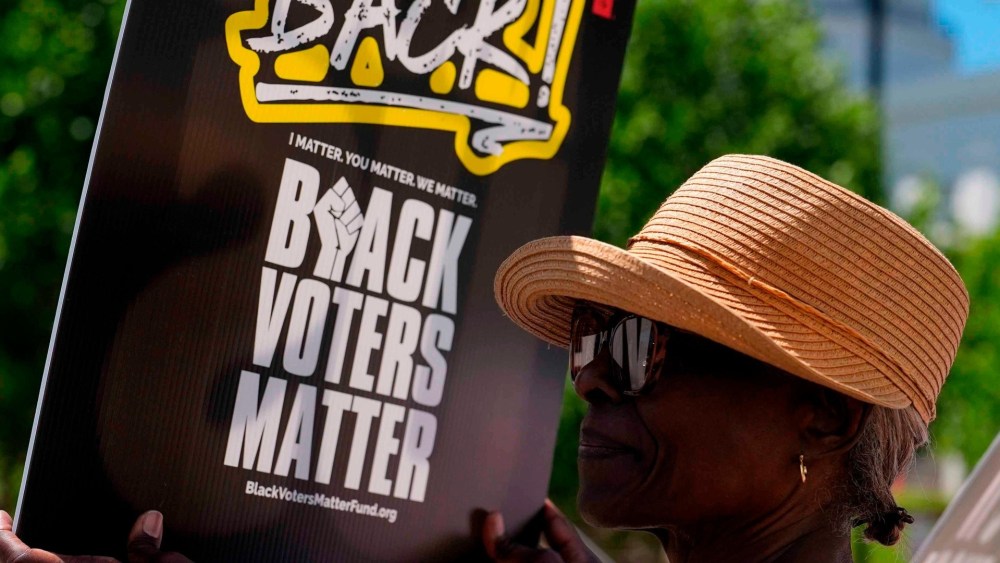
The Supreme Court dealt a blow to a remaining key protection of the Voting Rights Act less than two weeks ago in Louisiana v. Callais. Lawmakers in states across the South heard this starting shot from the high court, jumped off the block and sprinted to redraw maps to undermine Black voters’ voices.Alabama’s legislative majority wants different maps that would harm Black voters, and on Monday, the Supreme Court issued a ruling that opened the door for the majority to do just that. Plaintiffs in the case — everyday Black Alabama voters and civic organizations affected by this court decision — immediately went back to the district court to ask them to keep the current map, given people are already voting under it.
Play
Alabama pushes for new congressional map that would eliminate black-majority district
May 11, 2026 / 10:41
Louisiana is trying to stop a primary election that’s already underway and is signaling it will eliminate one or both of the state’s two majority Black congressional districts. South Carolina has opened a process to extend its session to gerrymander its state voting maps. Mississippi lawmakers have signaled they will consider redrawing the state’s maps. And Tennessee just became the first state to adopt new maps after Callais.
This is a crisis for democracy, but the people are making their dissent heard, testifying and rallying at statehouses across the region. Voters in these states refuse to quietly accept these cynical attempts by lawmakers to choose their voters in order to unfairly retain power. The day after the decision, tens of thousands registered for a single organizing call with the “No Kings” coalition.
Hundreds showed up outside