by Steve Benen | May 13, 2026 | Iran Tensions, Maddowblog, News, Politics
More than 10 weeks ago, when Donald Trump announced the start of the U.S. war with Iran in a prerecorded video filmed at his glorified country club in Florida, the president presented the public with five objectives. The first goal of the operation was to destroy Iran’s missiles and missile industry.
To hear the Republican administration tell it, that objective has been met. In March, for example, the president boasted that Iran’s missiles were “down to a scatter” and the Middle Eastern country had “nothing left in a military sense.” A month later, Defense Secretary Pete Hegseth echoed the point, adding that Iran’s military capabilities have been rendered “combat-ineffective for years to come.”
There is reason to believe the president and his team have not just mismanaged an unnecessary war, they have also taken deliberate steps to deceive the public about its progress. The New York Times reported:
The Trump administration’s public portrayal of a shattered Iranian military is sharply at odds with what U.S. intelligence agencies are telling policymakers behind closed doors, according to classified assessments from early this month that show Iran has regained access to most of its missile sites, launchers and underground facilities.
Most alarming to some senior officials is evidence that Iran has restored operational access to 30 of the 33 missile sites it maintains along the Strait of Hormuz, which could threaten American warships and oil tankers transiting the narrow waterway.
The Times’ report, which MS NOW has independently verified, went on to say the country “still fields about 70 percent of its mobile launchers across the country and has retained roughly 70 percent of its prewar missile stockpile.”
It
by Truthout | May 13, 2026 | Department of Health and Human Services, Donald Trump, hantavirus, Health, Mehmet Oz, News, Robert F. Kennedy Jr.
Speaking to reporters in the White House on Tuesday, President Donald Trump was asked about the potential spread of hantavirus in the U.S., following the return of over a dozen Americans who were on a cruise liner where the virus had infected multiple people. The question specifically asked about infectious disease experts expressing concern regarding the lack of an adequate government…
Source
by Allison Detzel | May 13, 2026 | News
Sen. Jeff Merkley, D-Ore., told MS NOW that Donald Trump’s high-stakes summit in China comes at a “moment of weakness” for the president, as his “war of choice” with Iran and its devastating consequences for the U.S. economy push the president’s approval rating to record lows.
Trump touched down in Beijing on Wednesday for the two-day trip, his first visit to the country since 2017. He’s set to meet with Chinese President Xi Jinping, whom Merkley suggested has the upper hand.
The senator told the co-hosts of “The Weeknight” that China is aware of Trump’s political position and is “kind of rubbing it in his face,” adding, “They’re talking about China is a rising power and America under Trump’s leadership is a declining power.”
The Oregon Democrat said that for the United States, “It’s a lose-lose-lose situation, and Xi is very aware of that.”
Merkley called Trump’s war with Iran a “massive mistake” and said Americans are “extraordinarily stressed.” During his campaign, Trump promised to lower prices for the American people and vowed not to involve the U.S. in new conflicts abroad.
“And what are we facing? He started a war that, not only on its face, is damaging our national security and our alliances and a whole host of objectives the president had in the start, but we’re bearing the burden here at home,” he said.
“Nobody is happy in this moment,” the senator told MS NOW.
Merkley said Trump could try to mitigate the pain the American people are feeling by proposing policies to lower costs in other areas of consumers’ lives, including housing and healthcare. “The president could say, ‘You know what, rising costs
by Steve Benen | May 13, 2026 | 2026 election, Congress, Maddowblog, News, Politics
After Donald Trump returned to the White House, an unhealthy competition emerged among many of his most sycophantic congressional allies. The goal was, apparently, to see who could go the furthest to impress the president with proposals to glorify him in the most outlandish ways possible.
Some championed legislation to create a $250 bill that would feature Trump’s face; others pushed a similar bill to put Trump’s face on $100 bills. Some tried to make Trump’s birthday a federal holiday, while others wanted to carve Trump’s face into Mount Rushmore. Some unveiled legislation to rename Washington Dulles International Airport after Trump, and others backed a bill to name the Washington, D.C., subway system after the president and his MAGA slogan.
While this might be difficult to believe, one House Republican even sponsored an actual bill to direct the National Institutes of Health to conduct research into “Trump derangement syndrome,” as if it were an actual ailment.
But these head-shaking proposals were all introduced in 2025, and now, as the midterm election cycle takes shape, the list of bills designed to venerate the incumbent president is still growing. The Hill reported:
Texas Sen. John Cornyn (R), who is in a tight reelection contest to keep his Senate seat, introduced legislation on Tuesday to dedicate a highway to President Trump.
“I am proud to introduce legislation to rename US Highway 287 as Interstate 47 in honor of our 47th President,” Cornyn wrote in a social media post. The highway is the second-longest U.S. route, spanning 1,791 miles from Choteau, Mont., to Port Arthur, Texas. GOP Sen. Cynthia Lummis (Wyo.) co-sponsored the bill.
There’s no reason to believe the

by Hayes Brown | May 13, 2026 | Opinion
Everywhere you look, the MAGA coalition that propelled Donald Trump back into the Oval Office is fracturing. The president’s poll numbers are plummeting across key demographics and dragging down congressional Republicans hoping to keep their jobs in November. Two weeks ago, the outlook for the GOP was looking especially grim, with predictions showing the House would almost surely be lost in the midterms and Republicans hanging on to the Senate by a thread.
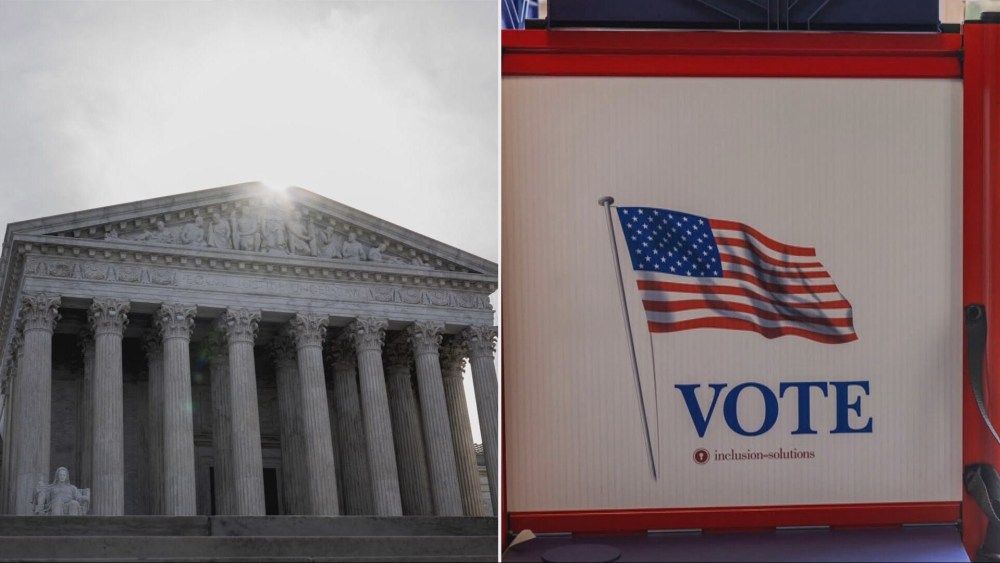
Then, in the span of about 10 days, everything shifted. The redistricting war Trump had begun, which had been looking like Napoleon’s doomed invasion of Russia, suddenly swung back in Republicans’ favor. The U.S. Supreme Court opened the door to a rush of racial redistricting across the South, and Virginia’s Supreme Court reversed Democrats’ gains in Virginia. The resulting Republican gerrymandering is acting as a superglue binding the GOP’s splintering hopes for surviving the midterms, but that gerrymandering leaves the party as fragile as ever in the long-term and destined to fall apart once Democrats can fully respond in kind.
Republican gerrymandering is acting as a superglue binding the GOP’s splintering hopes for surviving the midterms
The prevailing assumption for November’s elections was that Republicans would find themselves “cooked,” as one White House official recently told MS NOW. The factions that make up the MAGA base have all found things they don’t love about the administration. There’s the Make America Healthy Again crowd’s dismay that a weed killer hasn’t been banned, the anti-war isolationists’ anger at Trump’s Iran war and the anti-immigration wing’s furor that mass deportations are lagging.
Among so-called “normie” Republicans, as GOP pollster Kristen Solis Anderson called them