by Erum Salam | Jul 5, 2026 | 2026 election, News, Politics
Mallory McMorrow, a Democratic Michigan state senator, suspended her U.S. Senate primary campaign on Sunday, declining to endorse either remaining rival in the must-win seat for Democrats in November.
Her announcement, coming just one month before a nominee is chosen to replace retiring Democratic Sen. Gary Peters, leaves a two-way contest between one candidate backed by the party’s establishment, the other by its left flank.
“Today, I’m announcing that I am suspending my campaign for United States Senate. And I’m doing it with a deep, deep sense of gratitude,” McMorrow, who had positioned herself as a pragmatist, said in a video posted to X. She did not give a reason for her surprise decision.
The remaining candidates are Rep. Haley Stevens, a moderate supported by Senate Minority Leader Chuck Schumer, and Dr. Abdul El-Sayed, a former public health official who has been endorsed by progressive rock stars Sen. Bernie Sanders of Vermont and Rep. Alexandria Ocasio-Cortez of New York.
When asked if McMorrow would endorse before the Aug. 4th primary, her campaign said, “No. She trusts the voters of Michigan to pick their nominees. And she’s going to campaign for all of them this fall.”
Holding the seat is crucial to the Democratic Party’s chances of retaking control of the Senate in the November midterms.
Both McMorrow’s Democratic opponents spoke highly of her.
“Mallory McMorrow has been an important voice, both in this race and in the State Senate, for policies that benefit Michigan’s children and families, and I look forward to working with her in the future to build a stronger Michigan for everyone,” Stevens said.
El-Sayed, who has been the Democratic primary frontrunner in polling
by Erum Salam | Jul 5, 2026 | News
Interior Secretary Doug Burgum on Sunday defended an Independence Day demonstration in Washington by hundreds of masked men chanting “reclaim America!”
Wearing the same uniform — white face coverings, baseball caps, dark shirts and khakis — as that of the white nationalist group Patriot Front, they marched near the U.S. Capitol carrying a variety of flags, including Confederate flags. Some featured a circle of 13 white stars to represent the first American colonies.
“What they stand for is nothing that I could possibly agree with,” Burgum said during an interview on CNN. “But one of the foundational principles of the United States, which makes democracy messy, is free speech.”
“There are plenty of things that I see that I might personally find offensive, reprehensible. But in America, free speech is allowed,” he said, before comparing a public display of racial supremacy to communism.
Echoing President Donald Trump’s midterm-election season attacks on the Democratic Party’s insurgency of democratic socialist candidates, Burgum said, “I mean, we’re a country where someone can run and be elected saying that they’re a communist, but yet this is what our nation has stood against and fought for.”
The Interior Department secretary, who oversaw Trump-branded celebrations of the nation’s 250th anniversary, didn’t directly answer when host Dana Bash asked if he would recommend to Trump that the president condemn the white nationalist group and its messaging.
“Part of my response to that is that there are protests on the mall that people say things that I think are reprehensible about President Trump, and yet they’re allowed to go on because of free speech in our country,” Burgum replied.
The Southern Poverty Law Center,

by Susan Del Percio | Jul 5, 2026 | Opinion, Supreme Court
Last week, the Supreme Court struck down President Donald Trump’s executive order to end birthright citizenship, an issue so important to the president that he attended oral arguments in person back in April.
Despite the court’s conservative majority, the ruling should not have surprised the president — not really. For one thing, his order had been rejected by every lower court that had considered it. Because, as many, many legal scholars had pointed out, it seemed to clearly run counter to the citizenship clause of the 14th Amendment.
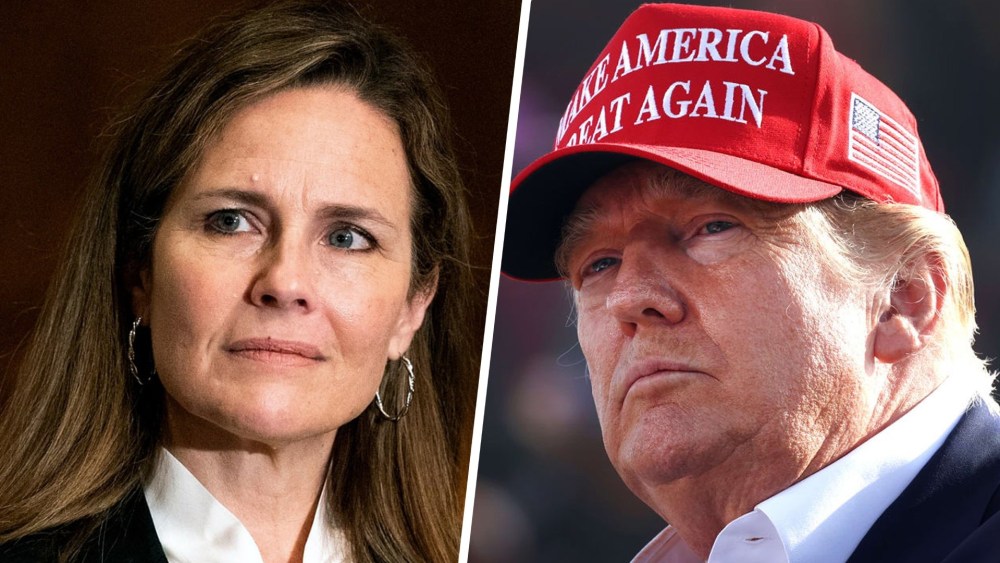
Following oral argument, the consensus among legal scholars was that a majority of justices did not buy the government’s argument. They were correct, as Chief Justice John Roberts’ majority opinion made clear. Roberts, appointed by President George W. Bush, in 2005, has remained a solidly conservative jurist. But it was Justice Amy Coney Barrett’s vote in favor of the majority which took some court watchers by surprise. And it was also Barrett’s vote which seems to have enraged conservatives in a specific, and perhaps specifically revealing, way.
It was also Barrett’s vote which seems to have enraged conservatives in a specific, and perhaps specifically revealing, way.
Following the ruling Trump called on Congress to take action on social media. “Congress should start TODAY to work on ending expensive and unfair to our Country, Birthright Citizenship.”
Right on cue, his sycophants picked up the chorus. Never mind the inconvenient reality that experts across the political spectrum widely believe the issue settled, or that changing the 14th Amendment would require a supermajority vote in both the House and Senate (or an even less likely constitutional convention), and ratification by
by Robyn Autry | Jul 5, 2026 | culture, Opinion, Politics
Victor Willis, a lead singer for the Village People who died Tuesday, insisted that the 1978 hit “YMCA,” the group’s most famous song, was not a gay anthem. Never mind its innuendo — its description of the YMCA as a place that has “everything for young men to enjoy/You can hang out with all the boys” and “do whatever you feel.”
Jacques Morali, the openly gay French music producer who helped create the group, said he did so after thinking to himself that “gay people have no group,” but Willis, who was the straight frontman dressed as a police officer surrounded by gay costumed bandmates, said “YMCA” was merely about young men having a place to clear their minds at the gym in the comfpany of other men. He said the songs “Macho Man” and “In the Navy” weren’t about gay life, either.
Willis said “YMCA” was merely about young men having a place to clear their minds at the gym.
Maybe that’s what Willis needed to tell himself to justify becoming a closing act at MAGA rallies. Willis performed “YMCA” the night before President Donald Trump’s second inauguration alongside a new group of band members, as Trump twisted at the waist and pumped his fists instead of doing the simple hand motions fans created to spell out the letters. To many people, Willis aligning himself with MAGA, including his performance at the inauguration, felt like a betrayal, but Willis maintained the month before that performance that “YMCA” was for everyone and that after he decided to entertain MAGA “the financial benefits have been great.”
Willis was right about one thing. Like the cultural institution
by Hayes Brown | Jul 5, 2026 | Opinion
The Supreme Court ruled Tuesday that the 14th Amendment’s birthright citizenship clause does, in fact, apply to all people born in the United States. Only five justices reached that conclusion — a much closer decision than it should have been. (The sixth, Brett Kavanaugh, joined the majority on purely statutory grounds.) The primary dissent from Justice Clarence Thomas accused his colleagues of expanding the meaning of a clause narrowly tailored to help newly emancipated Black Americans.
The dissent was yet another bit of ahistorical storytelling from Thomas, which Justice Ketanji Brown Jackson was simply not willing to abide. Though Jackson joined Chief Justice John Robert’s majority opinion defending the constitutionality of universal birthright citizenship, she also filed her own concurring opinion on the case. In 20 pages, the most junior justice on the bench provided a tour de force of narrative history to counter her oldest colleague’s claims.
The dissent was yet another bit of ahistorical storytelling from Thomas, which Justice Ketanji Brown Jackson was simply not willing to abide.
Jackson has long used the history and context behind the drafting of the Constitution and its amendments as an intellectual counterweight to so-called “originalist” legal scholars. From their standpoint, laws must only be interpreted as their drafters intended.
Soon after her confirmation in 2022, Jackson explained during a hearing on a case involving the Voting Rights Act that, counter to her conservative colleagues’ claims, there was no justification for reading the Reconstruction Amendments, ratified after the Civil War, as being blind to race. As she explained at the time: “[W]hen I drilled down to that level of analysis, it became clear to me that