by The Associated Press | Jul 24, 2026 | News
LOS ANGELES — Nearly 150,000 California voters’ mail-in ballots were rejected for the state’s June primary, a spike from recent elections even as the state tries to make voting easier to boost participation and by counting every ballot.
California has become notorious for its slow vote counts that can drag on for weeks and sometimes longer, largely the result of multiple changes over the years intended to increase turnout but have done little to achieve that. Among the changes: Every voter receives a mail-in ballot that can arrive at an election office seven days late and still be counted, provided the envelope is postmarked by Election Day.
Yet even with that weeklong window, the primary driver of the higher rejection numbers is late-arriving ballots, according to data compiled by the secretary of state’s office. Voting experts suspect the main problem is postmarks on ballots that came after Election Day, making them ineligible to be counted. The problem may be U.S. Postal Service changes that might affect the timing of when postmarks are applied.
Late-arriving ballots drove the rejections
According to state data, 148,241 mail ballots were rejected in the June election, or a rate of 1.7% of all mail ballots.
In raw numbers, that’s up from the 2024 primary, when 108,982 mail ballots were rejected, or a 1.56% rate. In 2022, 105,818 mail ballots were voided during the primary, or a rate similar to 2024.
Lateness accounted for 93,479 rejected ballots in June, by far the largest category for disqualifying a ballot. That was up from about 70,000 in the 2022 primary and about 76,000 in the 2024 primary, though turnout in those elections was smaller compared to last June.
Kim Alexander, president of
by Steve Benen | Jul 24, 2026 | Congress, Maddowblog, News, Politics, White House
There’s one word Donald Trump clearly doesn’t like to hear: “No.” And yet, it’s precisely what Senate Majority Leader John Thune has been forced to tell the president quite a bit over the past year or so — not because the South Dakota Republican necessarily disagrees with the White House’s agenda, but because Thune hasn’t had the votes to give Trump everything he wants.
One GOP senator, who requested anonymity to discuss the internal dynamics, told MS NOW last month that Trump and Thune “have an awkward relationship.” The lawmaker added, “It’s awkward for everybody.”
This is especially true of the president’s top legislative priority, a sweeping voter suppression package he has labeled the SAVE America Act that Republicans have already conceded they can’t pass. Trump, apparently furious by Congress’ inability to meet his demands, has increasingly turned against his own party’s Senate leader.
During a campaign-style event in Georgia this week, the president told supporters, “[House Speaker] Mike Johnson and Congress have done a great job, but we’re having a hard time in the Senate. The Senate, what they’re doing, it’s just not right.” The Republican added, “It’s like the Senate is where you send things you want them to die. We’re not going to be able to take it much longer.”
He didn’t elaborate as to what would happen after he’s no longer content to “take it,” though Trump specifically told attendees to “call John Thune” and demand that the GOP-led Senate pass the president’s anti-voting legislation.
White House press secretary Karoline Leavitt echoed the message during Thursday’s briefing.
Leavitt on Trump’s views on Thune: “His patience is running out”— Aaron Rupar (@atrupar.com) 2026-07-23T15:46:36.874Z
Asked

by Zeeshan Aleem | Jul 24, 2026 | Business, Opinion, White House, World
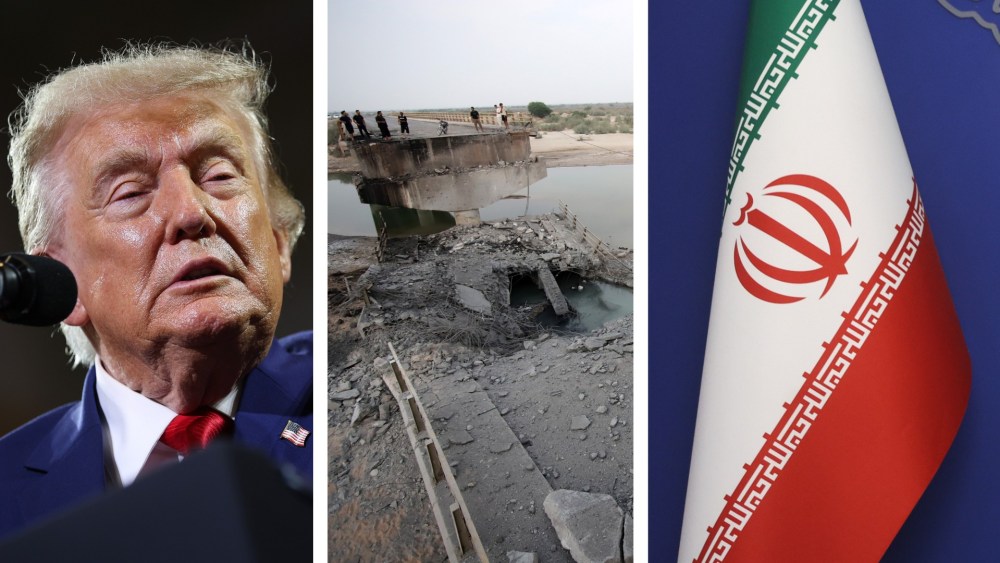
The Strait of Hormuz remains at a virtual standstill because of President Donald Trump’s foolish war, and now, in what represents a new global energy price nightmare, Houthi militants in Yemen have begun to block a separate corridor that is critical for global oil shipping. On Thursday, oil surged past $100 a barrel for the first time since May in response to the news that the war with Iran is on the brink of expanding to a new front. And Trump’s promise to bomb the Houthis should they continue is unlikely to improve the situation.
Those Houthi militants, who are allied with and supported by Iran, announced Monday that they would were enacting a blockade in the Bab el-Mandeb Strait against Saudi Arabia. The Houthis said their blockade is retaliation for airstrikes against a Yemeni airport intended to prevent an Iranian aircraft from landing. (Yemen’s Saudi-backed government claimed credit for the attack.) On Thursday, the Houthis said they had attacked two Saudi oil tankers and successfully warned 10 more to turn back. (Saudi Arabia’s official news agency confirmed at least one tanker was hit.)
Should the Houthis continue to attack ships, Trump ought to be concerned; his record fighting the scrappy militia is not impressive.
The Houthis’ blockade is a huge deal. Before the Iran war, about a fifth of the world’s oil passed through the Strait of Hormuz. Now it’s effectively closed. Saudi Arabia, which had transported the bulk of its oil through the Strait of Hormuz, started moving oil west through a pipeline. From there, Saudi Arabia was sending its oil out through the Red Sea and the Bab al-Mandab Strait, which connects the Red Sea
by Hayes Brown | Jul 24, 2026 | culture, Opinion
Even as Christopher Nolan’s “The Odyssey” rakes in ticket sales and critical praise, Elon Musk has petulantly insisted he could do a better job — or at least throw money at someone to make a film that better fits Musk’s aesthetic preferences.
Musk suggested on X this week that Grok Imagine, the latest generative version of his racist pet artificial intelligence chatbot, would produce a “full-length movie of The Odyssey that is historically accurate and true to the art of Homer.” Musk also responded positively to an X user’s pitch to “give Mel Gibson $100 million to film an Odyssey adaptation with painstakingly accurate ships, armor, weapons, and casting, with all dialogue taken straight from the original poem and delivered in Homeric Greek.”
The notion that a “historically accurate” version of “The Odyssey” is required to counter Nolan’s is nonsensical.
Let’s set aside Gibson’s overly simplified forays into historical epic dramas. Criticism of “The Odyssey,” particularly on the right, is well documented. So is Musk’s history of making grand declarations that never come to fruition. The notion that a “historically accurate” version of “The Odyssey” is required to counter Nolan’s is nonsensical. Such a film would likely be the Greek mythology equivalent of DW Griffith’s “The Birth of a Nation” in its white supremacist overtones and failure to grapple with nuance and human nature. In a word: unwatchable.
“The Odyssey” is a timeless tale not just for its title character’s tricks and triumphs amid gods and monsters. At its core, the story deals in the struggle between fate and free will and the things that we mortals owe each other, in life and in
by Lisa Rubin | Jul 24, 2026 | News, White House
The Justice Department on Thursday withdrew the subpoenas it issued to three reporters for The New York Times who reported on security concerns about the new Air Force One gifted to President Donald Trump by the Qatari royal family. The department also withdrew subpoenas to phone service providers for call records.
The withdrawal comes after the Times moved to quash the subpoenas last week, arguing that they “represent a brazen effort to intimidate the press” and “violate the most basic First Amendment protections for newsgathering activity.”
Press freedom groups, including the White House Correspondents’ Association, also condemned the issuing of the subpoenas, alleging that the government issued them due to officials’ embarrassment over the negative press rather than on any legitimate legal basis. The DOJ argued that the journalists were not the targets of the subpoenas and that they were instead seeking to identify who the government said leaked what it described as national defense or classified information.
In court on Thursday, Judge Arun Subramanian started by asking the government if it would withdraw the subpoenas and, when the DOJ declined, invited their lawyer to argue otherwise. In response, Sean Buckley, the former deputy U.S. attorney and current chief counsel to U.S. Attorney Jay Clayton, argued for the better part of an hour that the subpoenas were lawfully issued and said they were authorized by acting Attorney General Todd Blanche. However, Buckley also admitted that the subpoenas erroneously sought information from a parent and spouses of the reporters as “a consequence of trying to move quickly.”
Later, after conferring with his co-counsel, Buckley said “the government is prepared unilaterally to withdraw these subpoenas at this time,” according to