by Steve Benen | Mar 10, 2026 | Congress, Maddowblog, Politics
Though it might seem like ages ago, as recently as November 2024, Republican candidates actually made gains with Arab and Muslim voters. A year and a half later, there’s a reason the organization that used to be Arab Americans for Trump decided to change its name.
On Monday, for example, Republican Rep. Andy Ogles of Tennessee published a message to social media that argued, “Muslims don’t belong in American society.” A day earlier, Republican Rep. Randy Fine of Florida, whose track record of peddling Islamophobic rhetoric was already well established, wrote that Americans should “be afraid of Islam” and that Muslims should be expelled from the country.
This followed related recent bigotry from Republican Sen. Tommy Tuberville of Alabama, who also recently called for the United States to deport Muslim Americans because of their religion. In Texas, meanwhile, where concerns about border security have waned, GOP officials and candidates have begun shifting their focus, attacking Latino immigrants less while attacking the state’s growing Muslim population more.
Democratic leaders have been quick to condemn the ugly and hateful partisan trend, but GOP leaders have failed entirely to do the same. In the aftermath of Ogles’ online statement, HuffPost reported:
Ogles’ office did not respond to a request for comment. Neither did Speaker Mike Johnson (R-La.), nor any of his top lieutenants: Majority Leader Steve Scalise (R-La.), Majority Whip Tom Emmer (R-Minn.), Republican Conference Chair Lisa McClain (R-Mich.) and Republican Policy Committee Chair Kevin Hern (R-Okla.).
GOP officials appear to be sending an unmistakable signal: In the contemporary Republican Party, anti-Muslim attitudes are, at a minimum, tolerated, if not encouraged. It would be easy for any party
by Steve Benen | Mar 10, 2026 | 2026 election, Congress, Maddowblog, Politics
In the House, independent members are quite rare. In fact, in recent years, there are only two examples: former Rep. Paul Mitchell of Michigan, who left the Republican Party to become an independent in 2020, and former Rep. Justin Amash, another former Michigan Republican who became a Libertarian the same year.
This rarefied company now numbers three. The Hill reported:
Rep. Kevin Kiley (Calif.) announced Monday that he will formally leave the Republican Party this week to become an independent. […]
‘I will be the sole independent member of the House of Representatives,’ Kiley told reporters Monday during a virtual press conference.
Kiley had already indicated that he intended to run for re-election as an independent, instead of a GOP incumbent, though there have still been questions as to his party affiliation between now and Election Day.
The California congressman took steps to answer that question on Monday afternoon, telling reporters that he’s filing the paperwork with the House Clerk’s Office to identify as an independent, effective immediately, for the remainder of the current Congress.
As an electoral strategy, Kiley very likely realized that his options were limited: Under the state’s new congressional district map, designed to give Democrats a significant boost, his district will become vastly more difficult for a Republican to win. Abandoning the GOP might give the incumbent lawmaker a better chance of keeping his seat.
But while Kiley scrambles to save his career after voting for some very conservative legislation, including the Republican Party’s domestic policy megabill last summer (the inaptly named One Big Beautiful Bill Act), there’s the broader context of Capitol Hill to consider.
As of New Year’s Day 2026, the House

by Everett Kelley | Mar 9, 2026 | Opinion, Politics
If you’ve traveled through airports such as New Orleans’ Louis Armstrong or Houston’s Hobby recently, you may have seen something unusual.
Security lines stretching farther than you, or anyone, would expect. In you flew out of New Orleans on Sunday, you may have seen those security lines stretch out into the parking garage. They also stretched outside at least one terminal in Houston. Maybe you were worried about missing your flight. Maybe you were frustrated and stood there wondering what was going on.
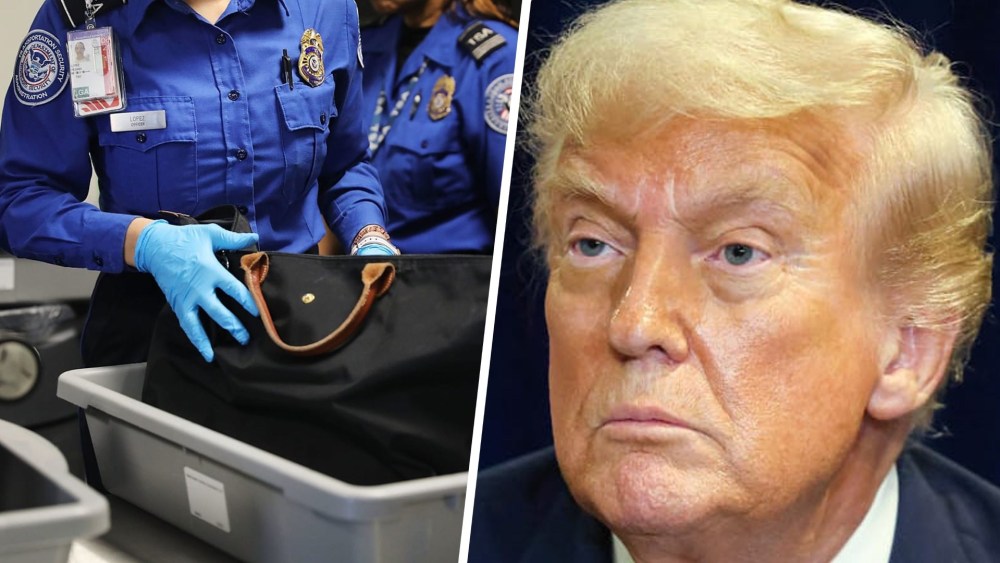
Across the country, TSA officers are once again being asked to report to work without a paycheck.
Let me tell you what was going on.
Those lines were not a fluke. They were a warning about what happens when the people responsible for keeping our aviation system safe are forced to choose between performing a public service that keeps us all safe for no pay, or flipping burgers with pay.
Across the country, Transportation and Security Agency officers are once again being asked to report to work without a paycheck. In the most recent pay period, many officers received only a fraction of their normal pay. Some members of the American Federation of Government Employees took home as little as $5.
Now, the checks have stopped entirely.
Play
TSA officer slams shutdown: ‘Sick and tired of these political games’
October 24, 2025 / 03:39
Think about that for a moment. These are the officers with what ought to be a steady government job protecting our nation’s airports. They have families, mortgages and bills like everyone else. Yet they are being told to come to work every day without knowing when they will be paid. For the third
by Steve Benen | Mar 9, 2026 | Congress, elections, Maddowblog, Politics
A few months before Election Day 2024, House Speaker Mike Johnson made a pilgrimage of sorts to Mar-a-Lago to kiss Donald Trump’s ring and unveil a proposal they seemed excited about.
The Republican duo pitched legislation that would require documentary proof of citizenship to register to vote. (The absurdity of watching two notorious election deniers pretend to be deeply concerned with the integrity of elections was a detail the public was apparently supposed to overlook.) Soon after, the proposal took legislative form, and the Safeguard American Voter Eligibility Act (or SAVE Act) was born.
In time, however, this solution in search of a problem metastasized. Instead of just making it harder for Americans to register to vote, Trump and his allies expanded the original version of the SAVE Act by adding provisions that also made it harder to cast votes and renaming the package the “Save America Act.”
In recent weeks, the president announced that this still wasn’t good enough. In addition to making it harder to register to vote and requiring an ID to cast ballots, Trump decided the package also had to impose harsh new restrictions on mail-in voting, as well as new restrictions on transgender athletes and gender-affirming care for minors.
He still hasn’t explained what punishing transgender Americans has to do with voting rights, but the president has begun condemning earlier iterations of the legislation as “the watered-down version,” which he expects Congress to disregard.
The far-right package doesn’t have any realistic chance of success in the Senate, where it would need 60 votes to advance, though Trump apparently has a new plan in mind. After spending part of the weekend
by Steve Benen | Mar 9, 2026 | Iran Tensions, Maddowblog, Politics
MS NOW reported over the weekend that Russia has provided Iran with information that could help Iranian forces strike American ships, aircraft and bases in the region, according two U.S. officials, one whom said point-blank, “Russia is providing intelligence help to Iran.”
The Associated Press and The Washington Post had related reports, with the latter noting, “The assistance … signals that the rapidly expanding conflict now features one of America’s chief nuclear-armed competitors with exquisite intelligence capabilities.” On NBC’s “Meet the Press” host Kristen Welker pressed Iranian Foreign Minister Abbas Araghchi on this, and he made no effort to deny the accuracy of the reporting, emphasizing Iran’s “strategic partnership” with Russia is “not a secret.”
Common sense might suggest that Donald Trump and his team should express outrage over this development and condemn any effort to help Iran target American personnel and resources.
It’s just not quite working out that way.
White House press secretary Karoline Leavitt, for example, told Fox News on Friday that it “does not really matter” whether Russia is sharing intelligence with Iran to target U.S. assets. Defense Secretary Pete Hegseth similarly told CBS’s “60 Minutes” that the administration is “not concerned” about whether Russia is assisting Iran.
At a White House event on Friday, the president himself brushed off the issue, chiding a reporter for asking what Trump described as “a stupid question” — because he wanted to focus solely on college athletics, not the deadly, ongoing conflict in the Middle East.
If we were to stop here, it’d be a striking story about a Republican administration that has expressed little more than indifference to serious allegations. But as it turns
by Steve Benen | Mar 9, 2026 | Maddowblog, Politics
On the campaign trail in 2024, Donald Trump recognized that Americans were still deeply concerned about inflation and the cost of living, despite the improving conditions after the 2022 spike. To that end, the Republican candidate focused heavily on the issue and made all kinds of bold promises about “Day One” improvements, all while struggling with the most basic of questions: What would he actually do on the issue?
When pressed, he tended to focus on gas prices. To hear Trump tell it, he would focus obsessively on drilling for oil, everywhere and all of the time, which he said would lower gas prices, which in turn would make it more affordable to transport goods to marketplaces, which in turn would lower prices.
It was, to be sure, a highly dubious pitch rooted in suspect assumptions, but it was a line much of the electorate was willing to embrace, as evidenced by his return to power.
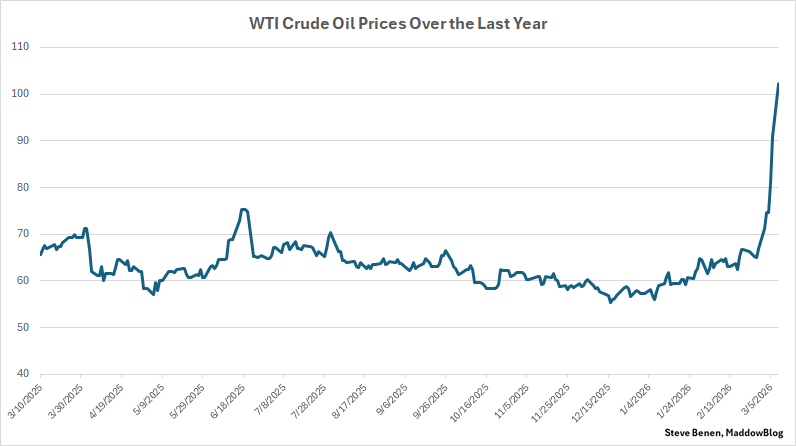
The gap between what Trump promised to deliver and what he has delivered is enormous — and growing. As The New York Times summarized, “Oil prices surged on Monday in a sign of growing concern that the war in the Middle East will continue to take a toll on energy supplies, raising gas prices for American consumers and weighing on the stock market.”
The Washington Post added, “The average cost of a gallon of regular gasoline in the U.S. increased by 34 cents in the last week to $3.32 on Friday, according to AAA. The cost of diesel has grown even more significantly and analysts expect the price of both fuels to keep climbing.”
Broadly speaking, the benchmark metric