by Steve Benen | May 4, 2026 | Maddowblog, News, Politics
A couple of weeks ago, when it was clear that Spirit Airlines’ future was in doubt, Donald Trump did what he too often does: He tried to avoid blame for a looming setback by shifting responsibility to one of his Democratic predecessors.
“So, Spirit is an airline that’s had some trouble,” the Republican president said at a White House event. “They were going to merge with People Express, or one of them, a number of years ago, and Barack Hussein Obama decided it was a bad idea. How did that work out?”
Even by Trump standards, this was a mess, for the simplest of reasons: People Express ceased operations in 1987, when Obama was still a community organizer in Chicago, and it never tried to merge with Spirit.
Nevertheless, in the days that followed, Commerce Secretary Howard Lutnick led a Trump administration initiative to bail out Spirit Airlines, as part of a deal that would’ve led the federal government to take a significant ownership stake in the business. A variety of Republicans raised a new round of concerns about state-run capitalism, the private negotiations ultimately failed, and the carrier permanently closed its doors late last week.
One day later, Trump administration officials, led in large part by Transportation Secretary Sean Duffy, moved away from the president’s effort to blame Obama, and instead tried to convince the public of a related claim: This was the Biden administration’s fault.
Sean Duffy on Spirit Airlines: “I think it’s important to talk about why we are here today. Joe Biden and Pete Buttigieg … “— Aaron Rupar (@atrupar.com) 2026-05-02T16:23:59.743Z
On Sunday, Treasury Secretary Scott Bessent also toed the new party

by Jeff McCausland | May 3, 2026 | Opinion, Politics
Defense Secretary Pete Hegseth’s testimony to the House and Senate Armed Services committees this week was his first appearance before Congress since U.S. military action began against Iran.
So far, this conflict has resulted in the deaths of 14 American service members, including one whose death was not combat-related, and a reported cost of over $25 billion. These hearings were originally scheduled as a routine review of the administration’s proposed $1.45 trillion Pentagon budget for fiscal 2027 but ended up being the first opportunity lawmakers had to question Hegseth about the war.
The testimony was disturbing from the onset for his combative and argumentative style, as he immediately lashed out at lawmakers from both parties.
But this was not “routine” and was a critical moment for the nation’s security. The American people are threatened by an ongoing conflict that could easily escalate and is already having a dramatic effect on the global economy. The nation is potentially facing its greatest energy crisis in history, and Hegseth’s testimony cast doubt on his fitness for the position of secretary of defense. The testimony was disturbing from the onset for his combative and argumentative style, as he immediately lashed out at lawmakers from both parties. Hegseth began the hearing with a formal statement that argued “the biggest challenge, the biggest adversary we face at this point are the reckless, feckless, and defeatist words of congressional Democrats and some Republicans.” This was hardly a serious effort to demonstrate his understanding of defense economics or elicit support from members of Congress concerned that the proposed massive Pentagon budget — a 45% increase over 2026 — would have serious implications for the nation’s
by Rep. Bennie Thompson | May 3, 2026 | Opinion, Politics
Though President Donald Trump has not carried out his threat to eliminate the Federal Emergency Management Agency, his administration has systematically weakened it during his second term. He has hollowed out its workforce, pushed out experienced staff in favor of political lackeys, dismantled preparedness programs and undermined the agency’s ability to respond when Americans need it most. Last spring, the administration announced that it had canceled billions of dollars worth of key mitigation programs that helped communities become more resilient to the effects of floods, hurricanes and other disasters.
More than 5,000 employees have left or been pushed out of FEMA since the beginning of the second Trump administration.
The elimination of those mitigation projects shifted risk onto states and local governments that lack the resources to pay for them themselves. More than 5,000 employees have left or been pushed out of FEMA since the beginning of the second Trump administration, worsening an already severe staffing shortage. Now reports suggest the Trump administration is considering even deeper workforce cuts — a highly dangerous proposal with the start of hurricane season less than a month away.
But just as worrisome as qualified people being pushed out of FEMA is unqualified people being brought in. Gregg Phillips, whom Trump appointed associate administrator of the Office of Response and Recovery in December, holds one of the most powerful positions at FEMA. It’s his job to lead the federal government’s frontline response to hurricanes, tornadoes, floods, wildfires and other disasters. Because lives are on the line during such emergencies, the role ought to be filled by someone with relevant experience who has demonstrated a commitment to public safety,
by Steve Benen | May 1, 2026 | Iran Tensions, Maddowblog, News, Politics
For reasons that have never been explained, Donald Trump decided months ago that Steve Witkoff would serve as the administration’s top negotiator with Iran. If his name sounds familiar, that’s because Witkoff is also helping lead the administration’s negotiations with Russia and Ukraine, despite the inconvenient fact that Witkoff is a New York real estate developer with no relevant experience in foreign policy or delicate international diplomacy.
Nevertheless, the White House’s top amateur diplomat has, in fact, met with Iranian officials, including interactions last year that long predated the president’s decision to launch an unnecessary war. According to Witkoff’s own public comments, in one of the discussions he talked about developing a “verification” system that might allow Iran to produce low levels of uranium for a nuclear energy program.
That wasn’t an outrageous position to take. In fact, Witkoff’s position dovetailed with elements of the Obama-era nuclear agreement, which did roughly the same thing.
On Thursday Trump spoke with Newsmax’s Greta Van Susteren, who told the president as part of the on-air interview that Witkoff told her that the United States offered Iranian officials a possible agreement in which they could enrich uranium for a domestic medical program, below levels needed for a nuclear weapon.
The president, who too often seems like a bystander in his own White House, apparently wasn’t aware of the offer — and immediately denounced it.
VAN SUSTEREN: Witkoff told me the US offered Iran enriched uranium for medical purposes, free, if they’d give up their nuclear programTRUMP: Well, I wouldn’t have approved that. I’m not giving them anything— Aaron Rupar (@atrupar.com) 2026-04-30T20:16:08.507Z
“Maybe it wasn’t a very serious offer because I
by Steve Benen | May 1, 2026 | Health, Maddowblog, News, Politics
It was about a year ago when Donald Trump abandoned his first choice to serve as surgeon general, Fox News contributor Janette Nesheiwat, pulling her nomination without explanation. This week, the president also gave up on his second choice, a wellness influencer named Casey Means, who faced bipartisan opposition in the Senate due to her obvious lack of qualifications.
This set the stage for the White House’s third choice: Dr. Nicole Saphier, a former Fox News contributor and radiologist, whom the president described as “an INCREDIBLE COMMUNICATOR” who will “help ‘MAKE AMERICA HEALTHY AGAIN.’”
A NOTUS report noted, “The mere fact that Saphier has a professional medical background … is likely to increase her odds of confirmation greatly.” That’s probably true, though it was a jarring observation to see in print: We’ve reached the point at which a surgeon general nominee is positioned to succeed, not by earning a reputation as a celebrated public health professional, but by merely having “a professional medical background.”
That said, as Saphier’s nomination moves forward, there are a couple of key details that are worth keeping in mind. The first is that the nominee’s record on matters of science and medicine is not without controversy. As The New Republic summarized:
While Saphier is a radiologist, she’s not much better than Means. She has weighed in culture war issues on Fox, railing against movies with “woke ideologies.” … Her stance on vaccination is also troubling, as she has criticized mask and vaccine mandates and praised Trump for allowing military servicemembers expelled for refusing the Covid-19 vaccine back into the service.
An Ars Technica report added that Saphier also founded an
by Steve Benen | May 1, 2026 | Maddowblog, News, Politics
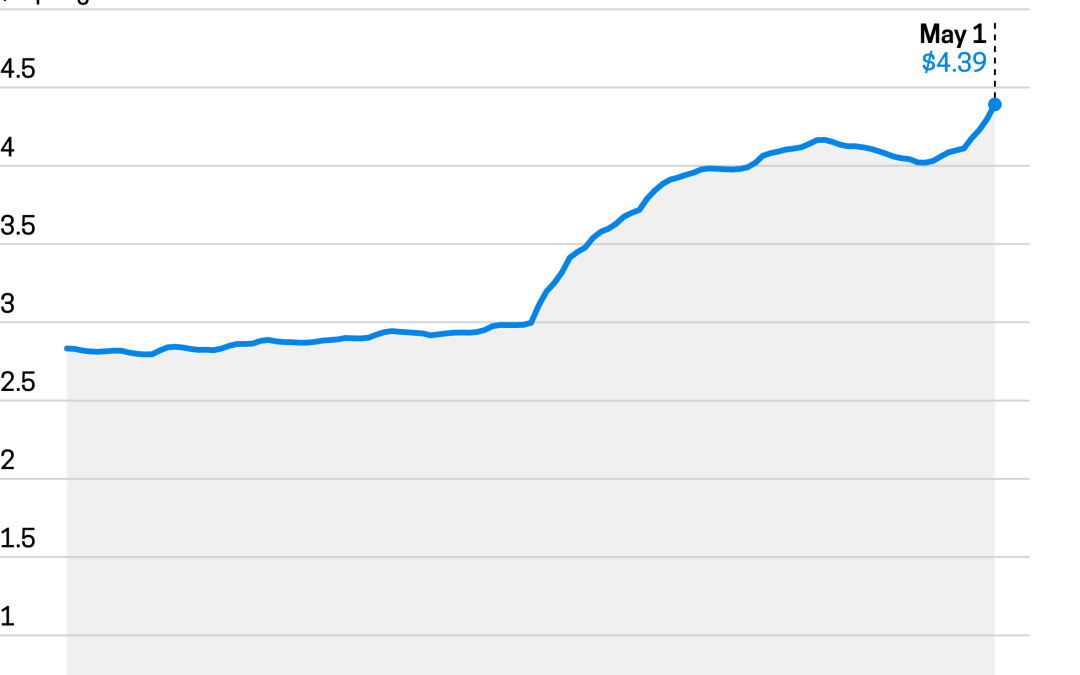
For American consumers worried about the cost of living, this week brought another round of discouraging news: Not only is inflation climbing overall, but gasoline prices reached their highest level in four years.
Consumers, however, weren’t the only ones who were bothered. Republican officials, feeling political headwinds and increasingly anxious about the midterm elections, quickly realized that rising prices created yet another challenge for them, leaving the party to figure out what to say to dissatisfied voters.
For obvious reasons, prominent GOP voters couldn’t just tell the truth — rising gas prices are the direct result of President Donald Trump launching an unnecessary war in Iran — so leading Republicans settled on three remarkable tactics.
1. Rewrite the recent past. On Thursday morning, House Majority Leader Steve Scalise appeared on CNBC and tried to argue that gas prices are lower now than they were in 2024. “People will remember that two years ago, we were paying almost $6 a gallon for gas,” the Louisiana Republican said. “Right now, it’s $3.”
The problem with Scalise’s pitch was that he didn’t appear to have any idea what he was talking about. Gas prices weren’t anywhere close to $6 a gallon two years ago, and gas prices are well above $3 a gallon now. The House GOP leader asked people to “remember” a version of reality that did not, and does not, exist. It led Scott Horton of Harper’s Magazine to note, “The GOP campaign this fall will depend entirely on misremembering recent history.”
SCALISE: We’ve delivered. Remember that 2 years ago, we were paying almost $6 a gallon. Right now it’s in the $3sKERNEN: When were we