by Lt. Col. Rachel E. VanLandingham (ret.) | May 17, 2026 | Opinion, Politics
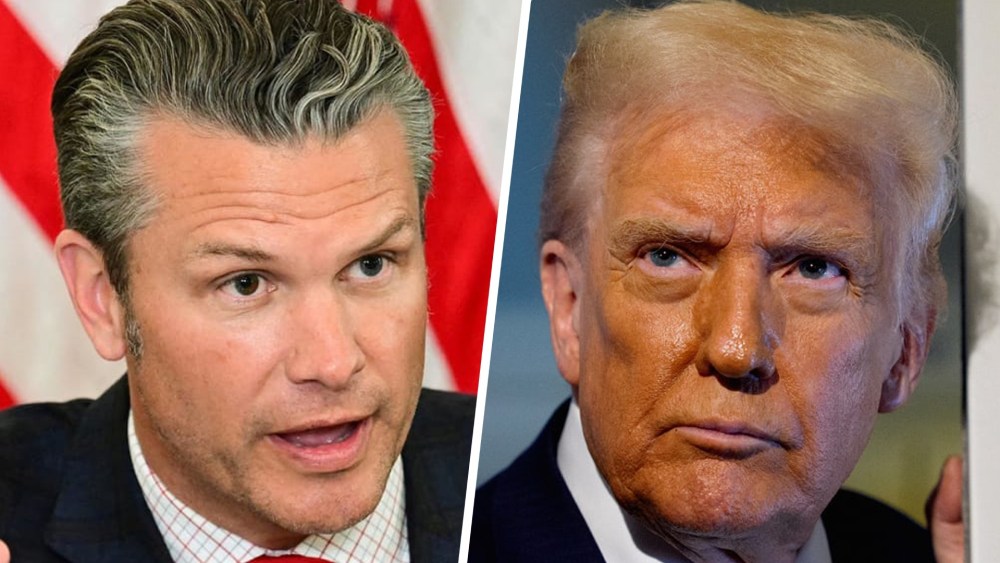
It is ironic as well as troubling that Defense Secretary Pete Hegseth recently went on X to accuse Sen. Mark Kelly, D-Ariz., a decorated naval aviator who flew combat missions and served as a NASA astronaut, of improperly sharing privileged military information on CBS’ “Face the Nation” on Sunday.
It’s ironic because Hegseth himself revealed classified information and compromised operational security last year by sharing sensitive targeting information with a journalist, as well as his wife and brother, over Signal chats regarding a U.S. bombing raid in Yemen. Kelly, on the other hand, in his “Face the Nation” appearance, merely repeated the general concern that U.S. weapons stores are being depleted due to the Iran war. Not only has that concern been reported in the media for weeks, but it has also been discussed with the defense secretary in open congressional hearings.
The “Signal Gate” defense secretary should not be insinuating that Kelly’s public comments violated any oath Kelly made,
The “Signal Gate” defense secretary, whose own inspector general found that he mishandled classified information, should not be insinuating that Kelly’s public comments, such as “we’ve expended a lot of munitions,” violated any oath Kelly made, whether as a military officer or his Senate oath of office (senators do not take secrecy oaths, nor do they have security clearances). But Hegseth continues to reveal himself as a Pentagon chief more concerned with picking frivolous fights with a military-seasoned senator than making the case to the American people for war in Iran.
The defense secretary first targeted Kelly because he was one of the Senate Democrats who recorded a video reminding service members that they
by Jarvis DeBerry | May 17, 2026 | Opinion, Politics
Between 1910 and 1970, an estimated six million Black people left the South, changing the region from a place where almost all Black Americans lived to one where slightly more than half did. Even so, I was born the child, grandchild and great-grandchild of Mississippians who stayed put. And like the frog who reliably croaks for its own pond, I was defensive of Mississippi, defensive of the South and I resented those who suggested we lacked the good sense to leave.
Medgar Evers, the field secretary of the Mississippi NAACP who was assassinated in the driveway of his Jackson, Mississippi, home in 1963, had a deep love for Mississippi and once said, “I don’t know if I’m going to heaven or hell, but I’m going from Jackson.” My father, Melvin DeBerry, has long expressed a more cynical reason for staying: “At least the white man in the South will tell you what he thinks about you.”
I was defensive of Mississippi, defensive of the South and I resented those who suggested we lacked the good sense to leave.
“Y’all need to shut up, boy!”
Dadrius Lanus, a Black man who serves as Louisiana’s Democratic Party executive director, said that’s what state Sen. Jay Morris, a white Republican, said to him May 8 during a redistricting committee hearing at the Louisiana State Capitol. Morris and his party were gleefully redrawing the state’s congressional map in a way that will hinder Black people’s political power and, for good reason, Black people in the room weren’t being quiet about it.
Morris denied using a pejorative, and a Baton Rouge TV station said it only captured him saying, “Y’all
by Kevin McGill | May 16, 2026 | Opinion, Politics
As a two-term Republican incumbent in a Deep South state, with a conservative record and plenty of campaign money, Sen. Bill Cassidy of Louisiana should be cruising to re-election this fall. But Cassidy is in danger of losing his party’s nomination in Saturday’s primary election because he was one of the seven Republican senators who voted guilty when President Donald Trump was impeached after the Jan. 6, 2021, U.S. Capitol riot. And Trump has an insatiable thirst for retribution.
Cassidy has a dilemma, or as some people in Louisiana might say, he’s in a trick bag. He wants the state’s conservative voters to forgive him and see him as a reliable ally of Trump, and he needs voters opposed to Trump to see him as their best option. And he’s got to pull off that balancing act under a new partisan primary that didn’t exist during his previous two runs for the Senate.
He wants the state’s conservative voters to forgive him, and he needs voters opposed to Trump to see him as their best option.
As much as Trump supporters may consider his vote to convict Trump a deal-breaker, his vote that helped install Robert F. Kennedy Jr. as Health and Human Services secretary is just as offensive to people who don’t support Trump.
Cassidy is a physician who has long touted the lifesaving importance of vaccines. Not only that, but after years of working at a Louisiana hospital for the poor and uninsured, he launched a vaccination program to better protect those vulnerable patients from disease.
Even so, he gave his blessing to the nation’s best-known anti-vaccine fanatic and elevated him to a
by Steve Benen | May 15, 2026 | Iran Tensions, Maddowblog, News, Politics
About a month after Donald Trump launched the war with Iran, he did something unexpected: The president suggested he was largely indifferent to one of the foundational reasons for the conflict.
After countless comments about the importance of addressing Iran’s nuclear program, when asked about the country’s enriched uranium, he told Reuters, “That’s so far underground, I don’t care about that.” He went on to say Iran was “incapable” of developing a nuclear weapon in light of the damage it has suffered, fueling his passive attitude about its stockpiles.
In the days and weeks since that April 1 interview, the president has not just shifted his focus back to the purported Iranian nuclear threat, he has also raised the possibility of some kind of invasion to seize the enriched uranium that he claimed not to “care about,” creating uncertainty about whether Trump was confused or has changed his mind.
During his latest interview with Fox News’ Sean Hannity, however, the Republican once again made it sound as if Iran’s enriched uranium just isn’t that important.
Trump on retrieving enriched uranium in Iran: I don’t think it’s necessary except from a public relations standpoint. I think it’s important for the fake news that we get it. I’m the one that said we are going to get it. pic.twitter.com/eaWVIbvVQd— Acyn (@Acyn) May 15, 2026
“I don’t think it’s necessary except from a public relations standpoint,” Trump said about Iran’s stockpiles. He added that the issue is only important “for the fake news.”
To be sure, it’s difficult to know whether the president believed what he said, whether he will change his mind at any given moment or whether
by Steve Benen | May 15, 2026 | Maddowblog, News, Politics
During Donald Trump’s first term, a former IRS contractor named Charles Littlejohn gained access to the president’s tax returns and shared the documents the Republican had been desperate to hide. Littlejohn was caught, charged, convicted and sent to prison.
Earlier this year, however, Trump decided the criminal penalty wasn’t enough. Indeed, the Republican filed a $10 billion lawsuit against the federal tax agency in February, setting up an unprecedented situation in which a president sought a massive payout from the same executive branch he leads.
Shortly after the president filed the radical (and by any fair measure, frivolous) lawsuit, he told reporters that he assumed “nobody would care” if he received a giant check from the government because he and his team were “thinking about doing something for charity.”
More than three months later, as settlement talks between the agency and the Republican’s lawyers continue, money for “charity” doesn’t appear to be the principal goal. ABC News reported:
President Donald Trump is expected to drop his $10 billion lawsuit against the Internal Revenue Service in exchange for the creation of a $1.7 billion fund to compensate allies who claim they were wrongfully targeted by the Biden administration, sources familiar with the matter told ABC News.
The commission overseeing the compensation fund would have the total authority to hand out approximately $1.7 billion in taxpayer funds to settle claims brought by anyone who alleges they were harmed by the Biden administration’s “weaponization” of the legal system, including the nearly 1,600 individuals charged in connection with the Jan. 6 Capitol attack as well as potentially entities associated with President Trump himself.
The arrangement, ABC News noted, “would be
by Steve Benen | May 15, 2026 | Maddowblog, News, Politics
The more Republicans are pressed for answers about rising gas prices, the more obvious it becomes that they have no idea what to say. Some, such as House Majority Leader Steve Scalise, have tried pretending that consumers are paying $3 per gallon, which wasn’t even close to being true. Others, such as Donald Trump and Republican Sen. Tim Scott of South Carolina, have tried arguing that gas prices have improved, contrary to reality.
But arguably the most unusual partisans are the prominent GOP voices who’ve responded to the recent trend with indifference.
A couple of weeks ago, for example, Republican Sen. Rick Scott of Florida appeared on CNN and said, “It’s terrible that we have higher gas prices … but it’s worth it to me.” (Scott, for context, is one of Congress’ wealthiest members, with a net worth of more than a half-billion dollars.)
On Thursday night, House Judiciary Committee Chairman Jim Jordan adopted a similar posture while trying to defend the administration’s record. CNN’s Kaitlan Collins asked the Ohio Republican, “What about [Trump’s] promise in 2024 that if he was re-elected, gas would be under $2 a gallon because of his policies?”
Jordan replied, “Well, gas prices were coming down until we had to deal with this situation [in Iran]. But, you know, that’s life, that’s dealing with the world we live in.”
After the congressman wrapped up his answer, the anchor told her guest, “But if someone’s listening to you, and they were paying $2.98 a gallon of gas before the war started, and now they’re paying $4.53. I mean, saying, ‘That’s life,’ might not make them feel better.”
At that point, Jordan quickly