by Lyz Lenz | Jun 2, 2026 | Opinion
When the story broke this past weekend that the Democratic frontrunner for U.S. senator in Maine, Graham Platner, had exchanged sexually explicit texts on the messaging app Kik with women outside his marriage, the first acknowledgement the public saw from Platner’s campaign came not from the Senate candidate, but via a lengthy video from his wife, Amy Gertner.
In the video, which Platner shared on his X account with the text “A message from my wife Amy,” Gertner appears frustrated. She rambles, she even swears a little, as she voices her exasperation that the media was focusing on her marriage rather than the policies her husband is campaigning for. Platner has denied statements related to the messages.
It’s hard to watch, but like so much of the Platner campaign, it’s compelling and authentic.
It’s hard to watch, but like so much of the Platner campaign, it’s compelling and authentic. The video is a far cry from the polished “60 Minutes” interview that Hillary Clinton gave in 1992 to tamp down rumors about her husband’s alleged affair with Gennifer Flowers, stating, “You know, I’m not sitting here, some little woman standing by my man like Tammy Wynette,” referring to the “Stand by Your Man” artist. It’s very different from the gilded, well-lit interview that Melania Trump gave to Anderson Cooper as she covered for her husband’s “grab them by the p––––” comment, dismissing it as boys-will-be-boys “locker room talk.” Very different from the footage of Silda Wall Spitzer silently standing beside her husband, then-New York Gov. Eliot Spitzer, her face drained and exhausted as he spoke at a press conference about his involvement in a
by Jason Houser | Jun 2, 2026 | Opinion
When I served as chief of staff at Immigration and Customs Enforcement, and before that as a senior official at Customs and Border Protection, one principle guided operational decision-making: Critical national infrastructure should never be collateral damage in political disputes.
That is why recent threats by DHS Secretary Markwayne Mullin to halt or limit federal processing operations at airports in so-called “sanctuary cities” should concern all Americans regardless of their views on immigration.
Airports are not political bargaining chips. They are among the country’s most vital security and economic assets, connecting businesses to global markets and supporting national security.
CBP officers are not simply checking passports. They are protecting the economic arteries of the United States.
If the goal is immigration enforcement, disruptions to airport processing are an extraordinarily indirect tool. Local sanctuary policies generally affect cooperation between local law enforcement and federal immigration authorities. They do not prevent federal officers from enforcing immigration law at ports of entry.
More importantly, they do not change the mission of CBP, which is far larger than border security and immigration inspections. Every day, CBP facilitates billions of dollars in legitimate trade activity, processes hundreds of thousands of travelers, protects supply chains, interdicts narcotics, seizes counterfeit goods, disrupts transnational criminal organizations and identifies threats before they reach American communities.
CBP officers are not simply checking passports. They are protecting the economic arteries of the United States.
Every inspection booth, customs screening area, cargo facility and international terminal exists to accomplish two missions simultaneously: facilitate lawful travel and commerce while stopping illicit activity. The U.S. cannot afford to neglect either mission.
Play
DHS Secretary Mullin floats idea of reducing customs staffing at airports
by Jessica Calarco | Jun 2, 2026 | Opinion
In the United States, we often put more focus on building new things than maintaining what we’ve already built. It’s just as true in the way we run our government, where politicians claim glory for the new laws they pass, while workaday bureaucrats go largely unnoticed as they run the government agencies built to carry out those laws.
Ironically, the boringness we ascribe to bureaucracy is currently allowing Trump-appointed bureaucrats — like Office of Management and Budget Director Russell Vought — to operate with impunity as they try to dismantle the engines of progress. Just look at the federal government’s new 412-page proposal to change the rules governing federally funded research.
[Trump] has given Vought free rein to destroy key engines of progress — including universities, research institutes and scientific and professional associations.
Much of the progress this country has made over the past 75 years was achieved with the help of government money for research. As the federally funded National Science Foundation touts on its website, “Next time you talk on a cell phone, hear a weather report, search the web, or get an MRI, remember the U.S. National Science Foundation helped make that all possible, and more.” To name just a few examples of what the “more” includes: the development of artificial intelligence, along with the semiconductors and supercomputers that run AI technologies, research into AI’s effect on the U.S. workforce and research on the social and ethical guardrails needed to rein in AI.
Historically, federal agencies have supported research not in the spirit of an investor looking to make a quick profit, but rather in the spirit of a benefactor looking
by Nick Akerman | Jun 2, 2026 | Opinion
President Donald Trump is in a legal bind of his own making.
Reports emerged Monday that Trump, under pressure from Republican lawmakers, is preparing to drop the $1.776 billion “anti-weaponization” fund that sparked public outrage, political chaos and, crucially, legal questions. The Justice Department announced it would temporarily pause implementation to comply with a court order.
There’s no indication that Trump would also drop the IRS immunity that was part of his controversial lawsuit settlement. Therefore, a federal judge is likely to proceed in her inquiry that poses a significant legal threat to Trump.
The president may be preparing to drop the settlement fund that has sparked political backlash, but if he attempts to hold on to the IRS immunity, he would still have to answer to Williams.
Judge Kathleen M. Williams signaled Friday that she is deciding whether to reopen Trump’s $10 billion lawsuit against the IRS in order to investigate the propriety of the lawsuit and the subsequent settlement.
Trump, of course, had recently withdrawn the lawsuit he filed in January against government agencies under his control. The Department of Justice later announced a settlement that created a slush fund for allies and precludes future IRS investigation of him, other Trump family members and Trump businesses.
The settlement in the wake of Trump’s dubious lawsuit reeked of self-dealing — and now the judge’s order may leave Trump with little room to maneuver. The president may be preparing to drop the settlement fund that has sparked political backlash, but if he attempts to hold on to the IRS immunity, he would still have to answer to Williams.
Play
Trump plans to drop ‘anti-weaponization’ fund
June 1, 2026 / 09:32
A
by Ja'han Jones | Jun 1, 2026 | Opinion
Like many other GOP state chapters, the Minnesota Republican Party has been unabashed about flaunting its extremism in recent years.
One of the clearest examples of this has been in the party’s promotion of far-right figures like Royce White, who rode the Minnesota GOP’s endorsement in his 2024 Senate race to a shellacking in the general election.
But even so, a moment of silence the party held for Derek Chauvin over the weekend — that is, the former Minneapolis police officer convicted of murdering George Floyd — underscores a uniquely sadistic strain of racial bigotry within the state Republican Party.
Last week marked six years since Floyd’s murder by Chauvin, who placed his knee on Floyd’s neck for several minutes. The killing spurred widespread protests for racial justice and against police brutality across the country.
On Saturday at their state convention, Minnesota Republicans held a moment of silence for Floyd’s murderer at the request of a state lawmaker, according to the Minnesota Reformer. Per the outlet:
The convention day began at 9 a.m. with a prayer from Father Richard Kunst of Duluth that the adopted platform of the party “promotes true, good, conservative values, fiscally and socially,” followed by the Pledge of Allegiance.
A delegate then called for a moment of silence for Derek Chauvin, who was convicted of murdering George Floyd in 2020 and is in prison. State Rep. Danny Nadeau, R-Rogers, led a 10-second moment of silence after taking an informal vote.
Nothing speaks to the state of today’s Republican Party quite like following up a prayer designed to tout “conservative values” by honoring a killer whose name, to many, has become synonymous with racist
by Hayes Brown | Jun 1, 2026 | Opinion
“Donald Trump is a numbers guy” is not a phrase one would normally use without a certain amount of irony. (Fortunately, that is exactly how it is being deployed here.) The details of the federal budget may elude him, but Trump is a big fan of branding, as evidenced by his penchant for slapping his name on every edifice and product available. In the run-up to the nation’s upcoming 250th birthday, Trump has expanded into numerical iconography, treating this year’s semiquincentennial as yet another excuse to put the spotlight on himself.
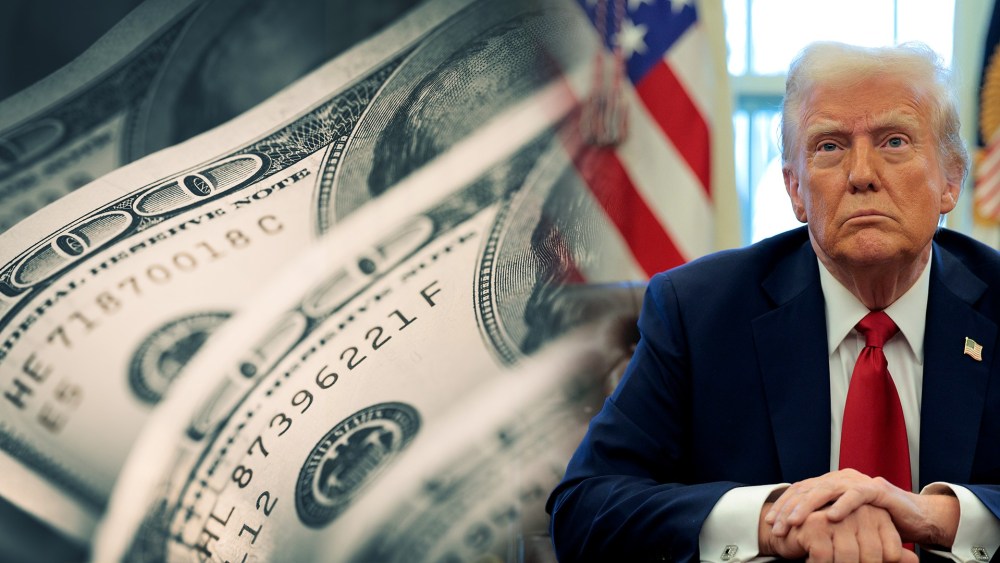
It’s well-established that Trump loves a big number, no matter how inaccurate it may be, and the bigger the better. He also loves redecorating, putting his face on things, and otherwise making it all about him. It’s no surprise then that his administration has been reportedly pressing the Treasury to issue a $250 bill featuring Trump, which would be the largest denomination issued since 1969.
It’s well-established that Trump loves a big number, no matter how inaccurate it may be, and the bigger the better.
Is it legal for the administration to simply print up a bill and issue it without Congress signing off? No. Would it be possible to do so ahead of the 250th anniversary of the nation’s founding? Still no. Would it get much use? Probably less than some of the other items featuring Trump’s presidential mug (not his mug shot, though, that’s a different cash grab for Trump’s business interests). There’s the Trump face-adorned special issue passports, this year’s National Park season passes and a commemorative gold coin he’s having minted.
But let’s focus on the important part here: