by Ja'han Jones | Mar 20, 2026 | Opinion
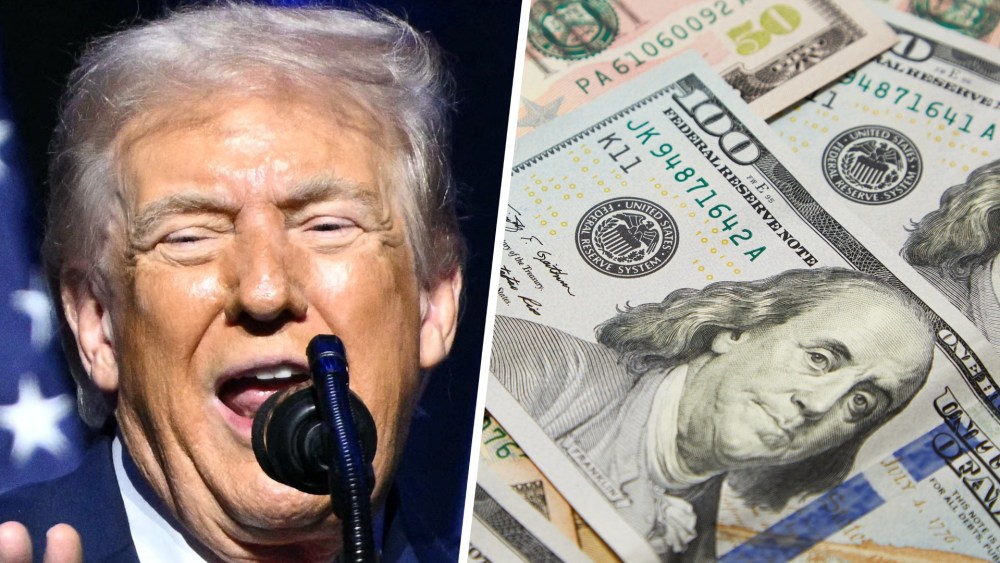
A reported $10 billion fee being collected from TikTok investors by the Trump administration is raising new questions about the deal that was struck for the social media platform to continue operating in the United States.
Sen. Mark Warner, D-Va., is demanding answers about the fee, which The Wall Street Journal reported is being paid out by a bunch of uber-rich corporations — based in the U.S. and Abu Dhabi — that have invested large sums of money in TikTok’s American operations.
Those companies include Oracle, which is led by pro-Trump billionaire Larry Ellison. Citing people familiar with the matter, the Journal reported:
The investors include cloud-computing company Oracle, private-equity firm Silver Lake and Abu Dhabi investor MGX. They and other backers paid the Treasury Department about $2.5 billion when the deal closed in January and are set to make several additional payments until hitting the $10 billion total, the people said.
MS NOW has not independently confirmed the report, but President Donald Trump has said the U.S. was getting a “tremendous” fee for making the deal.
In a letter to Treasury Secretary Scott Bessent this week, Warner requested documentation showing how the Trump administration negotiated this reported fee, what it’s being used for and how this collection comports with federal laws.
“It is critically important to determine how the President could legally permit this sale, why the $10 billion fee is being paid by the buyers (who include at least one foreign, state-owned firm), who requested the fee and who approved it, and how the money will be used” without violating the law, Warner wrote.
Warner’s letter notes the absurdity of the government collecting a $10

by Imran Khalid | Mar 19, 2026 | Opinion, Politics
U.S. and Israeli military strikes have killed several high-profile Iranian officials, with notable deaths this week including Intelligence Minister Esmail Khatib, security official Ali Larijani and Gen. Gholam Reza Soleimani, commander of the Basij paramilitary force. But before welcoming Khatib’s elimination as a decisive blow to the clerical regime, Washington should understand: Rather than inducing the collapse of the regime, these high-level assassinations are rapidly dismantling Iran’s institutional bureaucracy — and risk handing total control to hard-liners.
So far, the U.S. and Israeli war-fighting strategy has appeared to center on decapitation: removing the veteran bureaucrats and intelligence chiefs who provide the state’s institutional memory, and presumably the regime’s ability to coordinate complex regional operations will wither. This assumes that the Iranian state functions like a traditional Western hierarchy. But Iran is not a traditional state. Iran has a dual system where a formal government exists alongside a parallel military and ideological structure that has spent four decades preparing for this kind of attrition.
The United States and Israel are inadvertently clearing the path for Iran’s most radical elements, including those in the Islamic Revolutionary Guard Corps.
By targeting such institutional figures as Khatib and Larijani, the United States and Israel are inadvertently clearing the path for Iran’s most radical elements, including those in the Islamic Revolutionary Guard Corps. Khatib, Larijani and other slain high-ranking officials represented the “deep state” in its traditional sense; they were men who understood the nuances of diplomacy and the necessity of maintaining certain backchannels, even during periods of intense hostility. Larijani in particular, a former Revolutionary Guards commander who was once speaker of Iran’s Parliament and Iran’s chief
by Ja'han Jones | Mar 19, 2026 | Opinion
As the Trump administration continues to resist its legal requirement to release documents related to late sex criminal Jeffrey Epstein, a new fight is budding over details of how drugs may have played a role in his lurid activities.
That’s the crux of the exchange you see below, in which Sen. Ron Wyden, D-Ore., accuses Deputy Attorney General Todd Blanche — a former criminal defense attorney for Donald Trump — of interfering with the public release of an unredacted version of a 69-page memo outlining a Drug Enforcement Administration probe of Epstein and others. A heavily redacted version was among the documents released earlier this year.
Blanche and Bondi are hiding these files in a black box at DOJ in violation of the Epstein Files Transparency Act. They’re not accessible to the public. DOJ is surveilling members of Congress who go to view them. This is not on the level. https://t.co/VfIRcEjBKi— Ron Wyden (@RonWyden) March 18, 2026
Wyden accused Blanche of preventing the release of an unredacted version to the public. Blanche’s response didn’t address the claim, asserting instead that Wyden and other members of Congress can view the document in a secure facility, where the administration has been accused of monitoring lawmakers’ search history.
Such secure facilities are, obviously, not accessible to the public.
The 2015 probe, as reported by Bloomberg earlier this month, centered on allegations that Epstein and other individuals, whose names were redacted in the release, were “involved in illegitimate wire transfers which are tied to illicit drug and/or prostitution activities occurring in the U.S. Virgin Islands and New York.”
Among the redacted names are 12 individuals and two businesses, according to
by Eric Garcia | Mar 18, 2026 | Opinion
Neither President Donald Trump nor Gov. Gavin Newsom, D-Calif., talk about dyslexia and the people who’ve been diagnosed with it with the care and nuance that the topic deserves. Newsom, who’s been publicly talking about his dyslexia as of late, can be too glib about the challenges dyslexia pose, and Trump, not surprisingly, has talked about people with dyslexia as if they’re broken.
Newsom, as everyone knows, will likely seek the Democratic Party’s presidential nomination in 2028, and Trump referred to him Monday when he said from the Resolute Desk, “Honestly, I’m all for people with learning disabilities, but not for my president. I think a president should not have learning disabilities.”
Honestly, I’m all for people with learning disabilities, but not for my president. I think a president should not have learning disabilities.president donald trump
Trump went on to insult Newsom even more, saying, “Everything about him is dumb.” My mind immediately flashed back to elementary school, where I was regularly pulled out of class for a program called “Handwriting Without Tears.” I had dyspraxia, which impedes motor skills, and had to grip an extra-large red pen to make my penmanship legible. Though my grades shot up and I eventually got high marks for my essays, I still remember the hurtful comments from my classmates. Later, when I was pulled out of class for intensive assistance, known as “RSP,” my classmates mocked that the initials were for “Really Stupid People.”
I only recently learned that RSP stood for “Resource Support Program,” but the “Really Stupid People” taunt I heard on the playground sticks in my head 25 years later.
President Trump said on Monday that
by Ja'han Jones | Mar 18, 2026 | Congress, Opinion
House Speaker Mike Johnson’s, R-La., refusal, or perhaps inability, to name a single example of voter fraud that would have been prevented by Republicans’ SAVE Act, which has the potential to disenfranchise millions of eligible voters, provided a revealing kickoff to the Senate’s debate on the legislation.
At a Tuesday press conference pegged to the Senate beginning debate on the bill, Johnson was asked to provide an example of previously committed voter fraud that the SAVE Act would have stopped. Johnson dismissed the question saying, “We’re not gonna litigate that,” before going on with his talking points.
Considering any act of actual voter fraud warrants being litigated, both in actual court and in the court of public opinion, it was an interesting choice of words.
Q: Can you give one example of fraud in a previous election that the SAVE America Act would stop?MIKE JOHNSON: Look, we’re not gonna litigate all that pic.twitter.com/rLuEn4PJOx— Aaron Rupar (@atrupar) March 17, 2026
Note the little trick Johnson used after declining to provide an example, because it’s a trick many Republicans are using these days. He said polling suggests a broad majority of Americans support requiring a photo ID to vote and that this amounts to support for the SAVE Act, which, beyond requiring a photo ID, would authorize other disenfranchising policies, such as limiting mail-in voting. It’s also worth noting Republicans have not proposed corresponding changes to make it easier for people to obtain the IDs they’d require, which is why many of the bill’s critics have said the SAVE Act is essentially a poll tax reminiscent of Jim Crow.
As for the polling equating to support for
by Paul Waldman | Mar 18, 2026 | Opinion, Politics
There is no doubt the American Israel Public Affairs Committee has a great deal of power and influence. Yet in the Democratic Party at least, a dwindling number of candidates want to be publicly associated with the country’s most prominent pro-Israel political organization. It is no surprise, then, that multiple news organizations, including The New York Times and Chicago’s WBEZ, have found links between AIPAC’s donors, registered agents and vendors and new super PACs with innocuous-sounding names like Elect Chicago Women and Affordable Chicago Now. Those groups have poured at least $21 million into open-seat congressional primaries in and around Chicago, blanketing the airwaves with ads that don’t mention Israel at all.
AIPAC’s goal of keeping Israel a bipartisan cause looks increasingly endangered.
For all the money it invests, AIPAC’s goal of keeping Israel a bipartisan cause looks increasingly endangered. In many races, AIPAC can’t find a Democrat who will unequivocally stand by the Israeli government the way it would like. While Republicans have long been mostly unanimous in supporting Israeli Prime Minister Benjamin Netanyahu’s government, AIPAC also wants to elect Democrats who won’t put conditions on aid for Israel or be too critical of Israel’s government — because a bipartisan cause is more insulated from the shifting political winds of a particular moment.
But this election year is making clear how rapidly the politics of support for Israel is shifting, to the point where even among candidates who have historically supported aid to Israel, support from AIPAC has become a black mark with which few Democrats want to be tarred.
Play
‘Because AIPAC are bullies’: Rep. Bowman says voters ‘are afraid’ to discuss heated