by Steve Benen | Apr 21, 2026 | Maddowblog, News, Politics
When Donald Trump and his team were assembling their second-term Cabinet, former Rep. Lori Chavez-DeRemer appeared to be one of their least controversial choices. The Oregon Republican, tapped to lead the Department of Labor, was ultimately confirmed with 67 votes, including more than a dozen Senate Democrats, which reflected fairly broad support in this Congress.
A year later, she resigned under a cloud of overlapping scandals. MS NOW reported:
Chavez-DeRemer resigned Monday after a tenure marked by sensational allegations that she had an affair with a security staffer and that her husband sexually assaulted her employees. … Deputy Labor Secretary Keith Sonderling will serve as acting labor secretary, according to [the White House’s Steven] Cheung. […]
It is unclear when Chavez-DeRemer’s resignation is effective. NOTUS first reported on her resignation.
The secretary’s resignation came just five days after The New York Times reported on a series of new allegations, including a string of incidents in which Chavez-DeRemer, her relatives and her top aides “routinely” sent personal messages and requests to young staff members. Those came on the heels of a related MS NOW report on Labor Department employees who had lodged formal workplace discrimination complaints against Chavez-DeRemer, “alleging she created a toxic workplace and sought to retaliate against women who reported her husband for sexual misconduct in her office.”
MS NOW’s report noted that two of the complaints were filed by young female staffers who alleged Chavez-DeRemer’s husband, Dr. Shawn DeRemer, “subjected them to unwanted sexual touching late last year when they were working at U.S. Department of Labor offices.”
A series of related allegations, reported by various outlets in recent months, claim that Chavez-DeRemer had “an inappropriate
by The Associated Press | Apr 21, 2026 | News
TOKYO (AP) — Japan on Tuesday scrapped a ban on lethal weapons exports, a major change in its postwar pacifist policy as the country seeks to build up its arms industry amid worries over Chinese and North Korean aggression.
The approval by Prime Minister Sanae Takaichi’s Cabinet of the new guideline clears a final set of hurdles for many arms sales, including of a next-generation fighter jet and combat drones.
China criticized the change in policy, but it has been largely welcomed by Japanese defense partners like Australia and attracted interest from Southeast Asia and Europe.
Opponents say the change violates Japan’s pacifist constitution and will increase global tensions and threaten the safety of the Japanese people.
The new policy will “ensure safety for Japan and further contribute to the peace and stability in the region and the international society as the security environment around our country rapidly changes,” Chief Cabinet Secretary Minoru Kihara told reporters. “The government will strategically promote defense equipment transfers to create a security environment that is desirable for Japan and to build up the industrial base that can support fighting resilience.”
Japan could start selling weapons like fighter jets, missiles and destroyers
Japan has long prohibited most arms exports under its post-World War II pacifist constitution. It has made recent changes because of rising global and regional tensions, but exports were limited to five areas: rescue, transport, alerts, surveillance and minesweeping.
The new guidelines scrap those limits and allows the export of equipment such as fighter jets, missiles and destroyers. That’s a major change from existing exports such as flak jackets, gas masks and civilian-use vehicles that Japan has sent to Ukraine and intelligence

by Antonia Hylton | Apr 21, 2026 | News
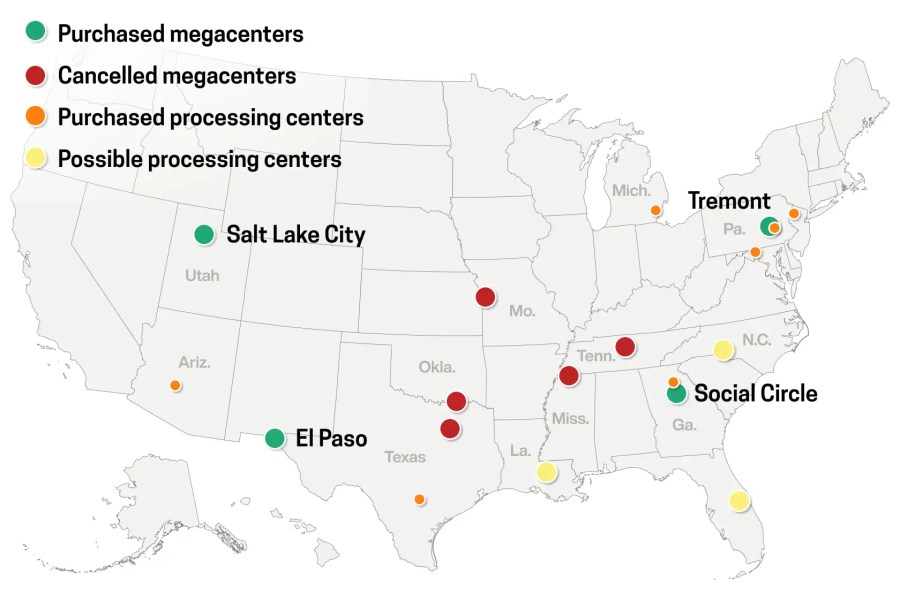
SOCIAL CIRCLE, Ga. — In this deeply conservative town east of Atlanta, a political realization is unfolding. What began as a distant policy debate in Washington has arrived, quite literally, in residents’ backyards.
Back in December, local officials learned through media reports that the Department of Homeland Security had quietly purchased a 1.2 million-square-foot warehouse in their little town with the intention of turning it into a mega detention center with capacity for up to 10,000 people.
In a town of about 5,000, the scale is staggering.
Local leaders have scrambled to respond by organizing meetings, raising alarms about infrastructure strain and pressing federal officials for answers. Concerns include aging water lines, limited sewage capacity and the site’s proximity to the elementary school.
Months into those efforts, they are still waiting for DHS to answer their questions. They also say their Republican congressman and governor have been largely absent, unwilling to attend meetings, return calls or advocate on behalf of the very residents who overwhelmingly helped put them in office.
What lingers is a growing sense of abandonment among voters, many of whom are already questioning the people they have long supported as the 2026 midterms approach. They include many in Social Circle, where more than 70% of voters supported Donald Trump for president in 2016, 2020 and 2024.
When policy hits home
Eric Hutcheson, a 21-year Air Force veteran and father of seven, bought a property in Social Circle in 2018 after retiring from the military, convinced he was buying his dream home.
“We came here with the intent of being in our retirement home, the place where we can raise our children,” said Hutcheson, standing beside
by The Associated Press | Apr 21, 2026 | News
MEXICO CITY (AP) — Mexican President Claudia Sheinbaum said Monday she would demand explanations over what U.S. and Mexican officials were doing in northern Chihuahua when they died in an accident over the weekend, noting that any joint collaborations between the local government and the U.S. without federal permission would be a violation of Mexican law.
The crash, following an operation to destroy a clandestine drug lab in a rural area, has reignited a debate over the extent of U.S. involvement in Mexican security operations. Speculation was only fueled by Sheinbaum, local officials and the U.S. Embassy appearing to contradict each other and at times themselves, and offering sparse details about the U.S. officials who died.
“It was not an operation that the security cabinet was aware of,” Sheinbaum told journalists. “We were not informed; it was a decision by the Chihuahua government.”
It comes at a key moment for the relationship between the two neighboring nations as Mexico faces escalating pressure from U.S. President Donald Trump crack down on cartels and Sheinbaum underscores Mexico’s sovereignty.
Sheinbaum said her government would investigate the incident to ensure no laws were broken after the deaths on Sunday, adding that state governments must have authorization from Mexico’s federal government to collaborate with U.S. and other foreign entities “as established by the Constitution.”
A mountainside car crash
Chihuahua Attorney General César Jáuregui said Sunday the officials died while returning from the operation to destroy labs of criminal groups. They were driving in the middle of the night through rugged mountain territory connecting Chihuahua to the state of Sinaloa, when the truck “appears to have skidded at some point and fell into a ravine, exploding.”
He
by Paul Murphy | Apr 21, 2026 | News
The most fundamental hurdle to the Department of Homeland Security’s plan to hold tens of thousands of immigration detainees in structures built as would-be retail distribution centers isn’t political.
It’s the plumbing.
Documents reviewed by MS NOW, along with interviews with city workers and elected officials, show that all 11 of the warehouses that DHS has purchased and wants to convert to detention facilities face critical challenges with water supply, wastewater processing or both.
Some of those issues will cost tens millions of dollars to fix, if they’re fixable at all: Public works infrastructure that services the warehouses DHS bought won’t be able to handle the strain from such a facility, MS NOW found, at least not without drastic expansions and updates that the communities can’t afford and that the government has so far not included in its public plans. Several can’t be made to accommodate them no matter what.
Warehousing detainees is the next phase of the DHS effort to make good on President Donald Trump’s campaign vow of mass deportations, with a $38.3 billion budget and a target capacity of 92,600 before December. To make it happen, the agency has hustled through purchases of existing buildings rather than build new ones or contract out all the additional beds to the private prison companies it already uses.
Newly minted Homeland Security Secretary Markwayne Mullin tapped the brakes on that plan as one of his first acts on the job, The Associated Press reported this month, citing a senior DHS official as saying the department would pause warehouse purchases and “scrutinize” the ones it’s already bought.
But the department has given no indication it is abandoning
by Sydney Carruth | Apr 21, 2026 | News
In the White House Rose Garden last April, President Donald Trump proudly hoisted a chart that listed sweeping reciprocal tariffs he planned to levy on nearly all of the United States’ global trading partners. Just over a year later, the controversial tariffs have allowed the Trump administration to collect $166 billion in revenue from import taxes.
But now, after a devastating Supreme Court ruling in February that found Trump lacked the legal authority to impose those tariffs, the administration is on the hook to pay it all back to American importers — plus interest.
On Monday, the Trump administration officially debuted the tariff refund portal to make that happen. American importers can apply through the portal to get back the billions of dollars the U.S. illegally collected from them over the past year.
The launch of the portal marks a turning point for the American businesses that have largely footed the bill for the president’s aggressive trade policies.
Here’s what businesses and consumers can expect
Because tariffs are taxes on imports, American companies that rely on foreign inputs to conduct business have borne the brunt of the economic cost of a trade policy the White House once billed as necessary to guarantee “the national and economic security of the country and its citizens.”
The refund program, known as the Consolidated Administration and Processing of Entries, or CAPE, allows entities that directly paid taxes on imports to submit documentation to Customs and Border Protection — the federal agency responsible for managing tariffs — to request reimbursement.
The portal is just the first step in a multi-phase effort to return the tariff revenue. It’s designed to “consolidate refunds of