by Joe Scarborough | May 1, 2026 | Morning Joe, News, Tea Spilled Morning Joe, The Tea Spilled Morning Joe, The Tea, Spilled
This is the May 1, 2026, edition of “The Tea, Spilled by Morning Joe” newsletter. Subscribe here to get it delivered straight to your inbox every Monday through Friday.
As Nazi divisions blitzed across France, Winston Churchill warned Britain of difficult times ahead, telling Parliament he had “nothing to offer but blood, toil, tears, and sweat.”
Franklin Roosevelt also warned Americans in the early days of World War II that things would get worse before they got better.
Americans deserve the same kind of straight talk today. Gas prices are going up, health care costs are unaffordable, and the rent is too damn high.
Americans need leaders who will tell it like it is. Unfortunately, Republicans are choosing instead to lie to workers.
Jonathan Lemire writes in the Atlantic that a lasting peace will not come any time soon. Projections range from two to nine months. Like these experts, I could predict that the war will be over in two months, 14 days, and two hours from now. But no one knows. We are looking through a glass darkly, and only time will tell whether Iran’s terror regime will survive the next week or last another 47 years.
Jon points out that none of the administration’s goals have been met. An emboldened terror regime remains in power, Iran’s nuclear program is still alive, and the Strait of Hormuz remains closed.
Iran has greater control over the strait than ever before.
Richard Haass, a former senior official at the State Department, tells Jonathan: “Even if Iran does not have explicit control, there is now always an implicit measure of control.” They’ve shut the strait once. Now they know they
by Steve Benen | May 1, 2026 | Iran Tensions, Maddowblog, News, Politics
For reasons that have never been explained, Donald Trump decided months ago that Steve Witkoff would serve as the administration’s top negotiator with Iran. If his name sounds familiar, that’s because Witkoff is also helping lead the administration’s negotiations with Russia and Ukraine, despite the inconvenient fact that Witkoff is a New York real estate developer with no relevant experience in foreign policy or delicate international diplomacy.
Nevertheless, the White House’s top amateur diplomat has, in fact, met with Iranian officials, including interactions last year that long predated the president’s decision to launch an unnecessary war. According to Witkoff’s own public comments, in one of the discussions he talked about developing a “verification” system that might allow Iran to produce low levels of uranium for a nuclear energy program.
That wasn’t an outrageous position to take. In fact, Witkoff’s position dovetailed with elements of the Obama-era nuclear agreement, which did roughly the same thing.
On Thursday Trump spoke with Newsmax’s Greta Van Susteren, who told the president as part of the on-air interview that Witkoff told her that the United States offered Iranian officials a possible agreement in which they could enrich uranium for a domestic medical program, below levels needed for a nuclear weapon.
The president, who too often seems like a bystander in his own White House, apparently wasn’t aware of the offer — and immediately denounced it.
VAN SUSTEREN: Witkoff told me the US offered Iran enriched uranium for medical purposes, free, if they’d give up their nuclear programTRUMP: Well, I wouldn’t have approved that. I’m not giving them anything— Aaron Rupar (@atrupar.com) 2026-04-30T20:16:08.507Z
“Maybe it wasn’t a very serious offer because I
by Steve Benen | May 1, 2026 | Health, Maddowblog, News, Politics
It was about a year ago when Donald Trump abandoned his first choice to serve as surgeon general, Fox News contributor Janette Nesheiwat, pulling her nomination without explanation. This week, the president also gave up on his second choice, a wellness influencer named Casey Means, who faced bipartisan opposition in the Senate due to her obvious lack of qualifications.
This set the stage for the White House’s third choice: Dr. Nicole Saphier, a former Fox News contributor and radiologist, whom the president described as “an INCREDIBLE COMMUNICATOR” who will “help ‘MAKE AMERICA HEALTHY AGAIN.’”
A NOTUS report noted, “The mere fact that Saphier has a professional medical background … is likely to increase her odds of confirmation greatly.” That’s probably true, though it was a jarring observation to see in print: We’ve reached the point at which a surgeon general nominee is positioned to succeed, not by earning a reputation as a celebrated public health professional, but by merely having “a professional medical background.”
That said, as Saphier’s nomination moves forward, there are a couple of key details that are worth keeping in mind. The first is that the nominee’s record on matters of science and medicine is not without controversy. As The New Republic summarized:
While Saphier is a radiologist, she’s not much better than Means. She has weighed in culture war issues on Fox, railing against movies with “woke ideologies.” … Her stance on vaccination is also troubling, as she has criticized mask and vaccine mandates and praised Trump for allowing military servicemembers expelled for refusing the Covid-19 vaccine back into the service.
An Ars Technica report added that Saphier also founded an
by Steve Benen | May 1, 2026 | Maddowblog, News, Politics
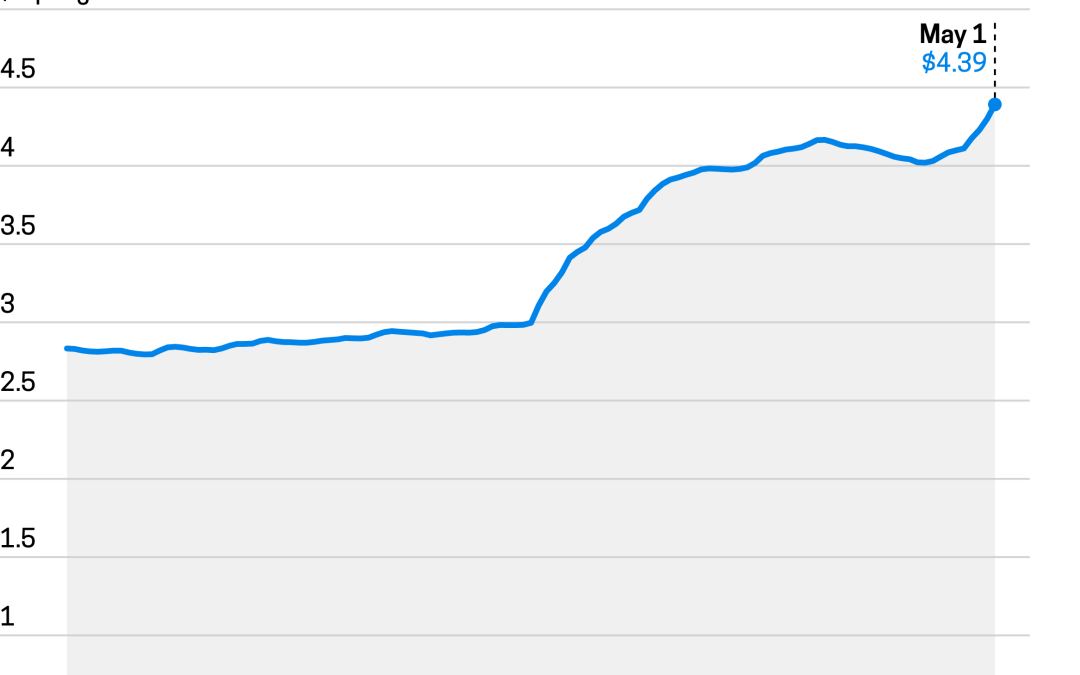
For American consumers worried about the cost of living, this week brought another round of discouraging news: Not only is inflation climbing overall, but gasoline prices reached their highest level in four years.
Consumers, however, weren’t the only ones who were bothered. Republican officials, feeling political headwinds and increasingly anxious about the midterm elections, quickly realized that rising prices created yet another challenge for them, leaving the party to figure out what to say to dissatisfied voters.
For obvious reasons, prominent GOP voters couldn’t just tell the truth — rising gas prices are the direct result of President Donald Trump launching an unnecessary war in Iran — so leading Republicans settled on three remarkable tactics.
1. Rewrite the recent past. On Thursday morning, House Majority Leader Steve Scalise appeared on CNBC and tried to argue that gas prices are lower now than they were in 2024. “People will remember that two years ago, we were paying almost $6 a gallon for gas,” the Louisiana Republican said. “Right now, it’s $3.”
The problem with Scalise’s pitch was that he didn’t appear to have any idea what he was talking about. Gas prices weren’t anywhere close to $6 a gallon two years ago, and gas prices are well above $3 a gallon now. The House GOP leader asked people to “remember” a version of reality that did not, and does not, exist. It led Scott Horton of Harper’s Magazine to note, “The GOP campaign this fall will depend entirely on misremembering recent history.”
SCALISE: We’ve delivered. Remember that 2 years ago, we were paying almost $6 a gallon. Right now it’s in the $3sKERNEN: When were we
by The Associated Press | May 1, 2026 | News
WASHINGTON (AP) — The Trump administration is arguing that the war in Iran has already ended because of the ceasefire that began in early April, an interpretation that would allow the White House to avoid the need to seek congressional approval.
The statement furthers an argument Defense Secretary Pete Hegseth laid out during testimony before the Senate earlier Thursday, when he said the ceasefire effectively paused the war. Under that rationale, the administration has not yet met the requirement mandated by a 1973 law to seek formal approval from Congress for military action that extends beyond 60 days.
A senior administration official, who spoke on condition of anonymity to discuss the administration’s position, said for purposes of that law, “the hostilities that began on Saturday, Feb. 28 have terminated.” The official said the U.S. military and Iran have not exchanged fire since the two-week ceasefire that began April 7.
An administration official did not immediately respond to MS NOW’s question about what would happen if either side breaks the ceasefire.
While the ceasefire has since been extended, Iran maintains its chokehold on the Strait of Hormuz, and the U.S. Navy is maintaining a blockade to prevent Iran’s oil tankers from getting out to sea.
Under the War Powers Resolution, the law that sought to constrain a president’s military powers, President Donald Trump had until Friday to seek congressional authorization or cease fighting. The law also allows an administration to extend that deadline by 30 days.
Democrats have pushed the administration for formal approval of the Iran war, and the 60-day mark would likely have been a turning point for a swath of Republican lawmakers who backed temporary action against Tehran but insisted on congressional
by Jake Traylor | May 1, 2026 | News
Ballistic glass. A bulletproof vest. Reimagined indoor events.
In the week since a gunman attempted to breach the White House Correspondents’ Dinner, President Donald Trump’s administration has been quietly rethinking how to protect a president who refuses to slow down.
On Monday, White House chief of staff Susie Wiles convened a meeting with the Secret Service leadership, Department of Homeland Security officials and the White House operations team, according to a White House official granted anonymity to speak about private conversations. The agenda focused chiefly on hardening security for Trump’s attendance at the 2026 FIFA World Cup, America 250 celebrations — including a UFC fight on the South Lawn of the White House — and midterm campaign rallies, according to an administration official familiar with the meeting.
The tension was visible immediately after the shooting: Trump wanted to return to the stage and address the crowd, but the Secret Service strongly recommended against that. Secret Service Director Sean Curran and the leader of the event’s security detail convinced him it was neither safe nor practical, according to four people familiar with the conversations who were granted anonymity to speak candidly.
Trump and his top aides have arrived at one firm conclusion: No future events will be canceled over security concerns — but they are being reimagined, according to the White House official.
Changes that are made — even those more obvious — will not receive much public explanation from the administration, said a former Trump White House official familiar with internal conversations about security.
“I know the sentiment on any vulnerabilities or changes to the security procedures won’t be publicized, and there is a desire not